167. The Itchy & Scratchy & Poochie Show

(originally aired February 9, 1997)
This is a ridiculously meta, self-aware episode, and I love it for some of the same reasons that I don’t. It’s conflicting, but I appreciate most of what’s being done. It lambasts market research, bonehead executives who blindly follow said research, critical dog-piling, and a disturbing late-90s trend that John K. scornfully referred to as “tude.” But let’s just get into it: ratings show that “Itchy & Scratchy” isn’t pulling in the viewers anymore, so the head honchos formulate a new idea to introduce a new character to shape things up, and promote the hell out of him. Said character is Poochie the dog, a hip, rapping surfer who takes no guff from no one. After chewing out the director, Homer finds himself hired to do the voice of Poochie, something he takes with an unusual sense of pride. The tide turns after the new episode airs and is met with unanimous hatred from hardcore fans and critics alike. Not even an impassioned speech from Homer can stop the I & S folks from abruptly killing off the Pooch and give the people what they want: the same cat & mouse formula they’ve had for the last eight years.

In this show, we see “Itchy & Scratchy” is a long-running, much beloved and aggressively merchandised cartoon experiencing a slight slump in popularity mostly due to its longevity. Sound familiar? The writers seem to have made this episode as a coping mechanism for their current predicament; it ain’t easy keeping a hit show fresh and afloat for so many years. There’s a lot of fantastic stuff in this episode. Lindsay Naegle, in her first appearance, is absolutely brilliant as the TV executive, attempting to spark the creative process as soullessly as possible (“I feel we should Rasta-fy him by… ten percent or so.”) As a concept, Poochie is hilarious, representative of what stuffed suits in their 50s imagine what’s “hip” and “cool” for today’s youth. I’ve suffered through many characters and entire shows with stuff like this in it (see: Rocket Power,) so Poochie rings very true to me (even more hysterical on the commentary, some writers said that their kids loved Poochie un-ironically, so I guess it worked more than they thought). He’s the perfect example of a character created by focus groups, not by a creative spark from an actual person.

For all the good stuff this episode has, there’s a vein throughout the whole thing that seems kind of petty, when we get to the third act especially. The scene with Comic Book Guy and Bart, which is basically the fans versus the writers, is pretty egregious. We get “Worst episode ever” out of CBG though, so that’s good, as he expresses his displeasure out of the Poochie show. Bart then goes on a tirade about how those poor writers have been providing hundreds of hours of entertainment for free and you owe them. Not only does it not feel right that Bart is saying this, but it’s a little too on-the-nose, don’t you think? And what does that mean, for free? We’re not paying anything, but the people involved with the show are getting good money to produce quality entertainment, so that’s what we expect when we turn on our TV sets. It’s also especially ironic that this episode is basically at the peak before the show starts its inevitable descent into horribleness. So it’s our fault, right? As Lisa says, “We should thank our lucky stars that they’re still putting on a program of this caliber after so many years.” In other words, shut up and keep watching. But in spite of all the egregious inserted messages, the episode is still sharp in its criticism of the ridiculous television process, and select jokes targeted against nerdy superfans like you and me. Ribbing is fine, “if you don’t like this, you’re ungrateful” is not.

Tidbits and Quotes
– We get some great Itchy & Scratchys here. First, Scratchy ends up bungee jumping over a volcano with his intestines thanks to Itchy, who then pours gasoline down his system so he’ll burst into flames. Then later they do the old William Tell routine, but thankfully Itchy’s arrow misses… poking a hole in the giant tank of acid Scratchy’s been standing behind.
– Great sign on Krusty’s door (“Cleaning crew: the liquor is not for you.”) It slightly confused me that Krusty is the one chewing Meyers out, since it’s not like he’s his boss. I guess it makes sense since the cartoons are killing stock on his program, but it’s just a little out of sorts since later we see the executives calling all the shots.
– Marge lets Bart and Lisa go off on their own at the mall, but tells them to be careful. So when a stranger asks them to come with him, the two kids agree whole-heartily. They’re put in a focus group for Itchy & Scratchy, which is a great scene: the totally not suspicious sneezing mirror, Ralph eating the knob (“Please refrain from tasting the knob,”) Nelson messing with Milhouse’s trigger (“They like Itchy, they like Scratchy, one kid seems to love the Speedo man,”) and Meyers’s outburst toward the kids, leading to Ralph crying and turning the knob in kind.
– The I&S writers are of course the Simpsons writers, and each of their egghead quips are quickly squashed or ignored by the executives (“We’re talking the original dog from hell.” “You mean Cerberus?”) Naegle outlines what Poochie will be (“He’s edgy, he’s ‘in your face.’ You’ve heard the expression ‘let’s get busy’? Well, this is a dog who gets ‘biz-zay’! Consistently and thoroughly.”) One of the writers (George Meyer) points out the obvious, with a price (“Excuse me, but ‘proactive’ and ‘paradigm’? Aren’t these just buzzwords that dumb people use to sound important? Not that I’m accusing you of anything like that. …I’m fired, aren’t I?” “Oh, yes.”) Later, David Silverman (complete with a tuba in his office) is designing the character with the executives over his shoulder barking at him. His first pass looks exactly as Poochie would eventually look, but the execs aren’t sold. The artists darkens his sunglasses. Now it’s perfect.
– I like how understated Roy is, as if he’s been there the whole time. It really works, as I’m sure there’s been executives breathing down the writers necks about putting in a new hip young character that the kids will enjoy, and this is their chance to mock them for it.
– Nice back-and-forth between Homer and Bart when they learn of the Poochie audition (“Haven’t you ever listened to yourself on a tape recorder?” “I prefer to listen to Cheap Trick.”) I also like Homer’s smooth DJ voice he does on tape, and his horror at how his voice sounds played back.
– Even the hardcore stoner Otto is shocked by the I&S change (“A talking dog! What were you guys smokin’ when you came up with that?” “We were eating rotisserie chicken.”)
– Nice animation reference in June Bellamy, obviously a stand-in for June Foray, famous cartoon voice actress of Rocky the squirrel, Granny from classic Looney Tunes, and hundreds of others. It’s also great that she’s voiced by Tress MacNeille, arguably one of the biggest, most versatile voice actresses working today, who then also does the voices of Itchy & Scratchy, who are Dan Castellaneta and Harry Shearer respectively. I like the respectful relationship she develops with Homer (“Is this cartoon going on the air live?” “No, Homer. Very few cartoons are broadcast live, it’s a terrible strain on the animators’ wrists.”)
– Classic bit at the voice actor Q&A where one of the college nerds complains about a minute error in an episode (“In episode 2F09, when Itchy plays Scratchy’s skeleton like a xylophone, he strikes the same rib twice in succession, yet he produces two clearly different tones. I mean, what are we to believe, that this is some sort of a magic xylophone or something? Boy, I really hope somebody got fired for that blunder.”) Homer is quick on the defense (“Let me ask you a question. Why would a man whose shirt says ‘Genius at Work’ spend all of his time watching a children’s cartoon show?”) The nerd shamefully withdraws his question, opening a candy bar to drown his sorrow.
– I love the massive build-up for Poochie, that it’s the greatest television event since the moon landing. I feel networks end up shooting themselves in the foot when they promote shit like this so heavily, to the level that it can’t possibly meet expectations.
– Poochie’s first episode is great, consisting of the show stopping dead in its tracks for him to do his rap and some extreme sports. I love Homer’s “Quiet, you’re missing the jokes!” then cut to Poochie biking up a ramp and dunking a basketball to extreme music. No one likes the show, not even the family can put on their game faces. Or Homer’s brain for that matter (“Oh, you don’t want to know what I really think. Now look sad and say ‘D’oh’.”)
– Nice backpedal from Naegle, the typical network executive covering her ass when her foolproof idea is a flop (“I’d attribute the product failure to fundamental shifts in our key demographic, coupled with the overall crumminess of Poochie.”) Homer has his own notes for how the show can be improved (“One, Poochie needs to be louder, angrier, and have access to a time machine. Two, whenever Poochie’s not onscreen, all the other characters should be asking ‘Where’s Poochie’?”)
– Homer demands the writers record his own lines to save Poochie. Bellamy reads as Itchy, “Hi, Poochie. You look like you’ve got something to say. Do you?” Homer replies as Poochie, “Yes, I certainly do.” Then he immediately switches to his regular voice, giving his little speech, a quick bit I always laugh at. And I don’t know why, since it never made much sense why Homer was so passionate about this character, but I always kind of tear up at his last-ditch plea. Maybe it’s the emotional music or something. Kinda silly (“Hello there, Itchy. I know there’s a lot of people who don’t like me and wish I would go away. I think we got off on the wrong foot. I know I can come off a little proactive, and for that I’m sorry. But if everyone could find a place in their hearts for the little dog that nobody wanted, I know we can make them laugh and cry until we grow old together.”)
– Homer vows the next Poochie episode will be “bigger than ten Super Bowls,” but he doesn’t want to oversell it, another line I use quite often. And of course, the wonderfully crummy way Poochie leaves us (“I have to go now. My planet needs me.”) They couldn’t even be bothered to animate anything, they just manually move his animation cel out of frame and out of the show forever. That’s how little they cared, or felt the audience would care, about Poochie. The Krusty show segment ends with the reveal of a sworn and signed affidavit that the character would never, ever return. Homer closes the story by summarizing his experience (“The thing is, I lost creative control of the project. And I forgot to ask for any money. Well, live and learn.”)
166. Simpsoncalifragilisticexpiala-D’oh-cious

(originally aired February 7, 1997)
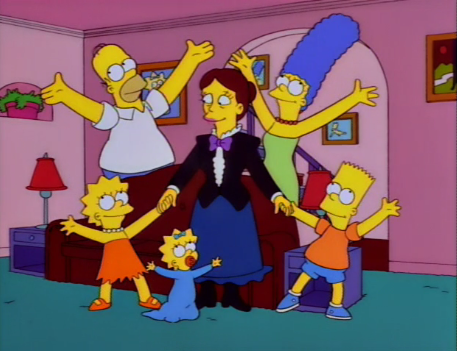
One of the most delightfully bizarre installments of the series, this episode is a tour de force of hilarious isolated bits, great musical numbers and a nice reaffirmation of the family and their self-determined place in the world. We start things off seeing Marge losing her hair due to stress from dealing with the family, so she suggests that they find a housekeeper to help out. Enter Shary Bobbins, a completely original character (like Rickey Rouse and Monald Muck), a prim and perfect nanny who in no time at all makes the Simpsons a polite, dignified household. I think originally the writers wanted Julie Andrews for obvious reasons, but Maggie Roswell does a dynamite job, dare I say a better Andrews sound-alike than the genuine article. This episode has forever tainted that character and that movie for me, and I couldn’t be more glad about it. It takes about six seconds after Bobbins leaves for the Simpsons to descend into bedlam again, and in the end, the family reassures her that despite their shortcomings and foibles, they’re happy just the way they are.

I previously decried “The Springfield Files” a bit for being thin on story, and here we have another Jean/Reiss produced episode that is just the same, and has a helluva lot of padding. But, that doesn’t bother me at all here. A lot of filler comes from extended TV segments, but they work within the first and third acts when the family begins as lazy slobs, and eventually turn back into lazy slobs. Their disinterest in bettering themselves is passed onto the viewer; if the family isn’t doing anything interesting, why not see what’s on TV? And every bit we see is gold: the Krusty Komedy Klassic (“KKK? That’s not good…”), li’l Rainier Wolfcastle’s first commercial, Charles Brosnan’s guest spot on The Andy Griffith Show (“Now, I’m going down to Emmett’s Fix-It Shop, to fix Emmett,”) and of course the special Itchy & Scratchy show directed by Quentin Tarantino. The segments with Bobbins are also fantastic, either contrasting against the Simpson family’s boorish ways, or in seeing the kids actually behave, like the scene from Mary Poppins where they take a walk through the unusually old timey park.

The music is superb, each either assisting the plot or a wonderful parody from Poppins. We start with “Minimum Wage Nanny,” as the family yearns for the perfect nanny (“Teach us songs and magic tricks / Might I add, no fat chicks!”), “Cut Every Corner” teaches a questionable lesson about sweeping problems under the rug (“If nobody sees it, then nobody gets mad / It’s the American way!”), and “A Boozehound Named Barney” is a hilarious parody of “Feed the Birds,” featuring Barney’s operatic lament of being sober (“Move it, yah drunk, or I’ll blast your rear end! / I found two bucks / Then come in, my friend!”) They’re all fabulous, but my favorite is probably the final number, “Happy Just the Way We Are.” While the family has hopes and dreams, they are also fully aware of who they are and comfortable with that fact. As seen in the series, any massive shift in their world will eventually dissolve, leaving them back where they started, and they’re fine with that. It’s also like a song in ode to the status quo; we love these characters as is and don’t want to see them change. It’s a truly wonderful episode, one of the all time greats, with a solid main story, classic music and lots of extra funny bits peppered into the mix.

Tidbits and Quotes
– Krusty’s Komedy Klassic doesn’t go so well. First up, an act Krusty claims has never been done before: dumb pet tricks! He has a dog trained to catch a red rubber ball, which is suspiciously similar in shape and color as his clown nose. I wonder what’s going to happen? (“Auggh! Somebody shoot it! Somebody shoot it!”) Then he tries out a new sketch: “Mad About Shoe,” where he’s shown married to a giant piece of footwear. The audience understandably boos (“You’re not going to like our ‘NYPD Shoe’ sketch. It’s pretty much the same thing.”) Even Krusty’s biggest fan Bart is unimpressed, and would change the channel if they could find the remote. Turns out Grampa has it in the kitchen, thinking it’s a phone, but instead tries the “old-fashioned model,” holding a plugged in iron up to his ear, complete with sizzling noise.
– I love the “Hair” montage, scandalously starting with Marge in the shower, shocked to find a clump of hair by the drain. Also great is Bart and Milhouse playing cowboys in the living room, and a blue tumbleweed rolls by. It isn’t long before Marge’s beehive is covered with empty patches. Homer tries to calm his devastated wife (“Don’t worry about a thing. I’ll teach you to comb it over so no one can tell. Just like my hair!”) Marge imagines herself only with her husband’s three strands of hair and immediately breaks down in tears.
– To pay for the nanny, Homer vows to give up his membership of the Civil War Re-Creation Society. Moe’s now out a General Ambrose Burnside, and Barney voices his complaints about their Stonewall Jackson, Apu (“The south shall come again!”)
– The family interviews some potential nannies: the first, an elderly woman Mrs. Pennyfeather, who seems like a fine choice, but Homer is suspicious (“Wait a minute, Marge. I saw Mrs. Doubtfire. This is a man in drag!”) He then accosts her “wig,” trying to expose her disguise. It’s such a great read from Dan Castellaneta, culminating in him chasing her across the lawn yelling, “Gimme those!” Those? Like her fake breasts or something? Kearney puts in his bid for the job, impressing Homer (“I’ll keep a watchful eye on your kids and if they get out of line… Pow!” “I like him.” “Thanks. Hey, where do you keep the liquor?” “I hide a bottle of schnapps in the baby’s crib.”)
– Shary Bobbins informs Homer of her previous employer, Lord and Lady Huffington of Sussex, and he whispers to Marge, asking if they know them. He ultimately confuses them with “the guy he bowls with” (“So, you work for Carl, eh?”) Bart has questions of his own for the potential new nanny, channeling Dennis Hopper in Speed (“Pop quiz, hotshot. I’m supposed to be doing my homework, but you find me upstairs reading a Playdude. What do you do? What do you do?” “I make you read every article in that magazine, including Norman Mailer’s latest clap-trap about his waning libido.”)
– I love the energy of “Cut Every Corner,” as well as checking in with Wiggum and Apu doing their own brands of half-assery (“And the clerk who runs the store / can charge a little more / for meat (for meat) / and milk (and milk) / from nineteen-eighty-foooooooooouur.”)
– Great great scene of Willie’s one-man band version of “Maniac,” and his past encounter with the lovely Ms. Bobbins (“Shary Bobbins and I were engaged to be wed back in the old country. Then she got her eyesight back. Suddenly the ugliest man in Glasgow wasn’t good enough for her.” “It’s good to see you, Willie.” “That’s not what you said the first time you saw me!”)
– Miss Bobbins even manages to soothe the black heart of Mr. Burns, entrancing him into flying a kite. He starts to really enjoy himself, until he’s quickly struck by lightning (“What’s this strange sensation in my chest?” “I think your heart’s beating again.” “Oh, that takes me back. God bless you, Shary Bobbins!”)
– I love the momentary break in Bobbins’s kindly nature, initially annoyed at Bart and Lisa’s request for yet another song (“I’ve been singing you songs all day. I’m not a bloody jukebox!”)
– Great second act break of Grampa getting a hold of Bobbins’s umbrella (“I think we got our umbrellas swiiiiiiitttcchhed!”)
– The third act is a little bit cruel, as Bobbins has basically replaced Marge as the family maid. Not even her catchy songs can motivate them anymore (“But the beer will taste more sweet, if you get up off your seat…” “Lady, the man asked for a beer, not a song.”) I also love her muttering “Do-re-mi-fa-so…” under her breath as she walks out of the room. Eventually she fully breaks, getting drunk with Barney in the Simpsons living room. The family reassures her that they’re happy as is, to which Bobbins replies in song, “Don’t think it’s sour grapes, but you’re all a bunch of apes / and so I must be leaving yooooou!” And then she’s sucked into a jet engine, an ending that by all purposes should be horrifying and brutally off-tone, but by God is it funny as hell.

165. Mountain of Madness

(originally aired February 2, 1997)
Homer and Burns snowed in and getting rampant cabin fever? Almost seems like a silly plot out of a Saturday morning cartoon. I remember Rocko’s Modern Life had an episode like this, as I’m sure many other shows have. It could almost be viewed as an alteration of the “trapped in a small space” trope where two characters are stuck having to resolve their differences, but in this case they want to kill each other. After a disastrous fire drill, Burs arranges a company retreat in the snowy park around Mt. Useful. All the employees are paired up and given the task of finding a far off cabin using teamwork, with the incentive that the last group to get there will be fired. Burns ends up paired with Homer, who of course get to the cabin first by use of snowmobile. As bizarre and improbable as it may seem, I kind of like the odd camaraderie the two have in this episode. Putting himself in the competition, Burns has leveled himself down to the place of the common worker, able to enjoy the cozy cabin with a fellow chum. Homer is hesitant at first, but then realizes being with Burns is a guaranteed win for him, and is much more complacent on getting chummy with the boss.

An avalanche gets the two snowed in, and their successful escape attempt is thwarted by a continual string of more avalanches. A stigma is set in almost immediately as each holds the other to blame for their predicament, and they grow more and more resentful toward each other. I think part of why this somewhat tired plot still works for me is it seems to be conscious of itself. The two build snowmen, comment on how they’ve managed to stave off cabin fever… then agree they need to dress the snowmen. It’s tricky to comment on predictable plot twists, sometimes you just end up making it worse, but I thought it was handled well here. I like the climax where each envisions the others army. Homer sees Burns with a battalion of snowmen, and Burns takes Homer’s bizarre threat (“Stay back! I have powers! Political powers!”) as a cavalcade of historical figures like Lincoln, Teddy Roosevelt and Gandhi. The music swells as the two armies prepare for war, then they dissolve as we see the scene for what it is: two feeble, crazy men attempting to beat each other up, who are then saved by the cabin becoming a rocket, a stupid plot twist absolved by a single hilarious line from Lenny (“Something’s wrong with its brakes!”)

There’s some small side stories that are sort of interesting and funny as well. Homer brings his family along, not realizing he wasn’t supposed to, so Marge and the kids are left to their own devices. Bart and Lisa end up tagging along with Smithers, who is the odd man out with no partner. I like seeing Smithers, who always has things calculated and under control, out of his element and visibly frustrated at his boss’s betrayal, and on top of that he has to deal with Bart and Lisa’s childish antics. I especially love his annoyance at Lisa’s constant retrieval and concern over injured animals (“Aren’t there any healthy animals in this forest?!”) We also get another look at Lenny and Carl’s relationship, something that would soon grow and spiral out of control into this weird subtly gay co-dependency nonsense. For now, they’re just two old chums, and we see Carl holding an unusual grudge against Lenny for some strange reason. This show may not have the most original plot, but it’s got enough humor and good characterization to keep it interesting and fun.

Tidbits and Quotes
– Great stuff with the fire drill. The alarm sounds and no one is the wiser at first, with Carl thinking it’s the microwave for his popcorn, and he just dumps a bag full of kernels into a bowl. When they finally realize what it is, the entire plant goes nuts. Strangely, Homer is the first one out, using a bench to barricade the door behind him, hustling up to Burns and Smithers asking what he’s won. In the next scene we see the aftermath, with the windows on the building completely smashed and a man using a rope to climb out to join the rest of his co-workers to be yelled at by Burns.
– Homer bemoans having to go on the teamwork retreat, leading Bart on a rant about various topics that interest his father (“Sharing is a bunch of bull, too. And helping others. And what’s all this crap I’ve been hearing about tolerance?” “Your ideas are intriguing to me and I wish to subscribe to your newsletter.”)
– Great animation of the family car skidding on the ice in the parking lot, hitting basically every single car before coming to a stop near the center.
– Homer’s commentary during the explanation of the retreat feels kind of forewarning. Him standing near the front with his childish interrupting comments feels very latter-day Homer. Though I do like the scene with the time dissolves of Smithers reading off partners, with Homer just standing in the center dumbly as everyone else has left around him.
– Classic bit with the Smokey the Bear robot (“You pressed ‘you,’ referring to me. That is incorrect. The correct answer is ‘you.'”) I also love the off-screen film featuring a rambling, possibly drunk John Muir, which Marge watches blankly before slowly backing out of the room.
– Great scene with Burns building Homer up to believe that cheating is perfectly fine. Homer is hesitant at first, mostly due to not wanting to set off his boss, but Burns is very persuasive (“If you can take advantage of a situation in some way, it’s your duty as an American to do it. Why should the race always be to the swift or the jumble to the quick-witted? Should they be allowed to win merely because of the gifts God gave them? Well, I say cheating is the gift man gives himself!” “Mr. Burns, I insist that we cheat.” “Excellent.”)
– I love Burns’s incisive comment about the beauty that is sitting (“From the mightiest Pharaoh to the lowliest peasant, who doesn’t enjoy a good sit?”) and his incredulous reaction to Homer’s amazing tactic of retrieving dip from the other side of the table.
– It’s stupid, but I still like Homer opening the door, which lets in all the snow, then going to try the window, to the same result, then he thinks for a bit… and then he tries the door again and he lets more snow in, burying him slightly.
– Just a random thought, the mountain is so unstable that Burns and Homer’s whispering trigger massive avalanches. But the ranger says there’s going to be a music festival there? The band would play one note and everyone would be buried.
– Great bit with the ranger openly announcing he’s going to humor the children (Bart and Lisa), which he does, before telling the crowd they’re searching for two dead bodies and to bust out their corpse-handling gloves. Bart is none-the-wiser (“You hear that, Lis? Dad’s gonna be just fine.”)

164. The Twisted World of Marge Simpson

(originally aired January 19, 1997)
And so we come to another Marge episode, and we know how much fun those can be. It’s somewhat an examination of a more determined Marge that more or less works for the purposes of the story. We start in showing her involvement with the Investorettes, a group where the ladies of Springfield try their hand at stocks and local investments. Being the overly cautious type, Marge certainly does not fit in, and is quickly expelled from the group when she raises concerns that high-risk ventures “sound a little risky.” The Investorettes is comprised of Helen, Maude, Edna, Luann and Agnes (basically every single female character of note in this sausage fest of a show), all of whom act as a single, overtly catty entity, stonewalling Marge throughout the episode. I do like seeing these characters outside of their respective male partners for a change, giving them a bit more individuality, even if it is just more bitchiness. The only one I question is Maude, but then I like that outside the circle of namby-pamby influence from her husband, she can have a bit of a mean streak to her.

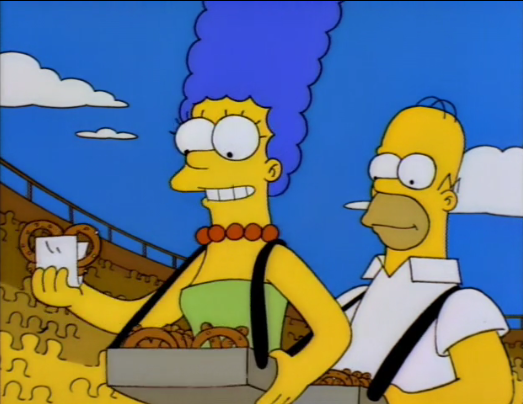
At the local franchise expo, Marge is discouraged at her lack of gumption, but is taken in by the kindly vendor of the Pretzel Wagon, Frank Ormond (voiced by the legendary Jack Lemmon). Invigorated to one-up her former friends, she agrees to join the franchise for a hefty five hundred dollars. At this point, I thought back to “Scenes of the Class Struggle in Springfield” when Marge greatly hesitated spending ninety dollars on a dress, but the difference here is that she has a bit of ire, and she’s really driven to do this. Motivation outside of housework is such a rarity for Marge that she truly puts her heart and soul into her new business venture, with the rest of the family providing assistance and moral support. There’s a lot of cute family moments in this show, like their fake ticker tape parade to drum up business (“Welcome back, space girl!”) and Homer’s makeshift title of “Pretzel Inspector” examining the product with a micrometer. All of Marge’s efforts seem to be thwarted one way or another, which ends up being very crushing for her. Wanting to help his wife, Homer goes to Mr. Ormond for help. Finding him to be deceased, he turns to the next most reliable people: the mob.

Given the low-key nature of the episode, the third act is especially silly, jump starting with a montage of Marge’s business thriving thanks to the mob smashing up hot dog carts and transporting girl scouts out of the city limits. We go from that to Fat Tony being briefly dissuaded by a dimwitted Homer, and then a really disconcerting scene where Tony and his goons knock Marge’s car off the road in the desert and confront her. It just seems like there’s a weird tonal clash going on at the end, where things seem grave for Homer and Marge, even though we know they’re not. It’s not a major quibble, really, just something I noticed. Thankfully the Simpsons are saved by the Investorettes of all people, who in retaliation for ruining their business sick their own criminal gang on Marge’s, the Yakuza, leading to an all-out mob war on the Simpson lawn. Yeah, really, really absurd, but it does work since it ties in with the bitch fight of the entire show, and it’s really funny. There are some ups and downs, but this is a pretty solid Marge show with plenty of laughs in it. And now I really want a pretzel. Where’s that Pretzel Wagon when you need it…

Tidbits and Quotes
– I like the times we see Marge’s attempts to be sociable, because they always turn out disastrous. She was truly an outsider and ended up being warped by the country club, she’s not enough of a go-getter for the regular ladies of Springfield… poor Marge, a woman without a friend in the world.
– This is a tour de force episode for Agnes, who gets a fair share of great lines (“Children are so fat today. Isn’t there some way we could make money off that?” “Gimbels is gone, Marge. Long gone. You’re Gimbels!”)
– Pretty dumb, but I love Homer’s selective response to Marge’s sad story (“Wait, wait, back up a bit now. When are the pancakes coming in the mail?”)
– Nice sign at the Franchise Expo: “Where You Can Make Your Non-Sexual Dreams Come True.”
– Disco Stu returns with a vengeance at his own booth at the expo (“Did you know that disco record sales were up four hundred percent for the year ending 1976? If these trends continue… aayyyyy!“) He then laments he can’t get the dead fish out of his aquarium platform shoes.
– I love the scene with the Investorettes checking out Fleet-A-Pita, starting with Helen’s extremely insensitive concerns (“I don’t know about food from the Middle East. Isn’t that whole area a little iffy?”) The representative has done all she can to sanitize and localize the brand, renaming the traditional ingredients (“falafel” is now “crunch patty”) and offering pitas dubbed the “Ben Franklin.” She also attempts to discretely disguise the disgruntled Arabic cook, “Christopher.”
– I like Lemmon for his small role, especially his riffing with his “knot bread” joke, and his dramatic speech on what Marge’s territory will be (“Wherever a young mother is ignorant of what to feed her baby, you’ll be there. Wherever nacho penetration is less than total, you’ll be there. Wherever a Bavarian is not quite full, you will be there.”)
– Marge receives her ingredients: two big hefty bags, one reading “Salt,” and the other “Ingredients.” Seems on the up-and-up to me.
– It’s really sweet how Homer puts on a charade at work to entice pretzel fever (“Let’s all give in to deliciousness, the Pretzel Wagon way!”) Unfortunately the Investorettes and their flashy Fleet-A-Pita van intervene (“Wow, check out that van! It looks like it doesn’t even need our business.” “Hey, let’s go!”)
– The best scene of the show hands-down is Cletus’s big score of three hundred pretzels with three hundred coupons (“I should’ve said ‘Limit: one per customer.’ “Should’a but didn’t’a,”) and him calling his army of kids by name. I love how they all just walk out and gather on the porch and wait for the rest to come out. Some of their names feel like “hillbilly” names, but they’re all believable, unlike later seasons where Cletus’s children would be given “hilarious” names like Incest and Crystal Meth. Real sharp work, you guys.
– Free Pretzel Day at the ball park proves to be a bust. Just as every patron was about to take a collective bite, the winner is announced for the grand prize ’97 Pontiac Astrowagon: C. Montgomery Burns. The crowd throws their pretzels at the car in disgust. Hall of Famer Whitey Ford attempts to calm the crowd, but is knocked unconscious by the barrage of snacks. Things look grim, but the family tries to put a positive spin on things (“You can’t buy publicity like that. Thousands and thousands of people saw your pretzels injuring Whitey Ford!” “You could call them Whitey-Whackers.”)
– i like how Homer claims that Ormond is doing pretty well for himself, walking through a lawn of plastic flamingos and cheap garish lawn ornaments.
– Grim but great scene of Skinner forced to buy pretzels at gun point. Marge questions his bandaged hand. An off-screen thug whispers, “Boating accident.” Skinner fumbles, “I believe it was a boking accident.” [gun cock] “I have to go now.”
– Seeing Fat Tony threaten Marge is a bit unnerving, but it’s softened a bit by the sweet scene where she assists him in taking the keys out of the ignition, and his final proclamation (“You have twenty-four hours to give us our money. And to show you we’re serious… you have twelve hours.”)
– I like Homer’s defense to Marge on how he got into this mess (“I saw your pouring your heart and soul into this business and getting nowhere. I saw you desperately trying to cram one more salty treat into America’s already bloated snack hole. So I did what I could. I did what any loving husband would do: I reached out to some violent mobsters.”)
– He’s always great, but Joe Mantegna’s really fantastic in this as Fat Tony (“I’m afraid I must insist. You see, my wife, she has been most vocal on the subject of the pretzel monies. ‘Where’s the money?’ ‘When are you going to get the money?’ ‘Why aren’t you getting the money now?’ And so on. So please, da money.”) I also love his low-key “C’mere, you little squirt” when he’s hit in the face by one of the Yakuza.
– Great bit at the end where Homer anxiously awaits what the little Yakuza guy is going to do, just standing there biding his time. Of course when Homer goes back into the house, we hear the results of some epic fighting move. Then later the Japanese man gets thrown through the kitchen window and runs outside back into the fray.

163. The Springfield Files

(originally aired January 12, 1997)
Being about aliens, and told as a story-within-a-story (by the great Leonard Nimoy), parts of this episode feel a bit like a Halloween show. It’s like I’ve seen it before: Homer believes to have made alien contact, but is dismissed by his family thinking he’s drunk. …oh wait, I have seen this, in “Citizen Kang” like eight episodes ago. This one is totally different though, I’m not trying to cry foul, but it’s just unusual that such a similar and unique plot element would appear in two episodes within three months of each other. This episode takes place in the “real” world, and this time around, Homer actually is drunk, stumbling home late one night, and sees what he thinks to be a glowing green alien in the woods. Understandably, no one believes him. Despite the ludicrous claim, FBI agents Mulder and Scully come to investigate the matter, but conclude that Homer’s just another nutcase. Determined to prove he’s not crazy, Homer, along with Bart, camp out at night and end up getting video footage of the creature, creating a media circus anxiously waiting for its return. But the alleged alien turns out to be an entirely different sort of monster.

What struck me about this episode is how little really happened in it. There’s no story to be had until the very end of the first act when Homer sees the alien, act two is largely Mulder and Scully dealing with Homer, and act three is just a ticking clock to the reveal of who the alien is. I’m not entirely sure how they could have beefed up a small story like this, but I felt like it needed a little more to keep it from meandering. But onto the business of the crossover; it’s sort of similar to “A Star is Burns” in that the episode is about the subject matter of the crossover series, with the stars appearing within the Simpsons universe. I’ve never watched The X-Files, so I can’t comment on any inside jokes or the authenticity to the characters, but I think they did a fine job for what they had to do. Nimoy was also fantastic in his second appearance on the show, getting plenty of laughs for his minimal amount of screen time.

I feel I haven’t much to say about this one… probably because as I mentioned not a lot happened in it. There were plenty of jokes interspersed and I was never bored, it’s just one of the thinner episodes we’ve seen. I guess I should address the ending. It’s one of those reveals that sort of rides the line between being so ridiculous it’s funny, and so ridiculous it’s stupid. It’s close, but I still give it the former. I laughed at the wonderful animation of Burns being altered and contorted on the conveyour belt, of course under the watchful eye of Dr. Nick (“The most rewarding part was when he gave me my money.”) But why would Smithers allow Mr. Burns to go wandering around by himself in the middle of the night in that condition? And we’ve seen Burns at night before without that green glow. Perhaps the procedures affect some minor radiation poisoning in his system or something that makes it more prominent? Whatever. All I know is I got a duet of “Good Morning Starshine” with Burns and Leonard Nimoy, and that’s the best I could hope for. A somewhat paltry, but still substantial outing.

Tidbits and Quotes
– Nice bit from Homer recalling a movie that inspired his plan to get out of work (“I saw this in a movie about a bus that had to speed around the city, keeping its speed over fifty. And if its speed dropped, the bus would explode! I think it was called… ‘The Bus That Couldn’t Slow Down.'”)
– Nice knock at Waterworld, even if it is incredibly dated at this point. Sort of reminds me of Waterworld on Virtual Boy. As the Angry Video Game Nerd intelligently put it, “it’s like puking on a pile of shit.”
– At Moe’s, Homer is in the mood for something more exciting than boring old regular Duff. With quick use of a marker, Moe provides him with “Doof,” allegedly direct from Sweden. Surprisingly, Homer isn’t fooled for long, and Moe gives him Red Tick Beer, with a striking taste he just can’t place. Turns out it’s dog.
– Great gags on Homer’s spooky way home: he hears the famous Psycho theme, but it’s actually just a bus carrying the Springfield Philharmonic, all playing their instruments for some reason. Then a frightening billboard: “DIE.” Homer screams. A neighboring tree is blown away slightly to reveal the full message: “DIET.” Homer screams again.
– Even someone as thick as Chief Wiggum is quick to mock Homer’s ridiculous story (“Your story is very compelling, Mr. Jackass, I mean, uh, Simpson. So, I’ll just type it up on my invisible typewriter!”) He also has the same reaction to a self-confessed arsonist a minute later.
– I’m torn about the alien line-up gag. It’s neat to see Marvin the Martian, Chewy and ALF standing side-by-side, but does that mean they’re all real? Are they just people in costumes? The whole story is about no one believes Homer saw an alien, then we see a line-up of five seemingly real ones. I’m kind of over-thinking this, I know, but it just struck me a weird way.
– Great readings by David Duchovney and Gillian Anderson captivating by Homer’s blubber while he’s on the treadmill (“His jiggling is almost hypnotic.” “Yes. It’s like a lava lamp.”)
– We get another look into Moe’s shady backroom antics, where this time he’s abducted a killer whale from Sea World for some reason. Nice callback after Mulder gives his dramatic “the truth is out there” speech and we see Moe and his cronies attempting to carry the whale off in the background (“Cheese it! The feds!”)
– Bart and Homer actually have a great night out camping, which is nice to see. The best moment is Bart’s chilling ghost story (“…and that’s how much college will cost for Maggie.”)
– Tonight on Eyewitness News, a man who’s been in a coma for 23 years wakes up. But upon hearing Sonny Bono is a Congressman and Cher won an Oscar, he figures it’d be better to just die on the spot.
– Homer is pleased to see T-shirts reading “Homer Was Right” are being sold at the alleged sighting site, but then finds the alternative “Homer is a Dope” shirts sold out immediately. Even Marge bought one (“These shirts are a hundred percent cotton. And look at the fine stitching on ‘dope.'”)
– I love Hibbert’s response to the alien’s offering of love (“Is that the love between a man and a woman or the love of a man for a fine Cuban cigar?”) and Willie’s cries to kill the alien, which he repeats with the same intensity after it’s revealed to be Mr. Burns.
– The animation of Burns wandering into the woods is hysterical, it really does make up for the logical fallacies I brought up earlier. This episode is flawless, I realize this only now.