172. Grade School Confidential

(originally aired April 6, 1997)
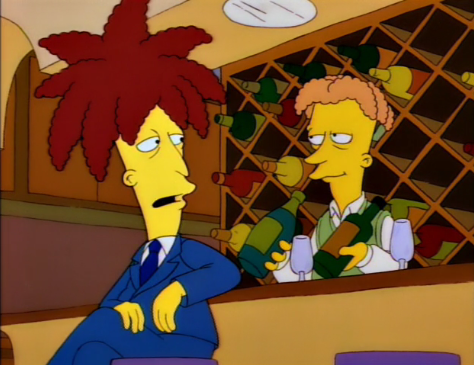
Well, my timing is impeccable. Just in time for Valentine’s Day, here’s an episode centered around a torrid schoolhouse romance. Having Skinner and Krabappel kindle a relationship isn’t exactly an original idea, but it’s kind of interesting to see in action. Harry Shearer and Marcia Wallace hand in very believable and nuanced performances. The scenes building up to their kiss feel very genuine, and we buy that they’re attracted to each other as two lonely people wishing to share a connection. It’s a sweet story overall, but it feels a little thin, with things included to draw it out that don’t really feel right. First, their relationship must, for some reason, remain a secret. This seems like the kind of weirdly paranoid stuff lesser minded characters would be nerve-racking about, but Skinner and Krabappel are two pretty intelligent people. Do they really think Chalmers would go into a rage if they ran it by him? What does it matter? Instead, they must keep it hush-hush, and strike a deal with the only witness of their kiss, Bart, with his silence being made in exchange for his hefty permanent record being swapped for some other poor sap (Milhouse).

From this point, Bart falls into the weird role of Skinner and Krabappel’s walking excuse. When Chalmers stumbles upon the two at a late night movie, Skinner rushes to get Bart out of bed to the theater to keep up the ruse of a school field trip. They use Bart to exchange mash notes to each other. Bart must watch Agnes while Skinner is out. Atop the absurdity of keeping this such a ridiculous secret, why are they throwing Bart around like this, and why is he agreeing to it? Bart has all the leverage, why would Skinner force Bart to say, “I love you, Edna Krabappel,” in front of the class, when he knew it would humiliate him? It’s incredibly bizarre to me. The second act is only saved due to the individual scenes being hysterical, such as Chalmers whispering to a half-asleep Bart in the movies (“Do you think they actually filmed this in Atlanta?”) and Agnes’s photo album of pictures of cakes (“You can’t have that one! That’s a coconut cake!”)

Bart finally reaches his limit and exposes Skinner and Krabappel’s make-out session in the janitor’s closet to the entire school. The innocent embellishments of the scene by the kids get their parents all flared up, as well as Chalmers, who is out for Skinner and Krabappel’s jobs. After a pep talk from Bart, Skinner springs into action, barricading Krabappel and himself in the school until their jobs and relationship is secure. Things start feeling more draggy in the third act. The silliness is ever present and you know how it’s going to end, so you’re just drawing out the clock until the credits. What is successful is how the controversy begins and ends. All the kids give their own outrageous versions of the story, some by here-say, which when it gets to the parents becomes here-say of here-say, until it goes too far (“Sordid public sexual congress!”) To completely clear his name, Skinner must make a shocking public confession: at forty-four years old, he is still a virgin. The crowd is stunned. I remember seeing this episode quite often as a kid (during my syndication viewings, season 8 seemed to be in heavy rotation), and I can’t remember what I thought about this ending or what it meant. But I love it now, how everyone is so floored and uncomfortable they just disband from the crowd as quick as they can. So yeah, while the story is flimsy and some parts don’t make sense, we’re still left with a fair share of amusing scenes, and a solid overall premise. It’s passable. But since it’s Valentine’s Day, I’ll be nice, it’s pretty darn neato.

Tidbits and Quotes
– I love Skinner’s boring morning announcements (“Finally, the bake sale to raise money for the car wash has been cancelled due to confusion.”) Krabappel’s class is so struck with boredom that Edna must light a firecracker in the middle of the room to wake them up.
– I don’t know why, but I love Homer’s little scene play-acting astronauts for a bored Bart and Milhouse. It feels really sweet that he’s doing this for Bart. The writers needed a scene where Bart decides to go to Martin’s lame party, so they needed to have him doing something even more lame. This is a logical and amusing solution. And we have Homer mimicking Richard Nixon.
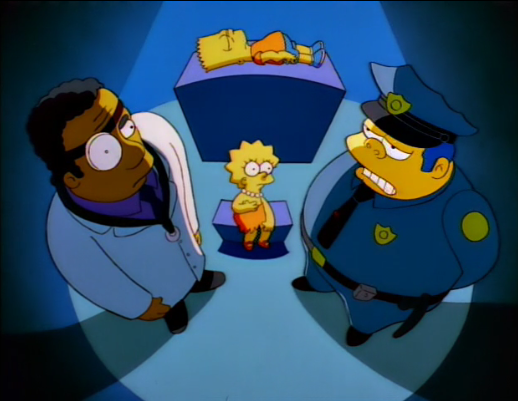
– Martin’s party is a pretty lavish gala, complete with an ice statue of himself, which Bart breaks the fingers off to put in his class. We also get a great scene with the Mathemagician, who has the power to make remainders disappear (with help of a magical 7). The climax of the kids getting sick from oysters is pretty great. Bart notices Lisa on a stretcher (“Hey, why’d you eat them? I thought you were a vegetarian.” “I didn’t. I just wanted to leave.”)
– The scene with Skinner and Krabapple in the playhouse is pretty sweet (“What kind of little boy has a tea set?” “I think we both know the answer to that… a lucky boy.”) I also like both party’s compliments to each other; Edna finds Seymour’s innocence charming, and Skinner likes Krabappel’s “tart honesty and ability to be personally offended by broad social trends.”
– The scene with Agnes and Bart is my favorite bit of the show. I like seeing Mrs. Skinner act like an old lady. Later, they’d just use her to be angry and bitter at her son all the time. It reminded me of Bart having to deal with Mrs. Glick in “Three Men and a Comic Book.” (“I don’t have much saliva left, so you’ll have to lick my thumb before I can turn the page.” “Can’t I just turn the page for you?” “No!”)
– I like how childishly giddy Lisa is recounting Skinner and Krabappel allegedly being naked in the janitor’s closet, and Homer’s knee-jerk reaction to this news (“Bart’s teacher is named Krabappel? I’ve been calling her Crandall! Why didn’t someone tell me? Oh, I’ve been making an idiot out of myself!”) Then of course, there’s Ralph’s immortal retelling (“Mrs. Krabappel and Principal Skinner were in the closet making babies and I saw one of the babies and then the baby looked at me.” “The baby looked at you?!”)
– Skinner announces from the school roof they’ve locked themselves in until their demands are met, to an audience of one (“Willie hears ya. Willie don’t care.”) Bart assists in creating a scene, calling the local news about a giant octopus, spurring up a media circus. Kent Brockman reports (“So, once again, I’ve been had. But an even more interesting story has developed high atop this two-story school: a love story.”)
– Great bit with Homer and the megaphone, asking Bart where the remote is. Turns out it was in his pocket the whole time. I like how he talks back to Marge through the megaphone for a second, then realizes it and puts it down to finish his sentence. Latter-day Homer would just scream into the megaphone in his wife’s face.
– I love how embittered Chalmers is, speaking how as a public servant he isn’t permitted to use his judgement in any way, and his response to Krabappel’s request to take their case to the people, raising the dander of a certain Mr. Sideshow Mel (“Oh, yeah, that’ll be real productive. Who do you want to talk to first? The, the guy with a bumblebee suit, or the one with a bone through his hair?” “My opinions are as valid as the next man’s!”)
– I don’t buy that Skinner would go with Bart’s bomb idea, but it’s saved by jokes (Harry Shearer’s read on “I… have a bomb,” the Armour hot dogs jingle, and the animation of one lone hot dog sticking to Skinner’s shirt, then peeling off.)
– The crowd is miffed about the alleged naughty behavior going on in the school (“I don’t think we’re talking about love here. We’re talking about S-E-X. In front of the C-H-I-L-D-R-E-N.” “Sex Cauldron? I thought they closed that place down!”) Skinner’s admission of being a virgin shuts them up, with a great follow-up question from Homer (“Hey, does this mean that Mrs. Krabappel is a virgin, too?” “Ha!”) Chalmers is mollified (“Well, it’s clear you’ve been falsely accused. Because no one, anywhere, ever, would pretend to be a 44-year-old virgin.”) I love Hank Azaria’s quieted and hurried read for this last scene, so stunned by this news that he just wants to get the hell out of there.

171. Homer vs. the Eighteenth Amendment

(originally aired March 16, 1997)
Springfield is a really boozy town if you look at it. So just like depriving our main character of beer in “Duffless,” this episode depletes the entire city limits of alcohol. It all starts with an over-exuberant St. Patrick’s Day parade, where in the midst of the calamitous celebration to Lady Liquor, Bart accidentally gets drunk in the most preposterous of ways. The footage of a shitfaced ten-year-old makes waves of outrage to the moralizing busybodies of Springfield, who demand that the town enact prohibition. Upon discovering there’s already an unenforced two-hundred-year-old law on the books banning alcohol, Quimby puts it into effect, making the entire town dry as a bone. Now, not only does this throw the title of the episode into question, wouldn’t the twenty-first Amendment supersede this law? But ’tis a minor quibble. I’m sure Quimby is clueless of it, and any of the town’s drunks who could have protested with this argument are just as in the dark.

Within no time, Moe’s becomes a hush-hush speakeasy under the new guise of “Moe’s Pet Shop.” It’s quickly discovered by the aforementioned busybodies, and upon seeing Wiggum graciously partake in its wears, they make further demands to Quimby to bring in an actually competent law enforcer. Enter Rex Banner, a smart suited fed straight out of the 1930s, who outs Wiggum and boots the booze bootleggers. Banner is voiced by Dave Thomas, a Canadian comedian who gives a great old timey performance (“Listen, rummy, I’m gonna say it plain and simple. Where’d you pinch the hooch? Is some blind tiger jerking suds on the side?”) With supply cut off, Homer steps up with a plan, unearthing the dozens of buried beer barrels and swindling them into Moe’s himself, through an admittedly clever plan involving hollowed out bowling balls and an elaborate piping system. I’ll accept that someone as dim as Homer could come up with this idea (even Marge is impressed), but that he actually efficiently constructed it and put it into action? I dunno, but it’s not incredibly bothersome.

There’s a lot good about this show, but some parts don’t exactly fit right with me. I like Homer’s bravado attitude upon being dubbed the Beer Baron, and upon running out of supplies, he starts brewing his own liquor instead, with dozens of basement bathtubs all on the brink of explosion. Marge discovers Homer’s operation, and is unusually supportive of it. I could see her thinking the law is silly, but I don’t think she would support Homer in something like this. There’s also the matter of Rex Banner, who’s tough as nails, but also kind of ineffective, unable to apprehend Homer even with him right under his nose. But I’m not a fan of his expulsion by catapult, even though it never really bothered me until now. As one commenter astutely pointed out, this season is full of one-off characters getting killed, but I guess there’s a certain finesse you need to have to pull it off. Shary Bobbins was a cruel ironic joke at the last second of the show, the undoing of Frank Grimes is something the whole episode is building towards, but here, Banner is hoisted out merely for convenience only. It gives the ending a sourness that doesn’t feel necessary. But despite that, I like the overall story, and there’s a lot of great funny bits in here, so in light of the cruel, cruel death of Mr. Banner, this show gets a pass.

Tidbits and Quotes
– All the St. Paddy’s Day at the beginning is great, from Bart’s fatal mistake of not wearing green (“No one’s pinching his legs!”), Moe booting out the designated drivers (“I got no room for cheapskates,”) the Irish cops float, Marge’s green hair, and Kent Brockman’s shock at seeing the parade descend into drunken disorder (“All this drinking, violence, destruction of property. Are these the things we think of when we think of the Irish?”)
– Drunk Bart is pretty disconcerting and hilarious at the same time. I like his friends cheering him on, and Brockman’s cold echo of his drunk statements (“‘What are you looking at?’: the innocent words of a drunken child. Well, I’ll tell you what we’re looking at, young man. A town gone mad. A town whose very conscious was washed away in a tide of beer and green vomit.”)
– Marge feels she’s the worst mother in the world for what happened with Bart, and Homer assures her she’s not, citing “that freezer lady in Georgia.” Anyone want to shine light on what this is a reference to?
– When the fun police of Springfield demand prohibition, I love the responses from Quimby (“It tastes great, makes women appear more attractive, and makes a person virtually invulnerable to criticism.”) and from Wiggum (“All our founding fathers, astronauts, and World Series heroes have either been drunk or on cocaine.”)
– We get a quick look at Dr. Hibbert’s wife Bernice’s latent alcoholism. We don’t hear, or see, much from her, but perhaps there’s a reason.
– A wonderful call-back between acts: at the end of the first act, we see a newspaper sub-headline dovetailing the prohibition main story, “Bums Threaten to Leave Town.” Then at the start of act two, we see “Bums Extend Deadline.”
– Great bit with the CEO of Duff insisting that customers will stick with the brand now that it must release a non-alcoholic brew. Minutes later, the company is out of business (“Well, that’s the end of me.”)
– The animation of the partying at Moe’s is crazy. Wiggum dances with Princess Kashmir, with a tube top and breasts that laugh in the face of gravity. This leads to a great moment where Helen Lovejoy gets increasingly horrified when a tipsy Wiggum walks closer to her, and in a line delivery that you can hear shook the walls of the recording booth, she screams, “PERVERT!!!”
– Rex Banner’s brick wall in the middle of the highway with cars crashing and piling up is pretty dumb, but the reaction shot of him pleased with his work as jagged metal flies around by him is great. I also love his warming up to, but ultimate denial of Fat Tony’s bribes (“Okay. You win. From now on, we’ll stick to smuggling heroin.” “See that you do!”)
– The chase scene between Homer and Banner is kind of silly, but the over-the-top music helps it. The jangly ragtime number sort of fits the era Banner walked out of.
– Moe tells Barney a bowling ball beer’s gonna cost him a pretty penny (“Forty-five bucks?! This better be the best tasting beer in the world!”) Sip. “You got lucky!”
– I love how ruthless Banner is, smashing through the diner window to accost Barney. Then later we get the great scene with Moe’s safety switch, rotating the bar and stools for bird cages and aquariums to keep up his pet shop ruse (“What kind of pet shop is filled with rambunctious yahoos and hot jazz music at 1 am?” “Uhh… the best damn pet shop in town!”) Banner is suspect, but leaves with a warning (“Baby turtles and alligators may seem like a cute idea for a pet, but they grow up.”) Moe changes his bar back, only to find Barney had rotated as well (“Wow, those gears down there really hurt!”)
– Homer and Bart’s beer brewing operation hits a snag when the stills start exploding. I love their scream in shock at the first one, and Homer’s cover to Marge (“I think it must have been that bean I had for dinner.”) Bean, singular.
– Great moment where Banner insists the “Beer Baron” was a concoction of the media, and that the very concept of such a person is laughable. He attempts to laugh to demonstrate, but is physically unable to (“Well, you all know what laughter sounds like!”)
– Upon being released, Quimby asks Homer how long it will take to get alcohol back to Springfield, but he insists he’s done with the business. Fat Tony swoops in, insisting it’ll take four minutes. Five minutes later, the town’s full of liquor again, giving us the classic final line from Homer: “To alcohol: the cause of, and solution to, all of life’s problems.”

170. My Sister, My Sitter

(originally aired March 2, 1997)
Here’s a smaller character story that sort of spirals out of control, but not in an entirely bad way. It’s an over-the-top character examination of Lisa, and her attempts to be viewed as mature by any means necessary. There’s some silliness along the way, but the episode is mostly successful. The first pill to swallow is our general premise: Lisa becomes the town’s foremost dependable babysitter. As competent as the girl is, she’s still only eight years old, and looking after kids her age or younger (and older, as Rod Flanders is at least Bart’s age). It’s just something that bugged me a bit throughout the whole show, though a great Marge line almost excuses it (“Parents need to be sure their sitter can handle anything that might happen. That’s why they hire teenagers”) One weekend, Homer and Marge go out to the grand opening of a new seaside shopping promenade, leaving Lisa in charge of Bart. And Maggie. Would Marge really feel comfortable with her eight-year-old looking after her infant child? …alright, I gotta let this issue go.

Putting that problem aside, I love all the second act stuff with Bart engaged in full bratty brother mode, doing all he can to make Lisa’s night a living hell. All the people Bart prank calls to come over are great, from an annoyed Krusty (“I ain’t leaving ’till I get paid! I get five hundred just for ‘Hey hey'”) to EMTs sent to perform an emergency “sisterectomy.” But horseplay leads to tears when Bart accidentally falls down the stairs and gets a dislocated shoulder. In spite of his sister, he attempts to aggravate his injuries, but ends up knocking himself unconscious. Lisa is in a panic; not wanting to expose her faux-pas on the job to family physician Dr. Hibbert, she must make a long trek to the bad part of town to Dr. Nick’s clinic, hauling Bart in a wheelbarrow and a hyperactive Maggie in a pet carrier.

The last act is all about Lisa’s descent further into madness, trying to get everything smoothed out before her parents get home. Her dream featuring Dr. Hibbert is fantastic and well-directed (“Dislocated shoulder… bump on the noggin… my diagnosis… bad babysitting!!“) It’s interesting to see how low Lisa will stoop to try to retain her reputation. As outlandish as it gets at the finale, it still feels true to character, and also is quite tongue in cheek when her worst dreams become a reality. There’s a lot of other great isolated scenes in the show: babysitting the Flanders boys, who survive a nasty moth attack, Maggie going nuts after being fed coffee ice cream, and it’s always nice to see Homer and Marge gussied up for a night on the town. Despite my issues with the general premise, this episode has a lot of stuff going for it, with enough nice single scenes and hilarious moments to keep it firmly in my good graces.

Tidbits and Quotes
– Lisa gets Reverend Lovejoy to make an announcement about her babysitting service at mass, with a one dollar discount for anyone who can name the topic of the day’s sermon. Total silence. Lovejoy reveals the topic was love. Man, not even Ned got it.
– I’m not a fan of Homer’s incredibly callous attitude toward Ned’s story about his wife being held hostage. But contradicting that, I love that when Ned asks for Homer’s permission for Lisa to babysit, despite her eagerly standing there, he remarks, “I’ll have to ask her,” and slams the door.
– I love Rod and Todd not being able to use wicked dice, and them asking Lisa to tell them a bedtime story about robots. It’s really sweet. Ned is impressed (“Sleeping quietly after a bug attack! And Todd’s as dry as a bone!”)
– Nice bit where Wiggum is disappointed he’s mixed up Bob Seger with Bob Sagat. And classic Ralph line: “I can dress myself!”
– Homer’s logic regarding his rented tuxedo is pretty sound, relating it to a rent-a-car (“Get all the mileage you can, then ball it up and cram it through the mail slot.”)
– Homer drives right through the crowds at the waterfront. Marge considers they should park, given the mayor is yelling at them. Quimby’s muted line from outside the car, “Stop, you idiot!” makes me laugh every time.
– The different stores at the promenade are great: “Malaria Zone,” “Just Rainsticks,” “Much Ado About Muffins”… Like the Leftorium, they’re large, extremely niche stores that I have no clue how they stay in business. We also get a great parody of Planet Hollywood in Planet Hype, with Rainier Wolfcastle at the opening (“It’s true! The entire menu was personally approved by my secretary.”) Moe’s also has a set-up at the boardwalk, but it’s actually just an extremely large ramshackle tunnel leading to his actual bar (“Hey, this isn’t ‘faux’ dive. This is a dive!” “You’re a long way from home, yuppie boy. I’ll start a tab.”)
– Great bit where Bart goes limp and Lisa must drag him around. Bart insists he’s opting for non-violent resistance, and Lisa finds it ridiculous to compare himself to Gandhi. Bart’s response, of course, is, “Who?”
– I love the second act break when Krusty comes back to the house, notices Bart unconscious, then quickly makes his exit.
– It’s somewhat questionable that Lisa would entrust Dr. Nick, but she’s very desperate, and even though she helped a bit, the man did successfully perform bypass surgery on her father, so he’s not completely incompetent.
– Dr. Nick’s waiting room is packed. At the front, Snake spins a cockamamie story about falling onto a bullet, but there’s no judgement at this office (“You don’t have to make up stories here. Save that for court!”) It’s much too crowded for Lisa; there’s even a wheelbarrow line she must get into, right behind an incapacitated Comic Book Guy (“Ohhh, loneliness and cheeseburgers are a dangerous mix.”) There’s also a very disturbing implication with a stiffly standing up Smithers, contritely saying he needs a mysterious something taken care of. Like he’s got a phallic instrument shoved up his ass? That’s rather raw…
– I love the stupid fake out with Wiggum’s flashlight slowly approaching Bart… and then… “Just as I thought! It’s a Yard King! That is a quality barrow. Well, I gotta run.”
– Lisa’s exposure at the end is even more preposterous than any of her nightmares, which is kind of the point. I especially love Sideshow Mel’s theatrical narration (“And, as a grim finale, she intends to drown that poor caged baby!”) and of course Helen Lovejoy (“And she’s on drugs!!”) Homer will have none of it (“Give me the drugs, Lisa.”)
– The ending of Springfield’s parents ultimately being unfazed by the whole incident is a fantastic ending (“Didn’t you hear I almost killed my brother?” “You did? Just a minute. ………what time can you come over?”)

169. Brother From Another Series

(originally aired February 23, 1997)
Sideshow Bob episodes must be challenging to come up with and write. As complex a character as Bob is, I feel his role within the Simpsons universe is inherently limited. Bob must have a new devilish for Bart to uncover, and he’ll be out of and back in prison within twenty-two minutes. Formula aside, all past Bob outings have been absolutely stellar, and this one is no different. Spicing up the mix here is the addition of Bob’s brother Cecil, played by David Hyde Pierce, who options Bob for a work-release program to be employed to his construction company. This is clever casting, having the Terwilliger brothers mirror the Cranes from Frasier. I have enough knowledge of the show from bits of reruns I’ve seen whilst channel surfing that I can appreciate Grammar and Pierce’s banter being mimicked here, along with the title card starting the second act. It’s really neat seeing Pierce go toe-to-toe with Grammar performance-wise as Cecil, with a brief backstory illuminating the existing strife between the two brothers. We see that it was Cecil originally aiming for the gig as Krusty’s sidekick, but fate stood in the way, and Bob was given the role.

Bob and Cecil get to work on building the Springfield Hydroelectric Dam. Meanwhile, Bart remains understandably skeptical that Bob is a changed man, but uncovers little evidence to prove otherwise. Some detective work by him and Lisa uncovers a briefcase of embezzled money at the construction site, which leads to a subversive revelation that Cecil was the mad schemer this time around. I think it’s an effective bait-and-switch. We’ve had a few misleads of Bob appearing menacing with accompanying dramatic music cues, some being hilarious (“Madam, your children are no more… than a pair of ill-bred troublemakers.”) But Cecil is the perpetrator here, tired of living in the shadow of his big brother, who now serves as an excellent scapegoat so he can get away with fifteen million. This finale puts Bart and Bob in an awkward situation in that they have to work together for the common good, which leads to an interesting and exciting finale where they end up saving the day and each other. But then the dangerously unstable dam bursts anyway, flooding the town, and Bob is sent to prison along with Cecil, allowing the writers once again to have their cake and eat it too.

I kinda feel this should have been the last Bob episode. At this point the traditional Bob framework had grown a bit stale, so the logical conclusion was to turn the character around, but they handle it in an entirely believable way. Further examination into his personal life reveals an intellectual foil, and eventual counterpart he must thwart. And in the end, the status quo is still restored, efficiently and amusingly. Bob gets to be the hero at long last, but ultimately ends up in prison anyway. It kind of feels like the perfect end for his character. This isn’t to say that Bob couldn’t have returned and “turned evil” again, it’s just the ways it was handled in the future were either repetitive of previous efforts or just kind of lazy. For all the balls this episode tries to juggle, the Frasier parody, the witty banter, the action-adventure final act, it all feels very cohesive, coming together for a sharp and solid pseudo-final outing for our favorite homicidal maniac. So ta-ta for now, Bob. Sadly, like every other character, fate will not be as kind to you in a few years from now…

Tidbits and Quotes
– Great opening with Krusty channeling Johnny Cash in his prison special (“I slugged some jerk in Tahoe / They gave me one to three / My high-priced lawyer sprung me on a technicality / I’m just visiting Springfield Prison, I get to sleep at home tonight.”) The convicts ain’t too happy about the song, but Krusty easily sways them back. After all we’ve seen how much they love his show in “Sideshow Bob’s Last Gleaming.”
– I kind of like how Bart is pretty traumatized by Bob, a man who’s attempted to kill him twice now. Compare this to the next Bob episode when Bart is unfazed by his appearance, playing it off as a joke that he’s bested him so many times he’s not threatened by him.
– Pierce is great out the box as Cecil, with a great line read when Bob asks if his brother knows of his criminal past (“Goodness! I had no idea! For you see, I have been on Mars for the past decade, in a cave with my eyes shut, and my fingers in my ears.”)
– An angry mob protests the release of Bob at first, but a cockamamie speech from him completely turns them around in less than fifteen seconds, as Springfield mobs tend to do. Bart is livid, insisting Bob hasn’t changed (“He’s pure evil! If only you knew what he was thinking!”) Cut to dramatic music as we see Bob being driven off, and we finally hear his dastardly thoughts: “I hope they still make that shampoo I like.” Hilarious. And logical, too. For hair that outlandish, he must be using some incredible product to get it to stay like that.
– Great moment where Bart prays to God to kill Sideshow Bob (“It’s him or me, O Lord!”) Homer scolds him for it (“You do your own dirty work!”)
– I love how angry and displeased Krusty is at the sidekick auditions, greatly contrasted with Cecil’s stammering meekness. Krusty insists that a pie in the face gag is only funny if “the sap’s got dignity,” and has one thrown at Bob, proving to be an instant comedy classic. Cecil remembers the incidence mournfully (“When that pie hit your face, I saw my dreams explode in a burst of cream and crust.”)
– Bob is so incredibly contemptuous about the new business prospect (“Just the thought of all that raw power makes me wonder why the hell I should care.”)
– Bob’s date with Edna is a great scene. I love seeing him out of his usual element, being quite the charmer (“I did once try to kill the world’s greatest lover, but then I realized that there are laws against suicide.”) Bart arrives to spoil the evening, and Edna is indignant (“That’s the last time I announce my dinner plans in class!”) So is Bob (“That was Edna Krabappel. You only get one chance with Edna Krabappel, I hope you’re happy.”)
– A minor bit, but great direction of the quick few scenes of Bart, Lisa and Bob running through the interior of the dam. The part where Bob pokes his head up in center frame as Bart and Lisa run across scaffolding behind him is one that I remember after all these years. Well directed and staged images stay with me, something that would be increasingly less frequent as the series went on.
– I love Kelsey Grammar’s reading of “Where did that come from?” at the reveal of the briefcase full of money. It doesn’t sound entirely sincere, leaving the viewer to still question, up to the last minute, whether Bob is actually innocent or not.
– I like how Cecil is a much less theatrical villain than Bob. This is his first outing, so he doesn’t know the ropes (“I forgot to mention, I’m planning to blow up the dam with you inside.” “Well, obviously.”) He does get a pretty good villain line in by the end though (“And now, to kill you. There may be a slight ringing in your ears. Fortunately, you’ll be nowhere near them.”)
– Great bit when Lisa worries for their doom, and Bob jealously mocks her for it (“Oh, I see. When it’s one of my evil schemes, you can’t foil it fast enough, but when Cecil tries to kill you, it’s hopeless, utterly, utterly hopeless!”)
– Cecil’s briefcase of money ends up over the cliff… floating down to Hans Moleman’s cabin. He’s grateful at first, then holds a gun up to the air, demanding the Almighty to keep it coming.
– Bob becoming an action star to save Bart is a bit over-the-top, but I’m already swept up in the story that I didn’t mind. It leads for a pretty good finale though (“Bart, how would you like to do something incredibly noble?” “Do we have to?” “…yes,”) their having to take a breath while screaming to their deaths, and of course the giant pipe being their savior… to all but Bob’s genitals.
– The dam actually bursting and flooding the town is a great scene, even though it probably would mean the entire town got totally destroyed. This should have been the last episode ever, actually. But instead, we get a great scene where Homer says he’s going out to find the kids, which is a great nod to the fact that they’ve been gone all night, then he runs back inside when he sees a gigantic tidal wave heading his way. When the rumbling stops, he looks back outside to find the street just a little waterlogged… and also Ralph is there in his jammies (“I think I wet my bed.”) Hysterical.
– I love Cecil slyly feeding words to Bob to further discredit him in the squad car (“You’ll live to regret this! …oh thanks a lot, now I look crazy!”) Then later the two childishly fight over the top bunk in their cell.

168. Homer’s Phobia

(originally aired February 16, 1997)
Honest depictions of gay people on TV have been slowly emerging in the last ten to fifteen years, but if you think back to when this episode aired, they weren’t very prevalent at all. Then again, I was a kid and don’t remember too well, so someone out there can confirm or deny this. But Wikipedia informs me Will & Grace was still a year away, and Ellen DeGeneres had come out the month this aired, and later on her TV show (that then tanked.) The Simpsons seems to have been ahead of the curve, but not in a self-righteous way, just in that they thought it would a fruitful topic to explore. It’s an interesting episode set when America was still very iffy about homosexuality. …well, iffy-er. The Simpson family finds themselves a new friend in John, the eccentric owner of a local antiques store. However, despite the incredibly obvious signs, Homer is absolutely shocked to discover that he’s gay, and wishes to cut off all ties with him. The rest of the family continues spending time with John, and Homer begins to fear that “the gay” will rub off on Bart. To combat this, he, Moe and Barney arrange a hunting trip so that Bart can shoot a helpless innocent animal to prove his manly manhood.

I’ve got mixed feelings about Homer’s exaggerated intolerance in this episode. On one hand, it comes from an understandable place. Homer is representative of the average American man (at the time, at least), who assumes the worst about gays because they’ve never met any, or are just too oblivious to acknowledge those who are. Homer’s as oblivious as they come, and the fact that John maybe, just maybe might bat for the other team didn’t even occur to him (I feel like in “Simpson and Delilah,” even after Karl kisses him, I bet Homer didn’t even think he was gay). Once Marge spills the beans to him, Homer flips out and spends the rest of the episode being completely (and hilariously) irrational (“Think of the property values! Now we can never say only straight people have been in this house!”) On that note, the allegedly telltale signs that Bart may be turning are just as ridiculous: picking pink snack treats over traditional chocolate (which is absurd since nobody likes Snoballs. Nobody), wearing Hawaiian shirts, and dancing to Betty Everett in a wig. Everything is ramped up to such an high level that it becomes absurdist, just as homophobia is in real life. But toward the end when Moe and Barney add more slightly realistic bigotry to the fire, it becomes a bit more depressing. Yes, their anti-gay viewpoints are played for laughs, but there really are assholes who think this stuff for real. The episode mostly avoids villifying Homer for his ignorant viewpoints, but there are one or two scenes that don’t quite pull it off.

John Waters plays John, who seems to just be playing himself, or at least how I imagine him to be from interviews and the like. He’s a wonderful one-off character, and the perfect foil for Homer’s battle of the sexual orientations. He plays off Homer’s accusations with gentle good humor, as I’m sure he’s dealt with hundreds of small-minded fellows just like him in the past. I also like how Bart becomes critical to the plot midway through, just getting dragged around by his father to various places without knowing why. The kicker, of course, is his critique about hunting, “Something about a bunch of guys alone together in the woods… seems kinda gay.” Also, despite the thick-headedness of his crusade, I did feel a little bad for Homer believing he’d failed as a parent, wishing he’d spent more time with his son to avert this “tragedy.” Even when he’s absolutely terribly misguided, there’s something about Homer’s earnesty that ellicts a positive response from me. John ends up saving Homer and Bart from some dangerous reindeer, which gives Homer newfound respect for the man. John sums up the message perfectly (“I won your respect, and all I had to do was save your life. Now, if every gay man could just do the same, you’d be set.”) Although in terms of general viewpoints on gays, this is as relevant then as it is now fifteen years later, this is a real great episode, with a lot of laughs, an excellent performance by John Waters, and it ends up having a heart even alongside all of the hilarious bigotry.

Tidbits and Quotes
– The episode starts with Bart’s antics slapping the family with a $900 gas bill. They resort to selling an antiquity of Marge’s, which leads them to meet John… then the money issue is never brought up again. It’s a bit of a hanging plot thread. I dunno, maybe while visiting the Simpson house, John could have found some little knick knack that was unknowingly worth a pretty penny and bought it, which would get him in the family’s good graces even more. Just a thought.
– Nice campaign buttons at the antique store (“Quayle Can’t Fayle,” “Click for Dick”) and Skinner’s desire to find some non-partisan ones (“Don’t you have any neutral ones? ‘May the better man win’? ‘Let’s have a good, clean election’? That sort of thing?”) Also, a really minor point, but in the next scene, we focus on Bart and Lisa, and we see Skinner leaving the store in the background. Stuff like that makes things feel more cohesive, that each scene leads into the other, in that they weren’t separately and thoughtlessly produced.
– I love Homer’s strange defensiveness at John’s chiding of Jackie O’s poor crossword abilities (“Give her a break! Her husband was killed!”)
– That Johnny Reb liquor bottle is actually a pretty neat item. I like the cavalier way John just unscrews the top and drinks whatever contents may be inside (“That’ll make your bull run!”) Marge is understandably crestfallen over the exposure of her fradulent family heirloom (“I guess it’ll always be a monument to Grandma’s secret drinking problem.”)
– I love Homer’s confusion and inability to comprehend John’s love of camp, or even what camp is (“The tragically ludicrous?  The ludicrously tragic?” “Oh, yeah. Like when a clown dies.” “Well, sort of.”) Also, nice touch that Homer gave his Pin Pals shirt to Goodwill. At least he didn’t bury it like the Dancin’ Homer outfit.
– John is in heaven with the garish decore of the Simpson house, which is sort of a critique on the perpetually retro look of the show (“Pearls on a little girl? It’s a fairy tale!”)
– Great act break where Marge attempts to get Homer to realize John’s true colors (“Didn’t John seem a little… festive to you?” “Couldn’t agree more. Happy as a clam.” “He prefers the company of men!” “Who doesn’t?”)
– Homer’s upset that John, according to him, should have acted more gay so it would be obvious to him (how much more did he need?), giving us this classic line (“I like my beer cold, my TV loud and my homosexual flaming!”)
– As per any homophobe, Homer’s internal logic is full of holes. The only people who wear Hawaiian shirts are gays and big fat party animals, so it’s okay if he wears one. Later, he gleefully hums the “Shoop Shoop Song,” but is horrified to find Bart dancing to it. There’s so many instances of Homer acting effeminate in the past, the list would go on forever, so there’s so much delicious irony laced in this episode.
– When John confronts him, Homer gets more vehement. Only someone as lovable as Homer can make an ignorant hate speech hilarious (“They’re embarrassing America. They turned the Navy into a floating joke. They ruined all our best names like Bruce, and Lance, and Julian. Those were the toughest names we had!”) He also takes displeasure of John using the word ‘queer’ (“That’s our word for making fun of you! We need it!:)
– Homer’s mission to straighten Bart out (ha ha ha) is fantastic: first he sits him in front of a cigarette billboard featuring two sexy ladies having a pillow fight for two hours, with not-so-effective results. Bart feels like he wants a smoke afterwards. which Homer thinks is a good start until Bart mentions he’d like “anything slim.” Then we have the steel mill scene which… words cannot properly explain the brilliance that unfolds. It’s one of the best scenes in show history just because it’s off-the-wall crazy bonkers insane (“You’re all sick!!” “Oh, be nice!”) My best friend in high school put “We work hard, we play hard” as one of his senior quotes (attributed to “Anonymous Steel Mill Worker,”) and I am forever respectful for him for it. I also love how it carries into the start of the third act. Homer finishes his story at Moe’s (“…and the entire steel mill was gay.”) If you were just tuning in, what the hell would you have thought happened before the commercial break?
– When their hunting trip proves futile, Moe tries to cheer Homer up, that maybe they can try taking Lisa out hunting and make her a man. Homer says she wouldn’t since she’s a vegetarian. Moe is dumbstruck (“You and Marge ain’t cousins, are you?”)
– I love John’s explanation for why the reindeer fled his mechanical Santa (“Well the sound is just brutal, and I figured reindeer would naturally be afraid of their cruel master Santa Claus. I mean, wouldn’t you be?”)
– One of the best endings of the series: spending the whole episode in the dark, Bart is stunned that his father thinks he’s gay. Cut to C&C Music Factory as John’s car drives off into the night. Then we get the final message: “Dedicated to The Steelworkers of America. Keep Reaching For That Rainbow!” Incredible.