177. The Simpsons Spin-Off Showcase

(originally aired May 11, 1997)
“Spin-off! Is there any word more thrilling to the human soul?” Spin-offs are kind of like sequels in that they’re easy-to-green-light productions. It’s an established brand that the audience recognizes, so it requires studio heads to do less work in testing their products. They’re kind of less frequent nowadays (unlike sequels), but they were quite plentiful in the golden age of television. So here, we have three hypothetical Simpsons spin-offs, all aping a different TV show genre and featuring some of our favorite supporting players in different ridiculous scenarios. Troy McClure hosts the fourth-wall breaking show as he did “The 138th Episode Spectacular.” We haven’t heard much from Phil Hartman lately (unfortunately he’s only got a few more appearances left), and it’s such a joy to see him back again. The first show is “Chief Wiggum, P.I.,” a parody of buddy cop shows featuring Wiggum and his new partner Skinner (or “Skinny Boy”) working their new beat in New Orleans. Each one of these segments really do feel like they’re pilots to spin-offs. The first scene is so knowingly expository, with Wiggum talking about why he left Springfield and why Skinner came with, finding out he’d been a Louisiana-bred street punk all along (not as shocking a revelation as what would come three episodes from now, of course). This one doesn’t really get that great until the end, with the absolutely silly chase scene with criminal king pin Big Daddy and his hideout of the stolen governor’s mansion in the middle of the bayou. The cheesy music stings, the commercial break fake-out, the freeze frame ending with credits… the attention to detail on these tropes is fantastic.

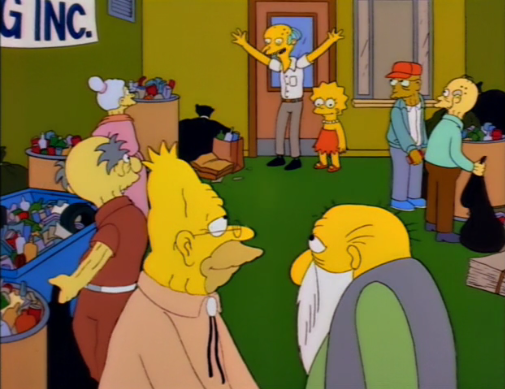
Next up is “The Love-Matic Grampa,” where Moe finds his love tester is inhabited by the spirit of Abe Simpson, who apparently must spend his afterlife assisting him with his romantic life. The set-up is kind of My Mother the Car, but it’s more a parody of cheesy bad sitcoms in general, complete with live studio audience laughter, cheering and hooting. We start with a really neat stylized animated opening, sort of like I Dream of Jeannie or The Nanny, showing the stupid backstory that Grampa died at the supermarket and his soul was re-routed on the way up to heaven. Now he must help the incredibly lecherous Moe get a date. The premise is so absolutely ridiculous, but it couldn’t be more perfect as the conceit for a dumb sitcom. Comic situations are a-go as Moe must bring the love tester with him to his date at a fancy restaurant, carting him off to the men’s room, dressed in a tuxedo for some reason. As star of the “original” show, Homer makes a cameo appearance, to massive audience applause, which gives us a wonderfully brutal joke when he cuts the power on the love tester (“That’s the second time he’s pulled the plug on me…”) The skewering of conventions is so great. I love Moe’s smiling shrug to the camera leading to a scene change as Grampa rambles on, a non-verbal “He so crazy!” Of everything, the theme is probably the best part. I love that jingle (“He’ll fill our hearts with looooooooovve.”)

The last segment is my favorite, just because it’s the most incredibly bizarre. “The Simpson Family Smile-Time Variety Hour” is an entertainment extravaganza starring the Simpson family, borrowing heavily from 70s musical variety shows. The most direct inspiration is from The Brady Bunch Variety Hour, where the family plays “themselves,” but one member has been auspiciously replaced. “Lisa” here is a dim, vivacious teenager (“Sophomore prom queen five years running!”) but nobody seems to mind. This element just makes me envision Lisa’s falling out with the real family over this stupid show, a sorted past swept under the rug for the sake of their careers. The show is a collection of purposely horrible comedy sketches and musical numbers, intercut with quick bits from other characters, dubbed the “Springfield Baggy Pants Players.” The cheese factor is ramped up pretty high: the stilted acting, and the sorry lead-ins into sketches (“Have you wondered what we would be like if we were beavers?” “Yes!”) and the 50s diner locale of the “I Want Candy” number, which blends Jasper attempting “Lollipop,” with Smithers in Western chaps doing “Whip It,” a segment where any sliver of doubt of his homosexuality is swiftly eliminated. My favorite bit is at the end of the big number seeing the family members breathing heavily, exhausted but still keeping their big smiles for the audience. Everything about this episode is so absurd, but all three segments are so well crafted, they feel like genuine examples of the genres they’re parodying. It’s a really unique episode. The series has only gone completely meta a few times, but it’s always interesting and entertaining when it does.

Tidbits and Quotes
– Troy McClure is brilliant as the host of course. His best bits are at the beginning when he’s walking and talking and hits a dead end unexpectedly, and his introductions after the commercial breaks: act two opens with him getting caught staring at the chest of one of the Charlie’s Angels statues, and act three has him abandoning his talk with the curator of the Museum of Television.
– “Not long ago, the FOX Network approached the producers of The Simpsons with a simple request: thirty-five new shows to fill a few holes in their programming line-up.” Basically all they got is The X-Files and Melrose Place. Fair enough for the time. King of the Hill had started, but was still in its infancy.
– In a weird way, I’d like to watch all of these proposed shows. A gritty crime drama with a slightly more serious Wiggum and Skinner? Great. A cheesy sitcom with Moe? That’s excellent telvision.
– Another hand wave of unseen backstory is that Wiggum is now divorced (“It’s no cakewalk being a single parent, juggling a career and family like so many juggling balls… two, I suppose.”
– Ralph gets his fair share of gems in so little time (“These rubber pants are hot!” “Look, Big Daddy! It’s Regular Daddy!”)
– Nice cameo of sorts by chef Paul Prodhomme (“I gua-ran-tee!” “Would you stop saying that!”)
– It’s great that Skinner mentions he read about Big Daddy in Parade Magazine, and it’s even better later when the man himself lists the reference on his calling card.
– The alligator attack is so wonderfully stupid, an exaggerated version of the creative animal assassins (“Lucky for you this is just a warning gator.  Next one won’t be corked.”)
– The Simpson family has a brief cameo in Wiggum’s new show (“Chief Wiggum, I can’t wait to hear about all the exciting, sexy adventures you’re sure to have against this colorful backdrop.”)
– I love the ending of “Wiggum, P.I.” and how dumb it is. Big Daddy hurrying to sit in the main office with the chair turned around so he can dramatically turn around, the stupid dialogue (“New Orleans is my town. Nobody going to mess with me. I got interests, and I ain’t talking about stamp collecting, though I do find that extremely interesting,”) and his “Blagh!” as he throws Ralph at Wiggum and escapes out the window. I guess I should give recognition to Gailard Sartain for voicing Big Daddy, he makes the small role very memorable.
– I love the ending of the “Love-Matic Grampa” opening where Moe horns in on the titles, and flicks away an invading cherub.
– The studio audience is in full swing right away (“I’ll have you know I wrote the book on love!” “Yeah, ‘All Quiet on the Western Front’!” [audience ooooooooos!] “Ah, kiss my dish rag.” [audience laughs])
– I love the bit we hear of the start of Grampa’s ramble about how he invented kissing (“It was during World War I, and they were looking for a new way to spread germs…”)
– Moe is not exactly the most romantic guy (“You know what’s great about you, Betty, is you’re letting your looks go gracefully. You’re not all hung up on looking attractive and desirable. It’s just so rare and refreshing.”)
– Kent Brockman’s introduction to the “Smile-Time Variety Hour” (“And now, a family that doesn’t know the meaning of the word ‘cancelled'”) may have been cute then, but is depressingly more accurate now.
– I really like all the Laugh-In-style interstitials, especially at the end where they have a few of them all in a row, like they had to cram them all in. The best being the shot of Captain McAlister with his hat raised (by an obvious wire) and steam shooting from his pipe (by an obvious tube system around the pipe). And of course, a poem by Hans Moleman (“I think that I shall never see, these cataracts are blinding me.”)
– I like the sign-off of the show with the family (and Tim Conway) in bed, and Marge’s seemingly signature line, “We’re like this all the time!”
– Nice nod to the fall of The Flintstones in Ozmodiar, a parody of the Great Gazoo, the weird little great alien that appeared toward the end of the series.

176. Homer’s Enemy

(originally aired May 4, 1997)
Oh man, is there a lot to say about this one. “Homer’s Enemy” has always been, and still remains one of my favorite episodes the show has ever done, but it’s incredibly unique, and an interesting prelude for a lot of the content and tone of later seasons. Homer’s dimwitted nature and bravado are ramped up to a ridiculous degree in this episode, but within a specific context where it makes sense, but much of said behavior would bleed into his regular personality later on. But let’s set the stage first. The power plant has a new hire: self-made man Frank Grimes, a normal, no-nonsense kind of guy. He’s instantly put off by Homer’s laziness, his oafish demeanor, and his disregard for reading labels on lunch bags. It isn’t long before he openly says to his face that he hates him and that they’re enemies. This deeply affects Homer, who does his best to try to get ol’ Grimey in his good graces, but all he does seems to aggravate him further. Grimes attempts to humiliate Homer by tricking him into entering a children’s modeling contest, but it completely backfires when he wins and is applauded for it. Past his breaking point, Grimes snaps and runs about the plant mimicking Homer’s careless behavior, ending with him grasping electrical cords without safety gloves, resulting in his demise.

The alleged idea of the episode is that Frank Grimes represents someone from the “real world” who finds himself in the bizarre town of Springfield. It totally makes sense, as Grimes feels and sounds unlike any other character we’ve seen. Hank Azaria gives an absolutely fantastic performance. The voice and design have shades of Michael Douglas from the movie Falling Down, just this regular guy who is moments from being pushed over the edge. He’s right up there with Hank Scorpio for best one-off character ever. So Homer is a man of unbelievable incompetence and stupidity, yet he’s the safety inspector at a nuclear power plant, a position where he could ultimately doom the entire town. That’s one of the overall running jokes of the series, but here it’s shone upon more, as it would with any one of us seeing this in action in real life. The point is for all his redeeming qualities, at the workplace, we would be put off by a guy like Homer. A man who should have been killed dozens of times by now by his own ignorance should not be in that position.

Along with his slacking off at work, Homer is much more absent-mindedly annoying in this episode, stealing all of Grimes’s pencils, loitering at his workstation, and so forth. He’s almost like a caricature of himself, but in this episode it makes sense because that’s what he’s called on to be. It’s all the negative aspects of Homer all at the forefront from Grimes’s perspective to drive him absolutely bananas. The issue here is that I guess the writers loved writing Homer like this and wanted to carry on some of those exaggerated traits. And so from here on out, slowly but surely, we get more jokes of Homer being unabashedly dumb, thoughtless, careless, pompous, and just being an overall caricature of his previous self. The good folks at Dead Homers pointed out a particularly striking line: during his freakout, Grimes madly remarks, “I’m better than okay. I’m Homer Simpson!” To which Homer cockily responds, “You wish!” Homer may be a man comfortable with his lot in life, but he’s well aware that he’s just an average schmoe. His great achievements and accolades over the run of the series are contrasted with this, and that’s why they’re funny; Homer never acknowledges how amazing all these things are. But in later seasons, he seems almost aware of how great his life has been, thinking that he deserves things, and worst of all, thinking that he’s somebody. And worse than that, when times call for it, he becomes a celebrated town hero (a la winning the model contest) instead of a barely-tolerated working schmuck. Former Homer was more thrilled over a tray of brownies than meeting George Harrison. Two seasons from now, he cozies up to Alec Baldwin and Kim Basinger in a matter of seconds. I don’t know to what degree this episode was a specific catalyst for what’s to come, but it does feel like it played some sort of role in it.

But despite any and all visions of future doom, “Homer’s Enemy” on its own is absolutely brilliant. The idea of a real man’s frustration over Homer’s relatively easy road through life is pretty sharp, and executed splendidly. The best scene is when Homer invites Grimes to the Simpson home to hope to smooth things over, which ultimately makes things worse when it only illuminates more wonderful things about his life. Again, Hank Azaria is frigging amazing as Grimes, absolutely shocked and bewildered at the blessed life this absolute moron lives. There’s plenty of other great gags throughout the episode, like Lenny and Carl’s cavalier attitude toward Homer (“That’s the man who’s in charge of our safety? It boggles the mind!” “It’s best not to think about it,”) the new executive vice president (a dog), and the other kids at the model contest. There’s also a B-story involving Bart winning an abandoned warehouse at auction for a dollar, and he and Milhouse using it as their extremely dangerous playhouse. It’s amusing if not disposable, but it actually does play into the main story in a good way. Everything about Homer’s life is seemingly perfect, but Bart is a bit of a gray area. So now, irrepressible hellion becomes young entrepreneurial factory owner in Grimes’s eyes. So, in summation, “Homer’s Enemy” is fucking amazing and an inventive, solid episode. It’s just what followed in its footsteps that I got issues with.

Tidbits and Quotes
– Grimes’s life could not have been worse. Abandoned by his parents as a child (who were shooting footage of them leaving him from the back of their car for some reason), he spent his youth delivering toys to more fortunate kids. Then as a young man, he was greatly injured in a silo explosion (as we see, he was just running by said silo, which exploded only when he got directly next to it). He studied science by mail in his spare minutes of each day, and eventually got his correspondent’s in nuclear physics, “with a minor in determination,” according to Kent Brockman.
– Great character bit of Frank wiping his hand on his pants before going to shake hands. A small thing like that tells a lot about a character instantly.
– I love how even Burns is swayed by television fluff pieces: one day he’s swayed by Grimes’s story, the next of a particularly heroic dog (“He pulled a toddler from the path of a speeding car, then pushed a criminal in front of it!”) The dog becomes his “executive vice president,” getting a sash to that effect, and is later heard chewing out (or barking, rather) Grimes in Burns’s office, and also attends his funeral at the ending.
– Homer aggravates Grimes instantly, admiring one of his personally mongrammed pencils, knocking the coffee cup full of them over. I love how freaked out Grimes is over this.
– I’ve always loved how Homer claimed he had no idea what a “nuclear panner plant” was, then Grimes gives an unsure forced laugh, unable to determine if it was a joke or not.
– More great Hank Azaria as the fast-talking auctioneer.
– Grimes notices alarms at Homer’s workstation, informing him it’s a 513. Homer checks his watch. Grimes explains it’s a 513 procedural. Homer checks his watch again. When he finally registers there’s a problem, Homer returns to his workstation, pours a bucket of water on the console, frying it, “solving” the problem. Grimes watches from the window, mouth agape.
– Grimes is bewildered at how cavalier Homer can act after almost just drinking a beaker of sulfuric acid. The blank, grinning look on his face is so hysterical, and that one shot so summarizing of the episode, that there was no question what the header picture for this review would be.
– Homer goes to Moe for advice on having an enemy, to which the bartender reveals his own enemies list, but Barney points out it’s just the same one as Richard Nixon’s. Moe then tries to give Homer some real guidance (“Why don’t you invite him over. Turn him from an enemy to a friend. Then when he’s not expecting it, bam! The ol’ fork in the eye.” “Do you think it might work without the fork in the eye?” “There’s always a first time.”)
– Everything about the dinner scene is fantastic: the haggard Grimes at the Simpson doorstep, his slow registration of Homer’s lavish living space, revealing he lives above a bowling alley and below another bowling alley, and the piling on of Homer’s accolades to further infuriate him (“I’ve had to work hard every day of my life, and what do I have to show for it?  This briefcase and this haircut!”) Homer is nervous, but still clueless (“I’m saying you’re what’s wrong with America, Simpson. You coast through life, you do as little as possible, and you leech off of decent, hardworking people like me! If you lived in any other country in the world, you’d have starved to death long ago.”)
– I love Homer’s attempt to look professional, with his Mr. Good Employee poster and eating donuts with a fork and knife, and his insistence that he continue his conversation with Grimes during the designated work period (“Sincerely, Homer Simpson.”) Grimes is not swayed.
– Excellent foreshadowing when Grimes claims he could die a happy man if he could prove to everyone that Homer is a moron. Guess that didn’t work out so well.
– The only great bit of note from the B-story is Milhouse’s interpretation of his title as “watchman” when Bart returns to find the warehouse collapsed (“I saw the whole thing. First it started falling over, then it fell over.”) Then all the rats flurry into Moe’s (“Okay, everybody tuck your pants into your sock!”)
– The model contest is a great scene. First up is Ralph with a Malibu Stacy dream house, which Smithers is of course impressed by, but Burns, not so much (“Hot tub? Media room? It’s supposed to be a power plant, not Aunt Beaulah’s bordello!”) Martin provides an extremely impressive design, which happens to actually generate power, but Burns isn’t so receptive (“Too cold and sterile. Where’s the heart!”) Then we have Homer, with an extremely crude model. Grimes cries out about the ridiculousness of the scenario, but is quickly shushed. Homer points out how he copied the existing plant, added fins to the cooling towers for “wind resistence,” and added a sharp racing stripe. Burns is sold: first prize. Grimes is stunned (“But it was a contest for children!” “Yeah, and Homer beat their brains out!”) It’s the perfect absurd catalyst for Grimes to finally go mad.
– Grimes’s freakout is astounding, and oh so quotable (“I’m peeing on the seat! Give me a raise!”) The animation, Azaria’s performance, everyone else just following Grimes silently, the uncomfortableness of it really plays, that this is a man who’s truly lost it (“Hello, Mr. Burns! I’m the worst worker in the world! Time to go home to my mansion and eat my lobster!”)
– I love not even in death can Grimes catch a break, that in the eulogy, Lovejoy remarks that “Grimey” was his preferable nickname.

175. In Marge We Trust

(originally aired April 27, 1997)
Here we have another Marge episode coupled with an examination of an unexplored secondary character. But forget about all that, the most important thing this show has to offer is the immortal Mr. Sparkle, one of the greatest and most bizarre creations of the entire series. I’ll get to him later though. Despite that wacky and amazing sub-plot, the main story is actually quite strong, which surprised me as I didn’t really remember it all that much. It gives a real humanity to Reverend Lovejoy, a man who wishes to help and invigorate his flock, but has just lost his religious mojo. We establish at the start how his stale and droning sermons lull the entire town to sleep, and his advice to the community is rather lacking. A flashback sheds some light on the subject: Lovejoy was a spirited go-getter in the mid-seventies, open to the concerns of his new congregation in Springfield, but met his match with worrywart Ned Flanders. After weeks and months of calls regarding exaggeratedly inconsequential matters (“I think I may be coveting my own wife!”), Lovejoy was beaten down, admitting he just stopped caring (“Luckily, by then it was the eighties, and no one noticed.”)

While we find Lovejoy is a man who’s become completely numbed emotionally, Marge has an open and caring heart toward everyone. She volunteers at the church and ends up falling into the role of the “Listen Lady,” assisting the citizens of Springfield with their problems. This role fits perfectly, as people are instantly taken by her motherly advice. Meanwhile, Lovejoy finds himself effectively replaced. There’s a spectacular sequence when he envisioned the saints on his stained glass windows (which have never been seen before or since, of course) chewing him out. Another great scene is seeing him all by his lonesome in the basement with his train set. It really did bring a tear to my eye. The show is so good at making us care about these minor characters in no time at all. Basically the episode is fantastic up until the third act, where things get a bit strange. Marge’s words of wisdom backfire involving Flanders dealing with some hooligans, which end up with him being chased out of town all night by the bullies on mini-bikes, for some reason. Then Ned hides out in the baboon sanctuary at the zoo, for some reason. And Lovejoy has to fight them off to save him, for some reason. The resolution was just kind of silly and nonsensical, and the big dramatic brawl ending is just a big harbinger for similar over-the-top action-oriented endings to come. I did like Lovejoy’s emphatic sermon at the end though, finally having gotten some life back into him (“A pair of the great apes rose up at me but bam, bam! I sent them flying like two hairy footballs!”)

Okay, enough of that. Miiiisstaah Sparkllllee! On a trip to the dump, Homer is extremely bewildered at the discovery of a Japanese detergent box with his face on it. He seeks out answers, with a return appearance of Akira and a visit to the library, where he asks for a Japanese phone book, then asks to use the phone (“Is it a local call?” “……yes.”) The Mr. Sparkle company sends him a video tape that should clear things up, featuring the Mr. Sparkle commercial, which is one of the best single segments the series has ever done. After watching a fair share of Japanese media after seeing this, it basically is pretty spot on. It’s just such a spectacular piece, where just when you think it can’t get weirder, it does. And you gotta love the subtitles (“I am disrespectful to dirt! Can you see I am serious?”) Homer is initially as baffled as we are, but it’s then revealed Mr. Sparkle is the result of the merging of two companies and their logos. A grinning fish combined with a lightbulb become… Homer’s head. It’s an absolutely brilliant conclusion (“There’s your answer, fish-bulb!”) A solid and interesting A-story, and one of the greatest side stories of all time? Awesome-ah power!

Tidbits and Quotes
– Great read on Homer’s loud “Dammit!” whilst nodding off and hitting his head on the pew. Sacrilicous. Before long, everyone is asleep, and the Reverend must use his noise buttons to awaken his flock (he chooses “Bird.”)
– I like Homer, Bart and Lisa’s joy of coming back from church, touting it the best part of the week (“It’s the longest possible time before more church!”)
– While Marge is doing chores at church, like putting the collection plates in the dishwasher, Lovejoy uses his time wisely (“Did you know, thanks to you, that I discovered a form of shame that’s gone unused for 700 years?”)
– Marge is an instant hit with her advice, first with Moe (“I’ve lost the will to live.” “That’s ridiculous, Moe. You’ve got lots to live for.” “Really? That’s not what Reverend Lovejoy’s been telling me. Wow, you’re good, thanks!”)
– Great meta moment when in response to Homer’s paranoia about the Mr. Sparkle box, Marge comments that it’s absurd that he thinks that they’re being watched. Cut to an aerial shot of the dinner table as the family eats a tad nervously for a few seconds. I love that it’s an underplayed moment and doesn’t get drawn out.
– I love Akira’s explanation of Mr. Sparkle (“He identifies himself as a magnet for foodstuffs. He boasts that he will banish dirt to the land of wind and ghosts. You have very lucky dishes, Mr. Simpson. This soap is from the sacred forests of Hokkaido, renowned for its countless soap factories.”)
– I’m sure some people don’t care for the extended bit of Homer dialing the phone, thinking it’s just filler, but I love just how long it goes, and how he has to look back at the book for each number he dials. He can’t remember more than one number?
– Lovejoy must confront his visions of the saints, accusing him of being uncaring and not doing enough for his congregation (“I thought saints were supposed to be friendly.” “You’re just lucky God isn’t here!”)
– As I said, I love the bit with Lovejoy and his trains. I also like that Helen calls Marge in genuine concern of her husband. It feels so real, it’s great (“Attention, HO-scale passengers. The dining car is closed. Root beer is still available, but the cost is now six-fifty. If the passengers will look to their right, you will see a sad man. That is all.”)
– Where does one get gas at the cheap price of $1.49 and eight-tenths? Donny’s Discount Gas! And holy shit, you’re damn right that’s a discount from today’s standards.
– The only things I like about the ending is the zookeeper explaining why he can’t help Ned (“If they don’t kill the intruder, it’s really bad for their society,”) and Lovejoy’s thank-you to Marge (“She taught me that there’s more to being a minister than not caring about people.”)
– One minor bit, I kind of wish that when the family went to Japan, they’d have made a Mr. Sparkle reference. Considering those tourists at the zoo immediately identified Homer, it would seem to make sense. But then, of course, if you’re watching that episode and have never seen this one, it makes no sense, so I get why they wouldn’t have done it.

174. The Old Man and the Lisa

(originally aired April 20, 1997)
It’s always interesting to see instances of Burns out of his element. Behind his position of power, he’s a vulnerable, feeble old man who hasn’t had to deal with the outside world and the peons who live there for decades. This episode cuts the miser down a peg, as he finds out that his fortune has all but depleted thanks to his team of spineless yes men not having the nerve to correct him on his poor and outdated stock choices. Without his mansion or his plant, Burns has nothing, a sad old man left to his own devices in his former subordinate’s apartment. Now, this defanged Burns characterization is a delicate balancing act, to thrust poor old Monty out into the world to marvel at ordinary items like public transportation and cereal boxes, but never lose sight that this is the same man who blocked out the sun and kidnapped Tom Jones. They succeed… mostly. Burns getting trapped in the freezer and seeking for a cereal with his face on it works, but absent-mindedly greeting fellow human beings doesn’t (“I’m shopping!”) Overseeing the delirious old man, two grocery clerks end up having him escorted to the retirement home. I get where they’re going with all this, but seeing Burns this far removed from his former persona is a bit unusual.

Alongside this story, we also have Lisa’s crusade for recycling, as part of her Junior Achievers Club at school. Burns is a guest speaker at one of their meetings, and the two have a heated back-and-forth on the subject of conservation, setting up Lisa’s personal distaste for the man. They cross paths again later on at the retirement home, where Burns beseeches Lisa’s help to regain his fortune. After some persistence, and a parody montage, she reluctantly agrees (“You could only earn money by doing good, socially responsible things. Nothing evil.” “That’s exactly the kind of radical thinking I need!”) The kindly Burns/Lisa dynamic is kind of sweet, I’ll admit, as the two do their part in picking up cans and organizing and separating various recyclables, which then leads to Burns somehow having enough money to open his own recycling plant. Perhaps he took out a loan of some kind, I dunno. But Lisa is shocked to see that Burns hasn’t changed much, as he has taken to recycling creatures of the sea into industrial slurry to sell for a profit. Soon after, Burns reveals he has sold the plant and offers Lisa her entitled 10%, but she tears up the check, knowing in good conscious she couldn’t accept it knowing where it came from.

I really love the reveal of the Li’l Lisa animal slurry. We set up the six-pack rings twice before, once at the very beginning and later with Burns, as Lisa explicitly shows him how fish can get caught in them. But while she is demonstrating how to compassionately free a helpless animal, Burns sees it the other way around, how such trappings can be used to ensnare sea life for profit. His gigantic net is such a great idea, one he’s extremely proud of and believes Lisa will be impressed too. Even when Burns is not trying to be evil, he’s just hard wired to be that way unintentionally, he honestly doesn’t understand what Lisa is so upset about. While I don’t care for some of the poor delirious Burns stuff, I love this turn at the end. The story is pretty solid, if only a bit rushed. The recycling plant couldn’t have been operational for more than a few days before Burns up and sold it. The laughs are also kind of sporadic. There’s a lot of great stuff at the beginning with Skinner and the recycling center hippie, and a few other things here and there, but multiple scenes will go by with no real laughs. However, it’s still a pretty good episode on the whole, with a different look at Mr. Burns, albeit one that would be exaggerated to a terrible degree in the future.

Tidbits and Quotes
– It’s a quick bit, but I love “Dracula Joins the Navy” (“Uh, Colonel?” “Blehh!”)
– I like Bart’s attitude on recycling being useless (“Once the sun burns out, this planet is doomed. You’re just making sure we spend our last days using inferior products.”) Not even Marge can feign interest after Lisa chides her for mixing polyapolane with polyurethane (I love Homer’s high-pitched indignant “Marge!” at her mix-up.)
– Homer stupidly chuckling whilst dropping entire books in the trash feels like a very latter-day Homer thing to do, but it’s saved when after Lisa tells her father it’s a serious matter, he continues doing it with a stern face, stifling his giggles.
– Two great Burns speeches, first in addressing the Junior Achievers (“I’ll keep it short and sweet. Family, religion, friendship. These are the three demons you must slay if you wish to succeed in business. When opportunity knocks, you don’t want to be driving to a maternity hospital or sitting in some phony-baloney church, or synagogue.”) The second is when Lisa urges the need to save the planet (“So Mother Nature needs a favor? Well maybe she should have thought of that when she was besetting us with droughts and floods and poison monkeys. Nature started the fight for survival, and now she wants to quit because she’s losing? Well I say, hard cheese!”) We also get a great callback with Lisa holding up a copy of “Will There Ever Be a Rainbow?” Surely Homer tossed it aside when Burns gave it to him, leaving Lisa to pick it up and read it.
– Nice read on Burns when he checks the stock ticker tape and discovers the 1929 market crash. He chastises Smithers for not informing him, who rebuffs by saying it occurred twenty five years before his birth (“Oh, that’s your excuse for everything!”)
– I love seeing Skinner irritated upon finding a half ton of newspapers only earns them seventy-five cents. Lisa tries to reassure him that all that paper combined could save an entire tree, but a frustrated Skinner speedily pulls out of the parking lot, smashing into a tree causing it to collapse, while children inside bawl uncontrollably. Brilliant.
– Not much I can say about Bret Hart, but why would Burns ask his permission to take his portrait with him? It’s his possession, he’s only selling the house. And in the end he leaves it behind anyway.
– I loved seeing Lenny in charge, and the later reference of his abuse of power, and him being a “real bear” on tardiness.
– Not only am I not sure why Krusty is shopping at the local supermarket, but why is he buying Krusty O’s? Doesn’t he remember writhing in horrible pain after eating one at a press conference? Because I sure do, because it was hilarious. I like Burns’s concession of picking Count Chocula, commenting that the vampire sort of looks like him.
– “Ketchup… catsup… ketchup… catsup… I’m in way over my head.” “Are you here to solve my ketchup problem?” I laugh every time at this.
– It’s kind of sweet in a weird way that Homer drank himself to sickness so his daughter could recycle all the beer cans. The animation of him smashed out of his mind is so funny.
– I don’t really care for the bits of Burns and Grampa conversing. What about their Hellfish past? They hate each others guts.
– Cute bit when Maggie gestures her hand like a gun toward Burns, to which Burns cavalierly reacts (“Ah, the baby who shot me…”)
– I like that the recycling plant windows made out of old beer bottles… and of course Barney is there to lick them clean.
– The animal slurry is quite disgusting, but I love its many many uses (“It’s a high-protein feed for farm animals, insulation for low-income housing, a powerful explosive and a top-notch engine coolant. And best of all, it’s made from one hundred percent recycled animals!”)
– The ending is fantastic, where Homer has four simultaneous heart attacks when Lisa rips up the check. At the hospital, he forgives his daughter for blowing twelve thousand dollars. Lisa innocently informs her dad what her cut actually was worth, and then… “Code blue! Code blue!” Rearrange the order and this could be the final episode. Homer had one last heart attack and died. Series over.

173. The Canine Mutiny

(originally aired April 13, 1997)
I gotta tell you, I’m not quite sure where to start with this one. There were so many elements to it that confused me or just didn’t work… so I guess I’ll take it from the top. Shenanigans begin when Bart gets his hands on a credit card under his dog’s name (I do like how Santa’s Little Helper becomes Santos L. Halper) and goes on a spending spree. Amongst the extravagant items he buys is a pure bred collie named Laddie, who is basically the most perfect of perfect dogs. It isn’t long before all of Bart’s purchases are repossessed, and in a knee-jerk decision, Bart has Santa’s Little Helper taken in Laddie’s place, eventually leading to his great remorse of this decision. The rest of the family is basically in the dark about most of this, for reasons that escape me. Bart gives them all lavish gifts and has a room full of expensive junk and nobody says anything? He also claims he got Laddie at a church carnival two towns over at a “truth-telling contest.” I get it’s supposed to be a joke, but there’s so many points in this episode I feel like Marge or even Homer would say something about what’s happening, but everyone just kind of goes along with it. It didn’t make a lot of sense to me.

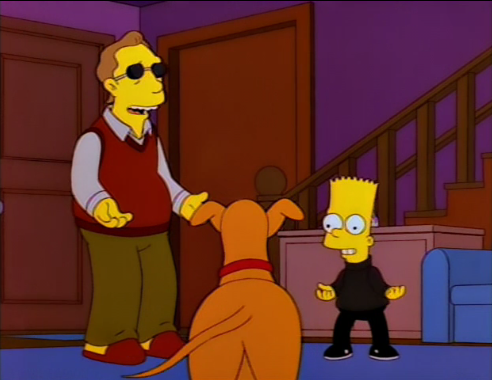
This is an episode that kind of needs to hinge on Bart’s relationship with Santa’s Little Helper… except it doesn’t really show it. In the first act we see the dog clumsily knock into the front door and stare into the window for hours on end, but not much affection is given to the poor mutt. There’s one scene where Bart hugs the dog after receiving the phony credit card, but it’s not really something that’s genuine, he’s just glad using the dog as a pawn in his scheme worked. He ignores his dog when Laddie comes into the picture, and then later feels bad when he gives him away, which all could have worked if we had more build-up showing the love for his dog. Of course we know that Bart loves him, as we’ve seen in “Bart vs. Thanksgiving” and “Dog of Death,” but thinking back to those episodes only makes this one feel more ramshackle. Toward the end, we find that a blind man now owns Santa’s Little Helper and Bart must get him back. This is a tough pill to swallow, even knowing how much those two love each other, but in this episode, it’s even worse given that I don’t even buy Bart loves the dog. I’d rather he stay with the poor blind man.

This episode marks a first, at 173 episodes in, this is the first one I felt like turning off. After getting Lisa’s blessing for robbing the blind man (what?!), Bart’s sneaking into his house is so tedious, we get cloying out-of-character Bart pleading with the man and a hackneyed bit where they let the dog decide ownership (what is this, Air Bud?) Not even the marijuana twist at the end can save it. The show just felt incredibly thin, where nothing important really happens in the second act at all, it’s just filling time before Bart decides to get the dog back. There are a few good jokes and amusing parts, but a lot of it felt pretty dead to me. It set up a situation where Bart’s antics and behavior went too far, and I found myself rooting against him. Even at his lowest pathetic point, I didn’t think he deserved the dog back. It’s just a really scatterbrained episode that misses most of its marks.

Tidbits and Quotes
– I guess it’s good satire that even Bart’s phony application is good enough for “MoneyBank” to get him a card. I like how he lists his income, “Whatever I finds, I keeps.”
– Bart finds out pretty quickly he can’t get away using his card at local vendors, such as Comic Book Guy (“Your phony credit card is no good here. Now make like my pants, and split!”)
– I like the voice over of Bart’s pachinko machine (“You winner! Ha ha ha!”) and Lisa’s ticked reaction to her new pep pills (Trucker’s Choice).
– I love the condescending, but cheerful speech the creditor gives Bart on the phone (“Because you sound like a mature, responsible person who wouldn’t want an unpaid credit card bill to spoil all his hopes and dreams for the future. Dreams such as home ownership, boat ownership and event-attendance!”) Bart decides enough is enough and has Laddie bury the credit card. Fat Tony and his goons bury a body alongside him (“We didn’t see nothin’ if you didn’t see nothin’!”)
– Mr. Burns likes Laddie? What happened to “Dogs are idiots!” Then again he did take a shine to one of Santa’s Little Helper’s puppies. But then again, he wanted to skin the rest of them.
– Milhouse indignantly recalls an incident with Santa’s Little Helper (“Remember the time he ate my goldfish, and you lied to me and said I never had any goldfish? Then why did I have the bowl, Bart? Why did I have the bowl?”) Bart responds, “Yeah, he was a great dog.”
– Bart’s dog furnace fantasy is a bit slow and boring, but saved by him looking out the window musing, “Where are yah, boy?” followed by a distant boat horn noise.
– Classic Homer line: “You gave both dogs away?! You know how I feel about giving!” I also kind of like his pep talk speech to Bart, which he hopes will end in his son eating dog food.
– The best gag in the episode is probably Moe’s repossessed floor. We see the Repo Depot is not a large building, then all of a sudden we see Moe’s entire floor propped against the wall (“Hey, next time, pay your bills.” “But I don’t want to!”)
– I always liked the red bow tie on Polly’s skeleton neck. You’d think it would have rotted much quicker than its body. Or maybe Mr. Mitchell’s been fitting the tie on his beloved bird’s remains for a long while now.
– I was so numbed by the third act, the marijuana bit didn’t even faze me, though I do love Mr. Mitchell’s excuse (“Without it, I could go even… blinder!”) Hank Azaria ad-libbing with himself as Wiggum and Lou to “Jamming” over the credits is pretty amusing too, with one last “Jamming!” over the Gracie Films logo.