147. A Fish Called Selma

(originally aired March 24, 1996)
Troy McClure is pretty much a gag character, a washed-up actor from another era trying to keep himself relevant (and get paid) doing crummy infomercials and instructional videos. This episode is extremely fascinating as we see a more human side to the character, or at least whatever humanity he has left in him. Reported to pass an eye test at the DMV, he crosses paths with Selma, whom he sweet talks into getting his license OK’d in exchange for a date. Right off we establish Troy as a man desperately clinging to his past fame: his slight disappointment that Chief Wiggum doesn’t recognize him almost comes through his phony smiling facade. He clearly has no interest in Selma during their date, at least until paparazzi take notice, when Troy quickly finds that having a healthy relationship is just the thing to kick start his career. It isn’t long before he pushes the train forward into marriage, and a starstruck, man-crazy Selma gleefully accepts.

This episode is just so surprising, it’s one of the more serious the series has ever done. The pacing is pretty leisurely, with a lot of scenes of characters talking through situations that are really emotional. A drunken Troy confides with Homer about the phony marriage, which quickly gets to Marge, leading to her confronting Selma about it. Troy is quick to admit to his new wife that their marriage is a sham, but doesn’t see the harm in it: his career is on an upswing, and she’s living the glamorous life she’s always wished for. Seeing how their situation is mutually beneficial, Selma decides to just go along for the ride. It’s just very interesting watching these two opposite characters interact: for all her gruffness, Selma’s actually quiet gentle and genuine, while every word out of Troy’s mouth are empty, self-congratulatory pleasantries. It’s not an episode with the biggest laughs, aside from the Planet of the Apes musical, of course (one of the best bits of the entire series,) It’s an odd breed of episode where you’re not really laughing that much but you’re still extremely engaged in this adult story.

Troy finds that he can boost his image even further by having a baby, an idea Selma is lukewarm about, but, having always wanted a child, she agrees to. The scene where the two attempt to get in the mood is so very bizarre. Selma attempts to be beguiling, and Troy… I have no idea what the hell he’s doing. There’s the ongoing gag about his bizarre fish fetish (what that is exactly, I’m not even going to think about), but really, what is his sexuality? He doesn’t even seem to fathom how sex operates. He exists in this vacuum of fame where anything coming close to an actual emotion doesn’t even permeate. Coming off this energy, Selma concludes that while she and Troy’s loveless marriage may be fine for them, but she can’t bring a child into this world in this situation, and with that, she bids Troy adieu. Even in its climax and conclusion, this episode is so low-key and subdued, but very powerful, ending with two adults coming to a realization and going their separate ways. It’s an episode we haven’t seen much of, and probably won’t ever again. This show doesn’t always have to be a laugh riot. Sometimes we can have more intimate shows with our minor characters, with the Simpsons peeking in every once and a while. The series features a rich universe, full of different characters and emotions, waiting to be explored. Or we can have Homer take up another job. That’ll be funny.

Tidbits and Quotes
– Watching this episode makes me all the more sad that Phil Hartman is dead. There were talks that he was interested in starring in a live-action Troy McClure movie, and honestly, doesn’t that sound like the most amazing idea ever? It would have been great.
– Though it seems to be displaying the contrary, we open with seeing Troy in his prime starring in “The Muppets Go Medieval.” Big stars were scrambling to be on The Muppet Show in the height of its popularity, so this is McClure at his finest. As a Muppet fan, it’s fun to see. I love whoever’s doing Piggy’s voice’s (Dan Castellaneta?) take on her low serious voice, and Homer’s explanation to the kids on what a Muppet is (“Well, it’s not quite a mop, and it’s not quite a puppet, but man… so to answer your question I don’t know.”)
– Great naive Marge line in response to Homer mentioning McClure’s alleged fetish, where she asserts that he’s a perfect gentleman “like Bing Crosby or JFK.”
– I don’t know why, but it’s somewhat fitting that Troy drives a DeLorean. It’s also great that Wiggum gets knocked in the face by its gull wing doors.
– The constant references to the fish fetish thing are so discomforting (“Hot damn! I’m going to Sea World!”) We see his house has a giant aquarium too. It’s so strange… like what is it? Then I think back to a horrifying, horrifying drawing I saw online and I stop thinking of it. I’m not going to say what it is, and certainly not going to try and find it and post it, but it involves Troy doing unnatural things to poor three-eyed Blinky.
– The Pimento Grove is freeze frame central with all the celebrity portraits on the wall, both real and Springfield-adjacent celebrities we’ve seen on the show before. Troy’s portrait is on the doggie door.
– Troy kissing Selma ends up on Page Ten above a column “Look Who’s Drunk” with a very inebriated Rainier Wolfcastle.
– It’s perfect how the upscale restaurant crowd turns on Selma like a rabid animal when she attempts to light a cigarette (“Excuse me, I ordered a Zima, not emphysema.” “Please, don’t smoke in our restaurant; we don’t serve contemporary Californian cuisine in your lungs.”) Also great how it turns into a romantic moment when Troy puffs up with Selma outside.
– “Stop the Planet of the Apes, I Want to Get Off!” is brilliant. And I think it should be turned into an actual musical. And why not? They made Spider-Man a musical, why not this? I could totally see it, and I would love it. And if no one else is gonna do it, then I’ll write it. One of these days. “You’ve Finally Made a Monkey Out Of Me” rivals “A Stranger’s Just a Friend You Haven’t Met” for best song of the series .It’s the perfect finale for a musical version of the film. The “I love you, Dr. Zaius!” at the end seals the deal.
– I love Selma’s fashionable outfits throughout the show, a non-verbal indicator of how she’s enjoying the good life.
– Classic bit when Lovejoy asks those to speak now or forever hold their peace at Troy and Selma’s wedding. Close-in on Homer… “Na na na na na, hey!” I only know the song by that, but it’s actually “Rock ‘N’ Roll Part Two” by Gary Glitter.
– I love how non-plussed Troy is at his own wedding, with their nuptial photo just him mugging for the camera, and when Selma says it’s the best day of her life, he proclaims, “It’s a good day for me too, baby!”
– I haven’t mentioned Jeff Goldblum as Troy’s agent MacArthur Parker, but he does a swell job. He’s almost more cold and disconnected than Troy (“You and your, er, wife have gotta have a baby.”) When Troy asks how, he says he’ll send him a pamphlet. I’m still confused about this, is it like Troy’s so disconnected from reality in being a big star in his mind he literally cannot function without being told what to do? I’ve never pondered this much about a cartoon character’s sex life before… He starred in “The Erotic Adventures of Hercules” for God’s sakes, he must know something!
– I guess I’ll end with this: The Contrabulous Fabtraption of Professor Horatio Hufnagel. I’d watch it right after the live-action Troy McClure movie. The perfect double bill.

146. The Day the Violence Died

(originally aired March 17, 1996)
Itchy & Scratchy has always been the show’s outlet to animation parodies, and this episode is absolutely no exception. For a cartoon nut like me, this show is a treat, with so many different kinds of animation and allusions to toon history. Some of the most iconic characters of the medium have shaky histories as to who created what. Felix the Cat was conceived by Otto Messmer, but heavily marketed by Pat Sullivan. Ub Iwerks animated most of Walt Disney’s “Steamboat Willie.” And here, we have our own cartoon controversy: Bart comes upon penniless bum Chester Lampwick (voiced by Kirk Douglas), who claims he created the character of Itchy, having the original 1919 film to prove it. Sadly, upon one screening to prove it to Bart, the film burns up in the projector, but that’s enough to make Bart vow to get Lampwick the rightful credit (and cash) he deserves. Hope appears lost during an ensuing trial until Bart uncovers a message written to Roger Myers, Sr. from Lampwick on an old production drawing, vindicating him. However, the huge cash settlement results in the immediate shutdown of Itchy & Scratchy Studios.

The animation references in this episode are amazing, from the original Itchy cartoon filled with the anarchic spirit of old 30s cartoons, to the R. Crumb-styled “Fritz the Cat” crossover. Most astounding is “Amendment to Be,” the Schoolhouse Rock-inspired segment. It’s absolutely flawless, it couldn’t have captured the source material better. If not for the Simpsons-esque overbites, you could easily place that into rotation with other Schoolhouse segments and no one probably would notice. Getting Jack Sheldon, who voiced the Bill in the parodied segment, is genius, and he does such a phenomenal job. On top of everything else, it even has a great political slant in its ending, as the ratified anti-flag burning amendment opens precedent, allowing all of the crazy and nutty bills to storm Congress. Also fantastic is Roger Meyers, Jr.’s outburst in court, claiming that all animation was built on plagiarism, referencing The Honeymooners predating The Flintstones, Huckleberry Hound aping Andy Griffith, and our very own Chief Wiggum being just a riff on Edward G. Robison (in the court room, Wiggum acknowledges this reference with an odd look.) He finishes his rant with a spectacular line (“Your honor, you take away our right to steal ideas, where are they gonna come from?”)

The third act is pretty great, in a bizarre sort of way. After getting his millions, Lampwick becomes of absolutely no help to Bart. He’s a man who once may have had artistic integrity and a desire to make cartoons, but now, after decades of sitting in the gutter, his only ambition was to get the money he had coming to him, and now that he’s got it, his life is complete (“I’m not greedy. As long as I’ve got my health, and my millions of dollars and my gold house and my rocket car, I don’t need anything else.”) He couldn’t be less interested in Bart and Lisa’s pleas to reopen I&S Studios, despite owing everything to them. At this point, we get another edition of Bart and Lisa Detective Agency as the two study up on copyright law and statutes of limitations to see if they can overthrow the ruling. This conceit of pint-sized problem solvers has become so ridiculous by now that the writers acknowledge it, giving us a ridiculous meta ending where the day is saved… by two other crime solving kids Lester and Eliza, modeled after the primitive Tracey Ullman-era designs of Bart and Lisa. Who are these two? Where did they come from? Are they from some bizarre parallel universe? Who knows, but as Bart attests so well, there’s something very… unsettling about them.

Tidbits and Quotes
– We get Itchy & Scratchy cartoons as bookends in this show. The one at the start is pretty standard fare (I love Scratchy’s angry eyes as Itchy stirs them in his glass), but the one at the end is really amazing. It starts with a chase through the desert a la Road Runner cartoons. Itchy spots a church and immediately stops to pray. Scratchy is then crushed by the foot of God, who is later revealed to be a mouse, and He and Itchy wink at the camera. What a strange conceit. God created Itchy in His image, so are mice His chosen ones, and cats are scourges of the earth to be killed in horrible, horrible ways? It’s a real thinker.
– This really is the season of Comic Book Guy, he’s been in almost every episode. Not that I’m complaining of course. I love his contemptuous reading of “toodle-oo.”
– The commentary of the Itchy & Scratchy parade is great, with the wooden, stoic male announcer reading his teleprompted lines as unenthusiastically as possible, played against the peppy Suzanne Sommers.
– Right when the parade enters Bumtown, you’re thinking why exactly did they have the parade go through there… then it’s commented on (“This certainly seems to be a poorly planned parade route.”) I love the quick animation and sped up music as the parade guns it out of the sketchy neighborhood.
– All Lampwick needs is a ninety-year-old projector to play his old reel. Where can Bart get such an ancient piece of technology? Springfield Elementary, of course.
– “Manhattan Madness,” the first Itchy cartoon, is absolutely fabulous. Its look and feel is so authentic, as well as the title cards (I love the bit where Milhouse slowly reads it, but gives a small groan when he doesn’t finish in time for the next scene.) Itchy’s mischievous nature is so spot-on too, mirroring the early days of Mickey Mouse. People may only know of “Steamboat Willie” from Mickey gleefully whistling at the helm, but go and watch it and you’ll see Mickey was kind of a dick, abusing animals to get them to play music, totally different from the innocuous corporate logo he would become in later years.
– Bart vouches for the good nature of Roger Meyers, Jr. (“Every Christmas, he goes down to the pound and rescues one cat and one mouse and gives them to a hungry family.”)
– Bart hides Lampwick in the basement to, at first, no suspicion. Homer walks by the basement door and tosses down some change when asked with no reaction, but Lisa is more observant (“Mom, there’s a weird smell and a lot of cursing coming from the basement and Dad’s upstairs.”)
Lionel Hutz is fabulous as always (“No, money down!”), as are his catalog of surprise witnesses, consisting of a Santa in crutches, John Swartzwelder, and the McCrary twins on their motorbikes.
– I love Grampa and Chester’s furious feud over an unpaid debt about a painted fence. The animation of Grampa leaping over the table and the brawl that ensues is pretty great. And there’s a great callback later when Krusty and Chester have a similar altercation in court, this time over blintzes.
– The Blue Haired Lawyer is at his most contemptuous here, which does make sense given that Hutz literally has no evidence at all to support his client’s claims (“Your famous film, the one you destroyed before the trial and haven’t been able to find another copy of! Oh yes, that film.” “Yes. You don’t have a copy, do you?”)
– I love how recklessly Bart opens up the frame on the drawing Lampwick gives him, busting the frame and the glass, ripping the paper, then callously flinging it up for the judge to catch. Also great that Lampwick calls him “Brad,” showing that he really has no regard for this kid who’s helping him before or after the trial.
– Another Disney reference in showing that Meyers, Sr. has to keep his father’s head in an icebox (now thawing and melting), obviously alluding to the rumor that Uncle Walt is cryogenically frozen somewhere. Alex Rocco’s reading of “You comfortable in there, daddy?” is perplexing to me. I’s like half sincere, half sarcastic, all disturbing.
– I l
ove the resolution to Meyers, Jr.’s plight: finding that his father’s pathetic stick figure creation Manic Mailman was “ripped off” by the postal service’s similarly simply designed Mr. Zip. Also great is how in the middle of the press conference, he draws in extra details on Manic Mailman to make it appear more similar to the other one, eliciting no suspicion at all from the crowd.

145. Homer the Smithers

(originally aired February 26, 1996)
One thing that makes this show so great is that the personalities of its characters are malleable. They can be pushed to certain degrees, ramping up specific aspects of themselves, all depending on the episode. This episode opens with a power plant trip to the speedway, and we see Smithers assist Burns in every which way, from holding up “bi-oculars” to feeding him teaspoons of booze (“This beer isn’t working. I don’t feel any younger or funkier.”) Look back to “Dancin’ Homer” when Burns downed buckets of Duff with Homer. Later this episode, he can barely drive his own caddy, whereas he was behind the wheel in “Bart Gets Hit By A Car.” These discrepancies aren’t bothersome since in both episodes, Burns is still Burns, just two different shades of him. Here he’s the enfeebled old man who has been waited on hand and foot his whole life, unable to cope with something as harmless as a brief encounter through his car window with a drunken Lenny.

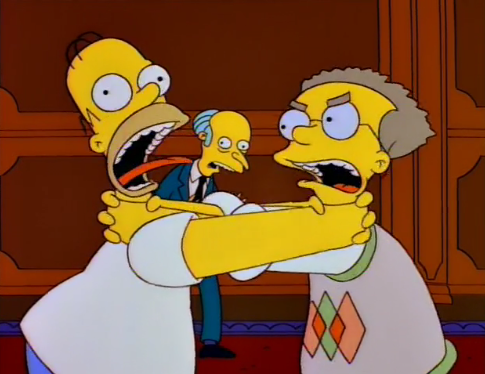
Noting Smithers is running himself ragged, Burns demand he take a vacation. Smithers must find a temporary replacement, one who’s not very competent and won’t outshine him in the toadying department, and you’ll never guess who he picks: Homer Simpson! The second act is basically a series of goofy scenes of Burns’s ridiculous daily routine and demands, with Homer repeatedly fumbling and coming up short. We also get glimpses of Smithers as he repeatedly calls to check up on Burns, where he appears to be at an all-male resort. Even when references about Smithers’s sexuality are incredibly overt, they’re still handled with an ultimately subtextual manner, like when Smithers tells Burns the resort he’s at forbids photography so he can’t show pictures. All the buffoonery with Burns and Homer reaches a tipping point when Homer can only take so much verbal abuse from Burns, finally snapping and impulsively socking him in the face. I love how serious this sudden act of violence is taken, with Homer greatly worried and sorry for what he did. Burns, terrified of Homer, must now fend for himself, doing his basic everyday tasks, until eventually he becomes completely self-sufficient. Smithers returns and finds that he’s sorely out of a job.

Hearing Burns’s speech about how happy he is that he does things for himself, it makes me feel a little bad that the status quo must be reverted to by the end. Similar to Krusty at the end of “Bart the Fink,” these characters seem so happy with their recent turn of events, that it’s almost unfortunate to see them get knocked down to square one as they must. Here, feeling bad for inadvertently causing him his job, Homer agrees to help Smithers back in Burns’s good graces. When Homer obviously screws it up, the two have an all-out brawl (a wonderfully animated and arranged sequence), culminating in Burns getting knocked out the office window, becoming completely infirmed and wholly dependent on Smithers once more. This is another episode that focuses on characters being happy just where they are. Regardless of needing someone else to prepare and alphabetize his breakfast for him, Burns is still most content in his position of power. More importantly is our view on Smithers. All the times we see his vacation, he’s never really actively participating in anything. A conga line forms behind him, he drives the motorboat instead of actually waterskiing, and so on. His entire world is Mr. Burns, and that’s where he belongs.

Tidbits and Quotes
– Wonderfully timed sequence of the dragracers after Smithers tells them to slow down so Burns can see. They keep it in first gear, and their parachutes simply unfurl and prattle along behind them. Burns’s “Excellent” in response to this pathetic display is hilarious.
– I love how Burns complains about the over-sized novelty foam hand and asks for a smaller one. And that they even sell those that Smithers can buy. Drunk Lenny is hilarious too, with his face squished against the window, and that his thumbs up is what drives Burns over the edge.
– Great cavalier reaction from Burns when Smithers tries to drown himself in the water cooler, where he simply pressing the dispenser to drain the tank until Smithers surfaces.
– Smithers’s search for a replacement is a classic bit indicative to the viewers, who obviously know it’s going to be Homer. First he searches for employees with the qualifier, “incompetent.” 714 matches found. He decides to expand the search a bit: “lazy”, “clumsy”, “dim-witted”, “monstrously ugly.” All of which results in… 714 matches. “Oh, nuts to this, I’ll just go get Homer Simpson.” And then we get the great Homer line into the next scene that just builds on it (“I think Smithers picked me because of my motivational skills. Everyone always says they have to work a lot harder when I’m around.”)
– Smithers lays out the job description for being Burns’s assistant: answering his phone, preparing his tax return, moistening his eyeballs, assisting with his chewing and swallowing, lying to Congress, and some light typing.
– It’s nice that Burns’s mother is set up so early in the episode, and that the rift between them is Burns never forgave her for having an affair with President Taft (Homer comments, “Taft, you old dog.”) Mama Burns is 122 years old, and here we learn Burns is 104, at least according to Homer.
– Great bit where Homer blindly picks one duty to ask Smithers about out the door, what to do in case of fire, and of course that’s what immediately happens. The shot of Burns’s office on fire with Burns blankly sitting at his desk is hilarious. I also love that it carries into the beginning of the second act as Homer frantically extinguishes it.
– Homer’s incompetence is pushed to its limits when he attempts to make breakfast. He skewers eggs and breakfast meats like a shiskabob and places it over the burner. It bursts into flames. Then he smashes open the microwave and sticks the kabob in there. Bursts into flames. He then pours cereal and milk in a bowl. Flames. In the end, he settles on a nice, healthy bag of Lard Lad donuts and Kwik-E-Mart coffee. Burns is not pleased (“Dough-nuts? I told you, I don’t like ethnic food!”) Then there’s a great bit where Burns asks about his stocks and what are his options (“Well, you can either get up or go back to sleep.” “I believe I’ll get up.”)
– Brilliant scene where Homer relays Burns’s messages (“You have 30 minutes to move your car. You have 10 minutes. Your car has been impounded. Your car has been crushed into a cube. You have 30 minutes to move your cube”) It’s so great how Burns’s expression gets more and more annoyed after each message, and how when Homer answers the phone, Burns asks, “Is it about my cube?”
– The montage of scenes leading to Homer’s breakdown is fantastic, starting with something as small as Homer getting the wrong light bulbs (“60 watts? What do you think this is, a tanning salon?”) The scenes get shorter and shorter until they’re just shots of Burns throwing things at Homer and berating him, until Homer just loses it and punches the old man out. The tension is just so wonderful, with an aerial shot of the office and Homer whimpering until he dashes out and back home, huddling himself beside the door. Marge has to squeeze information out of him (“Is there something wrong, Homie?” “No…” “Except?” “Except… I killed Mr. Burns!!”)
– The POV shot of Homer coming back for Burns is hysterical, with Burns’s heavy breathing and him clearly hiding behind the potted plant. Also great is when Burns attempts to check if the coast is clear, sticking a mirror under the door. All clear… then Homer’s smiling face comes into view, complete with dramatic music sting.
– Excellent bit where Burns attempts to call Smithers (dialing S-M-I-T-H-E-R-S), getting Moe’s Tavern. But Moe’s been fooled one too many times to fall for this (“So you’re looking for a Mr. Smithers, eh? First name ‘Waylon,’ is it? Listen to me, you! When I catch you, I’m gonna pull out your eyes, and shove ’em down your pants, so you can watch kick the crap outta you, okay? Then I’m gonna use your tongue to paint my boat!”)
– This episode is a haven of old time Burns words, especially when he describes how to operate a motorcar (“I’m sure the manual will indicate which lever is the velocitator and which the deceleratrix.”) I also love his cockiness later when he becomes self-sufficient (“No, you have the wrong number. This is 4-2-4-6. I suspect you need more practice working your telephone machine.”)
– I like the montage of Smithers’s job searched, starting at AT&T… actually Neat & Tidy Piano Movers, where he seriously injures his spine in one day. Then he’s the announcer at the Speedway, where he’s chucked out for his incessant commentary about the ramping-up script (“The people are already here, we don’t need to keep hustling them like this, do we?”) His lowest point is almost working at Moe’s: keeping Barney away when the beer delivery comes. Homer talks him out of it, but when the clock strikes and there’s no guard, we get a hilarious off-screen encounter of Barney gleefully assaulting the delivery man and sucking down all the new supply, made even better by Moe’s look of shock and despondency.
– Classic boneheaded Homer impersonating Burns’s mother, especially at the tail end when he calls Burns ‘Montel.’
– The Homer/Smithers fight is great, especially the bit where Smithers’s fist gets stuck in Homer’s flab, which Homer delights in, who proceeds to just smush his hand against Smithers’s face, tilting his glasses.

And that’s my last review for 2011. I should be back sometime the first week of January, at a somewhat truncated schedule. But thanks everyone for reading, and have a lovely New Year’s.

144. Lisa the Iconoclast

(originally aired February 18, 1996)
Lisa episodes always tend to be more understated. Not as bombastic as episodes starring Homer and Bart, but more introspective, or about a broader topic. In this show Lisa inadvertently uncovers a horrible truth regarding the town’s beloved founder Jebediah Springfield, that he was actually a murderous pirate who had nothing but contempt towards the town. This occurs during preparation for the town’s bicentennial celebration, and if one thing unites the typically ornery and volitale citizens of Springfield, it’s their mutual love and respect for their town founder. Among those excited is Homer, who manages to horn his way into the position of town crier, who he admittedly is quite good at (Bart comments, “You’re a big fat loudmouth and you can walk when you have to.”) A particularly sweet component of this episode is that Homer believes in Lisa’s story (remarking she’s usually right about everything), and vehemently assists and vouches for her in her quest to expose the truth.

Lisa finds herself butting heads with the curator of the Springfield Historical Society (where she found Jebediah’s confession stuffed in his old fife) Hollis Hurlbut, voiced by Donald Sutherland, giving a wonderfully subtle performance. Hurtbut assures Lisa the note is a forgery, even with her logical evidence to back it up. Any attempts Lisa makes to spread the truth are met with great scorn. From the school to Moe’s Tavern, no one will bear to hear anything derogatory about Jebediah Springfield. Lisa’s pursuits can only be calmed upon exhuming the founder’s corpse to see if he bears a silver tongue (his actual one apparently was bitten off during a grog house fight). When no tongue is found on the skeletal remains, Lisa is discouraged, but soon unravels the mystery, finding that Hurlbut is attempting to cover up the truth, unable to admit he had spent years devoting his life to a fraud. Unable to cope, he swiped the silver tongue off the body quickly, hoping the controversy would fade. But in the end, Lisa finds she just can’t rain on the town’s parade and keeps the facts to herself.

Like many Lisa episodes, this one doesn’t go for the huge laughs, but more focused on the content and feelings of the characters that keep it going. Jebediah Springfield’s true past is reminiscent of many other famous historical figures whose pasts may not be as clean-cut as we are led to believe. However, the ending is spot on: regardless if the man was the real deal, the legend certainly is. It brought out the best of the entire town, and that makes the myth just as real as anything. As I said, I love that Homer teams up with Lisa in this, and also that both end up in dour positions as a result: Lisa seemingly being proven wrong, and Homer being stripped of his town crier position as a result of making a fuss. The best moment of the episode is when Lisa apologizes to her father, who accepts, and Homer attempts to feign a smile until he deflates into a mope. He wants to keep his spirits up for his daughter, but can’t quite bring himself to it. But of course things are a-OK at the end, as father and daughter lead the parade in grandiose fashion, a sweet end to an interesting show.

Tidbits and Quotes
The beginning film strip of young Jebediah Springfield (played by a young Troy McClure) is very shoddily made, with stage hands and boom mics in shots, and a poorly disguised stunt double for McClure when he’s taming the buffalo.
– ‘Embiggen’ and ‘cromulent’ have both entered my personal lexicon. They may even be real words at this point. The former certainly sounds like one. Embiggen (verb): To make bigger.
– I believe this is our first mention of Kearney being an especially old fourth grader, who, since he can recall Watergate, must be at least twenty-five years old. Later episodes would reveal he has a young son, Kearney, Jr.
– I love the uselessness of the essay contest, that the top eighteen essays will be put on file at the library, to rot away unread.
– I really love Jebediah’s actual name Hans Sprungfeld. It’s very silly.
– Wonderful awkwardness between Lisa and Hollis after she discovered the confession. The “You have arthritis?” line was apparently an ad-lib from Sutherland, and Lisa’s quieted “No…” is adorable.
– I love the title of Lisa’s essay, “Jebediah Springfield: Super Fraud.” She certainly doesn’t sugar coat, I can give her that.
– Nice quick bit with Comic Book Guy at the copy store, paranoid Homer will rip off his unpublished screenplay. Homer is just waiting for Lisa, but makes a mental note: “Steal his idea.”
– Brilliant bit when Quimby warns Lisa about the corporations sponsoring their bicentennial. Lisa rebuts that they’re sponsoring a murderous pirate, to which one man responds indignantly, “A pirate? Well, that’s hardly the image we want for Long John Silver’s!” The animation of their quick exit is pretty funny too.
– I would think Jebediah’s skeleton, not to mention his clothes, would be mostly deteriorated after all this time, but I guess it’s worth it to have Wiggum desecrate a corpse for a little ventriloquism act.
– I love the pathetic sight of Homer shaking an alarm clock when his town crier bell is taken, almost similar to him singing the blimp song with a pickle in “Lisa the Beauty Queen.”
– The flashback of Hans fighting George Washington is pretty epic, and pretty stupid. But even that is handled with care, and lays in a subtle clue about the end. We see Hans smash against the portrait and knock it to the ground, which must have damaged it slightly, at least enough to Hans to catch part of it on his boot and rip it, which he later used to write his confession on. Lisa completes the puzzle, and exposes Hurlbut, who stupidly has displayed the stolen silver tongue out in the open in one of the dioramas.
– Hilarious bit where Quimby has hired a sniper to take out an eight-year-old girl, who still fires a shot after Lisa doesn’t expose the truth as she walks away.

143. Bart the Fink

(originally aired February 11, 1996)
There was a time when Krusty actually had artistic integrity. He was a clown of the people, one who lived to entertain. He has some of that vigor of the past deep within him somewhere, but his enthusiasm has been replaced by his status as a celebrity, his high accolade and millions of dollars made from shoddy merchandise. He’s become so far removed from his humble roots that if you take away the fame, you’ve broken the man completely. And that’s precisely what happens in this episode, as Bart inadvertently gets Krusty cited for massive amounts of tax evasion. His show (and his trademarked name) are stripped away completely, as are all of his subsidiary assets and his estate. He gets increasingly despondent about his situation, eventually culminating in him driving his plane into a mountain side, where he is declared dead.

This episode is an absolute vocal tour de force from Dan Castellaneta, giving his all as Krusty, loudly bemoaning his predicament and bitching about having to be a normal human being (“I was a big cheese. A huge cheese! And now look at me! I got to ride the bus like a schnook. I got to live in an apartment like an idiot! I have to wait in line with a bunch of nobodies to buy groceries from a failure!”) A key scene depicts Krusty’s show under IRS scrutiny, now dubbed the “Herschel Krustofsky’s Clown-Related Entertainment Show,” with Krusty in sweats forced to perform with no sets or props. Is his attempted enthusiasm his natural showmanship, or just his desire to stay on the air as a celebrity? I dunno, maybe it’s a little of both. Meanwhile Bart has to cope with ruining the life of, and then by association causing the death of, his beloved hero. As a result, he seems to see Krusty everywhere, until he realizes all of his sightings had some kind of connection… maybe Krusty isn’t dead after all.

As in many classic episodes, Bart and Lisa join forces to put this mystery together; it turns out Krusty is alive, now reborn as Rory B. Bellows, man of the sea. Krusty seems to have had a change of heart, no longer desiring a life of notoriety and riches, but a simple life of quiet solitude. I feel like I can buy this, that at his lowest point, Krusty concluded that he can begin life anew in an entirely different direction. But we’ve only got two minutes of show left so we have to get the Klown back into Krusty. Bart manages to convince him by reminding him how he’s more respected than all the country’s educators, and Krusty declares he’s not going to let them hog all the respect. I feel like the joke would have worked better if Krusty hadn’t already had a monologue about it earlier (“Everywhere I go I see teachers driving Ferraris, research scientists drinking champagne. I tried to drink a Coke on the bus, and they took away my pass!”) But regardless, the status quo is restored, a fair enough end to an episode with great performances and plenty of laughs to go around.

Tidbits and Quotes
– To receive an inheritance from their deceased great aunt Hortace, the Simpsons must stay one night in a haunted house. But unlike “Homer Loves Flanders,” the joke here is that the stay is actually quite lovely (Lisa comments, “Their tap water tasted better than ours.”) In the end, each Simpson only gets a hundred dollars each, with the rest going to Ann Landers.
– Another great Springfield business: the Tacomat, now with a special: 100 tacos for $100. Comic Book Guy makes out with a wheelbarrow full, all set for a Doctor Who marathon.
– I love the running gag about the various stupid bank promotions, first with “You’ll Go Ape Over Our Car Loans” (“A professional in an ape mask is still a professional,”) the reindeer antlers, and then later in New York, “Our Interest Rates Are Through The Roof!” with a man wearing a giant house.
– It’s kind of odd that Jimbo harasses Bart for only a one dollar check.
– Great laugh from Milhouse when he exposes his autographed stomach to some grossed-out girls. It’s so delightfully nerdy.
– One of the greatest scenes in the entire series is with the Cayman Islands representative. His character design is great, and the timing of his scene is just perfect (“I’m sorry, but I cannot divulge information about that customer’s secret illegal account. …oh, crap. I shouldn’t have said he was a customer. Oh, crap. I shouldn’t have said it was a secret. Oh, crap! I certainly shouldn’t have said it was illegal. …it’s too hot today.”)
– Great bit with Kent’s tiff with an off-screen producer on his pronunciation of ‘evasion’ as ‘avoision.’
– I love how uncontrollably devastated Krusty is meeting with the IRS. When told they’re going to garnish his salary, he thinks they said ‘celery,’ but he wasn’t actually joking, he’s just overtly (and loudly) distraught.
– IRS Burger is an example of a set-piece with ten jokes in one scene. The idea that the IRS wouldn’t just repossess the Krusty Burger building, but open their own restaurant is stupid enough, then we have Homer ordering various joke items (“I’ll have four tax burgers, one IRS-wich, withhold the lettuce, four dependent-sized sodas, and a FICA-ccino.”) Then Pimply Faced Teen gives him a form to fill out, which Homer intently does, asking Marge what her gambling debts were for the year (to which she loudly replies, “Seven hundred dollars!”)
– I love Krusty’s plane, the “I’m-on-a-rolla-Gay,” and Krusty’s sentimental memories of it (“I used to fly to Vegas in it with Dean Martin. One time we were flyin’ in it, and the moon hit his eye like a big pizza pie! We wrote a song about it! But it ended up infringing on one he recorded years before.”) I like the subversion that you think it’s going to be the origin of that song, but actually isn’t, making it even more stupid and hilarious.
– I love how mean Krusty is toward Bart, who is nothing but apologetic to him. He even considers punching a ten-year-old in the face when he asks him to, but not even he at his lowest point can go through with such a horrible thing.
– We see Chalmers and Agnes Skinner on a date this episode, and Skinner’s wishes for a distraction from the awkwardness are answered as Krusty’s plane whizzes by (“That’ll do nicely.”)
– Great read by Chief Wiggum proceeding to the crash site (“Folks, show’s over, nothing to see here… oh my God, a horrible plane crash!! Hey everybody, get a load of this flaming wreckage! Come on, crowd around, don’t be shy, crowd around!”)
– John Swartzwelder is among those at Krusty’s funeral, who for some reason has a Kermit the Frog puppet.
– Troy McClure is the perfect host for Krusty’s funeral (past ones he’s helmed include “Andre the Giant: We Hardly Knew Ye” and “Shemp Howard: Today We Mourn a Stooge.” It’s a bit random why he’s there, but I liked Bob Newhart as a guest, and his stumbling attempt at giving a speech about a man he knew nothing about. Then Troy concludes the funeral (“We’ll be sitting shivah at the friar’s club at 7 and again at 10. You must be over 18 for the 10 o’ clock. It gets a little blue.”)
– I love Homer’s attempt to console his son (“Don’t let Krusty’s death get you down, boy. People die all the time, just like that. Why, you could wake up dead tomorrow.”) He stares at Bart for a few seconds… then quickly bids him good night.
– Bart blows up a Krusty balloon asking Captain McAllister if he’s seen him. The Captain mistakes the distorted face as Handsome Pete, a midget accordionist who dances for nickels with a face just like Krusty’s, but more manic looking, perhaps the most insane idea for a Simpsons character. But we also get the great line from the Captain, “Not a quarter! Yarr, he’ll be dancin’ for hours!”
– We get a semi-satisfying conclusion to Krusty’s money problems where he reveals the life of his other persona is insured for a lot of cash… then his boat explodes.