117. Bart’s Comet

(originally aired February 5, 1995)
Y’know, after doing so many of these write-ups, some episodes you just kinda get stuck on what to say about them. This is a spectacular episode full of lots of great character bits, memorable set pieces and a satisfying, heartwarming ending, but I don’t have much to report on besides that. I’m sure I’ll come up with something, though. For how silly this episode can get, it’s very economical, where all the events lead you through the story and pay off in the end. We open with Bart’s brilliant balloon prank, which results in his punishment to help Skinner in his early morning astronomy. The balloon returns to distract Skinner as Bart observes a comet by happenstance and gets the credit. Then at the very end, the comet shoots through the balloon coming into the atmosphere, closing the book on Skinner’s public humiliation… for now.

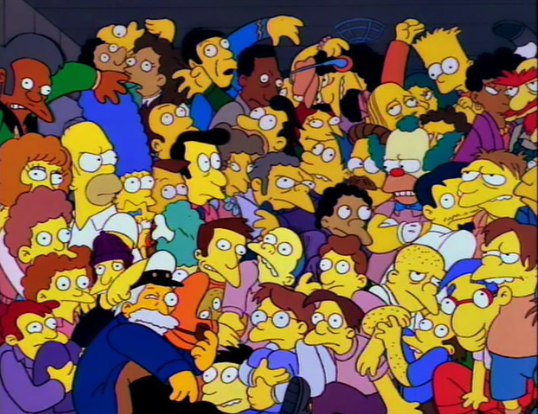
This episode is also a great look at mob mentality, which is a common theme in this show. A whole mass of Springfield residents arrive at the door of Ned Flanders’s bunker, wielding weapons hoping to get in, but they quickly disperse and apologize when Ned tells them they’re full. Ned thinks better and allows them all in, which leads to the hilarious image of all the townspeople stuffed in a small space, a visual that works wonders. Not only are there small jokes within (Waldo appears briefly, the bottom right with Nelson having Milhouse in a headlock), it’s interesting direction dealing with so many characters in a confined space. Anyway, Homer vindictively casts Ned out to save the rest, which Ned does so willingly of course. Then no sooner after does Homer decry everyone else for the decision he himself proposed (“I’m surprised and disgusted by all of you, especially his children!”) He goes out to join Ned, and the rest of the crowd is soon to follow. Springfield mobs are usually easy to sway, and when they shift focus, they go all out, regardless of any kind of sense (Moe is next to leave: “Hey Homer, wait up, I wanna die too!”)

Umm… ahhm… we see more general incompetence on behalf of local and national leaders. The Quimby-sanctioned plan to stop the comet is to send a missile to blow it up before it gets too close to the planet. The people of Springfield are easily mollified by this, thinking the plan sounds like dynamite. It can’t fail! They walk outside after the town hall meeting, take a look at the menacing comet in the sky, and they just laugh. And then they gather outside at night to watch the comet get destroyed like it’s some kind of fireworks display. It’s all a show, until shit gets real when the missile ends up blowing up the only bridge out of town. Later we see such ineptitude in a higher scale when a bill to evacuate Springfield on the floor of Congress is about to go through, until it is hastily paired with an unorthodox rider: $30 million of taxpayer money to support the perverted arts. The Springfield-slash-pervert bill is instantly defeated (Kent Brockman muses, “I’ve said it before and I’ll say it again: democracy simply doesn’t work.”) Sorry if this review feels kind of half-assed. Some episodes I kinda get stuck on, and while this is a really really great episode, I haven’t much to say about in on a whole. I’ll do better next time, I promise.

Tidbits and Quotes
– Skinner proudly closes science week with the launch of a weather balloon, which Bart seems suspiciously excited about (“‘Hurrah for science, woo’? I can’t say I approve of the ‘woo,’ but the ‘hurrah’ was quite heartening.”) The incredulous repeating of Bart’s excited words is hilarious. Harry Shearer is fantastic in this episode as Skinner, his passion for his amateur astronomy, his deep-imbedded hatred for his rival principal, and his feeble attempts to make things go his way, which always go wrong.
– The big butt Skinner balloon is such a fantastic design. It’s so fantastic, it’s something that really Bart should be praised for making something that creative and elaborate.
– I love the DJ alarm on Bart’s clock at 4 am (“Top of the hour, time for the morning news. But of course, there is no news yet. Everyone’s still asleep in their comfy, comfy beds. Good night, everybody.”)
– I could listen to Skinner read out findings all day. I love after the time lapse he’s still just as eager to read out the coordinates… but it still leads to nothing.
– Great, great line when Skinner manages to capture the balloon (“Got you, my rumpy doppelganger!”) And hilarious act break with a gut punch to Skinner: Bart steals his discovery, which causes him to let go of the balloon, then the paper boy makes his deliver, with headline “Prez Says: School Is For Losers.”
– Lots of great stuff at the town hall meeting, from Quimby’s opening statement (“Fellow citizens, when I learned about the impending crisis, I caught the very next plane to Springfeld… field”), to both the slideshow rendering and Frink’s model demonstration both resulting in Moe’s being singled out as destroyed (both accompanied by Moe reacting, “Oh… dear God, no!”)
– Great quick joke that the armory rocker is labeled, “Aim Away From Face.”
– The news report at the start of act three has some great lines, starting with Kent (“And, like Icarus, the rocket foolishly soared too high, and lost control of its servo guidance mechanism, leaving us with some six hours to live,”) Arnie Pye reporting on cars lunging over the destroyed bridge out of town (“It’s a silent testament to the never-give-up and never-think- things-out spirit of our citizens,”) and finally, Kent’s last-ditch revelation (“The following people are gay,”) a list that consists of a majority of the Simpsons staff.
– The ending with everyone coming together singing “Que Sera” is pretty sweet, and the harrowing fact that the only thing the comet destroys is the bomb shelter. And of course the very end is great with the shocking realization that Homer was right all along that the comet would break up to be no larger than a chihuahua’s head, and to further push that point, it lands right next to one of the tiny dogs just for scale’s sake.
116. And Maggie Makes Three

(originally aired January 22, 1995)
First we had an episode about Bart’s birth how it affected Homer and Marge. Then we had one about Lisa. Now we get up to Maggie, and for the second time in one of these flashback shows, family story time comes as a result of the television being turned off. Homer semi-reluctantly spins the tale of how when he became completely out of debt, he quit his job at the plant and started his dream job: as a pin jockey at the Bowl-O-Rama. Meanwhile, Marge finds she’s pregnant once more, but is hesitant to tell her husband. Any time we see Homer actually content with his life, it’s a real pleasure, and here it’s ramped up to an incredibly heightened degree where he crows that his life is perfect the way it is exactly, only to make Marge want to further delay giving him the news.

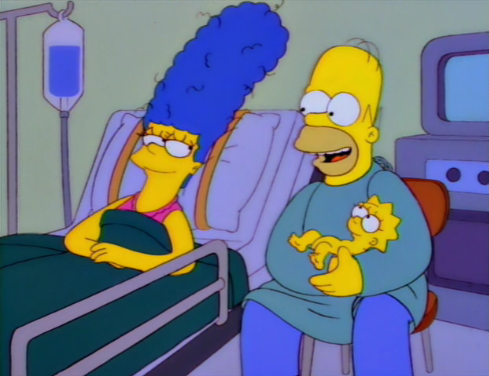
The flashback episodes before this really hinged on the emotional aspect of the stories: Homer and Marge finding love, and the birth of two beautiful children. This is the first one that really goes more for the laughs, with Homer’s love affair with the bowling alley, and Patty and Selma’s desire to ruin his life, countered only that Homer is the thickest, most oblivious person on the planet. It’s almost like a more comedic version of “I Married Marge,” where Homer’s perfect man-child life is disturbed by another unexpected pregnancy. It’s all pretty jokey up until the very end where Homer once again must sacrifice his dreams for his family, literally crawling back to a life of joyless servitude at the power plant. Things take a turn for sweet at the end when Homer’s mountain of woe crumbles at the mere touch of his newborn baby girl’s little hand, turning him into a cooing father. Homer sheepishly waving hello to a minute-old Maggie is one of the sweetest moments of the entire series, followed by the hilarious bit where he mistakes her umbilical cord for a penis (“It’s a boy… and what a boy!”)

I always love these flashback shows because it shines light on how our characters came to be and the decisions and sacrifices they made to be where they are now. This one is a bit different; only taking place a year or two before the present, it feels a lot more like a normal episode, since everything looks the same (save Homer’s one extra hair). The theme of Homer’s doing right for his family is there, but as mentioned, it’s treading familiar flashback ground. This episode is largely for laughs, with lots of crazy Homer antics and obliviousness, but at its center is Homer’s eternal love toward Maggie. In later years, there’d be a lot of jokes about Homer forgetting about his baby’s existence, which I don’t know if I care for considering this episode and its super duper sweet ending. At the end of the day, Homer is a man who loves his children, and has sacrificed so much of his own happiness for their own good. He’s A-OK in my book.

Tidbits and Quotes
– I love “Knightboat,” and how adamantly Homer shoots down Bart and Lisa’s complaints about the contrived nature of the premise (“I will not hear another word against the boat.”)
– I always like Homer’s (or sometimes Marge’s) opening monologues before the start of the flashback shows. This one is particularly great (“It was a tumultuous time for our nation: the clear beverage craze gave us all a reason to live, the information superhighway showed the average person what some nerd thinks about Star Trek, and the domestication of the dog continued unabated.”) It’s like he couldn’t come up with a third thing, so he just threw in something totally at random.
– The flashback section starts silly off the bat with Homer’s fantasy retelling of how he saved the plant from terrorists. Also great is later when Bart messes with the memories and has his father’s head explode.
– Homer knows how to make an exit. After “trashing” Burns’ office, he uses his head like a bongo (Burns muses, “I should be resisting this, but I’m paralyzed with rage… and island rhythms.”) He rides a cart through the plant, still holding Burns, then tosses him off outside (“That’s for employing me for eight years!”) He drives across a small wooden bridge, and for good measure, lights it on fire.
– Making budget cuts, Homer announces to the family they’ll be getting regular toilet paper instead of the fancy quilted kind. Bart is so upset about this he gets up and punches the wall.
– I like how Homer and Marge have a nice romantic moment on top of each other on the beach, but they’re semi-sensible adults now, so a little excess sand in their undergarments makes them want to just go home. But not before Homer shoves a bit more down his pants. Also, very graphic sequence of a legion of Homer sperm entering Marge’s lady parts, and the one lucky specimen to pierce the egg.
– Great sequence showcasing the wastefulness of Barney’s Bowl-O-Rama: all knocked down pins are carted off and discarded, while one large tree is shaved down to make a single new pin to be put up for the next set.
– I like Bart’s logic regarding the gender of the new baby (“You know nothing about genetics, Lis. It goes boy, girl, boy, girl.”)
– Great, great play on a classic convention: it appears that Patty and Selma have called every single person in the phone booth to blab about Marge’s pregnancy, but really they only called Mr. Aaronson and Mr. Zykowski, the two biggest gossips in town, to spread the news for them.
– I love Homer’s exaggerated obliviousness toward people congratulating him on Marge’s pregnancy, the best of which being Moe’s incredibly direct, “Hey Homer! Way to get Marge pregnant!” Homer blindly responds, “This is getting very abstract, but thank you, I do enjoy working at the bowling alley.” Of course it’s only when Maude congratulates Homer on his new job that it finally resonates with him that Marge is pregnant.
– Continuity police! Ruth Powers is at the baby shower even though they hadn’t moved in until after Maggie was born. Also, they flashback to Homer’s reaction to Marge being pregnant with Bart in the Simpson house, but they hadn’t lived there yet. I sure how someone got fired for these blunders.
I think Homer firing off shotgun rounds to arouse bowling interest is a bit too dumb, even for him, but I laugh every time (“My marketing plan attracted a record number of police and fire officials, but few stayed to bowl.“)
Apparently Captain McAlister is a father. Yep. Never seen that kid ever again.
– There’s another real cute moment toward the end where Homer is lovingly fawning over his new baby, and Marge, exhausted from her birthing ordeal, gives a quiet sigh of contentment. Homer urges his wife, “Come on, Marge, show a little enthusiasm!”

115. Homer the Great

(originally aired January 8, 1995)
I’m sure I don’t need to say, but this is one of the more famous classic episodes. Every Simpsons fan loves the Stonecutters. I’m interested in rewatching these most highly of remembered episodes for a few reasons, one of which is trying to pin what makes them stand out so much amongst the rest. Is it the great song? Is it the general silliness of the premise? Is it the exotic locale and satire of boorish brotherhoods? These episodes also get held under slightly tighter scrutiny, which sometimes can be to their detriment. In the case of “Homer the Great,” it maybe hurt a little: there are a lot of funny bits in here, and great classic moments of course, but as a whole it didn’t gel as well as I’d hoped. But it’s definitely fondly remembered for very good reason.

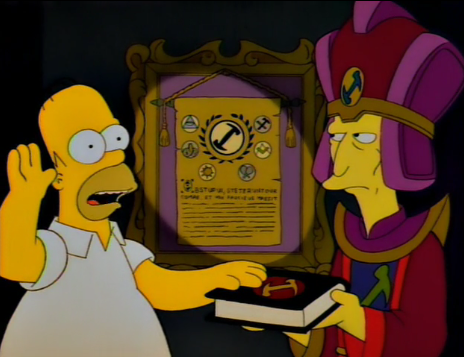
Homer grows suspect of Lenny and Carl’s suspicious behavior, and soon learns that they are members of a mysterious, exclusive club. He manages to worm his way in himself, becoming anointed into the Stonecutters, a secret society whose members don robes, assign identifying numbers and bow before the visage of their sacred parchment. Now, my knowledge of these kinds of clubs doesn’t extend much farther than the Royal Order of Water Buffalo, but I still get the point here: an organization of phony mysticism and alleged grandeur, but ultimately just an excuse for husbands to ditch their wives for the night, get drunk, eat ribs and play ping pong. But if this is the case, then the clientele should match. Lenny and Carl, Moe, Wiggum, Joe Quimby, Krusty, all make sense. But would Mr. Burns be a member of such a rowdy social gathering? Or Skinner? Dr. Hibbert? I dunno, maybe.

Upon desecrating the sacred parchment in the most spectacular, over-the-top way, Homer is banished from the group, until they notice an conspicuous birthmark that matches their logo. Homer is their fabled Chosen One who would lead their group to glory. Now… what does this mean exactly? If this group is really just a front to get smashed and goof around with the guys, what’s the Chosen One going to do? They keep playing cards and shooting pool, but now they have to let Homer win and bow before his every word. What do they get out of it? Is this a comment on the absurdness of ancient ritual? Like adhering to every word of the Bible? Am I digging too deep? These story issues are ultimately minor quibbles, since this episode’s got way too many classic bits to count. The egg council guy. The Gettysberg monkeys. The Stone of Shame, and the Stone of Triumph. And of course, No Homers Club. And a good sweet and sour ending in true Simpsons fashion. Despite my few issues, who still loves this episode? We do. …er, I do.

Tidbits and Quotes
– A breach of continuity, sure, but it’s really a great gag that Homer parks so far away from the plant, he’s right next to his own backyard.
– The “It’s a secret.” “Shut up!” bit is hilarious, I love Hank Azaria’s annoyed read for Carl, and when Carl can’t follow-up Lenny the third time, Homer steps right in to retort with his own “Shut up!”
– Homer attempts to present an excuse to his wife, but his brain fails to help him out (“I’ll be back in a minute. I’m…going outside. To…stalk… Lenny and Carl. …D’oh!”)
– Some bonehead Homer logic: hooking the paint to Lenny’s car to leave a trail is a good plan, I suppose, but then he tails him pretty much the whole way there. Why do the paint thing then?
– Homer confronting Lenny and Carl the night after witnessing the Stonecutters is great (“I saw weird stuff in that place last night. Weird, strange, sick, twisted, eerie, godless, evil stuff! And I want in.”)
– Homer laments to his wife in bed why people don’t like him. Marge responds that he’s a wonderful person. Perfectly on cue, Homer vents, “Why don’t those stupid idiots let me in their crappy club for jerks?” Then cue a classic flashback to the past of li’l Homer being barred from a neighborhood clubhouse: no Homers allowed. But Homer Glumplich is allowed (“Guh-hyuk!”) The explanation is flawless (“It says no Homeeeers. We’re allowed to have one.”) This of course has a pitch perfect callback at the very end.
– I like Abe at the table’s desperate pleas for attention. I could listen to him yell, “I’m a member!” through an entire irrelevant dinner conversation all day. Also great is how Homer carts him around like a possession at the lodge, gloating that now they have to let him in, whether they like it or not (“Okay, Homer, you’re in. Just don’t point that thing at me.”)
– Maybe another conflicting issue with the Stonecutters is Patrick Stewart as Number One, who delivers each dumb line with such a confident and serious air. He does an great, great job of course (his read on “The Paddling of the Swollen Ass… with paddles” is so very powerful), but I take him so seriously in that part, that the jokey nature of the story starts to drift.
– Homer lives it up with his perks as a Stonecutter: the secret passageway with fancy gilded paintings and music is great, and of course, the real 911 (912).
– Homer couldn’t have done more damage to that parchment: wiping his mouth, licking at it, cleaning his ears, blowing his nose… it’s a spectacular sequence, with great shots of the horrified members (my favorite is an incensed Moe, “Oh God!“) Then of course in a fit of merciful passion, he smashes the tattered remnants to bits accidentally.
– The turn at the end with Homer taking Lisa’s advice for the club to be more philanthropous and the group begrudging that makes total sense. He took their fun boy’s club into something that helps people and they hate him for that. I just feel there’s a way it could have worked better and hit the mark I believe it could. At the end, their over zealous anger feels too much when the joke should work better. Now I feel like I’m bitching again. I love the guest spot by H.W. Bush (“I’m afraid I have to disagree with Orville, Jack, and Mr., can’t we just do something to his voice box?”)
– We do have the sweet ending with Marge reminding Homer is club Simpson, where two members have very special rings (not Bart and Lisa’s cereal box ones, which actually look real cool). And then our snark with the team hazing of Homer (“Alright, alright, it’s Lisa’s turn.”) Not much in character for Marge, but hey, still funny.

114. Fear of Flying

(originally aired December 18, 1994)
Where we took a glimpse at Homer’s past in the last episode, here we take a look at Marge’s. We got into some heavy material by the end of “Grampa vs. Sexual Inadequacy,” seeing how psychologically damaging Abe was to little Homer, small bits that really let your mind wander as to how harsh Homer’s youth must have been. Here, we get even more horrible reminiscences about Marge’s childhood. I’ve talked before about Marge’s sad state of affairs, how she lives a life of eternal under-appreciation by her oafish husband. She’s a woman who’s permanently repressed, but most often of her own volition. Why is she like that? This episode gives us a bit more information, perhaps not as much as one would hope, but I’m of the mind that less is always more. The other elements surrounding the main Marge story aren’t quite as strong, but the emotional center of the episode is rock solid.

We start with Homer being banned from Moe’s and his fevered search to find a new dive bar to get wasted in. His last resort is a pilot’s bar, which gets him mistaken for a pilot himself and he ends up botches a take-off. What’s great with this is it’s not the expected stupid thing where Homer assumes the role of a pilot to avoid getting in trouble. He flat out admits he’s not a pilot, but no one believes him (“You fly boys crack me up!”) To keep the debacle hush-hush, Homer is offered free tickets for the family to anywhere in the US (except Alaska and Hawaii, the freak states). It’s when they finally get on the plane that Marge begins to have an anxiety attack and reveals her phobia of flying. It’s here we see how damaged a woman Marge really is: struck with a painful memory of her past, she converts into even more of a Stepford wife, continuously baking and working around the house, convincing everyone that everything is alright. There’s jokes shoehorned in around all of this, some of which work, but I’m pretty invested in the somewhat serious character stuff that some of it comes off distracting.

Marge ends up receiving counseling from psychologist Dr. Zweig, voiced by the great Anne Bancroft. There, we see a bit more of Marge’s past, at first not much more than we haven’t already seen. We know her sisters were bullies to her as a kid, as well as her mother teaching her to always bottle feelings and smile incessantly (“People know how good a mommy you have by the size of your smile.”) That scene in “Moaning Lisa” spoke such volumes, of how desperate for love and reassurance Jacqueline Bouvier must have been to instill such values on her daughter. Finally, we get to the source of Marge’s fear: the shocking childhood revelation that Marge’s father was not a pilot, but an airplane steward. It’s a hilariously stupid explanation, which is piled on more with multiple concurrent memories regarding terrifying airplane-related incidents (Zweig passes them off, “Yes, yes, it’s all a rich tapestry,”) but part of me wishes the story had been dealt with in a bit more serious manner. I love the dumbness of the ending, but it kind of reminded me of “$pringfield” where we have the joke of a serious problem swept under the rug, but that still leaves it a bit unsatisfying. Ultimately, I still like the episode for the devastating look at Marge’s past and present, and the jokes that managed to sneak their way past to make me laugh through the seriousness.

Tidbits and Quotes
– The opening is pretty funny, with the bar gang pulling very dangerous pranks on Moe, but Homer’s simple “unscrew the sugar jar” trick is going too far. I particularly love Barney’s prank: the episode starts and you see he’s wearing a new jacket with a flower in the lapel, so you think you know what’s coming. So when he asks Moe to smell it, following the deadly cobra in the cash register, you think maybe it’s got lemon juice or acid in it or something. But no, Barney just lights Moe’s apron on fire.
– I never watched Cheers so I can’t really comment on that whole scene. I know Fraiser Crane was there in the bar, but didn’t speak, perhaps because you would have thought maybe it was Sideshow Bob in disguise.
– I love the name of the lesbian bar, the She-She Lounge, and Homer’s slow realization… that it doesn’t have a fire exit. After his proclamation and swift exit, a woman going to the bar asks, “What was her problem?”
– Marge’s ramblings of her mother’s advice to be good and never complain are really serious signs of her emotional problems. While part of me likes how this is left to the imagination, I kind of wish they had explored it deeper and more seriously. I watch this show to laugh, but I could get into a bit more serious territory with characters I’ve grown attached to. Why not?
– I love the Alive parody, with the cheesy title drop, and the unseen gorging session (“Pass me another hunk of copilot.”)
– I like Homer’s insane paranoia of Marge going to therapy, that he’ll instantly be villainized, which would lead to a divorce. It’s a good running bit, but with all the other crazy stuff in this show, maybe a bit too much.
– Although I don’t know if I buy Marge having a Lost in Space dream, I love Dan Castellaneta doing Homer doing Dr. Smith (“As you well know, my back is a disaster area. Oh, the pain. Oh, the pain of it all!”)
– I like in the end how encouraging Homer is to Marge on her plane ride, and of course how it backfires when the plane fails to take off and lands in the water.

113. Grampa vs. Sexual Inadequacy

(originally aired December 4, 1994)
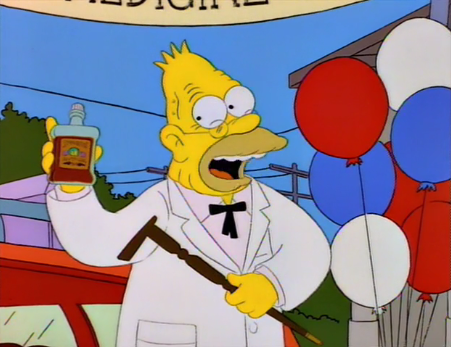
Oooh, look at this, two risque episodes in a row. I like that the series felt brave enough to tackle mature topics, sort of rubbing it in the face of all the ignorant viewers who automatically think all animation is appropriate for kids. Right away, we have several scenes set over a long period of time of Marge’s dissatisfaction over her inactive husband not fulfilling needs in the bedroom. It’s a neat dynamic, and a very realistic handling of the problem, as the two seek outside help with reigniting the sparks of their marriage with a book on tape by Paul Harvey (brilliantly mimicked by Harry Shearer.) When all suggestions seem to fail, Grampa, of all people, comes to the rescue with his secret home-brewed revitalizing tonic, which Homer takes begrudgingly (in the best line of the show, Abe yells to his son, “Think of me when you’re having the best sex of your life!”)

The tonic works wonders for Homer, which leads to he and his father traveling to various cities peddling their sexual rejuvenating wares. Here we get some jokes about shifty traveling salesmen, and an aborted subplot that kind of goes nowhere as the kids of Springfield draw up wild conspiracy theories as to why their parents are going to bed so early. But it isn’t long before things get serious. The two stumble upon the old Simpson farm where Homer spent his childhood, and start to wax nostalgic on the good ol’ days… almost. Homer recalls the rampant criticism his father gave him, and how it continues well into the present. As we’ve seen in flashbacks, there’s a real sour undercurrent in Homer’s youth that Abe was pretty hostile and psychologically damaging to his son, and while most of it is played for laughs, the serious gravity of it is still present. In a fit of anger, Abe admits the love tonic was responsible for his wife’s pregnancy, and that Homer was an unintended accident. Mighty harsh words, particularly for an early 90s sitcom. This show had balls, and wasn’t afraid to tread on matters like this.

Not wanting to be like his own father, Homer vows to be a better dad to his own kids, but ends up aggravating and smothering them. They could have kept this going much longer than it needed to, even dragged it into its own episodes (many episodes in the later era would do something similar), but good sense was made to have Bart and Lisa call their father out on his aggressive new parenting style (“No offense, Homer, but your half-assed under-parenting was a lot more fun than your half-assed over-parenting.”) Father and son come together in the end as each has a hand in accidentally burning down the family house, where Abe pays his son his very first cordial remark (“I’m not sorry I had you, son. I was always proud… that you weren’t a short man.”) It’s a really sweet ending that actually carries some weight, where they both admit they’re damaged individuals, and the house burning down being like wiping away their troubled past. Maybe I’m attributing too much symbolism, but I think the Homer-Abe dynamic was worked with really well, with a great human element to it.

Tidbits and Quotes
– “Good-Time Slim, Uncle Doobie, and the Great ‘Frisco Freak-Out” is a spectacular 70s Cheech and Chong type flick that of course Troy McClure would have starred in (“There’s more than one way to get high, baby.”) I also love Homer’s defense of it (“How often can I see a movie of this calibre on late-night TV?”)
– Very risque bit where we see Homer and Marge in the buff and an alarmed Bart runs in thinking he’s seen a UFO… which is actually a golf umbrella. Even the saintly parent Marge is so pent up she allows a panicked Bart to sit on the roof with a baseball bat, but Homer is passed out by the time she returns to bed. Homer explains his problems (“Marge, there’s just too much pressure, what with my job, the kids, traffic snarls, political strife at home and abroad. But I promise you, the second all those things go away, we’ll have sex.”)
– Great reference to Mapplethorpe. My art history classes actually came in handy.
– The Al Gore joke is so hilarious, but I love the set-up, where Lisa says UFO conspiracies are bogus, then we get the X-Files music where we follow a bunch of wires all the way to the White House, so you think you know where the joke is going, but then we get Al Gore celebrating good times (“I will.”)
– Dan Castellaneta is phenomenal this episode as Grampa, especially when we first see him and he asks his son what’s wrong, naming off many things, including a phony condition that’s got like a hundred letters in it. Then the great line, “What, seeeex? What’s so unappealing about hearing your elderly father talk about sex? I had seeex.” The drawn out readings of “sex” are so hilariously overdone.
– The Stock Footage film festival is such a great cop-out joke: why would there be a sign inside the theater saying what it is, and why would Bart and Lisa want to watch this? Regardless, still funny.
– I love Homer’s attempts to pitch at mall-going folk (“Hello You look like a man who needs help satisfying his wife.”) and then his musings over how that didn’t go so well (“I guess people have some sort of moral objection to our sex drug.”)
– Abe lists off their target cities, which of course all have impotent sounding names: Frigid Falls, Mount Seldom, Lake Flaccid.
– I thought li’l Homer imitating John F. Kennedy was really cute. And as I mentioned, Abe’s “advice” to his young son is as hilarious as it is emotionally devastating (“This is the greatest country in the world. We’ve got a whole system set up to prevent people like you from ever becoming president. Quit your daydreaming, melonhead!”)
– I love how pathetically the third act starts, where Abe shows up at the door with flowers apologizing to his son, who then slams the door on him. He crumbles a few of them through the mail slot, then puts his hand through and waves, “Hi.”
– Last thing, I love the blunt title. I’m sure at this point they didn’t give a shit about the episode names, so they were like, “What do we call this one?” And this is what they landed on. It may be my favorite title of any episode.