92. Homer the Vigilante

(originally aired January 6, 1994)
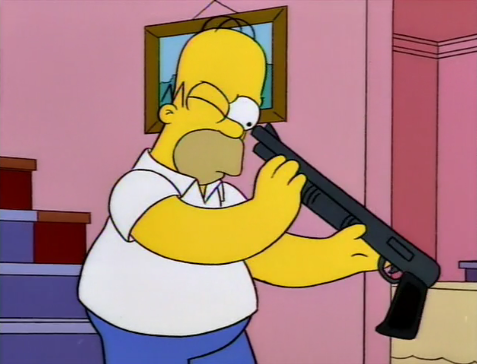
All through this season we’ve seen Homer take a drastic turn from his previous sadsack demeanor into something of a raving lunatic. The bumbling, but earnest and well-meaning father seems to have been replaced by a selfish, obnoxious, self-satisfying jackass. However, one must always look at the context. When you have characters as rich as this show, one can wax and wane their personalities to fit the story, allowing certain aspects of them to shine and take the helm. With “Homer Goes to College,” we saw his flagrant desire to emulate pop culture lead him into becoming a loudmouth party animal. “Boy Scoutz N the Hood” illuminated Homer’s penchant for childish teasing and torment, which admittedly was a bit less effective. In “Homer the Vigilante,” Homer is a petulant, power-hungry lout who functions purely on impulse. The idea of a neighborhood watch taking things too far is present, but the proper motivations for Homer’s actions don’t seem to sink that deep into his thick noggin, leading some of his behavior to be… kinda dickish.

The crisis starts after a wave of break-ins courtesy of the Springfield Cat Burglar. When local law enforcement seems to be ineffective (as usual,) a neighborhood watch program is started, with Homer volunteering to lead it. Before this point, we have a bunch of great jokes involving the town protecting themselves, like Frink’s mobile robot house and a paranoid Apu shooting down customers from the parking lot (“Thank you for coming! I’ll see you in Hell!”) Homer is elected to lead the watch group thanks to an already whooped-up crowd, but you’d think his actions would cause some dissonance in the organization. Some, like Moe, may just go along with harassing everyday Joes, but Apu? Principal Skinner? They may be Homer’s old Be Sharps buddies, but they’re much more level-headed and respectful. And what about Flanders? He pretty much disappears after the reigns of the watch group are taken from him. I think an internal clashing of the group would have made more sense, and given Homer more of a reason to fight.

There’s also a soft-spoken theme where Grampa’s help is continuously denied, as the masses seem to agree old people are useless… at least until he discovers the identity of the cat burglar: his retirement home neighbor Molloy, smoothly voiced by Sam Neill. It’s first brought up after the rage of enthusiasm after Homer is elected and people get behind him, and then it all kind of stops to introduce this plot angle that we know will culminate in the end. I dunno, it didn’t work for me. But this whole episode could have been garbage and still would have been saved by the It’s a Mad, Mad, Mad, Mad World ending. It fits perfectly with the blind mob mentality of the town that they would be fooled like that, creating a frenzy of people looking for a big T, only to ultimately be bamboozled as Molloy used this opportunity to escape for prison. This episode’s got some problems, but it works for the most part, and has enough classic, funny parts to keep it going.

Tidbits and Quotes
– The opening robbery sequence is full of jokes: Molloy going for his lock pick, then realizing Homer’s left his keys in the door, subduing Santa’s Little Helper and Homer with sausage links, replacing Bart’s portable TV with a book “Coping with Loss,” and removing Marge’s pearls, revealing deep imprints on her neck (she later reveals she has hundreds of them, all family heirlooms.) Bart also had his stamp collection stolen, a fact the family openly mocks him for, as well as Nelson, who literally phones in his “Ha-ha!”
– Frink’s moving house is one of those great “Why?” jokes. Upon danger, the house sprouts robot legs to run to safety; the model version runs, then falls and bursts into flames. Little wooden people fall out of the door, also ablaze. Frink tries to cover himself (“The real humans won’t… burns so quickly.”) Why did he even put people in the model? Then in the next scene, we see the house actually does exist as a full-size model runs away, and bursts into flames too. After seeing the prototype, why would anyone buy it?
– Lisa blowing the jug and Homer having a hoedown is a classic scene, as is the second time around when Homer is deep in thought (which is a hilarious drawing.)
– Nice spin (ha ha) on the spinning newspaper gag (“Is Nothing Safe?”) to have the cat burglar steal that too.
– I love the timing of this scene: Homer runs through the code names (“we’ve got the secret vigilante handshake. Now we need code names. I’ll be Cue-Ball, Skinner can be Eight-Ball, Barney will be Twelve-Ball, and Moe, you can be Cue-Ball.”) Short beat. Moe replies, “You’re an idiot.”
– A pretty dated MC Hammer reference, but I still really like the Rapmaster 2000 bit with all the kids dancing behind Homer.
– More great timing: on Smartline, Homer responds to criticism against him and his organization (“Kent, I’d be lying if I said my men weren’t committing crimes.”) Beat. Kent replies, “Touche.” Then there’s a phone call (“Well it looks like we have our first caller… and I mean ever, because this is not a call-in show.”)
– Another great newspaper the day after the burglary (“Zirconia Ztolen!”) with a drunken Homer as the sub-headline.
– Abe’s got a few good moments in the third act gloating about how he solved the mystery (“So you see, old people aren’t so useless after all. Malloy’s old, and he outsmarted the lot of you. And I’m even older and I outsmarted him!”) He laughs, and Moe tells him to shut up. Abe meekly responds, “I’ve had my moment.”
– Molloy proves to be so charming that mob mentality almost urges to let him go. Oddly enough, Wiggum is nonplussed (“Gee, I really hate to spoil this little love-in, but Mr. Malloy broke the law. And when you break the law, you gotta go to jail.”) Enter Quimby (“Uh, that reminds me, er, here’s your monthly kickback.”) Wiggum is not amused (“You just… you couldn’t have picked a worse time.”)
– I love all the different “big Ts”: the Big T Building, Big T Burgers and Fries, the Tea Factory, and the Big T Theater (featuring Ice T and Booker T). We have some cameos from Mad World actors, the most highlighted being Phil Silvers drowning in his car, with Bart subbing as the kid in the film that told him the stream was shallow enough to drive through.
– Great final line from Wiggum: “No, dig up, stupid!” And the Mad World end title music is among my favorite variations on the end theme.
91. $pringfield (or, How I Learned to Stop Worrying and Love Legalized Gambling)

(originally aired December 16, 1993)
This is one of those episodes where not much seems to happen plot-wise. I read that fans were crowing back in this day that the recent seasons suffered from focusing on gags and humorous set pieces replacing a solid through story, but I say if you have a fair premise and a lot of great jokes, how can you really complain? Faced with an economic crisis, Springfield agrees to legalize gambling and open a casino, where Marge proceeds to get addicted to gambling. That’s pretty much the main story, with little peppered elements by Homer, Bart and Mr. Burns. Our episode opens with some focus in showing us a prosperous 1940s Springfield dissolve into the crummy, dilapidated 90s. A tasteful gag involving Homer putting on glasses he found in the toilet actually fits with the theme: Burns is forced to make layoffs, but hesitates when he spies a bespeckled Homer (“Better keep the egghead. He just might come in handy.”) Even with a thin plot, at least all the jokes are derived from a consistent source.

Burns’s new casino on the waterfront is a rousing success, captivating young and old alike. Homer is hired from within to be a blackjack dealer, whose feeble understanding of the game makes his a popular table. It’s here we get the first appearance of the Rich Texan, a character who is mostly associated with the later seasons, but here, he’s quite funny out of the box (“Homer, I want you to have my lucky hat. I wore it the day Kennedy was shot, and it always brings me good luck.”) Bart is tossed out for being underage and, inspired by the hecklings of the teenage management, he opens his own casino in his treehouse. We get some good gags out of it, and a very special musical guest Robert Goulet, singing the very same naughty “Jingle Bells” tune that introduced Bart way back in 1989. Most interesting here is Mr. Burns, a man who craves money and power, who appears to have found the perfect business (“People swarm in, empty their pockets, and scuttle off!”) As such he becomes a paranoid wreck, adopting Howard Hughes-style germophobia and Kleenex-box shoes.

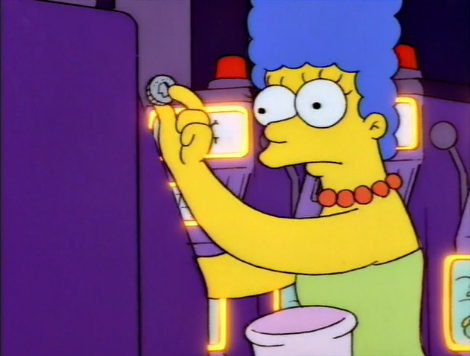
The primary story is Marge becoming a compulsive gambler, addicted to slot machines. The Simpson household falls to ruins without her, leading Homer to finally confront his wife about her problem. It’s interesting to see straightened arrow Marge to have a vice, but it doesn’t really build to much, that and the stuff with Homer fending the house by himself is kind of reminiscent of “Marge in Chains” or “Homer Alone.” But, again, jokes save all: Homer’s insane overreaction about the Boogeyman (“Bart, I don’t want to alarm you, but there may be a boogeyman or boogeymen in this house!”) and his make-shift meal consisting of cloves, Tom Collins mix and pie crust (the sound effect of him taking a bite is wonderful, then the pause and Homer uttering, “Let’s go see Mom.”) It’s nice they left the show open-ended, like Marge wasn’t going to cure her addiction that quickly, but all-in-all, I kind of wish they did more with the plot. It could have been a bit more emotionally charged. But that aside, this is a really funny show. A real keeper.

Tidbits and Quotes
– I love the painfully awkward pause at the doorway between Henry Kissinger and Burns and Smithers, where there’s nothing really left to say, so Burns just closes the door on him and the story continues.
– Great bit at the unemployment office with Barney, admitting he hasn’t held a job in six years. Kent Brockman asks what kind of training he has, to which Barney shamefully replies, “Five years of modern dance, six years of tap.”
– Just to make sure everything’s square with God, Flanders asks Lovejoy what he thinks about legalized gambling. The good Reverend responds, “Once something has been approved by the government, it’s no longer immoral.”
– Oh God, I love the endless Burns laughing sequence. I’m sure it’s like the Sideshow Bob rake scene where some people don’t think it’s funny because it runs so long, but to me, it just gets funnier and funnier, especially when he’s laughing in church, and then later when he ponders at what exactly he was laughing about, then remembers and laughs again, making you think it may start all over again.
– The pitchmen for the casino design are all hilarious. For some reason, I love the timing with the Englishman’s pitch: the grizzled old waitress comes into frame (“Freshen your drink, gov’nor?”) followed immediately by a Burns closeup of him grimly saying, “GET OUT.”
– Some would say the Gunter and Ernst getting brutally mauled by their tiger is not so funny now considering it pretty much happened with Siegfried and Roy, but for a sick fuck like me, it’s even funnier. This show is prophetic, mark my words.
– Great, in-character line from Marge upon finding a quarter on the floor at the casino (“I wonder if they have a lost and found.”)
– I wonder how Bart was able to afford a giant sign with light bulb framing for his casino. Or how he affixed it to the side of his wooden treehouse all by himself. Now that’s dedication.
– All the Burns scenes are hilarious: his vision of Smithers’s germ ridden face (“Freemasons run the country!”), his spectacular model of the Spruce Goose (“Model?”) and the amazing call-back to it when it seems Burns has regained sanity and is reopening the plant (“I said hop in.”)
– Lisa’s Florida costume is fantastic, as is Homer’s impassioned speech to Lisa when it’s finished (“The only monster here is the gambling monster that has enslaved your mother! I call him Gamblor, and it’s time to snatch your mother from his neon claws!”) And of course, a classic Ralph line at the pageant (“I’m Idaho!” “Yes, of course you are.”)
– Madman Homer running amok at the casino is hysterical, throwing people’s craps and hanging up their phone calls. He’s so crazed he rips the slot machine Marge is using right out of the wall and can’t even speak clearly (Marge first asks him to slow down, then to think before he says each word.) Homer finally gets it out, “You broke a promise to your child,” accompanied by a great music cue and camera whip-around. It’s a pretty impacting moment.

90. The Last Temptation of Homer

(originally aired December 9, 1993)
Going waaaay back to season 1’s “Life on the Fast Lane,” we saw Marge contemplating an affair, which doesn’t seem too out of the ordinary considering the dumb ape she’s married to. However, the flip side of this would be unthinkable: Homer is the luckiest guy in the world that he’s got Marge, and moreover, he knows it. The man’s shortcomings could fill a novel, but the one thing he’s not is unfaithful. That’s what makes this episode so interesting: Homer finds himself impulsively attracted to another woman, and he has no idea how to deal with it. It’s like fate put all the pieces together to screw with him and make him want to be with this other woman. It’s a great throwback to early Homer where life seems to be conspiring against him in every way.

The femme fatale in question is Mindy Simmons, new power plant hire thanks to the Department of Labor forcing Mr. Burns to have at least one woman on staff. Upon first sight, Homer is completely bowled over by how attractive she is, and promptly bolts out of the room, not sure of what just happened. As the show progresses, he gets more and more paranoid about his situation. He learns that Mindy shares the same love of junk food and slacking off at work, which only makes things worse. He attempts to take solace in his beloved family, only to be further perturbed by a very sick wife and the oddball antics from his children. Not even an out-of-body experience can give him relief: his guardian angel, taking the guise of Colonel Klink from Hogan’s Heroes, pulls an It’s a Wonderful Life to show Homer a world where he marries Mindy instead of Marge, only to find Homer is fabulously wealthy, and Marge is the President. Klink quickly gives up, leaving Homer even lower than he was before. Sure, this was presumably all in his mind, but even his wildest fantasies prove to betray him.

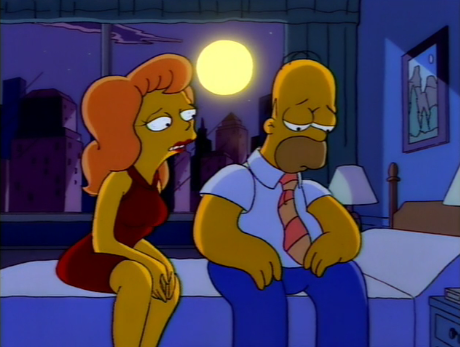
Homer’s continuing losing battle reaches a head when he and Mindy are sent off to Capitol City to represent the plant at a big energy convention, and are later gifted to a romantic dinner for two. Then, the last straw: Homer’s fortune cookie reads, “You will find happiness with a new love.” Even sweets have turned on him, and Homer concludes that he can’t fight fate. In one of the sweetest, most genuine scenes in the entire series, Homer breaks down with Mindy about their situation, where she tells him to look in his heart and go from there. It’s a spectacular performance by Dan Castellaneta, as well as guest star Michelle Pfeiffer, and  it looks amazing with the moonlight and shadows in the hotel room. In the end, Homer sticks with Marge, of course, and everything turns out alright. It’s a very intriguing episode regarding Homer, a real human-like portrayal after all the wacky stuff he’s been up to this season. But that’s one of the great things about the show, you never know what shade of character is going to be illuminated each week.

Tidbits and Quotes
– There’s also the B-story with Bart being prescribed glasses, special shoes, scalp salve amongst other treatments and becomes the ultimate social outcast. It’s got a few funny bits, but ultimately is just time filler since the A-story is so much more interesting. I do like the ending where the bullies are shocked to find Bart back to normal… then proceed to beat him up anyway.
– I love Martin’s anger and frustration over not being picked on, as Bart struggles to read a blurry chalkboard (“It’s ‘photosynthesis’!! Damn your feeble brain!”)
– More plant safety: the emergency exit doors are just painted on the walls. When Charlie goes to complain, Burns shoots him off in a tube, that apparently seems to lead all the way to India. Preposterous, yes, but still funny. With him gone, the plant needs a new dangerous emissions supervisor. Burns first goes with foreigner Zutroy until the Department of Labor flags him as an illegal alien (“That’s preposterous! Zutroy here is as American as apple pie!”)
– Homer finishes off his work day (“Another day, another box of stolen pens.”) He tosses them in his backseat with a whole bunch, some of which have been leaking copious amounts of ink on the seat.
– Classic bit with Homer coming up with a fake name to disguise his own story: Joey Jo-Jo Shabadoo. Moe comments, “That’s the worst name I ever heard,” causing another man at the bar to run out crying. Barney calls out, “Hey! Joey Jo-Jo!”
– Homer is befuddled to find Mindy seems to share all of his interests (“Foul temptress. I’ll bet she thinks Ziggy’s gotten too preachy too!”)
– Homer in the elevator with Mindy is a fantastic sequence, starting with both of their inadvertent Freudian slips. Homer attempts to think unsexy thoughts, starting with Patty and Selma shaving their legs, then Barney dancing in a bikini humming the I Dream of Jeannie theme. But he quickly morphs into Mindy and his plan is foiled. Homer decides to abort mission, hit the emergency stop and get off, where he slides down one of the cooling towers. This already makes no sense, but they seem to have been going down in the elevator. Down from what point? Whatever, I still laughed.
– TV betrays Homer too, with each channel featuring programming about adultery. He stops at a commercial with women in workout clothes and the slogan “Just Do It.” He screams and runs out before the end, where it turns out it’s for the NRA (the other one, the National Ringworm Association.)
– Very quick Lionel Hutz appearance, annoyed to find Homer in the knocked over telephone booth (“Hey, you, get out of my office!”)
– I love Stuart the duck, animal worker at the plant, and that later on, when Burns is surveying the antagonism amongst employees on the security monitors, the last is Stuart pecking at an unconscious co-worker.
– Great one-off character with the cheeky bellhop and his inappropriate noises regarding Homer’s king-size bed. Homer is not amused (“Stop that! I love my wife and family. All I’m gonna use this bed for is sleeping, eating, and maybe building a little fort. That’s it!”)
– The sexual tension between Homer and Mindy grows ever thicker. Mindy comments that a mere wall keeps the two from sleeping in the same bed at the hotel. Homer feebly responds, “Walls are a necessity in today’s society.” Later, Mindy seductively suggests the two do something that could get them in a lot of trouble… order room service. Burns becomes aware of this and sends his flying monkeys to stop them a la Wizard of Oz, but alas, the creatures fall out the office window into traffic. After a beat, Burns tells Smithers, “Continue the research.”
– Great bit at the convention with passer-bys chiding the nuclear power booth and Mindy and Homer shooting back insults (Homer yells, “Go to hell!” while throwing a brick.)
– Hilarious quick line from Mindy after finishing her meal at Madame Chao’s (“What a perfect evening. It sure was nice of them to make us cheeseburgers.”) Also, fate screws Homer again, as he was one cookie away from them cracking open the “Stick With Your Wife” barrel.
– That last scene with Mindy is amazing, as I’ve said, even from the start: Homer invites Mindy in, she sheepishly says, “Okay.” Homer then parrots what she said in a kidding fashion, like mocking her because he’s so fed up and defeated with the situation, feeling he has no choice but to sleep with her.

89. Boy Scoutz ‘N The Hood

(originally aired November 18, 1993)
We’ve seen Homer pushed to many radical degrees this season, getting dimmer, more reckless, and more impulsive. He’s pretty much all of this toward the final act of this episode, and while he does certainly dance around the tipping point of being a jackass, he thankfully never quite gets there. Before we examine this, let’s set our stage first: Bart and Milhouse come into some money and buy an all-syrup Super Squishee. The unimaginable sugar rush leads them to go crazy, Broadway style, in a great musical number and montage depicting a kid-friendly drunken bender (a highlight is the rub-on tattoo parlor, open all night). Unfortunately for Bart, his lost night also included signing up for the Boy Scou… err, the Junior Campers, an organization he derides as lame, but soon enough grows an affinity toward. Homer, meanwhile, mocks his son for it at every turn.

Homer’s questionable behavior starts with his constant teasing of his son. It works though, as it’s never really dwelled on too long, and fits Homer’s immature mindset. It also helps that Dan Castellaneta is hilarious doing his taunts (“Egghead likes his booky-wook!”) He’s not acting out of any malice or cruelty, he’s reveling in these schoolyard antics that tickle him so (it reminds me a bit of his glee of hearing childish quips at Flanders’s BBQ in “When Flanders Failed.”) This all comes to a head in a spectacular sequence where Bart and Homer are coaching themselves on how to respond when Bart, out of obligation, has to ask Homer to go on the father-son rafting trip. Bart rationalizes that his father will say no, so he’s got nothing to worry about. Despite concerns by his brain, Homer thinks the way to go is to say yes. Then, as angrily and bitterly as possible, the two storm out into the hallway, take antagonistic stances, and have a heartfelt father-son moment through gritted teeth (“Dad, I really want you to come on this trip with me.” “Bart, I’d be delighted to go on your trip with you.”) Both realizing what has happened, they utter a nice “D’oh!” in unison. Fantastic.

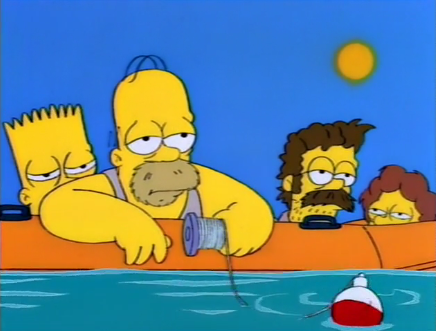
The last act consists of Homer and Bart stuck in a raft with Flanders and his oldest son Rod, lost out in the middle of the ocean. Every attempt to make a rescue or any piece of knowledge Ned provides, Homer is quick to screw it up or belittle it. At times this can be amusing, like his indignation regarding rationing the water (“Don’t you know the poem? ‘Water, water, everywhere, so let’s all have a drink.'”) Over and over, though, it gets a bit tough to stay on Homer’s side. I think the show might have benefited by having Homer know that Flanders is the scout master early on in act two, so the seeds of bitterness could be sewn in earlier. Instead, they really only clash at the end of the act, so it’s almost like building on top of the taunting of Bart to get the belligerence toward Flanders too. As questionable as the Homer stuff is, the episode is still heavy on laughs, and a great send-up of the scouts from Bart’s point-of-view, sticking around thanks to his interest in knives and trapping wild animals (or an oafish father). The ending with the Krusty Burger on an oil rig is the bizarre icing on the cake for this episode.

Tidbits and Quotes
– The My Dinner with Andre video game is one I really wish existed. Makes me think back to the old Simpsons arcade game that they never released on home console. They could have put out that game, and as extras, have smaller bonus games like the arcade games we see in the show, like this one, the boxing game in “Moaning Lisa,” and so on. The closest we got was in the “Virtual Springfield” CD-ROM game where at the Kwik-E-Mart, you could play Larry the Looter, which was kinda neat. But I want more, dammit.
– There’s a great Homer bit at the beginning catching up on some of his favorite reading: the ingredients off a container of honey roasted peanuts. Later, he has to consult his brain as to why finding a twenty dollar bill is better than finding his lost peanut.
– I’m really not quite sure how Bart and Milhouse could afford their wild night, as they seem to have used up their twenty bucks on the Squishee. It’s still a classic scene, regardless; my favorite part is when they’re front-row at Cats, and Bart blows a spit wad at the actors, distressing them. Milhouse, who had been looking away, looks back, darting his head back and forth like some kind of confused dog.
– At breakfast, Homer puts in his two cents regarding Bart (“Weaseling out of things is important to learn. It’s what separates us from the animals! …except the weasels.”)
– Great scene where the bullies play keep away with Bart’s uniform, but are put upon when they discover Bart could care less (“You better pretend you want your uniform back, twerp!”) Bart then proceeds to half-heartedly beg for his precious uniform back. They get comeuppance later when Bart weasels out of a pop quiz to attend a meeting. Nelson is stunned.
– The knife sequence, while feeling kind of ancillary, has some great stuff, like the badass moment of Moleman whipping out his huge knife, and Dr. Hibbert removing a man’s burst appendix, which he flings like a bomb, and it actually does burst (“Don’t thank me, thank the knife!”)
– “The 10 Do’s and 500 Don’t’s of Knife Safety” is just great. I like Bart’s labored reading of it (“‘Don’t do what Donny Don’t does.’ …they could have made this clearer”), and the amazing photos of Donny Don’t using a knife as a toothbrush, as ammo for a slingshot and for hunting wild game: the house cat.
– I’m not quite sure how Bart was able to dig through the concrete driveway to make that trap hole for Homer. Still funny, though.
– Great bit of Bart critiquing the accuracy of an Itchy & Scratchy cartoon. Lisa shoots back that cartoons don’t have to be 100% realistic, and then we see Homer walk by the window even though he’s still sitting on the couch.
– Another wonderful guest appearance, here by special celebrity dad Ernest Bourgnine. He’s a pretty good sport, being introduced coming out of the bathroom, getting lost in Deliverance territory and presumably getting killed in the great Friday the 13th ending. The best part is his laughter attempting to cheer up his camp buddy, which quickly deflates into a groan.
– Nice petty moment in the raft when Bart laughs at one of Flanders’s jokes, Homer, behind them rowing, quips, “You are not my son!!”
– The third act drags a little bit, since not much happens other than jokes about them being stranded. The resolution is great, though: a distressed Krusty apparently didn’t listen regarding the financial viability of building a restaurant on an unmanned oil rig (“I’m taking a bath on this.”) Immediately after Krusty orders the place shut down, Homer burst through the door (“Get me seven hundred Krusty Burgers!!”)

88. Bart’s Inner Child

(originally aired November 11, 1993)
Self-help gurus are a pretty open target, and this episode brilliantly nails them in a fantastic scene: self-described “PhD in Pain” Brad Goodman invigorates his crowd of suckers with catchy slogans and platitudes, leading them to grab all his books and tapes off the merch table and leave piles of money behind. Viewing the madness, Lisa points out, “He’s just peddling a bunch of easy answers.” An enthusiastic Carl passing by responds, “And how!” Perfect. All the stuff in the second act is fantastic. It’s just a little too bad we have a first and a third that have a lot of funny bits, but feel very disjointed. We open with Homer, who can hardly contain himself (or even speak properly) upon seeing an ad for a free trampoline. He sets up a backyard business charging kids to bounce, but when injuries start to pile up, he is forced to get rid of it. This is our first sign of truly insane Homer: ramming cars off the road thinking they’ll beat him to the trampoline, his dream of Homerland, his descent into madness when he repeatedly fails to get rid of the thing… first act Homer is crazy, but his incredible passion and giddiness over this bizarre venture keeps it funny.

The through-line emotion that brings us to act two is that Marge fears she is too much of a nagger, having been against the trampoline from the beginning. The segue is fair enough, especially considering the insanely disconnected act ones we’d see later on. Marge, Homer, and later the whole town are hooked onto self-help expert Brad Goodman, Albert Brooks’s most forgettable role, but still a strong outing. He delivers ridiculous lines with such a level of professionalism and calmness. At Goodman’s seminar, he latches onto the cheeky outburts of Bart, exemplifying him as a well-adjusted free spirit, turning the boy’s half-hearted excuse of “I do what I feel like” into a mantra to live by. This sort of becomes a plot line, where Bart feels a lack of identity in a town desperately trying to be as rebellious and irreverent as him. It never seems to amount to much though, as there’s no real concrete resolution to the story. The climax sort of ends on a joke and we have a scene of the family on the couch trying to recap the show, a la “Blood Feud” or “Rosebud.”

In terms of character-driven stories, we have two: Marge’s attempts to loosen up, and Bart’s losing his sense of self. The first is basically dropped half way, and the second doesn’t amount to much. Brad Goodman disappears in act three, and the story has no real ending. This isn’t exactly the most cohesive twenty-two minutes of television, sure, but there’s nothing egregiously off about it. The episode itself is saved by, as usual, the laughs. The only reason I can shrug off the ending is because it’s hilarious, and I quote it all the time (“They’re heading for the old mill!” “No we’re not!” “…well, let’s go to the old mill anyway and get some cider!”) The trampoline plot has nothing to do with the rest of the episode, but I love the black comedy that comes with seeing young children getting horribly hurt jumping on the thing. And of course Albert Brooks, who’s fantastic as always, with Phil Hartman as well. Great jokes and hilarious bits can save even the most fractured of episodes; this one may not be perfect structurally, but it’s damn funny.

Tidbits and Quotes
– Homer’s excitement over free items is great; we all know people who are more than willing to take in junk solely because they don’t have to pay for them. It’s taken even further here where Homer raves over soiled mattresses and surplus drums of mayonnaise from Operation Desert Storm.
– I’m not sure what Krusty is doing living in a residential neighborhood, nor why he appears to have sinister motives in giving away the trampoline. Regardless, him sitting on the porch aiming a shotgun at Homer when he tries to return it is hysterical (“You just keep right on drivin’.”)
– The reveal of the trampoline, with Homer jumping up and down from Bart’s window, is pretty neat, as are some of the camera angles, like Homer and the kids jumping up and down and the POV up-and-down shot from their view of a worried Marge.
– Fantastic Gone with the Wind parody with the endless lawn of injured kids. Again, children in pain are always funny. Also, it’s a perfect example of how you can break the rules and do stuff that makes no sense, like show that the lawn is thousands of feet long, only if it’s funny. Laughter excuses anything.
– I’m not a big fan of Homer’s attempts to get rid of the trampoline. It got a bit too wacky for me. I do like when his buzzsaw wraps around it and the entire electrical outlet rips out of the kitchen wall though.
– Brad Goodman is hilarious from the start with his “Feel Bad Rainbow,” listing off the personality disorders he treats. The icing on the cake is the disgruntled leprechaun depicted on the graphic.
– A wonderful bit of animation at the start of act two where Homer walks in the TV room doing a weird little strut until saying, “What up, Marge?” It’s given no context, but I love it so much. Maybe Homer was just having a particularly nice day outside and was having some fun.
– Troy McClure, brilliant as always. Two particularly great catalog titles this time, too (“Smoke Yourself Thin” and “Get Confident, Stupid!”) Brooks and Hartman together is like a match made in heaven. I only wish they had shown more of the special (“Troy, this circle is you.” “My God, it’s like you’ve known me all my life!”)
– There’s a bit with Goodman after having brought Homer and Marge on stage that’s really great. Goofing around, Bart identifies himself as Rudiger. Goodman continues spewing his gospel, and when Marge tries to correct him by telling her son’s actual name, Goodman snaps, “His name’s not important!” and continues. Marge immediately gives a half-lidded annoyed look, dually ending the first story of Marge’s elation toward Goodman, and illuminating Goodman’s slightly rougher side.
– Great look into Springfield history as Kent Brockman reports the “Do What You Feel” festival will replace the annual “Do As We Say” Festival started by German settlers in 1946.
– Wonderful Burns and Smithers moment, with Burns quite excited to eat his “iced cream” and Smithers confessing that he loves him… in those colors (“Who am I kidding, the boathouse was the time!”)
– Nice, brief appearance by James Brown. Nothing that amazing, but I do love his only line (“Hold on here! This bandstand wasn’t double bolted!”) How would he know that just from examining the rubble?
– The very ending is great, with the infamous McGonigle, which is another thing I quote a lot (“You’re off the case, McGonigle!!”)