
 (originally aired November 8, 1990)
Perhaps “Dancin’ Homer” suffers from following an episode that tackled so much and felt so epic in scale. Here we have a decidedly smaller, more low-key and leisurely saga featuring Homer’s trials and tribulations at a brand new job, the first of many many MANY occupations he would briefly hold over the next twenty years. There’s something about this story that doesn’t quite ring true with me, though. There are elements that are spot-on, a lot of funny bits, but it doesn’t pack the punch that it feels it does.
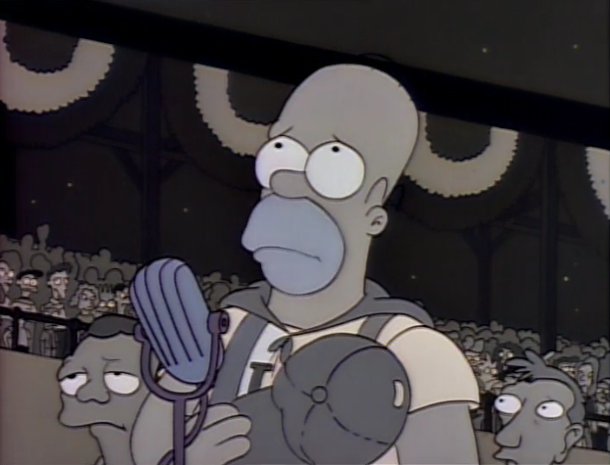
We start at Moe’s Tavern, where a despondent Homer spins his tale of woe, a wrap-around that I never thought was too effective. The story begins at the ballpark during the “Nuclear Plant Employees, Spouses, and No More Than Three Children Night.” In a bit of a reprisal from “There’s No Disgrace Like Home,” we get Mr. Burns’s contractually obligation to warm up to the lower, less financially well-off life forms that are his employees. Homer fears that being seated next to his boss will ruin his good time, but shockingly, Burns proves to be good company, buying them beers, heckling players and doing a two-man wave. Even though last episode showed Burns straining to smile and his vow to destroy Homer’s life, we can still believe these characters can get along in some degree. Their banter back and forth is charming, it’s like the oddest of odd couples. Attempting to rouse up the crowd to aid the failing Springfield Isotopes, Homer cavorts and dances about like a fool in the dugout, sparking a rise out of the crowd, including the batter, who hits a home run, winning the game.
Homer is hired by the team to be their official mascot. Dubbed “Dancin’ Homer,” his crowd-pleasing buffoonery carries on the Isotopes winning streak, and he gains greater and greater popularity. Perhaps part of why I’m not so into this episode is I don’t understand the in-universe Dancin’ Homer phenomenon. I get that that’s part of the joke, and the character is partially based off of overenthusiastic fans’ chants and rituals becoming fan favorites and stadium institutions, but really, Homer’s act is not all that rousing. The big finale where the Capital City folks don’t “get” him is not so much a letdown as it was a logical conclusion for me. Sure, I felt bad for Homer, but at least my feelings were vindicated. But I’m skipping ahead here…
It isn’t long until Homer is called into the big leagues: Capitol City. The true savior of the episode is the Capitol City montage. First off, it establishes the Simpsons as small-town rubes in the face of the big city, full of mystery and wonder. Accompanying their drive in is an ode to the city in song, sung by the great Tony Bennett, kind of a riff on “New York, New York.” It’s the first instance of a celebrity playing themselves as Marge points him out singing the song, and he gives a quick aside, “Hey, good to see you!” It’s a sweet little moment, and the song is so brilliant. It really sets the mood, of a city that makes a bum feel like a king, and makes a king feel like some sort of nutty coo-coo super king. Also brilliant is the Capitol City Goofball, the mascot Homer is filling in for, an bizarre, mismatched whatchamacallit mascot design, a weird Muppet-type creature with deely boppers, a baseball torso, a giant horn nose, and a smooth, mellow voice performed by Tom Poston. Part of the fun is the two sitting and talking about their acts very seriously. It’s where I most buy the premise: as preposterous and stupid as this game is, Homer is taking it to heart and trying as hard as he can. However, his best efforts don’t cut it for the Capitol City crowd, and he and the family are sent back from whence they came.
I like the basic premise of chronicling the story like it’s of a pro athlete’s rise and fall, but it’s just of the goofy mascot. We even get a great play off of Pride of the Yankees, wherein Homer considers himself the luckiest mascot on the face of the Earth, is comforted by a Babe Ruth lookalike, and stumbles into the dugout on his way out. There’s plenty of parts that work in it, but all-in-all, it doesn’t resonate with me as a whole story. The wraparound device and Homer’s interruptions about the seriousness of the story feel so out of place. Perhaps if they had stuck with the story playing out on its own, it wouldn’t have had that odd story bit over its head. But with “Capitol City,” Bleeding Gums Murphy’s 26-minute national anthem, and “little baby batter can’t control his bladder,” this episode is still deserving of classic distinction.
Tidbits and Quotes
– A true classic Homer line: “Marge, this ticket doesn’t just give me a seat, it also gives me the right, no, the duty to make a complete ass of myself.”
– Another call-back to “Disgrace” with Smithers giving Burns cards with his employee’s family’s names. Homer seems to have grown a bit more backbone in correcting his boss’s erroneously referring to them as “The Simps.”
– All the bits at the ballpark are really funny: washed out played Flash Baylor’s baseball coming onto Marge (and Homer’s immense pride about it), the Jumbo-tron, and, as mentioned, Bleeding Gums. I like how sweet it is that Lisa remains standing and attentive to her hero’s whole performance.
– Here we get the first real great “Burns talk,” where he speaks of shaming and taunting Satchel Paige and Connie Mack, players who were in the leagues, back in 1990, over eighty-some-odd years ago.
– Marge’s line upon seeing a Dancin’ Homer shirt (“A Simpson on a T-shirt? I never thought I’d see the day.”) is a great remark about the rampant Simpsons merchandising at the time.
– Kind of shocking to see Homer concerned about seeing if he can get time off from work, when in recent years he mostly doesn’t even show up. We get a great quick scene where his supervisor is more than happy to give Homer as much time away from the plant as possible (“Sure, what would you like? Four years? Five years.”)
– Homer and The Goof talking shop is a very lovely scene (“What exactly do you have planned for us?” “Well, I get up, I dance, I spell out the name of the city, all to the tune of ‘Baby Elephant Walk.'” “Ah, Mancini. The mascot’s best friend.”)
– For some reason, I always love Homer’s assertion that the Dancin’ Homer costume is buried. Like he felt so ashamed, he couldn’t even bear disgracing his trash cans with it.

 Me Blog Write Good