33. The War of the Simpsons

(originally aired May 2, 1991)
Character traits and compulsions that seem commonplace nowadays seemed to have more gravity back in these early days. In a later episode, Homer getting drunk at a party would work as an amusing flashback, but here, it’s treated much more seriously, as the catalyst to this Marge-Homer marriage trouble episode is Marge’s mortification over Homer getting wasted during their house party. His drunken antics are also varied, going from loud rants to chewing out strangers to lustfully staring down Madame Flanders’s neckline. Particularly jarring is his brief interaction with Bart; it’s an uncomfortable moment where he tries to get his son to “perform” for his buddies. It’s definitely a bit unsettling, but that’s what we need to get at. This is just far too much for Marge, as she puts it, “you didn’t just cross that line, you threw up on it!”

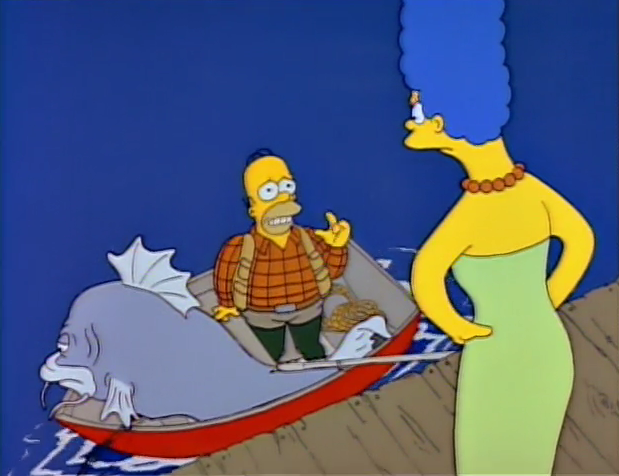
As a result, Homer is stuck having to go to a weekend marriage retreat hosted by Reverend Lovejoy. His attitude then turns when he finds out it’s being held lake-side so he can get in some fishing, and he’s enticed further upon hearing rumors of the famed giant elusive catfish General Sherman that dwells there. Meanwhile, Abe is left in charge of the kids, who quickly proceed to take complete advantage of him, letting them buy gallons and gallons of ice cream, drink coffee and smoke cigars. It’s a B-story I don’t much care for. Lisa does protest a bit and feel some remorse, but it doesn’t make much sense that she would go along with any of Bart’s schemes to this capacity. The ending bit with Abe tricking the kids into straightening up their act is a nice finale, but besides that, it’s mostly filler. Though we do get the first appearance of Snake, and our first “Haw haw!” out of Nelson.

The rest of the episode almost suffers from the fantastic first act; Marge and Homer at the retreat isn’t quite as interesting. By completely ridiculous happenstance, Homer winds up in a boat desperately trying to reel in the General, and when Marge catches him, he angrily tosses it back, showing his true devotion to his wife. It works, I guess, but his gallant gesture doesn’t seem to equal his general assholery at the party. This is another one of those episodes that gets buried amidst more stronger, classic shows, and while sometimes they may be hidden gems, this one’s just alright to me.

Tidbits and Quotes
– Odd that Ned of all people gets the ball rolling on Homer’s inebriation by serving him up drinks. A far cry from two years later when he’s still devastated by a raspberry schnapps he had ten years prior.
– Dr. Hibbert’s very dry manner of speaking is a source of great comedy: first in his commentary about how with all its chemicals, a gag ice cube is much more dangerous than a cube with an actual fly in it, then later upon leaving, he suggests that Marge turn a passed out Homer on his stomach, if she wanted him to live through the night.
– Homer’s recollection of the night before is spectacular, a wonderfully designed sequence with a great New Yorker cartoon-style featuring a dapper Homer as head of an Algonquin group type gathering. The rapid pan across the group morphing into their normal selves is spell-binding, it’s a really great piece of animation.
– One thing this episode has going for it is there’s a lot of great acting in it, from the subtle movements of drunk Homer to the not-so-happy couple during their fight at the retreat. There’s also a smaller bit when Homer is forced to explain his bawdy behavior to his son. Bart just sits there with a flat smile on his face. It’s like he’s humoring his dad, he’s well aware what being drunk means. When his father says he’s hoped he hasn’t lost any respect, Bart responds, “Dad, I have as much respect for you as I ever did or ever will.” Slick.
– I don’t know why, but I love the first couple at the retreat. “Queen of the harpies!” has stuck in my mind for years.
– I like how Homer talks aloud about his foolproof plan to catch and eat General Sherman before the morning, and he barely gets one foot out the door before Marge wakes up and catches him.
– We get a great line from the Reverend, who knows a lost cause when he sees one (“Marge, as a trained marriage counselor, this is the first instance where I’ve ever told one partner that they were 100% right. It’s all his fault. I’m willing to put that on a certificate you can frame.”)

32. Lisa’s Substitute

(originally aired April 25, 1991)
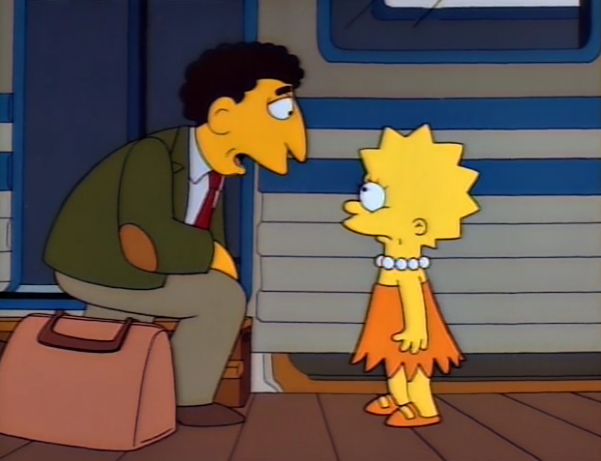
I guess it’s only appropriate we go from last episode that explored Marge’s lost potential amidst a boorish society to this one featuring Lisa in the same boat. Equally, if not more tragic a story than her mother’s, Lisa is an incredibly gifted and thoughtful young girl stuck in a school that undermines her and a family that is hard-pressed to acknowledge her. Plenty of episodes will give her some small amount of recognition or a kindred spirit, only for the cruel rug of life to be pulled out from under her in the end. Here is the first of many said spirits, perhaps the more famous, the soft-spoken intellectual Mr. Bergstrom. Miss Hoover’s absence brings him into Lisa’s life, and she is immediately smitten with this thoughtful, somewhat geeky substitute teacher.

Lisa’s infatuation is more than just a schoolgirl crush. Mr. Bergstrom represents the kind of father she wishes she had, a man who would enrich her, make her think and feel new things, and foster a love of learning. However, fate is a cruel mistress, and Lisa is stuck with a shaven ape who largely pays no mind to her daughter’s existence. It almost seems Lisa realizes this herself, which makes her tearful goodbye to Bergstrom all the more heartbreaking (as Mr. B succinctly puts it, “That’s the problem with being middle-class. Anybody who really cares will abandon you for those who need it more.”) And of course there’s the classic scene where Bergstrom gives Lisa all she needs whenever she feels alone in the world and needs reassurance of herself and the universe: a simple note, “You Are Lisa Simpson.” Just beautiful.

It’s unfortunate that due to the deep, poignant A-story, the goofy B-story of Bart running a mock platform for class president is all but buried from most people’s recollection of this episode. I guess there’s not all that much to examine about it, it’s just got a lot of fun stuff in it, and also lays groundwork for the very ending. Lisa explodes at Homer’s uncaring attitude, leaving him to have to pick up the pieces. He does the best he can with who he is, and in the end, his reconciliation scene works perfectly. Homer may not be the father Lisa truly deserves, but he still loves her and supports her. Plus I don’t think Mr. Bergstrom would hoot like a monkey and make Lisa laugh like Homer does. He’s the goofy dad, leaving Lisa to acknowledge she’s got to appreciate people for who they are, not who she wishes they could be. Following this, Homer calms Bart’s anger over losing the election by rightly speaking to his level, that being class president would mean having to do more work and he would hate it. Between these two and quelling a fussy sleeping Maggie with her pacifier, it’s probably Homer’s finest hour, and a sweet way to end the show.

Tidbits and Quotes
– We don’t see a lot of Miss Hoover on the show, but she’s still a very strong character: a passionless teacher waiting out the clock every day. She also is quite disturbed, as we see with her psychosomatic belief of having Lyme disease. We get a great line as Principal Skinner explains the unsettling details of the disease to the children, much to Miss Hoover’s abject horror (“The brain!? Oh, dear God!”)
– Now I can tell you, if a newly arrived substitute burst into a classroom firing fake guns in the air today, he would be arrested on the spot, no questions asked. Things were different twenty years ago…
– The challenge of naming the discrepancies on Bergstrom’s cowboy get-up is a cute and effective way of introducing his character, and Lisa’s instant connection with him. However, I always think about what Mr. B was thinking, that second graders would be able to figure out stuff about Texas’s annexation and when revolvers were invented. It’s a stretch enough that Lisa is an insanely smart wunderkind. But now I’m just nitpicking. Without it, we wouldn’t get the great line about Bergstrom pushing back against stereotypes about Jewish cowboys, who were actually, according to him, “big guys who were great shots and spent money freely.”
– Oh man… my favorite line of the show isn’t even from the A-story: during Martin’s first speech about creating a science-fiction library when he’s class president, featuring the ABCs of the genre: Asimov, Bester, and Clarke. When Wendell asks, “What about Ray Bradbury?” Martin replies, “I’m aware of his work” in the most dismissive, condescending manner possible, like it’s a pain for him to even acknowledge Bradbury’s name at all.
– I enjoy Mr. Bergstrom’s performance of “Home on the Range” with running commentary about the accuracy of the song. I guess at this point I should praise Dustin Hoffman (aka Sam Etic) for his great, great performance, giving Bergstrom that right mellow, powerful tone he needs, selling him as a truly engaging substitute teacher and someone Lisa could really admire and look up to.
– Lisa is very quick to begrudge her father and brother in front of Bergstrom, almost trying to distance herself from them for him. However, there’s a great moment when the two of them are witnessing one of Bart’s bombastic campaign stunts where Mr. B astutely points out that she’s going to miss Bart’s antics when she grows up and leaves this all behind. It almost sets the stage for the ending, about accepting and loving people for who they are. Reminds me of “Lisa’s Wedding” when she defends her oafish family to her future fiance, attesting she loves them regardless. Oh, and you gotta love Bart’s chant for more asbestos.
– We also get the first time that Homer has an internal argument with his brain, something that would happen much more as time goes on.
– I don’t feel like dissecting the ending much further; it’s one of those really great sequences that really speak for themselves. I will say it’s odd that Homer talks about having never lost anybody in his life, when his mother abandoned him as a child. Seems like something that would stick with a guy…

31. Brush With Greatness

(originally aired April 11, 1991)
Amidst its wacky nature and constant irreverence, this show has always had some negative undercurrents below its surface, one of the biggest being the quiet tragedy of Marge Simpson. From what we’ve seen in flashbacks to modern day, she’s sharp, she’s talented, she has a lot of potential, but she’s become perfectly comfortable in her role as housewife to an ape-like buffoon. In episodes where opportunity presents itself to do something more with her life, she remains ever hesitant (in her words, “I’ve dug myself into a happy little rut here and I’m not about to hoist myself out of it.”) This is the first episode dealing with Marge as more than just Homer’s ever-supportive wife, but on her feelings about the world and her own abilities.

We start off somewhat unrelated though, with a not-so-subtle plea from Krusty the Klown to visit the water park Mt. Splashmore. It works for Bart and Lisa, and the family end up going, but the visit has a disastrous end when Homer ends up lodged in a tube and ends up having to be hoisted out like a beached whale. This public embarrassment is just devastating enough to permeate Homer’s sense of shame, and he vows to lose weight. Digging in the attic for old exercise equipment, he comes across Marge’s old paintings of Ringo Starr, which puts our other plot in motion of rekindling Marge’s artistic tendencies. She enrolls in a painting class taught by Professor Lombardo (another wonderful voice by Jon Lovitz), an eccentric who must pepper any potentially negative comment with a compliment (hearing about Marge’s former art teacher’s scorns, he retorts, “The man was a fool! But still one must admire the force of his conviction.”)

After winning first prize at a local art show, Marge is then saddled with a near impossible task: a newly commissioned piece to present Mr. Burns in a positive light. Her self-remarked ability to see the inner beauty in everyone is tested to its limits by the insolent old curmudgeon, until it nearly breaks her spirits. But through insistence from her husband, and a much-belated fan mail response from Ringo Starr, she manages to pull through, presenting a bold painting of Mr. Burns in the wrinkly old buff. The final scene at the art show may be one of my favorites in the entire series, as it shows the show’s ability to utilize shock value for a higher purpose: Marge’s explanation of her piece, of how despite Burns’s evil mind, he is of as frail a body as the rest of us, is quite profound, and true to her character. Her version of retribution ends up being a smash hit; even Burns is impressed (with the great line, “I’m no art critic, but I know what I hate. And I don’t hate this”), even if she did mock his shriveled genitals. Marge may be forever a housewife, but her life does have its small victories.

Tidbits and Quotes
– The opening Krusty show is a great mockery of cross-promotion: Krusty films his show at Mt. Splashmore so kids will want to go, nailed even further with his singalong (“I want to go to Mt. Splashmore, Take me, take me, take me, take me now! Now! Now! Now! Now! Now! Mt. Splashmore, take me there right now!”)
– Homer is shown much more grotesquely obese than normal, which makes sense to set up the diet plot later, but it’s quite disturbing seeing him walk around topless, especially with his never-seen-again farmer’s tan.
– I love the homage to M.C. Escher with the never-ending line. I also love how brazen Homer is upon reaching the line: while Bart and Lisa came up with a cunning plan using the “crying child” angle, Homer merely exclaims, “The hell with this!” and pushes his way through.
– Homer getting stuck in the tube is pretty easy humor, but it’s funny all the way through, starting with the hilarious drawing of him sliding down along with Castellaneta’s great acting of Homer whooping it up. We get a look at the Splashmore control room, which apparently can detect if there’s a blockage in any of their tubes somehow. Believing the large block cannot possibly be human, they suggest to send a few kids down to shake it loose. The shot from the kids POV sliding down the tube, and eventually to a screaming Homer is spectacular. Lastly, we see the tube segment being airlifted, with a fantastic drawing of a weary Homer, accompanied by massive booing. A low point for Homer, but a high point for me as a viewer, laughing my ass off.
– The criticism of Marge by her thick-headed art teacher is so wonderfully scarring (“Someone might have used this canvas to create a masterpiece. Instead, you’ve soiled it forever.”) He then goes on to praise a painting of a sad clown. Philistine.
– The small montage of Homer exercising while Marge paints to Rocky-esque music is great; the drawing of a grinning Homer managing to lifetthe now-weightless bar is so great.
– I love the other two runner-ups in the art contest: dogs playing pool, and a sad unicorn overlooking polluting smokestacks thinking “Why?” The judge gives Marge the ribbon, with an affirmative “Yeah,” as if it were no contest.
– There’s a lot of great Burns lines here. My favorite is when he goes into one of his classic monologues (“Once again the wheel has turned, and Dame Fortune has hugged Montgomery Burns to her sweet, perfumed bosom.”)
– Despite Burns’s bastard-like behavior to follow, one can’t help to feel some sympathy for the way he implores Marge’s help (“This commission and all of its glory can be yours, but first you must look me in the eye and answer one simple question: can you make me beautiful?”)
– This show continues to become more multi-layered in time; showing Ringo meticulously answer every piece of fan mail he’s got is even more funny thanks to his famous announcement a few years back that he will no longer be signing autographs. Peace and love, peace and love!

30. Old Money

(originally aired March 28, 1991)
Many cultures honor and treasure their elderly, looking upon them as a source of wisdom. In America, we’re not quite as reverent. This series is nothing but a brilliant satire on all of society, and their depiction of old people is slightly exaggerated, but brutally honest. The elderly are shown as a burden, locked away in retirement homes, dank, desolate domiciles where old folks can putter away by their lonesome, desperate for a visit from a relative that will never come. We saw this early on in season 1 in “Bart the General,” where every inmate at the Retirement Castle reared their heads when Bart asked for “Grampa.” That’s also the first time we saw Abe Simpson, a grizzled old coot who may be a tad senile, but has enough pep and gumption left to complain about how the world’s going to hell-in-a-hand basket. This is an episode about the harsh and unloving treatment of old people, most importantly the Simpson family’s cantankerous old Grampa.

We begin with Abe meeting Beatrice, a beguiling fellow resident at the retirement home, and the two fall in love, fast. Some time later, Abe is reared up for Bea’s birthday, but is whisked away by the Simpson family for their monthly obligatory trip with the old coot, this time to Discount Lion Safari. The Simpsons getting their car attacked by lions is pretty goofy, but Abe’s plight always remains the focus, from Homer patronizingly playing off Bea to be part of Abe’s imagination to every shot in the car showing a stern-faced Abe in the backseat. Upon his return, Abe learns Bea has died over the past day, and left him her fortune of $106,000. We then get a look at society’s only viable use for old people: bilking them of their inheritance. Finding spending for himself brought him no happiness, Abe opens the floor to all the people of Springfield to pitch them how they’d put the money to good use, which gives us great scenes with a variety of characters from Mr. Burns, Marvin Monroe, Otto, and our first look at Professor Frink.

Also nestled in this show is an examination of Homer’s relationship with his father. Abe is infuriated with Homer over having missed out on Bea’s final moments, and Homer, understanding the blunder of his actions, feels a heavy remorse. By the insistence of Bea’s ghost, Abe forgives his son, and Homer later returns the favor in stopping Abe from gambling away his fortune. Abe had been trying to help too many people with too little cash, but in the end, decides a small step is as good as any, and repairs the down-and-out retirement home to look like new. It’s a bit of a sappy ending, especially with Abe’s final line, “Dignity’s on me, friends,” but it works all the same. The back half of the episode is a wonderful depiction of a man who desperately wants to do some good with a kindness that has been given to him, and eventually finds it in his own backyard.

Tidbits and Quotes
– The show brilliantly lays a lot of focus on how shitty the retirement home is. There’s lots of longer-than-usual establishing shots showing crusty walls and dilapidated tiles without feeling like it’s lingering on it. We also get it through jokes, like when you think Abe is crying over the photo of Bea when it’s just the leaky ceiling.
– I don’t know why I love Discount Lion Safari so much. The billboard for it is so spectacular. Maybe it’s the way the family yells it in unison… twice.
– I love when Abe remarks that Bea has “the bluest eyes he’s ever seen in [his] life” when, like everyone else’s, they’re just black dots.
– The scene with Abe and Bea when they eat their pills… mercy. It serves a story point of their form of courting, but my goodness is it disturbing.
– Another great Simpsons product: Lucky Lindy’s All Purpose Pomade (“You’ll never fly solo again!”)
– I’d like to have seen more of Grandma’s World; it’s so great that a wool shoal is in active ware. Also, the clerk appears to be the same as the grocery cashier in “Homer vs. Lisa and the 8th Commandment.” Second job perhaps?
– We get the second appearance of Lionel Hutz, a wonderful return as the executor of Bea’s estate. Phil Hartman also voices “Plato,” the casino greeter (“My philosophy is: enjoy!”)
– I love the montage of Abe attempting to enjoy himself, with halfhearted “Yeah”s along the way, ending with the great Diz-Nee-Land (not affiliated with Disneyland, Disney World, or anything else from the Walt Disney Company).
– It’s pretty heart-wrenching seeing Homer so broken up about his father. Marge suggests he seek help and hands him the phone connected to Marvin Monroe’s anxiety line. There’s a sweet bit where Marge pats her husband’s head reassuringly before leaving the room, it’s such a nice, subtle bit of animation that is sorely absent from recent years.
– This episode is pretty noteworthy in the shot of the line for Abe is filled with the collection of minor characters we’ve seen over thirty episodes. What would once be faceless nobodies are now established characters, as the series would grow to have hundreds and hundreds of familiar faces as crowd characters.
– There’s a great bit when Homer arrives at the casino and sees Abe about to gamble away his winnings. He screams with a shot in his open mouth, with a series of shots following pulling out further and further. It really intensifies the moment, and builds up to the fake-out that Abe has actually doubled his earnings.

29. Bart’s Dog Gets An F

(originally aired March 7, 1991)
NOTE: During the past week, I was visiting my hometown in New Jersey. However, that did not hinder my Simpsons obligations. I managed to burn through six episodes with two very good friends of mine, and together we recorded brief, five-minute commentaries for them. They’re quite rambling, misguided, and mostly disposable, but hey, they’re only five minutes, and if you’re reading this, chances are your time isn’t that valuable to begin with.


These audio reviews will also be an excuse for me to write less. A bit of a cop out, but hey, I got four hundred episodes more, so cut me a break.

This final audio “commentary” is the scarcest, and for good reason. Season 2 has been full of a lot of episodes full of great and complex characters and interesting meaty plots, but this is a relatively more low-key episode featuring the exploits of the Simpson family dog. We establish Santa’s Little Helper not as a goofy cartoonish dog, but an actual true-to-life untrained mongrel, who doesn’t obey any commands, digs up the yard, harasses the neighbors, and will chew up anything it sets its fancy on. This is pretty much the overarching content for the first two acts, as the Simpsons try to continue with their lives around their nuisance of a pet.

Homer has his eyes on Ned’s ‘Assassins’ sneakers, obnoxious and expensive footwear with mini vanity nameplates on each foot. I do enjoy Homer’s enthusiasm over a product that encourages exercise, like people who were anxious to buy Air Jordans so they could sit around the house wearing them. Meanwhile, Lisa comes down with the mumps, giving Marge time to share with her the Bouvier family quilt, which has lasted six generations through the Great Depression to Marge’s link in the chain of “Keep On Truckin’.” When both of these treasured items (and Homer’s giant cookie) are destroyed by Santa’s Little Helper, there is little recourse left other than to get rid of the dog. Bart is adamant against this, of course, promising he’ll get his dog trained.

Bart enrolls Santa’s Little Helper into obedience school, taught by a no-nonsense Margaret Thatcher type voiced by Tracey Ullman, comedienne responsible for the Simpsons gracing the airwaves in the first place. She gives a fine performance, but coming off of Herb Powell from the last episode, she’s not the most memorable one-off character. This show has its share of funny lines, and there’s nothing to fault it for regarding its story or characterization, but there’s not much here that is really too spectacular. In this season full of truly stellar shows, “Bart’s Dog” will have to settle with “pretty darn neato.”

Tidbits and Quotes
– I do love the bit where a jovial but annoyed Dr. Hibbert inquires how Marge got his home number, listens, then chuckles, commenting, “How ingenious.” This is also the first time we see the Hibbert family and household, all clearly an homage to The Cosby Show, an affectionate parody to the show’s then chief ratings rival.
– Of course there’s the great scene where an increasingly angry Homer tries to chew out his neighbor for accusing the dog is in her pool, believing he’s locked him up outside. His arrogance and fury over a situation we know he’s wrong about just builds up the inevitable laugh when he gets to the window and realizes he’s just made an ass of himself.
– We get a brief line from Troy McClure on the TV, a rare (maybe only) occasion of him being voiced by Dan Castellaneta (“As an actor, my eyeballs need to look their whitest!”)
– I do enjoy whenever we see the long-running soap opera on the show, whose name I forget. I’m also surprised they got away with showing the woman unzip her dress, revealing her bare back. Quite sultry. I also like “Father McGrath! I thought you were dead!” followed by a chipper “I was!”
– I like Homer’s accusatory speech at the free samples girl about roping people into making a purchase, all while spitting out cookie crumbs all over himself. Also his fool-proof plan of sticking the gigantic cookie on top of the cookie jar and putting a note on it. Santa’s Little Helper devours it ten seconds later.
– There’s a few more small things I do think are good, like the farm owner examining SLH’s pelt and genitals, and Lisa’s start of a new quilt depicting the destruction of the old one… but I don’t have much else to write about here, to be honest. Let’s move on.