5. Bart the General

(originally aired February 4, 1990)
This episode is a writer-director dream team: David Silverman in his third outing, and the prolific and mysterious John Swartzwelder in his very first episode, the man who’s written more Simpsons episodes than any other writer, many of them topping fans (myself included) lists of greatest episodes ever. And this episode’s a great one, full of really down-to-earth material, relatable emotions and experiences, combined with bizarre dream sequences and an over-the-top finale. It’s probably my favorite one so far, as it’s such a real story, but still manages to integrate so many funny and weird elements into it, but that’s really the genius of Mr. Swartzwelder, as we’ll see in many episodes to come.

We begin this episode as Bart, in his efforts to defend his sister’s honor on the school yard, inadvertently ruffles the feathers of big bully Nelson Muntz. While he plays a rotating role between ally and menace nowadays, Nelson is a real threat here at the start, with a great gruff performance by Nancy Cartwright. Stuck with a scheduled showdown after school, Bart passes the time by panicking through two fantastic dream sequences. The first is visually ridiculous, of Bart facing down a gigantic Nelson, who is completely unaffected by any knifes or gunfire Bart fires at him. The sequence is so well thought out, dream-Bart getting increasingly more manic to mirror his fear while Nelson slowly lumbers (and laughs) along, not even fazed by the attacks. The second scene is verbally ridiculous, Bart imagining his funeral, and those paying respect. Each one is hilarious in their own right; Skinner concluding that “homework really was a waste of your time,” Otto marveling at the fantastic job in reconstructing Bart’s face, and an amazing display, both in the animation and Dan Castellaneta’s performance, in Homer’s way waaay over-compensatory mourning of his son, after he’d previously expressed his delight of getting off work. Nelson is last, who simply socks Bart’s body in the gut. Not many shows can make punching a corpse funny like this show can.

Bart seeks advice for his bully problem: Marge urges Bart go to the principal on the matter, but Homer intervenes, stressing he would be breaking the code of the schoolyard (“Don’t tattle, always make fun of those different from you.  Never say anything, unless you’re sure everyone feels exactly the same way you do.”) Such a wonderful commentary on conformist parenting. After this advice gets him nowhere, Bart goes to his grandfather for help. In our introductory scene for Abe Simpson, we see him writing a letter to an anonymous advertising agency expressing his disgust at the depiction of old people in the media. This one scene completely encapsulates Abe’s character: nostalgic, forever crotchety, and full of piss and vinegar. He points Bart in the direction of a friend of his: the one-armed nutjob owner of a military antique shop, Herman. He helps them devise the perfect attack plan to take down Nelson.

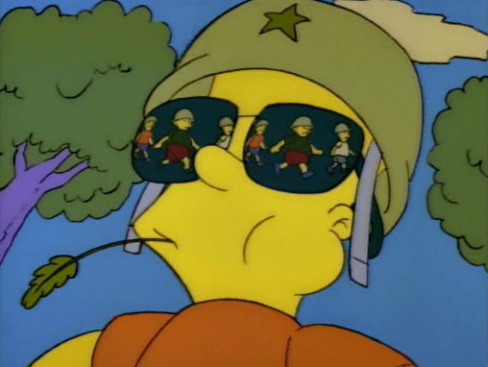
A seemingly simple story with Bart dealing with a school bully turns into one of the series’s first forays into pop culture parody. The third act pays tribute to a number of war films, like Patton and Full Metal Jacket. There are even more specific allusions to other famous wars, and even the friggin’ Nuremberg trials when Nelson’s cronies claim they were “just following orders.” The show ends with a treaty being written up, putting Bart and Nelson at a truce, with such great clauses as “Nelson recognizes Bart’s right to exist” and “Although Nelson shall have no official power, he shall remain a figurehead of menace in the neighborhood.” All this and the final end tag, a PBS-mocking segment with Bart attesting that there are no good wars, with the exceptions of the American Revolution, World War II, and the Star Wars trilogy, and that you can learn more at your local library. I appreciate this season for what it is, but this is the first episode I can truly gush about.

Tidbits and Quotes
– We get to know Lisa’s character a bit more here at the beginning. She’s a smart girl, but knows how to have fun, particularly at her brother’s expense. Their back-and-forth on the bus is a fantastic scene, further illustrating their personalities and relationship.
– Nelson’s two little crony characters are so odd to me. They are crucial to the story here, but I really don’t think they’ve ever been seen since, as they were pretty much replaced by the other bully characters. Poor guys. They didn’t even have names.
– “You made me bleed my own blood!” Such a great line, and great delivery too.
– There’s some great drawings of Bart’s mangled contorting face when he’s getting punched by Nelson.
– Abe’s letter is so great, it deserves to be quoted: “Dear Advertisers, I am disgusted with the way old people are depicted on television. We are not all vibrant, fun-loving sex maniacs. Many of us are bitter, resentful individuals who remember the good old days when entertainment was bland and inoffensive. The following is a list of words I never want to hear on television again. Number one: Bra. Number two: Horny. Number three: Family Jewels.”
– An amazing subtle animated bit: Bart arriving at the treehouse beaten, coughs up his hat (for the second time in the show), then just hangs it up on the wall and begins talking to the others. It just flows and isn’t addressed at all, it’s just there, and I love it for that reason.
– Another great Abe line: “I thought I was too old. I thought my time had passed. I thought I’d never hear the screams of pain, or see the look of terror in a man’s eyes. Thank heaven for children!”
4. There’s No Disgrace Like Home

(originally aired January 28, 1990)
As I’ve already mentioned, season 1 feels like a big experiment on figuring out what this show would end up being, and as such, some things feel sort of off watching them after so many years. The personalities of the Simpson family are so universally known, even by those who don’t even watch the show, that it’s pretty jarring seeing them act any different. This episode features many bizarre out-of-character moments, but I can’t say it doesn’t fit in with what we’ve seen already. At the start, this show was a bit more subtle and, dare I say, serious in its portrayal of middle class society and family life, and as such, it’s not as laugh-out-loud hysterical as the show would become. Here, we have Homer frustrated with his imperfect family and his efforts to better themselves, a conceit that sounds like the complete opposite of the Homer we know today. But there are plenty true-to-character moments sprinkled about, and given his desires to have a perfect Kodak Christmas in the first episode, it’s not a far leap for him to want to mold the stereotypical perfect family either.

We start with Homer demanding his family be on their best behavior at the company picnic, hoping he can score some brownie points from his boss, or at the very least not piss him off. At the event, Bart and Lisa are unrestrained brats, Marge ends up drunk off her ass, and Homer is in complete envy of a disgustingly polite and cordial family, wishing it was his own. Now, all of this already sounds like it’s from a completely different show, but as I’ve said, the premise fits within the overarching conceit of the season, this slightly off family and their interactions and reactions to society and social norms. Marge and the kids eat like slobs and are comfortable with this, assuming all families act like them, but Homer remains stringent that there is still hope for the Simpsons.

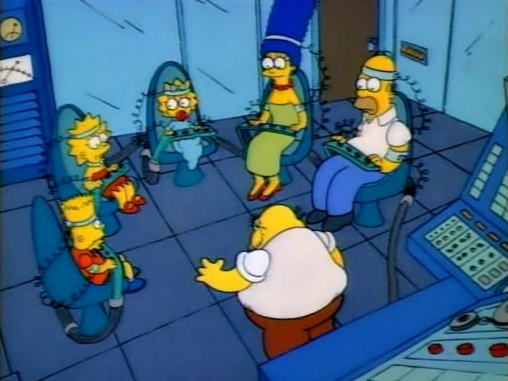
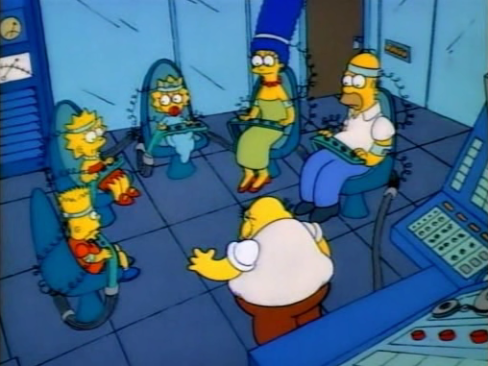
Like many of his problems, Homer finds the answer on TV at Moe’s: a commercial for questionable therapist Dr. Marvin Monroe. In one last grossly alien moment, Homer of all people pawns the family television to gather up the money to pay for therapy. During the session, the good doctor surmises that there is a great seething aggression within the family towards each other and they need to let it all out. They start out with whacking each other with foam mallets, which ends when Bart finds them to be more effective without the padding, right into Dr. Monroe’s shin. The doctor then pushes with more severe therapy: electroshock treatment, in a chaotic finale where each Simpson repeatedly shocks and gets shocked by one another, so much so that they cause power outages across Springfield. Even through this, the family remains thick as thieves, and when Homer catches Monroe on his money-back guarantee, getting back their $500, they are ecstatic. The Simpson family may get at each other’s throats, but at the end of the day, they’re still a family, regardless of its questionable foundations.

For all the out of whack things in this episode, there are also plenty of bits that still ring true today: Mr. Burns’ sprawling estate, the incompetence of the Springfield police force, and Homer’s undying belief in the words of TV. The episode ends with the family going off to buy a brand new television with their newly attained money. As they rush to the couch every week in the opening, TV is their great unifier as a family, it makes them who they are. There’s also a great subtle gag toward the end in Dr. Monroe’s waiting room, we see a bunch of waiting clients, including the suspiciously happy family from the picnic, all donning scowls. Perhaps it’s not the Simpsons aren’t the isolated screw-ups they may think they are.

Tidbits and Quotes
– “My boss is going to be at this picnic so I want you to show your father some love and/or respect!”
– As out-of-character as it may be, it feels very Homer to chase after his out-of-control kids like a wild man screaming, “Be normal! BE NORMAL!!”
– A very peculiar bit with the mother with the Southern twang talking to the other women about which child she loves more (“Usually I use their grades as a tiebreaker. They both got straight ‘A’s this term, so what’s a mother to do?”) There’s also a great follow-up by a tipsy Marge (“I sense a true greatness in my family, it’s a greatness that others can’t see. But it’s there, and if it’s not true greatness we have, we’re at least average.”)
– A very true early Burns quote yelling at the band, “Musicians, cease that infernal tootling!” Also the first mention of releasing the hounds.
– We get the first of many times of Homer breaking down into hysterics while saying grace (“Our kids are uncontrollable hellions! Pardon my French… but they act like savages! Did you see them at the picnic? Oh, of course you did… You’re everywhere, You’re omnivorous.”)
– Another testament to this season’s subtle humor is the stuff with the cops in the bar. Moe offers the two pretzels, to which Eddie declines (“No thanks, we’re on duty. Couple of beers would be nice though.”) Then later, when Homer tries to justify their dog’s attraction to them, claiming he has “wieners in his pocket,” Eddie responds, “Figures.” Like that’s a normal thing someone would have. Brilliant.
– Within the insane moment where Homer pawns the TV comes a great line when Marge suggests she pawn her wedding ring instead (“I appreciate that, honey, but we need $150 here!”)
– More bizarre background stuff: the walls of Dr. Monroe’s waiting room look like they’re made of waffle cone. Also the baffling cured alternate Simpsons, complete with the Homer substitute inviting his family out for frosty chocolate milkshakes.

3. Homer’s Odyssey

(originally aired January 21, 1990)
I don’t know how many characters can stoop to such shocking lows and still manage to bounce back, remaining likeable the whole way through, but if there is but one, it’s Homer Simpson. This episode has a lot of unusually dour content, stuff you don’t really expect or see coming, but manages to maintain the brisk feeling of the other episodes. We start with some lighter kid stuff with Mrs. Krabappel’s class on a field trip to the power plant. They are given a tour by an unusually tan Mr. Smithers, which begins with an old film on nuclear power, hosted by impish mascot Smilin’ Joe Fission. It’s a brilliant knock on the old 50s film strips, which I’m a huge fan of. The trip then bears witness to a sizable blunder: Homer knocks his transport cart into a radioactive pipe, and is promptly fired for his negligence.

Homer takes his mistake to heart, delving into a bit of depression. He maintains some will in his job hunt, but is discouraged further when he is denied at every turn. We get early hints of his later well-known alcoholism, as he finds he cannot afford another drink at Moe’s, and sinks so low that he smashes Bart’s piggy bank to scrounge up some cash. Realizing how deep of a hole he’s in, he resolves to commit suicide. This whole middle portion is so heavy, but it’s peppered with light bits of humor that feel really in-character of Homer. He writes his suicide note on “Dumb Things I Gotta Do Today” stationary, and unwittingly writes, “I can only leave you with the words my father gave me: stand tall, have courage, and never give up.” I don’t know how much I buy Homer’s death wish; it seems a bit uncharacteristic, but I have to give it up to the writers for having brass balls. An animated family sitcom where the father attempts suicide in episode three? That’s unprecedented.

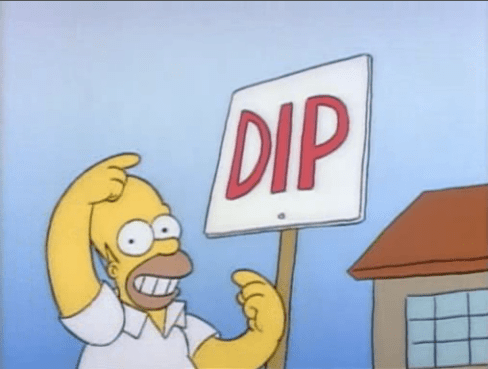
Homer, of course, lives, just in time to save his family from being hit by a truck. Acknowledging there should have been a stop sign at the intersection, he becomes a neighborhood watchdog, rallying an army of supporters in his crusade for safety. I never quite see how exactly this mollifies Homer’s predicament: his concern was of not being a provider for his family, and this new role of town hero can’t be getting him any money. But it does give him vigor and a newly gained sense of purpose, leading up to him crusading against his former employers at the nuclear plant. The rally is noticed by the head honcho, C. Montgomery Burns, who negotiates with Homer, offering him a position as safety inspector, to which he semi-reluctantly accepts.

The animation feels a bit rougher in this episode, but I still find its crudeness adds to some of the charm of these early shows. There are a lot of crowd scenes in the third act; the final one at the plant features a lot of tweaked out character designs. The Simpson family barely look human at this point, but next to some of these peculiar creatures in the background, they feel a lot more real. There’s also the weirdly bright backgrounds, particularly in the Simpson home, lots of washed out oranges and pinks that feel kind of crummy. Also present are the bizarre framed portraits on the wall, one featuring a screaming Homer, and another set of two framed pictures: one of Marge, and one above it of her beehive hair. These are ever present through the season, relics of these early classic years.

Despite the questionable actions he makes in this show, and many more to come, there’s just something about Homer that’s instantly forgivable. Through all his dimwitted decisions and pathetic pratfalls, he’s just a struggling every man trying to do what’s best for himself and his family. When grappling with the possibility of betraying his followers to work for the man, Homer’s mind goes to, among other things, thinking about how he can’t leave Marge burdened to support the family. As he put it, perhaps we all need to dig deep down to find the little Homer Simpson in us all.

Tidbits and Quotes
– A lot of characters have their first appearances in this show: Otto Mann, Sherri & Terri, Blinky the three-eyed fish, and Mr. Burns and Smithers (they appeared briefly in the Christmas show, but are truly introduced here.) Speaking of Smithers, most fans are aware of the coloring mistake of making him tan, but I’m more confused as how the almost Albino Sherri & Terri have a very dark-skinned father who works at the plant.
– “I defy anyone to tell the difference between these donuts and those baked today.” A great Homer line, speaking both his blind gluttony, and the plant’s cost cutting measures.
– Another first: Bart’s prank calls. Lisa laughing along with his brother’s hi-jinks is always heartening to see.
– A one-two punch of TV parodies: first, Homer is apparently watching LoafTime, the cable network for the unemployed (“We’ll be right back with more tips of how to win the lottery.”) Then, the fantastic Duff commercial: “Unemployed? Out of work? Sober? You sat around the house all day, but now it’s Duff time! Duff: the beer that makes the days fly by!” It’s such a brilliant back-handed slogan; Homer is easily taken by it, but I can just imagine a drunker, more depressed Homer still lying on the couch weeks later.
– ANOTHER first: Bart’s tag artist alter ego ‘El Barto.’ I can’t remember a lot of future episodes that really dealt with this; I think it was more picked up in the comic books and other Simpsons media.
– Homer’s introduction at the plant rally as a man whose very name is synonymous with safety is very odd to hear, considering how insanely reckless his character would later become. I also like his first words to the crowd (“Thank you. Unlike most of you, I am not a nut.”) The rest of Homer’s speech is great too (“Your lives are in the hands of men no smarter than you or I, many of them incompetent boobs. I know this because I worked alongside them, gone bowling with them, watched them pass me over for promotions time and again. And I say… This stinks!”)

2. Bart the Genius

(originally aired January 14, 1990)
In our first non-holiday episode, we get a better look at Bart, the miscreant of the Simpson family. From infuriating his father during a game of Scrabble to spray painting an unflattering caricature of his principal on school grounds, he’s perfectly portrayed as a fun-loving wise ass, not motivated by any kind of malice, but just a kid-like desire for crude mayhem. When know-it-all classmate Martin Prince rats him out for his graffiti, Bart exacts revenge by switching their aptitude tests. He is soon after declared a genius, and is sent off to a school better suited for his supposed intellectual gifts.

The Enriched Gifted Center for Learned Children is just as pretentious and snobby as the name suggests. Surrounded by students who speak in complex anagrams and engage in existential debates and a teacher who encourages her class to “discover their desks,” Bart finds himself a stranger in a strange land. He was penalized for his outbursts and breaking the rules at Springfield Elementary, but there he at least had a troupe of friends to cheer him on for it. Here, he’s stuck with a bunch of asshole smart kids who use intellectual queries to swindle him out of his lunch.

In the midst of all this is the reactions of the family. Feeling she hasn’t be properly nurturing her son’s gifts, Marge has the family attend more high-class events like the opera and film festivals. United by a mutual disdain for these things, Bart forms a greater bond with his father, who is extremely proud of his son’s alleged accomplishments. Eventually, in his attempt to return back to his normal school, Bart is exposed as a fraud and comes clean to Homer about it. Whereas a normal sitcom father would warmly forgive his son, Homer goes into a rage and chases his naked son throughout the house and furiously pounds on his bedroom door with reckless abandon.

These last two episodes were directed by David Silverman, who has worked with the Simpsons from the early Tracy Ullman shorts all the way up to directing the movie, and he knows how to animate these characters better than anyone. Utilizing a style that’s not incredibly visually arresting, he manages to not only create a great deal of interest in the animation itself, but make it a part of the story. There’s one scene sticks out with me, and I’m still dissecting why: Bart is in Skinner’s office, in trouble, of course, when Marge and Homer arrive. The frame cuts right at their necks, so right when they come in, you think of them not as their whole characters, but as Bart’s parents. First in is Marge, who enters with a very slow dainty walk, turning the corner slightly to find her seat with a cordial greeting to Principal Skinner. Then comes Homer, who has a quick lumber with his large frame, fist clenched at the ready to accuse Bart. Small bits like that really stick with me, and it clearly, verbally and visually, sets up the dynamic of the scene and the views of these two characters to it. The rest of that sequence is great too; when the psychiatrist shows up and starts rattling on about Bart’s supposed genius, there’s a bunch of repeated cuts to the three Simpsons, who blankly follow along, slowly processing the information.

Bart has been painted many different shades of the stereotypical “bad boy” over the years, but in this first episode showcasing his personality, he’s shown as just a fun-loving kid goofing around, something even most of the rest of his family appreciates. The family at the opera is a classic scene, where Homer and Lisa are very much amused by Bart’s joke lyrics and fart noises. As explored in many a future episode, the Simpsons, as much as they may be mystified or even tempted by high class pursuits, have their feet firmly planted in the middle of the road, and that’s just the way they like it.

Tidbits and Quotes
The opening scene is such a perfect way to start the episode. You get the impression that the family bought Scrabble as a way to raise their intelligence, but are stuck playing words no longer than three letters. Lisa displays her budding intelligence with “id,” Bart bestows upon us the immortal definition of a “kwijibo,” and Maggie gets her first hinting at being a baby savant by spelling “EMC-SQU” with her blocks.
– “I don’t want you to worry, class. This test will have no effect on your grades. It will merely determine your future social status and financial success… if any.” That last bit from Mrs. Krabappel was targeted at Bart, obviously.
– The dream sequence… what an amazing piece of animation. Firstly, it’s a fantastic mockery of those overly complicated “two trains leaving a station, x passengers get off and on” problems we had to slog through in school. As Bart thinks through the problem, things get more and more frantic, with numbers swirling around his head and appearing in the background as armrests, train handles, and even as the passengers. The energy just keeps building as Bart becomes more and more frustrated with the problem, with more and more quick, frantic cuts with wild animated takes until the two trains collide and Bart falls backward, literally, back to reality. It really is spectacular.
– A great exchange featuring between Skinner and Homer, showcasing the latter’s slow thinking (“I caught your son defacing school property this morning. We estimate the damage is $75, and frankly, we think it’s terribly unfair that other taxpayers should foot the bill.” “Yeah, it’s a crummy system, but what are you going to do?” [Marge whispers to him] “Oh no, he can’t mean that. My wife thinks you want me to pay for it.” “That was the idea.”)
– A great quick joke when Homer shows Bart how to put on a tie: just clip it on.
Bart’s Krusty lunchbox is greatly contrasted by one of the genius kid’s Anatoly Karpov lunchbox, who apparently is a famous champion chess player.
Homer learns he has to go to the opera with Bart (“But I’m not a genius! Why should I suffer?”)
– The ending bit with Homer banging and scratching against Bart’s door is unbelievable. The raw fury of the animation and Dan Castellaneta’s voice acting completely sells Homer’s blind rage.

1. Simpsons Roasting on an Open Fire

(originally aired December 17, 1989)

So we start with season 1, which is basically like a 13-episode long experiment in figuring out what exactly this new breed of show is, from the rough animation, the developing characterizations, and the humor and tone. These episodes kind of put me off in the past, but I’ve grown fonder of them over time. I really like the wonkier animation style, especially compared to how stiff the show is now. I can remember seeing some of these in syndication (“The Telltale Head” showed up a lot for some reason), but the main place I saw a lot of these was on the old Simpsons video tapes. Long before DVD, we were stuck with these primitive devices known as VHS tapes. I remember there were two episodes a tape (along with a Tracy Ullman-era short), and I think they got to the beginning of season 3 before they stopped making them. This episode was on its own tape, dubbed “The Simpsons Christmas Special.”

So this is our first look at the show, as we follow our hero, Homer Simpson, in his efforts to create an idyllic Christmas for his family. It’s a Homer that’s sort of fallen by the wayside in later years: the well-meaning father. While he can be bumbling, thick-headed or just not too bright, he still does what he can for his family. However, he finds that life can be a bitch, as many obstacles stand in his way: he is denied his annual Christmas bonus, and is shocked to find that the money the family had saved for the holiday has been blown to remove a tattoo Bart impulsively bought. Making matters worse, Homer constantly finds himself in the shadow of his do-good neighbors, the Flanderses, whose over-extravagant Christmas lawn display is a stark contrast to his one working light bulb in a string of a thousand. None of these things are done upon Homer with malice; it’s life dealing him a bad hand, but he pushes forward with all the gumption he can muster.

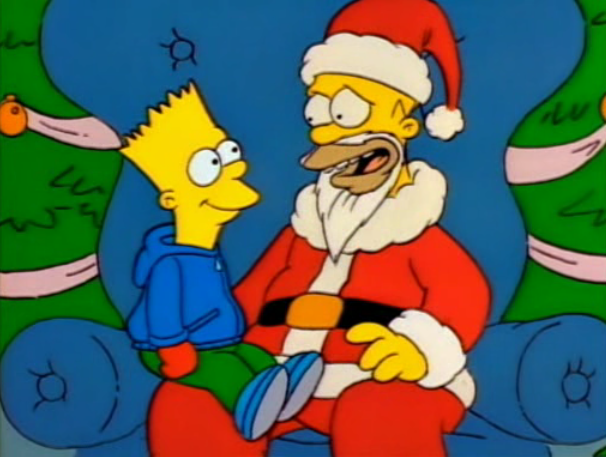
Homer takes a position as a mall Santa, perhaps hoping working for the season will save his own, but with extraneous expenses, he is only paid a measly thirteen dollars. On top of that, his plight is exposed to Bart after he yanks at his Santa beard as a prank, not knowing it was actually his father. To raise Homer’s spirits, Bart invokes the hackneyed traditions of television sadsacks, that miracles always happen on Christmas to those in need. It’s a brilliant speech that in the very first episode forebears a hallmark in Simpsons humor, the recognition of classic TV norms and flipping them on their ass. In his last desperate act, Homer tags along with his drunk pal Barney to the dog track to see if he can win big. In keeping with his faith in cliche underdog stories, Homer bets it all on a last-minute addition, “Santa’s Little Helper,” but the dog is easily defeated.

Slowly but surely losing all hope, Homer scrounges the parking lot with his son for any discarded winning tickets. But then, his own brand of miracle happens as the dog he lost everything on jumps into his arms. He doesn’t recognize this as the answer to his problems; he takes sympathy on the dog because in a way, its undying determination in the face of inevitable defeat reminds him of himself. When he returns home and the family is enthralled by the perfect Christmas gift, he’s dumbfounded. Every mistake and pratfall he endured was all crucial to lead him to this unintended success. But that’s Homer Simpson, the accidental hero. The show delves into a fair level of schmaltz, but almost out of obligation in that it is a Christmas special, but with an intentional self-awareness the show would later become famous for. With its true slice-of-life scenarios, believable and likable characters and slightly off-brand humor, this episode was a sure sign for things to come.

Tidbits and Quotes:
– I love Homer’s line “Pardon my galoshes” while scooting past people to an empty seat at the Christmas pageant. It’s such a throwaway line, but it feels so classic Homer, especially in the early Walter Matthau-esque voice.
– Lisa’s list reading “A PONY” in giant letters six times, followed by “Thank you, Lisa” in small print is pretty adorable.
– The kids applauding Homer’s fall from the roof setting up the lights is pretty adorable too. As, of course, is Maggie’s star suit.
– What mall has a tattoo parlor? The scene with Bart and the tattoo artist is brilliant. (“One ‘Mother’ please.” “Wait a minute, how old are you?” “Twenty-one, sir.” “Get in the chair.”) The shot angled from below of the tattoo artist makes it all the better, seeing things from Bart’s POV. He ain’t no 21-year-old.
– An early look at impulsively emotional Homer, and my favorite line of the show: “We’re ruined! Christmas is cancelled! No presents for anyone!”
– The earliest of many great Simpsons store names: Circus of Values. It’s an absolutely perfect name for a Dollar Tree-like store.
– There’s a lot of great moments toward the end of the second act when Homer is really at his wit’s end. Tired from coming home from Santa training, he trudges upstairs only to have Marge tell him her sisters are here. Hunched over and clutching the banister, he shudders, knowing he must endure yet another unpleasantness. Responding to Patty and Selma’s murmuring of there being no Christmas tree, Homer goes out alone to find one. It’s a fantastic sequence, as Homer passes lot after lot of trees out of his price range, getting increasingly madder as “Walking in a Winter Wonderland” plays.
– A great line from Bart after Santa’s Little Helper loses: “It doesn’t seem possible, but I guess TV has betrayed me.”