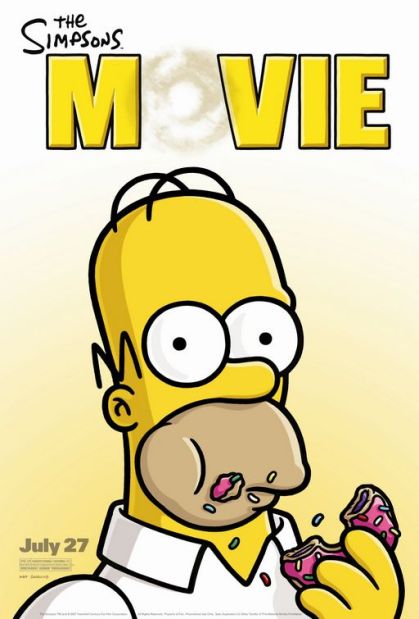
 (released in US theaters July 27, 2007)
This is it. The Simpsons Movie. Any fan of the show was awaiting this day. As a kid, I remember wondering when it was coming out, and what it would be about. I hoped that my mom would let me go see it, as I knew it would hold a PG-13 rating. But it wouldn’t be until the end of my high school days before it would finally see a release. In the spring of 2006, seemingly legitimate rumors began cropping up of the movie possibly being a reality. One voice actor mentioned he read the script. Another said he had recorded lines for it. Bunk, I said. I’ll believe it when I see it. Then it came: an official release date of July of the following summer. I was absolutely psyched. There were sneak peek clips from that year’s ComicCon. Teasers, posters and trailers started coming out through the year into the next. Regardless of my waning interest in the series at that time, I was fucking excited.
And what perfect timing; I graduated high school in June 2007, and was about to leave New Jersey to attend the University of Florida. The Simpsons had been such a big part of my life up to that point, and one of the last things I did with my friends in Jersey was go see The Simpsons Movie at midnight. It was almost like closing the book on one era of my fandom in a way. It was a packed theater, filled with a lot of people who were clearly super fans of the show like we were. I remember at 11:55 or so, I turned to my best friend and said, “You realize we’re about to see a Simpsons movie, right?” I just got this surreal feeling, this movie, this event I had been waiting years to see, and I was a mere five minutes away from finally experiencing it. And then it happened… The Simpsons Movie. Ninety minutes later, I walked out feeling pretty satisfied. I saw it one more time with a friend who couldn’t make it to the midnight show, and one or two times more on DVD. But I hadn’t seen it in full in at least a good four years.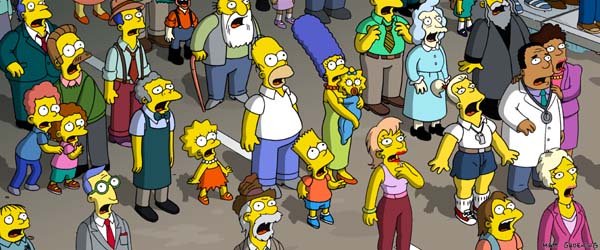 So how do I even start this review? I guess by saying that I think that I lean more toward liking the film more than I don’t, and I’ll boil down the specifics as I go. To introduce it in a succinct way, it’s basically a better-than-average extended episode, but since the average episode nowadays is total garbage, that’s not exactly the highest praise. It’s just I remember some critics at the time saying the movie recaptures the magic of the show’s most formative years, and was a return to form to the classic era. So, is this movie on par with seasons 1-8? Fuuuuuck no. Make no mistake, this is a “modern” Simpsons movie, and it has its fair share of problems associated with it because of it. Despite the things I like about it, it’s unavoidably plagued by a humungous “what could have been,” thinking of how amazing a movie would have been if it were made sometime after season 8 or so. And ended the series. What a world it would have been…
Let me get the plot out of the way first, though I’m sure everyone reading must know it. Springfield faces an ecological crisis and the whole town gets together to pitch in and do their part to clean house. But the local lake is so deathly polluted that it doesn’t take much to push it over the top, like Homer dumping an entire silo of pig feces into it, courtesy of his new beloved pet Plopper (or, Spider-Pig). This alerts the attention of the Environment Protection Agency, run by a power-mad Russ Cargill, who convinces President Arnold Schwarzenegger to quarantine the town indefinitely within a giant dome. When Homer is exposed as the responsible party, everyone in town is out for the Simpson family’s blood. They manage to escape, and go forward with Homer’s fail safe plan he formulated just in case he ruined their lives: move to Alaska. Soon after that, they learn the government plans in destroying Springfield, but Homer is adamant about not returning after being run out of town. Marge and the kids leave him behind, and ultimately Homer realizes what he has to do: to redeem himself and win back his family, he must save Springfield. And so he does. Hoorah.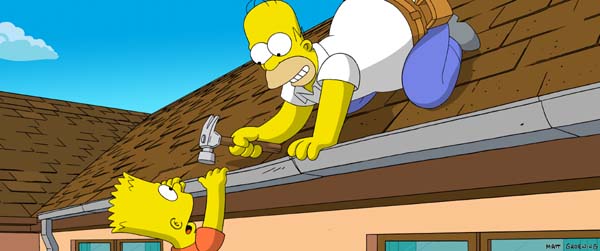 I must express my sympathy to the writers in some regard: the task of writing a Simpsons movie could not have been easy. At this point, every fan has hopes and expectations of nearly every aspect of it, and not everyone can be satisfied. So I feel any premise this movie could have had will be open for scrutiny… but the one they landed on just doesn’t feel right. Springfield vs. the Government, who traps them in a gigantic glass dome, constructed only God-knows-where. The movie follows the Simpsons on the run, and for two-thirds of the running time we barely see any of the rest of the cast. It’s just so weird to me that Springfield played such a large role in the story, yet its inhabitants feel so absent. The Simpsons has become this crazy ensemble show with such a great cast of characters, and all of them go underutilized. Of course, cramming in jokes and lines for characters just so they can be in the movie is no good either, but couldn’t the plot have been more focused on the town? You already have a great villain in Mr. Burns, friends of the Simpson family can help them on their quest…. I found myself missing characters as they would show up on screen for about five seconds before we cut back to the Simpsons again.
The main thrust of the story centers around, big shock, Homer, and his character turn of not being such a selfish jerk and to actually do good unto others for once. Yep, the star of many seasons, Jerkass Homer is very much present in the movie, but to be fair, he’s dulled down to a less extreme level. But having his son face juvenile court in lieu of him attending a one-hour parenting session after a prank that he instigated, and forcing him to walk around in public without pants on is pretty rough. Later, when it’s announced that Springfield is going to be destroyed, Homer is adamant about not returning to help, even though he’s solely responsible for dooming the town in the first place. At least we see that he suffers consequences for his actions in that this is what causes Marge and the kids to leave him, thus leading to his grand epiphany. But as our lead character, and the one we should root for in the end, it’s still difficult to really side with Homer. He’s still a far way gone from the lovable lug I used to know from the classic years. The other family members have their own little scraps of story. Marge allows herself to once again be bamboozled by Homer’s nonsense, then leaves him for the “last time,” and of course they get back together in the end. Meanwhile, Lisa gets a disposable love interest who we will never see again ever. The biggest, and most peculiar, subplot involves Bart developing a kinship with Flanders. After being betrayed and then ignored by his own father in favor of his new pig, Bart begins to yearn for the type of kindly, non-abusive parenting implemented by his neighbor. I really want to understand where they were going for with this, but it doesn’t work for me at all. It’s like they had to severely neuter Bart to get this to work. Why would he give a shit about having a decent father figure? And he looks in forlornly at Flanders tucking his kids in tightly (“Huh. So that’s what ‘snug’ is.”) Marge mothers him all the time, and moreover, like any ten-year-old boy, he’s annoyed by it. This leads to the very end, when Springfield is minutes from total destruction, he approaches Flanders like a wounded puppy with a small request (“I was just wondering, before I died, I could have a father who cared for me.”) It feels so un-Bart, I just can’t buy into this.
Humor-wise, the movie’s pretty much a mixed bag. There’s quite a few jokes that hit their marks really well, and others that don’t. Used (and over-used) of course is Homer getting injured. Why spend time wracking your brain writing clever material when you can have Homer pierce his eye with a hammer or fall through the roof? Due to being locked inside the dome, the side characters only end up with a few token scenes that aren’t super funny, and end up leaving you wanting to see more of them. That just leaves the antics of the Simpson family, which at times is amusing, but it’s nothing really we haven’t seen a thousand times before, and the stuff with Russ Cargill, who, thanks to a fantastic performance by Albert Brooks, provides some of the best laughs of the movie. But of all the gags in the whole film, I’d say only 20% of them really triggered a genuine laugh out of me, which is a bigger ratio than the episodes now, but pretty damn low considering you’d think they’d have stepped up their game for a feature film.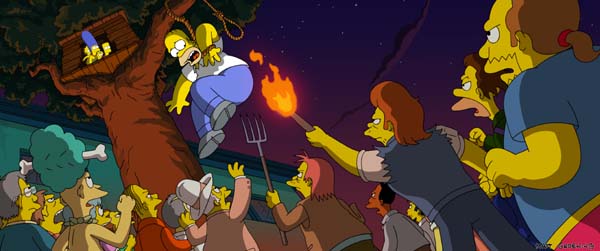 But here’s the most important factor in all of this: there’s this odd feeling I got through almost the entire movie. It had this calculated, airless quality to it, an aura I couldn’t quite figure out. But all was revealed thanks to the film’s DVD commentary. For almost the entire runtime, Al Jean and the gaggle of writers continually discuss jokes and scenes that were cut, re-timed, trimmed down or restaged, all of a result of one thing: test screenings. They talk about how they repeatedly held previews with audiences across the country, and how they seemed transfixed on their reaction to every single frame of the film. Some schlub in Portland didn’t snicker at a line? Change it. One girl had a glazed look over this scene? Cut it out. Through this process, it feels like the movie was hacked to shreds and pieced back together so many times that a lot of stuff ended up getting lost. Like Abe’s prophecy involves “a thousand eyes,” which originally was referring to a group of many mutated woodland critters, but now that it’s just the one squirrel, it doesn’t really make any sense.
In the end, I felt kind of sad listening to them talk about this. In its beginnings, The Simpsons was a show commandeered by snarky young comedy writers who were confident in their abilities to discern what was funny amongst themselves, threw out network notes and wanted to make something daring and subversive. This environment, I believe, is what made the show so great. They knew they could make an entertaining, funny, heartwarming show. The difference here couldn’t be more stark. Multiple times, they talk about jokes and scenes that they all loved, but removed immediately once one or two test audiences didn’t respond as well as they liked. Most filmmakers abhor focus groups, as they have their own creative vision and want to see it through. Meanwhile, these guys not only love them, but it became their crux. Another thing that burns me up is the limitless potential of this project. Eighteen years of brand recognition means that the writers could have done anything with this movie. It would have had a $70 million opening regardless what it was about because it was The Simpsons Movie. Rather than use that opportunity to do something a bit risky or out-of-the-norm, they went the safest route possible instead. But look! Marge said “goddamn” and Otto’s using a bong! Damn, we’re irreverent. The MPAA told us so.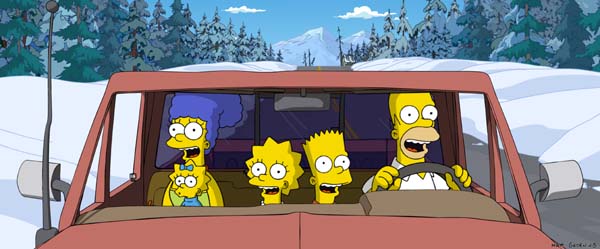 Most of this review has basically been me tearing this movie a new asshole… so why would I say I ultimately like it more than I don’t? Well, as shoddy as the story and the script are, everything else shines the whole way through. Director David Silverman and his team of artists and animators give their A-game on the film, delivering one gorgeous looking movie. The purposely crude style of the show looks great in HD, mostly due to the time and care that went into the animation, the backgrounds, the effects, everything (when the series went to HD on a TV budget… that’s a story for later). Silverman steps up from TV to film in his direction, giving us a number of interesting, dynamic shots. The voice actors give it their all, and composer Hans Zimmer supplies an amazing, heartfelt score, and all of this together manages to elevate and push further some of the more important scenes that would have just laid there dead with just the script alone.
Part of this whole blog’s purpose was to rip off the nostalgia goggles and take a look at the series from my current-day point-of-view. As I’ve seen, it’s astonishing how absolutely dreadful the show has been for the last ten years, and the movie definitely reflects that to a degree. It makes so little an impact, and the commentary definitely has reasons that point to why… but I just can’t hate it like I do the rest of the series. It’s largely disappointing, but I can’t tear part of myself away from the fact that I finally, after so many years of waiting, got to see a Simpsons movie. It looked great, it sounded great… the script was clunky and all over the place… but at least it finally happened. I guess you can consider this the most apathetic recommendation ever. And I’d barely even call it a recommendation.
Tidbits and Quotes
– I like the Itchy & Scratchy cartoon at the beginning, with its use of more extreme poses and the JFK references. The commentary illustrates a bizarre mentality from Al Jean right away: he recollects that they expected humungous applause from the audience when Scratchy turns around to reveal himself as the first on-screen character of the movie. He was stunned to find in the first test screening, “you could literally hear the crickets.” This explains a lot about not just the movie, but also the series: apparently they think people just want to see their favorite characters. It doesn’t matter if it makes sense for them to be there, or if they have anything funny to do, just throw them up on screen and those morons will lap it up.
– I did like that no less than five minutes into the film, we’ve killed off Green Day and are holding a funeral for them, and Lovejoy mourns the passing of yet another rock band in their town. It’s a rare moment of teeth for a show that nowadays has celebrities on just to kiss their already lipstick-smeared asses.
– I’ve recently mentioned the poor 2D-3D integration on the show as of late. There’s plenty of CG-assisted shots here, but largely they all work quite well. There’s a few that don’t, most of which unfortunately are toward the beginning, like the family getting out of the car and Homer and Bart on the roof, but most of the time it feels seamless and blends in well enough.
– Within the thousand iterations of this script, at one point Lisa’s romance was going to be with Milhouse, until they found test audiences were not that familiar with the relationship between the two. I just can’t see that working at all. Lisa falling for Milhouse? Get out of here.
– The long set-up and payoff to showing Bart’s dick is actually really funny, as is him smacking into the glass in front of the Flanders family, and Lou having to remove him with a squeegee (“Listen, kid, nobody likes wearing clothes in public, but, you know, it’s the law.”) The movie is actually pretty good until that pesky plot kicks in.
– I like how giddy Homer is about Plopper, and in turn, how completely blank-eyed and clueless the pig looks at all times. He invests so much love into that animal, yet in the end, he ends up nudging the plank over when the family tries to escape from the mob. And then we never see it again.
– In the commentary, they keep talking about how almost every scene and joke was put in “fairly late” or “at the last minute,” but the bit with Homer electrocuting the fish, and then himself? That was there almost since day one. Why tamper with comedic gold like that?
– Oh, the legacy of Spider-Pig. It became the anthem of this movie. I’m still really fond of the eerie choir version played over the epiphany scene.
– Moe’s “This is why we should hate kids!” at the town hall meeting really made me laugh.
– The Fat Tony appearance, Cletus unable to pollute the lake, Homer heimliching the cell phone out of Plopper’s gullet, Homer driving through a divider, then smashing through another one when he flees the lake… a lot of these jokes really do work at the beginning.
– I’m fine with Rainier Wolfcastle essentially subbing in as President Schwarzenegger. He gets in a fair share of good lines (“I was elected to lead, not to read!”)
– I try not to be a stickler with continuity, but the writers talk about how much care they put into the movie, coming up with floor plans and mapping out the town, yet they miss (or more likely, didn’t care about) some big stuff. Right when the dome is put over the town, we see that the Simpson house is right up against the edge of it. That makes Evergreen Terrace not even a cul-de-sac, the road just ends to the right of the house. So, what, they live on the very edge of town? In every other episode, and even later in this movie, we see that that’s not true. Then of course is the church right next to Moe’s joke, which I don’t mind (except that they made it “Moe’s Bar” so no dummies in the audience would miss out), but then later in the movie, we see the church is right up against the dome too with Moe’s nowhere in sight. Like, whatever. Who gives a shit?
– I kind of like how they destroyed the Simpson house. Not that it matters, considering it’s going to be rebuilt just as it was next season, but it’s so iconic of the series it was weirdly affecting seeing it completely decimated.
– In the commentary, the writers are insistent that Homer isn’t a jerk because he has a idiotic “back-up plan” of going to Alaska. I guess that makes up for everything else in the movie, and the entire series, then, huh? Homer is so reckless and careless, that he expects he’ll do something that will ruin his family’s life, so he has this fallback?
– The gas station gag with Bart defacing the wanted poster and the bizarro Simpson family appearing is pretty well executed.
– There’s a few time cuts that don’t make much sense in the movie: the Alaska scene where it appears to be daytime as Homer is avalanched into the house, then immediately into the sex scene we see that it’s sundown.
– Nice appearance by the gay steel mill workers amongst those trying to bust out of the dome.
– There’s a lot of great Cargill lines, but this may be my favorite (“Knowing things is overrated. Anyone can pick something when they know what it is. It takes real leadership to pick something you’re clueless about.”)
– I like the Tom Hanks cameo (“The U.S. government has lost its credibility so it’s borrowing some of mine.”)
– The Marge video tape is extremely painful to watch, given her breakup with Homer is explained with very valid reasons (“Lately. what’s keeping us together is my ability to overlook everything you do. And l overlook these things because… well, that’s the thing. I just don’t know how to finish that sentence anymore.”) Neither do I. Which is what makes her inevitable return to this dumb oaf all the worse. But you know, that ending with the swell of music and gorgeous animation of the two of them kissing on the motorcycle… I bought it. Goddamn, I bought it.
– The National Security Agency bit is a little too on-the-nose (“Hey, everybody, I found one! The government actually found someone we’re looking for!”)
– The epiphany sequence is really well directed, it looks really neat. And seeing Homer get ripped to pieces is karmically satisfying in a weird way.
– Homer and the wrecking ball is very gratuitous. But I love the crummy road signs (“Look, we can’t keep stopping at every ‘Sop,’ ‘Yeld,’ or ‘One Vay’ sign.”)
– More from the commentary: test audiences found both the epiphany scene and Marge and the kids returning to the decimated town to be “too scary.” What? They toned down the backgrounds for the latter, which is really bizarre to me. The point is that Springfield is a ravaged town, you’re supposed to feel somewhat uneasy as the Simpsons are. But heaven forbid this movie should elicit an emotional reaction, so they held back.
– I really don’t like Marge’s “goddamn bomb” line. Not for the language, but I felt that she shouldn’t have been seen until after Homer accomplished his goal and won her back. He sees her from afar, but is only reunited after he earns it. Instead, Marge just comes out of nowhere and swears, and it’s funny because she normally doesn’t. And of course, Otto smoking a bong. Funny!
– I like the callback to “Bart the Daredevil” where Homer and Bart finally make it over the gorge, just barely. They also threw in the crashed ambulance against the tree that Homer was initially driven out on.
– I’m sure there’s more I can discuss, but this post is already so frigging long. Unusually most of these tidbits have been pretty positive about things that worked and lines that were funny. That’s what’s so weird about this movie: individual scenes and jokes are amusing to think back on, but put all together, the whole largely doesn’t work. Eh. Whatever. Only two more seasons to go with this crap.

 (originally aired September 30, 2007)


 Me Blog Write Good