469. Lisa Simpson, This Isn’t Your Life

2205Original airdate: November 14, 2010

The premise:
After discovering Marge was a straight-A student prior to meeting Homer, Lisa starts to worry that she might be destined to the same future as her mother. Meanwhile, Bart ends up king of the schoolyard after unintentionally incapacitating Nelson on multiple occasions.

The reaction: Talk about a Frankenstein’s Monster of an episode, with plot elements basically cut whole cloth from classic shows of years past. To start, you have Lisa’s devastation that she’s seemingly doomed to become a homemaker, as seen in “Separate Vocations.” The key difference between the two is that in that episode, Marge actually tried to encourage Lisa not to give up on her own dreams. Here, Marge acts like a scorned child, laying a tremendous guilt trip on her daughter (“Would it be so bad to turn out like me?” “Mom, I admire everything you do!” “But it’s not good enough, is it?”) It just feels incredibly out of character for Marge to be that vindictive, especially with no real build-up either. In an effort to keep herself focused on her studies, she rids herself of all extracurricular “distractions,” including her saxophone, which makes no sense. Wasn’t she worried about having more out-of-school activities two episodes ago to better her chances at getting into an Ivy league college? Whatever. After that, she just so happens to pass by a bus for a more prestigious school and we spend the last third or so of the episode with her taking classes there. Making fun of high-end, pretentious schools for children is material that’s well-trodden for this show, and seen much better in the likes of “Bart the Genius,” “Lisa’s Sax,” “A Streetcar Named Marge,” etc. Lastly, our wrap-up. It turns out Marge was able to get Lisa admitted to the fancy school by agreeing to do all of their laundry, with mounds and mounds of it piled up in the Simpson basement and Marge working all night. Aren’t students typically responsible for laundering their own uniforms? And is the laundry bill that high to cover a full tuition? Anyway, a parent makes a huge sacrifice for Lisa’s happiness, and Lisa realizes it’s ultimately not worth it if her parent is suffering. “Lisa’s Pony,” anyone? And what a shallow imitation, it’s barely even worth comparing in detail. In “Pony,” we see Homer degrading into a sleep deprived mess, and Lisa pondering her decision after being exposed to the truth. Everything in the episode is leading to this final end point. In this episode, we see that Marge spoke with the dean of the school in private to get Lisa in, but we’re kept in the dark about what happened until the very end, wherein Marge still keeps her scorned attitude toward her daughter (“It’s important to you that you don’t end up like me.”) So we see Lisa making up an excuse why she doesn’t want to go to the school anymore, then give her mom a hug with a sad expression on her face. Where “Pony” ends with Lisa appreciating her father’s sacrifice for her and the two happily walking into the sunset together, this episode ends with Lisa succumbing to her mother’s petty guilt trip and feeling sad. What a heartwarming finale!

Three items of note:
– Despite my grave issues with the actual story, this is easily the best episode so far in terms of humor and ancillary ideas. The beginning features Homer’s attempts to get Maggie a rare Happy Little Elves figure out of a whole collection of blind box toys. I frigging hate those things. If I want to get one particular figure, I just want to buy that one figure. It’s basically like gambling. Homer’s increasing anger and frustration of getting the same ones over and over is great, as is his earnestness to try to please Maggie, but the montage of him repeatedly wasting tank after tank of gas is not very amusing.
– The Simpsons happen to get lost driving around, and they end up going by Marge’s childhood house. For some reason, a box of Marge’s stuff is still in their attic, and her room is still somewhat furnished as it was decades ago, with cobwebs on the dresser and a peace sign poster on the wall. The owner appears to be a crazy person, admitting to having rummaged in said box, but nothing ever comes of this, of course.
– As if ripping off multiple past episodes in the A-plot weren’t enough, the B-plot feels like a sorry retread of “Bart the General,” where Bart lives in fear that Nelson is going to get his retribution, only to end up unintentionally knock him out time and time again. Toward the end of the story, Marge gives Bart the same advice she gave twenty-one years prior to just talk to Nelson and try to make nice. And it works. No subversion, no clever twist, Bart compliments Nelson’s bullying, and that’s the end. How anti-climactic.

One good line/moment: There were a few amusing moments in this one. Lisa confronts Homer about him seemingly being responsible for Marge’s academic dip, and he’s in the middle of creating a giant cigar out of fruit roll-ups and bubble gum. He then encourages Lisa to pick a vice, because it’s basically inevitable (“Just pick a dead-end and then chill out until you die.”) He then blows smoke from his sugary stogie, which creates a bubble gum smoke ring, which then floats down to the floor in a plop. It might have been a bit too uncharacteristically negative for Homer, but the scene had an chuckle-worthy rhythm to me.

468. Treehouse of Horror XXI

2204Original airdate: November 7, 2010

The premise:
In “War and Pieces,” an evil board game in the Simpson attic brings classic board games to life to wreak havoc on Springfield. In “Master and Cadaver,” Homer and Marge’s maritime honeymoon is interrupted by a mysterious castaway of questionable intent. In “Tweenlight,” Lisa is captivated by a new boy in school, who turns out to be a vampire.

The reaction: This has got to be the least Halloween-y special yet, with three segments that are parodies of movies, none of which are of the horror variety. The first one is kind of like Jumunji, which is just a random assortment of disconnected board game gags. The second story is a parody of Dead Calm, a 1989 film I have never seen, which comes the closest to being scary, being based on a psychological thriller, but falls short. It’s just a bunch of laborious explanations and lazy sex jokes, culminating in Homer being violent murder man at the end for some reason. Lastly, we have our Twilight parody, which everyone and their dog had done up to this point, two years after the release of the first movie. There wasn’t even really a discernible plot. Lisa meets Edmund (ugh), he then invites her to dinner, then there’s an ending confrontation at a bell tower where characters keep switching motivation and I can’t figure out what’s supposed to be happening and why.

Three items of note:
– What better way to open up a spooky scary Halloween special than with a “parody” of the opening titles of The Office? Featuring monsters working in an office? Mummy Dwight puts the thing in the shredder and gets his wraps caught! Comedy? Like, what the fuck is this?
– The ending to the second segment is really fucking weird. It turns out the mysterious stranger was innocent, but when we find out, we randomly cut to Homer with a speargun, who just shoots him dead. He then kills everyone else in the room, as well as stabbing a pelican. Then Marge narrates why she’s committing suicide while doing so and the segment is over. Oh, actually, it turns out this was all in Maggie’s head during bathtime. We then see her become Alex from A Clockwork Orange for no reason at all, because references are the same thing as jokes. Who needs subversion, context or irony? If the audience recognizes the thing on the screen as being from another thing, they’ll slap their fins together! ‘Member Clockwork Orange? Oooh, I ‘member!
– Making fun of Twilight is like shooting fish in a barrel, it’s astonishing that the show can’t even handle mocking something that’s so so ripe for ridicule. Only the first two minutes or so are Twilight related, and the only thing they really “make fun of” is the scene where Edward stop the bus, which they turn into an endless segment where Edmund stops multiple vehicles in a row. Does repeating the same thing over and over count as a parody? There’s only one decent joke in the whole segment (“Let us move between the trees as a bat does: by jumping!”) The rest of it is just a bunch of nonsense: the Simpson family serving the vampires Ned Flanders’s carcass, which everyone besides Homer is just fine with, driving through the vampire district where they can trot out Simpson-ized versions of famous vampires, because references are jokes, and then the segment just ends with fat Homer bat falling to his death, with Lisa looking down from the bell tower with a disinterested expression for two seconds before we cut to credits. Oh, and there’s a random The Room reference for some reason, where they have Daniel Radcliffe say “You’re tearing me apart!” With no context. Why?

One good line/moment: At dinner, as Dracula Dad plays the trumpet, Homer dances with Santa’s Little Helper. It’s pretty adorable.

467. MoneyBart

2201Original airdate: October 10, 2010

The premise:
Attempting to bolster her extracurricular resume, Lisa becomes the manager of Bart’s little league team, despite knowing nothing about baseball. However, when she latches onto the statistics and probabilities linked to the sport, she leads the team in an incredible winning streak.

The reaction: Wow, three Lisa episodes in a row? We start with a recent Yale graduate returning to Springfield Elementary to admonish Lisa, an eight-year-old child, for not having more extracurricular activities. It’s the same thing as Declan Desmond in that astronomy episode. It skirts close to a point about more and more pressure being put on children and their parents to load up earlier and earlier to impress colleges, but it barely comes close to that point. The episode is all about Lisa delving into the science behind the game, utilizing probability to determine the outcome of plays, which is an incredibly interesting concept, but as usual with this show, it isn’t really delved into, it’s just briefly explained, and then we jump into a montage of the team winning every game as Lisa cracks open book after book. A rift is created when Lisa becomes a hardass stickler to her system and kicks Bart off the team for disobeying her play, despite him hitting a home run. In a pitch during the final game, Lisa pleads Bart to return, who disobeys her orders again as Bart attempt to run all the bases, and ends up losing the game. But the crowd was swept up in the excitement of the moment, swaying Lisa as well. It’s all so… boring. Everything about the ending is so stretched and laboriously spelled out, I guess because there’s barely any material here to begin with. The last two episodes featured Lisa stories that felt extremely rushed because of the presence of a B-story, but here with only one plot taking sole focus, the story still feels so thin.

Three items of note:
– There are very few things I’m aware of about all these episodes I’m about to endure, with the only stuff I remember is anything that was highlighted in the entertainment news. In this case, it’s the couch gag conceived by Banksy, where we see the hellish working mines where nondescript Asian children are painting Simpsons cells and making Simpsons merchandise. It’s pretty dull and boring, which would be okay if it actually was communicating a point that the show itself hadn’t already done twenty years ago. Remember Kent Brockman reporting on the production of the Itchy & Scratchy movie? Yeah, me too. Hell, The Critic already made this exact joke twenty years ago too, and it was quicker, more scathing, and funnier.
– In the middle of the episode during Bart and Lisa’s feud, we find Homer and Marge picking sides in their argument. They’ve barely been present in the episode, and I thought this would develop to something, but it really doesn’t. We also get a bizarre bit where we cut back and forth between the two glaring at each other down the dining room table: Marge mad, Homer mad, Marge mad, Homer asleep, Marge mad, Homer mad. Like, we don’t see him wake up or anything, she doesn’t get more angry at him passing out at her. It felt like weird padding.
– This episode is full of watered down bits from previous episodes. Lisa’s initial indigence about not being accepted as the new coach because she’s a girl rings of her attempt to join the football team in “Bart Star.” In that episode, her character was on the precipice of the indignant liberal mouthpiece she would eventually become, but it’s clear her intention was to shake up the “system” rather than play the game, but when she finds that not only is coach Ned Flanders is open to her joining, but she’s not the only girl player, she sheepishly leaves. Here, Lisa’s smugness is only deflated when she realizes the names of past baseball managers she thought were female were actually men, a belabored joke that takes two times too long to tell. We also get Bart and Lisa doing the coach signaling thing, which is nowhere near as hilarious or memorable as Burns from “Homer at the Bat.” Speaking of, we get the return of Mike Scioscia as a guest, creating a great example of the stark difference in how the show treats celebrities. Nineteen years prior, Scioscia’s undying work ethic got him laid in a hospital bed with radiation poisoning. Here, he gives Bart a pep talk on a roller coaster while showing off his World Series rings. Which sounds funnier to you?

One good line/moment: Any time we’re on the baseball field, the announcer is always Harry Shearer doing his Vin Scully voice, and while of course the quality of writing has gone down, there are still a few good lines in there from him (“Bart Simpson on deck, his bat’s just hungering for a Homer, like Chronos for his children. Speaking of ‘Homer,’ Bart’s father’s name is, you guessed it, not on my fact’s sheet.”)

466. Loan-A Lisa

2201Original airdate: October 3, 2010

The premise:
Lisa decides to anonymously invest in Nelson’s business of modding bicycles, but becomes horrified when he decides to drop out of school once business starts to take off. Meanwhile, Homer discovers a way to temporarily live the high life by purchasing extravagant items and returning them for full credit a few days later.

The reaction: This was a pretty dry and lifeless one. It’s especially hard to care when your A-story kicks in literally half-way through the episode. Or rather, there was one plot for the first half, then it became the B-plot in favor of the Lisa story. When Lisa starts looking up micro-finance and how to invest in a business, I certainly thought the episode was going to take a much larger turn, which at least might have been a little interesting. Instead, the episode is about Lisa giving Nelson $50 to start a business. Which from that paltry cash, he completely pimps out his garage and is able to pay employees $11/hr. How much work could he have possibly done? Lisa initially donates anonymously, but she eventually breaks and tells him, mostly because she is so satisfied with herself and wants to hear praise directly from him. So when she’s shocked to find out Nelson is dropping out of school and that’s the thrust of the story, it’s hard to care because she had been so smug before, and also, who cares? Her attempts to sway Nelson backfire, and ultimately he’s done in when he finds out he hasn’t been using water soluble epoxy on the bikes. So, just buy different epoxy and you’re all good? I guess ultimately the message is that he would have known that if he had gone to school, but he’s gonna get a shitty education anyway at Springfield Elementary, so what’s the point? The episode just felt like a cobbling together of elements from past shows (the Lisa-Nelson relationship, Abe giving out his inheritance, Marge’s awkwardness with high-class) strung together with a limp plot.

Three items of note:
– The Itchy & Scratchy at the start is a “parody” of Up, which of course means it’s a recreation of the opening montage of the film using exact shots and the exact same music, with the only differing thing in it being Itchy gunning down Mr. and Mrs. Scratchy at the end. Like all of the show’s references to the animation studio, it just feels like them holding up a giant “WE LOVE YOU PIXAR” sign. Looking up at the clouds, Scratchy points out images of Buzz Lightyear, Mike Wazowski and WALL-E. These aren’t jokes. I guess the audience is supposed to smile and clap their hands because they recognize those characters? The worst part is is that they could have actually done something actually clever with the material. The Up opening scene contains some genuinely heartbreaking moments that could have been deliberately and humorously sabotaged by over-the-top violence. Maybe you play the whole thing straight up until the end, when an elderly Scratchy having just buried his wife returns home only to be abruptly killed by a manic Itchy, who laughs and scurries from the room.
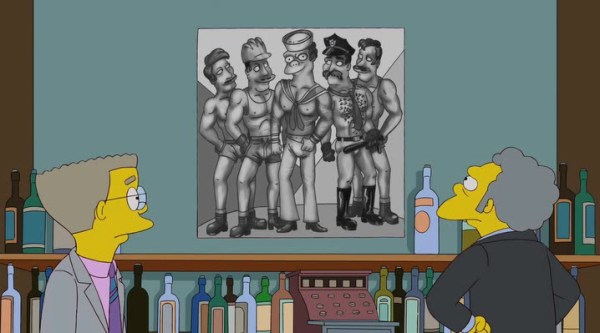
– I don’t really have much to comment about the A-plot, then B-plot. It starts as a “Scenes of the Class Struggle in Springfield” retread, then becomes Homer just buying expensive shit and getting caught. Well, he kind of gets caught, but then there’s no resolution to the story. At the start of the story, Marge feels cornered into buying an expensive purse by snobbish brow beaters Helen Lovejoy, Bernice Hibbert, and… Julio. I gotta say, I thought his character was slightly amusing at first, but now I cringe whenever he shows up. It’s basically just Hank Azaria doing his character from The Birdcage, except Julio has no character or purpose within a story, he’s just a flat gay stereotype, a literal card-carrying one as shown here, as he presents Marge with a dual calling card of “Sassy Gay Friend” and “Scheming Gay Enemy.” We’ve come a long way since “Homer’s Phobia,” baby.
– Unlike the classic years where celebrities who appeared on the show were subject to a fair share of good-natured ridicule, nowadays it’s like a promotional platform for them to look awesome. Nowhere is this better exemplified than the inexplicable appearance of Facebook creator Mark Zuckerberg. There’s plenty of rich material you can get out of privacy concerns or how social media has affected real-life relationships and the weird exacerbated social conditioning of it all, but the show is interested in none of that, and the only joke is that Zuckerberg speaks in Facebook statuses. What a riot! Like the Pixar segment at the start, it really feels like the show isn’t interested about making jokes about things, but would rather use their massive audience to advertise stuff they think is cool.

One good line/moment: Nobel Peace Prize winner Muhammad Yunus is another disposable guest appearance, and while he didn’t really have a lot to work with, you can tell he had a lot of fun recording his lines. His fading “Goodbyyyyyeeee” when he left the computer screen was just adorable.

465. Elementary School Musical

(When I rebooted the blog a few years ago to continue barreling through the rest of the seemingly endless run of the show, I barely got through a season. I considered it all to be a moot point; to me, the show had reached a plateau of quality where all the points I could complain about seemed to be covered, and bitching and whining about it even more seemed pretty fruitless and repetitive. But every now and again since then, I found myself drawn to wanting to cover the last seven or so years, like a moth to a yellow flame. So yeah, I’m gonna try it again. And yeah, I’m sure I’ll cover well trodden over ground and remake a lot of the same points. And I can’t even guarantee I’m not going to throw my hands up and stop mid-way through again. But the urge is striking my fancy at the moment so let’s see how long this crazy train can stay a-rollin’.)

2201Original airdate: September 26, 2010

The premise:
Lisa spends a week at an arts camp and has her creative spirits lifted, only to come crashing down once she has to return to a harsh reality. Meanwhile, Krusty drags Homer and Bart to Europe to accept a Nobel Peace Prize, only to find the award was only a ruse to put the clown on trial for his multitude of overseas crimes.

The reaction: “How I Spent My Strummer Vacation” comes to mind as a direct comparison to this, and the fact that this episode has an even more inept story than one of the worst episodes ever, that’s pretty astounding. Firstly, we spend the first few minutes with the Krusty story before Lisa is dropped off at camp with no real set-up whatsoever. The only bit we get is her complaining about being the overlooked middle child, which is not so much sympathetic as it is whiny and self-righteous. So here’s your problem: Lisa spends the back half of the episode missing the artistic freedom she had at the camp, when we barely saw any of it. After she gets dropped off, we get our opening number with the cast of Glee (FOX synergy at work!), and then we meet our guest stars, Bret McKenzie and Jemaine Clement, who, like Simon Cowell, Stephen Colbert, and others in the past, are basically just playing their TV personas, despite being billed as new characters. After that, we get two scenes that are basically poor attempts to do Flight of the Conchord-style banter, and Bret and Jemaine at the campfire, singing a song about art that says and means nothing, but inspires Lisa anyway for some reason. Homer’s dream of being a rock star made no sense, but at least we spent an entire act at the camp and got a sense of what it was. Lisa is disillusioned by her drab normal life, so she goes to “Sprooklyn,” the Springfield arts district, only to be shocked that Bret and Jemaine are actually depressing starving artists. Her childlike hopes dashed and her supposed idols exposed as frauds, she pleads with her mom to take her home, but then tells Bret and Jemaine that she’ll “try again when I’m older,” which I don’t quite understand. Try to strike it out as a broke artist when she’s older? What? It’s like they ran out of time and just had to end the episode. It’s yet another instance where the writers try to have their cake and eat it, where Lisa has the intellect and cultural knowledge of a forty-year-old, but is also a painfully naive child who buys into Bret and Jemaine’s indistinct empty pleasantries hook, line and sinker.

Three items of note:
– Way, way back, I bitched about the new HD opening titles, but seeing them again after all these years, it continues to really bother me. I guess you can consider the “slower” pace of the original titles outdated, but I think that’s better than them shoehorning jokes into every little moment, like Lenny and Carl doing a pratfall behind Homer at the plant or Otto eating the nuclear carbon rod for whatever reason. Stuff like that you may smirk at, at best, the first time you see them, but having to see it each and every week, you get sick of it real quick. We also get two new changing elements to the opening titles, something that flies by the clouds at the very start, and a sign gag right before we enter Springfield Elementary. Ironically for a show that at this point feels like it’s in a joke drought, the opening titles is like an exercise for how much we can cram into a minute so the audience won’t get bored. Also, the chalkboard gag, “When I Slept In Class, It Was Not To Help Leo DiCaprio,” it took me a good while to realize it was an Inception reference. Glad that joke held up.
– There are three campers who are voiced by Glee cast members, whose names I can’t be bothered to look up. Their opening number is so, so bland and sterile, lyrically and visually. The song is a “parody” of “Good Vibrations” by The Beach Boys with Lisa doing the chorus as “Art, art, art and education.” When you can’t think of jokes and need to fill time, I guess repetition is your next best bet. It’s just so boring, and ultimately leads to nothing, since act two features the campers doing nothing artistic at all other than dancing to Bret and Jemaine singing. Again, “Strummer Vacation” was a piece of trash, but at least I have an idea what the rock-and-roll fantasy camp was, with scenes of all the rock stars talking about writing songs, creating an image and averting the paparazzi. I haven’t the faintest clue what “Expressions: A Performing Arts Camp” is supposed to be. The best we get is a camera slideshow from Lisa at week’s end as a joke-filled recap of shit we never saw, including guest appearances from Andrew Lloyd Weber and Elaine Stritch and a performance of Angels in America, where the joke is basically someone just redrew the poster for the HBO miniseries and added Lisa to it.
– There’s not much to really say about the B-plot. Krusty brings Homer along for “being the easiest laugh I know,” and Bart tags along just because. Despite his many, many crimes, the judge decrees Krusty will be exonerated if one can cite one contribution he made to Western society. Bart saves the day by presenting a clip from 1990 of Krusty being a primadonna and refusing to play a gig in South Africa, and that three days later, Nelson Mandela was released from prison. That makes sense, right? They don’t even bother making a joke about it being illogical. Bart barely finishes his dialogue before the judge turns around and clears Krusty of all charges. I had to rewind because it went so fast and I could barely figure out what was happening.

One good line/moment: I actually smirked at a couple of gags, but my favorite moment was an unintentional laugh. One of the campers is a kid in a wheelchair, I guess as a reference to Glee, and in the wide shot toward the end of the opening song, you just see him alone in the corner spinning in a circle. It’s kinda sad, but I laughed at it all the same.