479. The Scorpion’s Tale

2215
Original airdate: March 6, 2011

The premise:
On a field trip, Lisa discovers a type of flower that renders dangerous scorpions completely docile. This discovery is caught wind of by a pharmaceutical company, who hopes to synthesize it as a drug to make crotchety old people more sedate. Unfortunately, the miracle drug comes with one unforeseen side effect: dislocated eyeballs.

The reaction: I honestly don’t understand what this episode was about, so I might as well go through it beat by beat. Abe is kicked out of the retirement home for being too irritating, and proceeds to aggravate the rest of the Simpsons living with them. So Homer doses him with Lisa’s flower extract she discovered and it peps him right up. In an aggravatingly expository scene, Lisa confronts her father about it, and Abe reveals he’s just fine with it, that he wants to live his later years feeling fun and fancy free. So, this is something Abe is absolutely fine with, and earlier we’d seen Lisa and the rest of the Simpsons living on edge over Abe’s crotchety mood, so where is the downside to this? Lisa was fine testing on the scorpions, so is this like an issue of messing with a human’s free will, even if the subject is complicit? Beats me. She flushes her sample vial down the toilet to dispose of it, which is an absolutely fantastic idea. This dangerous chemical that can alter behavior, let’s release it into the water supply! But despite dramatic music playing when it enters the ocean and fish come into contact with it, nothing comes of it. Instead, a pharmaceuticals guy just happens to be at Moe’s and convinces Homer and Abe to mass produce the chemical as a drug. But ultimately it ends up being circulated by the elderly of Springfield, and it results in their eyeballs popping out. Yup. Not since Sideshow Bob’s entire face peeling off have I seen something this aggressively cartoonish from the series. The point of all this, I guess, is that the seniors view their dangling eye tendrils as an acceptable cost to their improved mood, but it’s just so goddamn silly. And then the very end of the show involves Abe doing an about face that he and his fellow geriatrics are of the greatest generation and they NEED to be crotchety and focused to pick up the children’s messes. This all happens in the last minute or so of the episode out of nowhere, and I don’t really know what to make of it. They even lampshade it with Lisa not exactly sure what the lesson is. Me too, kid. Me too.

Three items of note:
– The opening field trip is pretty annoying. First, it’s a mix of the second and fourth grade students just so we have Lisa and Ralph in there, chaperoned by Principal Skinner. And, of course, Chalmers is there too. I’m going to be shocked when we get to an episode where we see Skinner by himself. The rest are just a series of pointless scenes, including one where Nelson walks behind a cactus to seemingly jerk off to some ye olde nudie photos the boys find? Gross? The opening feels like something the show used to do in the past: establish a setting or an emotion or some kind of thing that will lead to the start of the plot with a bunch of one-off gags. The difference is they used to be able to burn four or five jokes in like a minute and a half. The field trip lasts three and a half minutes before we get to Lisa and the scorpions; everything before it just feels like killing time by any means necessary.
– So the pharma guy gives Abe some prototype pills before they hit the market, warning to not let them fall in the wrong hands, lest they be sold off. Cut to Bart walking around with a little suit selling them to everyone in town. His motivation is not quite clear, as Bart’s money hungry for no real reason. He’s a kid, what does he care about money unless he wants to buy something specific? Like that stupid dirt bike from a few episodes ago? It all feels so unnecessary. I feel like Lisa should have inadvertently been responsible for spiking the water supply of the town by flushing her sample down the toilet. You could get more mileage from a premise like that.
– The ending truly baffles me. Homer encourages Pharma Guy to let the seniors have their drug, claiming their generation has got everything under control. He then claims he’s off to get drunk, gets in his car, and drives over some parking spikes. He proceeds to poorly jack his car, and then Lenny and Carl show up for no reason to give him bad advice. This all felt like a bit that was going on way, way too long, but then by the end of it, we see Abe looking on in disgust, which leads to his speech convincing everyone to get off the drug and stay malcontent. But then when the geezers start approaching the car, Homer smiles and nudges Carl before they proceed to fix the mess they had created. So was this his plan all along? Why would Homer care about wanting the seniors off the drug? We establish there’s no real problem, but we reset the status quo regardless. I’m still at a loss.

One good line/moment: The childproof door of the pharmaceutical building was pretty amusing, but it did run a little long with Homer’s continuous struggles to open it.
478. Angry Dad: The Movie

2214
Original airdate: February 20, 2011

The premise:
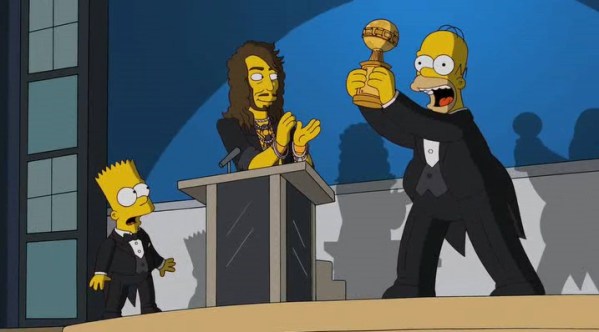
The current intellectual property holder of Bart’s old Internet cartoon Angry Dad approaches him about making it into a film, later turned into a short. As the film sweeps awards season, Bart becomes discouraged that his father is assuming all the credit for his work.

The reaction: Here’s a modern-era series trope that I’ve missed (sarcasm), wherein a Simpson becomes a gigantic success apropos of nothing, in an episode based entirely upon Hollywood navel-gazing. “I Am Furious Yellow,” an episode from nine years prior, was a perfectly enjoyable episode featuring then-contemporary riffing on Internet companies and web cartoons. This episode is less concerned with Angry Dad itself and more about fame and the awards circuit. From the moment they walk in the studio, Bart and Homer are regarded as legends of the industry. Why? Is Angry Dad like a cult classic? It’s the equivalent of animators today shitting themselves over meeting the Joe Cartoon guy. None of the history of why people care so much about Angry Dad or the production of the short itself is really dwelled on; we get the decision to make it a short rather than a film, act break, then we find out it’s been nominated for a Golden Globe. We don’t even know what the fuck the film is, and if you haven’t seen or don’t remember “Furious Yellow,” you should have no clue what’s going on. The emotional thrust of the episode is Bart getting bummed out that Homer, as the voice and inspiration of Angry Dad, is hogging all the credit for all the awards the short is getting. Boy, what a relatable conflict! But it’s not clear what exactly Bart’s role in this film is. Two-thirds of the way in, we find out he was the writer/director of the film. What? We never saw any of that. Bart is busy crowing about not getting the recognition he deserves, but meanwhile we never saw him really putting any work into the film at all. But none of that matters. I’ve referenced it many times in the past, but the entire episode reeks of the classic Krusty line of trying to relate to the common man (“Like when your lazy butler washes your sock garters, and they’re still covered with schmutz?”) This is a show with a staff that’s won countless awards, and this episode is all about their world and their problems, far removed from the average American family the Simpsons are supposed to be. When Bart gets the call that Angry Dad is up for an Oscar, he goes into a little song and dance (“I’m going to the Oscars! Not as a seat filler! I’ll get a gift basket! But I won’t declare it!”) So this normal ten-year-old boy knows about the concept of seat fillers, getting gift baskets at Hollywood events, and declaring them on taxes he doesn’t have to file because he’s fucking ten. Terrible, terrible episode.

Three items of note:
– Instead of getting any actual plot or character motivation, we’re treated to extended clips of other cartoons, aping the likes of The Triplets of Belleville, Wallace & Gromit, Persepolis, and so on. But there’s not really any parody element to them, they’re just references, Simpson-ized versions of the actual articles that are effectively love letters. We love you, Mixar! I mean, Pixar! Ooooh, but we made a small dig at Cars! BURN! The easiest comparison one can make is to “The Front,” as both episodes involve an award show for animation. Remember the “How to Buy Action Figure Man” bit from that episode? It’s one of the most brilliant jokes the show has ever done, eviscerating the not-so-hidden agenda of 80s cartoons existing to sell toys in a mere four seconds. We see only a few seconds of each nominee, because that’s all the time they needed to tell their jokes and move on. Here, we get at least forty seconds each of four different nominees, where, as mentioned, there’s no real joke, it’s just a tribute to those actual films. A whole lot can change in twenty years. The writing staff of season 4 wasn’t as highly gilded, still bitter off their Emmy loss to a claymation Easter special, so they took great pleasure taking fire at their medium and the hokey pomp and circumstance of award shows. Nowadays, it’s just a big inoffensive love fest. It’s like the ending of “Radioactive Man” played straight, with a kind, ever-forgiving Hollywood set to “Lean on Me.”
– Lisa tries to encourage Bart about making Angry Dad into a short, listing great directors who started out making shorts: Wes Anderson, Frank Tashlin, and Tim Burton. One of these names is not like the other, isn’t it? Anderson and Burton are contemporary filmmakers, so I’ll accept that Lisa knows of them. But Frank Tashlin? Tashlin was one of the lesser known classic Warner Bros. cartoon directors, doing a lot of the old Porky Pig cartoons of the 1930s. I’m a huge cartoon nerd and I didn’t even know that after that, Tashlin went off to direct some successful films in the 50s, none of which are titles I recognize. The point is, there’s no fucking way Lisa knows who Frank Tashlin is. I try to not reiterate points that are constant problems in for this series, but Lisa’s compendium of world knowledge when the plot needs it was especially glaring here. And the joke isn’t over; Bart replies to Lisa’s list by asking, “Name one more.” Lisa replies, “Taylor Hackford.” I looked up Hackford, seeing that he did some short films, but then later directed such films as An Officer and a Gentleman, The Devil’s Advocate, and Ray. Hackford and Tashlin are both names unknown to the public, but I’d hazard a guess more of the general public have greater familiarity with those movies than they do of Tashlin’s work. Did it all come down to that they couldn’t think of a third name to go along with Anderson and Burton? She could have just said fucking John Lasseter, which would then tie into their later Pixar dick sucking. Done.
– This episode has a parade of superfluous guest voices. First up is Ricky Gervais, who previously played not-himself in an episode he kinda sorta wrote the outline for, this time just playing himself. Now, remember when Gervais hosted the Golden Globes and made Hollywood feel uncomfortable with the jokes he told at their expense? Remember how big a “controversy” that was? That’s basically the underlying joke in his scene, and it’s a real eye roller. More inside baseball humor. Also, both of his scenes run far, far too long; as was the case in his last episode, his very rambling, long-winded style of comedy does not really fit well with this show. It would also help if his lines were actually funny. Russell Brand and Halle Berry appear to present awards, and pretend to make fun of themselves. The most curious appearance is Nick Park, Wallace & Gromit director, who admittedly is the best guest of the list (“I’m more clay than man now.”) But it’s just weird considering not many people must know who he is. I guess they figure the audience will figure it out, but they don’t even say his full name, Lisa just says “Mr. Park.”

One good line/moment: This is pretty difficult, since this is definitely the worst episode so far. I guess I’ll go with the aforementioned Nick Park line. I love Aardman anything.

477. The Blue and the Gray

2213
Original airdate: February 13, 2011

The premise:
When Marge discovers her hair stylist has been covering up her grayness for years, she decides to embrace her age and go full gray, much to Homer’s dismay. Meanwhile, Moe recruits Homer to be his wing man to help him get girls.

The reaction: The A-story was pretty empty, so let’s get that out of the way first. “Secrets of a Successful Marriage” already revealed that Marge dyes her hair, but I guess they added a line in here that the blue dye gives her memory loss? What? So Marge goes full gray, the other gossiping biddies give her shit for it, and she gets insecure. That’s about it. We don’t even get to that plot until a third of the way in. We also have some time-killing scenes after that where the boys tease Bart about his mom and he ends up in therapy, but that doesn’t amount to anything. The rest of the episode is Moe getting help from a swindler pick-up artist and utilizing Homer as his wing man to pick up girls at clubs. Like, hot, trendy clubs with young looking girls, who I guess exist in a dumpy town like Springfield? And here’s the kicker: it works. We see a couple moves that Homer pulls, all of which are bullshit gross pick-up artist 101 maneuvers: have the wing man go after the less attractive (fatter) friend, taking out rival competition by revealing something embarrassing. This all couldn’t be easier to make fun of. But they don’t. It’s played completely straight, and we see Moe scoring with girls. And Homer too. When Marge confronts Homer at the end, he has a throng of ten girls surrounding him, captivated by his every word. Why? Why?! For God’s sakes, why. It’s completely nonsensical. I don’t even know how the two plots are even supposed to connect. We don’t see Homer making excuses for why he’s been out so late to an inquisitive Marge. Marge finds out when two super skinny girls walk into a shop talking about what a great catch Homer is. It’s all very confusing.

Three items of note:
– There’s a gag here that almost works regarding the Simpson children’s hairlines. Bart ponders exactly where his head stops and his hair begins. Alright, good joke. But then it just goes on and on with Lisa nearly having a nervous breakdown over it, and it just kills the gag. Per usual, there are a lot of needlessly elongated segments in this show: Homer opening the door to Moe’s again and again, the slooooow dripping of the blue dye as Marge makes her decision, Gil’s scene at the supermarket, Homer envisioning Bond villains for some reason, the very ending with the Maggie and Gerald cupids that kiss (which felt kind of gross to me).. if you’ve got a gag that maybe kinda works, the writers will make sure they run it for at least twice its length.
– Dr. J. Loren Pryor from “Bart the Genius” makes a reappearance, sounding nothing like his original voice. He appeared in a few other episodes, and I remember he also showed up randomly in a more recent episode as well. Anyway, I don’t blame Shearer for not remembering, or caring, what Pryor sounded like. Would you?
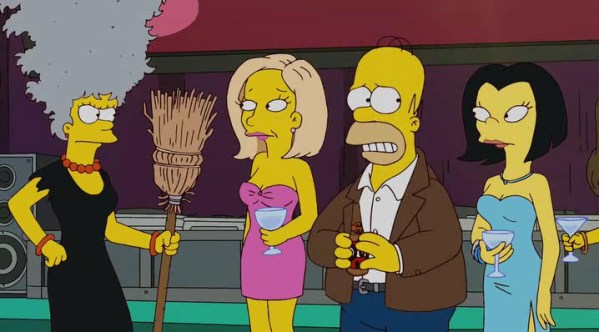
– Speaking of elongated jokes, the ending is such a slog. We devote an entire minute to a sequence showing Marge’s transformation into a witch. She crashes her cars and frazzles her hair, tears her dress, her shoes curl up, she ends up with a broom, cats follow her, and just in case you didn’t get it, the Wizard of Oz Wicked Witch motif cues up as well. And Mr. Teeney appears as a flying monkey. Yeah, with wings. It’s just so, so laborious. Fifteen seconds in, I get the joke. I get it. She’s the visually unfavorable comparison to those hotter younger girls. But I guess they’re just so desperate to fill time that they can stretch stuff like this out as long as they need to.

One good line/moment: The sleazy pick-up artist’s seminar is held at the Springfield Airport Motor Lodge. In the establishing shot, a landing airline swoops by, knocking the sign over. It was quick and unexpected, and I was actually amused by it.

476. Homer the Father

2212
Original airdate: January 23, 2011

The premise:
Homer’s new obsession with old 80s sitcoms leads to him emulating a TV dad parenting style. Frustrated that his father won’t get him a cool dirt bike, Bart ends up almost creating an international incident in his efforts to get one himself.

The reaction: I don’t think I’ve seen an episode yet with this dramatic of a gear shift. We go from absolutely nothing happening to disastrous foreign espionage within the course of a minute. The first half of the episode is devoted to Homer’s binge watching of “Thicker Than Water,” an 1980s sitcom, of which we see multiple scenes of, at least a minute and a half in total. Parodying these cheesy old sitcoms is like shooting fish in a barrel, but I wouldn’t say that they’re making fun of them as much as they are just recreating them. The theme song, the jokes, there’s no real edge to them. BoJack Horseman takes much better aim at garbage TV like this, and in a much shorter amount of time. Homer dons a Bill Cosby-style sweater and tries to instill Bart with TV-inspired fatherly advice, and everything drags on so long with nothing happening, all the while making me wish I was watching “Saturdays of Thunder” instead. With no recourse into getting his much desired dirt bike, Bart formulates a plan of writing letters to foreign nations saying he’ll give up his father’s knowledge of nuclear secrets to get what he wants. This… is kind of coo-coo bananas. They try to play the naivety card pretty hard with Bart not really acknowledging the gravity of his situation, but I refuse to believe Bart is that dumb; it just ends up casting him in a really negative light. Ultimately, the situation is rectified when Homer sacrifices himself to the Chinese, they take him to China, he supervises the build of a power plant there, it explodes, and then he comes back home. That all happens in less than a minute toward the end of the episode. I’m not exactly sure what I was supposed to get out of this, a flimsy father-son story that takes an insane right turn halfway through, with a crazy amount of padding, not only from all the sitcom snippets, but at the end, we not only get an Itchy & Scratchy, but a random tag ending of the cast of the old sitcom talking with James Lipton. Anything to make it to twenty minutes, I guess.

Three items of note:
– Bart gets his inspiration for treason when Apu shows up at Homer’s door, returning his power plant security card he left in his store. He then goes into a long monologue about how dangerous that access could be in the wrong hands, and rattles off a list of countries with said wrong hands. All non-Simpson characters seem to exist in this show for one of two reasons: either to spout the same kind of joke over and over again, or to show up as a walking plot device.
– Bart spends quality time with Homer in order to get close enough to him to get a USB stick of information from the plant, which I guess just automatically downloads all the pertinent info immediately when he plugs it in. After making the trade-off for the dirt bike, the next morning Bart is shocked to find that Homer had just gotten it for him, as thanks for spending so much time with him. This conceit feels straight out of a sitcom, which given the subject matter of the episode, could have been acknowledged or subverted in some way, but it isn’t. It’s just the plot, played straight.
– The Chinese informants seemed… I don’t know if I wanna say full on racist, but they seemed very stereotypical. This whole plot makes no sense at all. Bart sends letters out to ‘Chinese White House’ and ‘Iraq White House,’ and I guess they just get delivered, no problem. From this, all these different countries come after Bart. They didn’t think this was just a prank? And going back to Bart’s naivety, I feel like he’s much more shrewd than that. Classic Bart would have played hardball with these guys, not quiver and waver like “Ooohhhh, I don’t knoooowww…”

One good line/moment: To access the high security lock-up at the power plant, it requires an eye scan from Homer. Homer demonstrates there’s a work-around: he draws a circle with a dot in the center on a piece of paper, holds that up to the scan, and it works. I like meta jokes about the show’s art style.

475. Flaming Moe

2211
Original airdate: January 16, 2011

The premise:
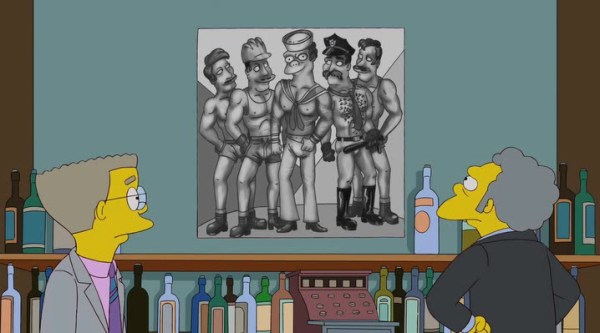
Discouraged by Mr. Burns’s fervent lack of respect for him, Smithers seeks out a new life venture, which he finds when he teams up with Moe to create a more accepting gay bar. But conflict arises when Moe misdirects his clientele into thinking he’s gay himself. Meanwhile, Skinner falls in love with the new music teacher for some reason.

The reaction: One of the things that discouraged me the most as this show went on was the squandering of its insanely large cast. With such an immense parade of secondary and tertiary characters, the number of stories you could do in the town of Springfield seems almost endless to me, but for whatever reason, the show seemed dead set on always having a Simpson take center stage in some regard. Meanwhile, most of the supporting cast wasted away until they became one-dimensional shades of their former selves. An episode like this has some immediate promise; pairing up two side characters and seeing their personalities bounce off each other is certainly an intriguing idea. When Smithers first walks into Moe’s and the two have a conversation, my interest actually perked up a bit. Maybe this could turn into something. But ultimately, it’s an episode that doesn’t really say anything or do anything all that interesting or new. The main thrust of the episode switches from Smithers to Moe fairly quickly; once their gentlemen’s bar opens, Moe pretends he’s gay to fit in, and Smithers becomes his nagging voice of reason, who only appears from that point on to pull him aside two or three times to confront him about it. It all felt like such a shallow conflict, and really meant nothing. There’s also this weird thing going on in the first half where they just won’t say the word “gay.” Concerning Smithers, the show at this point is still tiptoeing along the very edge of just flat out calling him gay; they finally “officially” outed him last season, I think, which felt like fifteen years too late. But Smithers and Marge both ask Moe, “Do these people think you’re really… one of ‘them’?” Like they’re another species or something. Then in the back half of the show, they champion Moe and urge him to run as the first openly gay councilman, and at that point, everyone just starts saying “gay.” It was quite strange. As far as episodes about homosexuality go, it’s nowhere near as offensive as something like “Three Gays of the Condo” was. The lazy, uncreative gay stereotyping is still there (something like The League of Extra-Horny Gentlemen feels so much less progressive than The Anvil from fifteen years ago), but it’s all so banal here. It was more boring than anything else.

Three items of note:
– The B-story is so flimsy and disposable, there’s not much I can even say about it. Mr. Largo leaves the school with his new lover (though I’m sure he’ll be back in future shows. We can’t afford to lose such an integral character like Lisa’s music teacher!) He’s replaced by Jennifer, some stereotypical hippie dippy woman. Skinner has a crush on her, for no explainable reason, and he enlists Bart to help him with his courtship: if Bart take Jennifer’s daughter out on a date (a girl we’d never heard of prior to this), Skinner could chaperone and get closer to her. What kind of plan is this, and why would he trust Bart to do this? But apparently, his asinine plan works, as over the course of a fifteen second exchange chaperoning the date, Jennifer says she likes Skinner too. When Bart breaks her daughter’s heart, Jennifer announces she’s leaving the school, and begs Skinner to go with her, which he does. Then the episode ends with Skinner returning from some kind of rave after being dumped. This premise of a major secondary character running off with the supposed love of his life takes up making a third of the episode’s run time, everything about it feels meaningless and incoherently rushed. Also, Jennifer is voiced by Kristen Wiig, at that point a major player on SNL, and her daughter by Alyson Hannigan, star of How I Met You Mother, so two pretty huge comedic actresses have their talents absolutely wasted in nothing roles particularly Hannigan, who gets barely three lines.
– We’ve been spending a lot of time at the school this season, and every single time we’ve seen Superintendent Chalmers there. This is a situation that cropped up in the last five or six seasons or so, as I guess the writers were so in love with Skinner-Chalmers interplay that they just had Chalmers at the school every day, all the time, even though he surely has other schools under his jurisdiction. He might as well be living in Skinner’s office at this point.
– Moe gestures to his wall of past failures to reinvent his bar: the English pub he ran with Marge in “Mommie Beerest,” his post-modern take in “Homer the Moe,” and Uncle Moe’s Family Feedbag, in “Bart Sells His Soul.” It doesn’t happen all that often, but it’s always sad and uncomfortable when you see a sling of references to past episodes, and they throw a classic one in there. It just feels so alien being put in sequence with a bunch of other junk.

One good line/moment: Like I said earlier, I actually enjoyed Moe and Smithers’s first scene together. It was fun at first seeing two characters who I don’t believe have ever had an interaction before have a conversation (“Can I have a scotch and water?” “My scotch is a scotch and water.”)