524. Dark Knight Court


Original airdate: March 17, 2013

The premise:
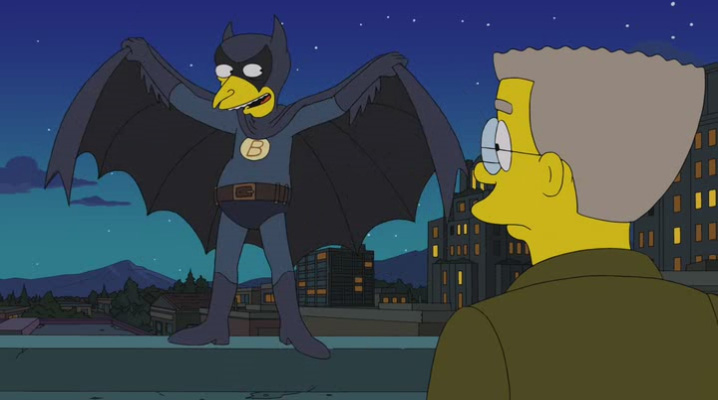
Inspired by a renewed childhood love of comic books, Mr. Burns adopts the superhero persona Fruit Bat Man. Meanwhile, an Easter festival debacle is blamed on Bart, leading to a mock trial with Lisa at his defense.

The reaction: Back in the day when I was still regularly watching the show, I remember reading about the upcoming episode “Simple Simpson,” featuring Homer as the superhero Pie Man, and thinking it was the dumbest thing ever. It actually turned out to be not that bad, but it’s a stroke of pure genius compared to this. Senile bucktoothed old mummy with bony girl arms Burns as a superhero? And him wanting to thwart crime and stand up for the little guy? He and Smithers randomly end up inside the Android’s Dungeon, he remembers reading comics as a kid, and he connects with a Batman-type character as a fellow billionaire misanthropic recluse, then he decides to be Fruit Bat Man! Smithers placates his beloved’s mania by paying people off and creating elaborately planned scenarios where Burns can swoop in, save the day, and be the beloved hero. When Smithers finally reveals he was actually orchestrating all of his heroic deeds, Burns is crestfallen. This isn’t like him helping him cheat at golf, this comes off as incredibly sad and pathetic. Burns may have his moments of naivety, but he’s a very ruthless, formidable character. There’s so many times in recent years where the easiest thing seems to just make him into a big joke, but it robs the character of his vital essence. But most of the episode is devoted to the trial plot, where Lisa defends Bart for some prank he didn’t do. It’s pretty damn boring. There was a Bob’s Burgers episode this season featuring a kids trial that had a pretty similar set-up, but that had characters that still have some soul and vitality to them. The ending features the two plots coming together (two episodes in a row, I’m shocked) where Lisa for some reason entrusts Burns in exposing the truth to prove her brother innocent, which he does. And then that’s it. And then they do an Avengers parody, but with all the old characters and they’re called the Dependables! Get it? Remember when this show had clever writing?

Three items of note:
– Janet Reno seems like such a bizarre booking as the judge of the trial. How many of the young people watching the show were even alive when she was a relevant political figure? Turns out Abe knows her from arguing in front of the Supreme Court (literally outside the building) when she was Attorney General back in 1998. From that, I guess they became pen pals for some reason. Also, the scene gave me “That 90’s Show” flashbacks of the show’s floating timeline wallpapering over the classic years. Abe (and Jasper and Crazy Old Man) look twenty years younger, but of course back in season 9, they were as old and cantankerous as ever.
– We have a montage featuring Burns thwarting “crimes” and the people Smithers has payed off to play along: Homer, Lenny and Carl (plant workers), Krusty, Sideshow Mel and Mr. Teeny (maybe they owe Burns money?), and the Crazy Cat Lady (a mentally ill person). Then we get to Burns’s house party, featuring dozens of people who Smithers happily hands out stacks of cash to. There’s also two hot young socialites who take Burns back to the hot tub. I sure hope they were paid the most handsomely of all. Again, the middle portion of this episode is Burns as a sad, pathetic old man who has no grasp on reality, a portrayal that feels so anti-Burns to me.
– I think this is the first instance of Lunchlady Doris being referred to as Lunchlady Dora. I think it wasn’t until a year or so later when her name was actually in print in an episode that fans bitched on Twitter, and one of the writers confirmed the name change was out of respect to Doris Grau. I still don’t get it. If was out of “respect,” why not keep her retired like they had for over a decade? Or create a new lunchlady character? If this is the excuse they’re using, then why not bring back beloved characters Roy McClure and Lenny Hutz, and have Hank Azaria voice them? Was Doris Grau any less of a respected performer to them as Phil Hartman?

One good line/moment: Witnesses are called to question Bart’s character, the greatest of which being Moe, who tearfully gets through his experience of being traumatized for years over Bart’s prank calls. It’s an amusing conceit, although as usual for this show, any humorous idea gets drawn out for twice as long, and then they bring it back again for a callback in the final scene. Good enough.

523. Black Eyed, Please


Original airdate: March 10, 2013

The premise:
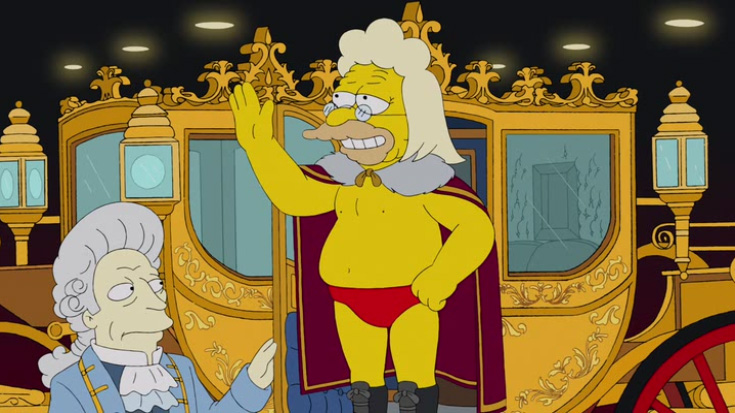
Ned finally reaches his breaking point with Homer’s boorish behavior and punches him in the face, leaving him wrought with guilt on how to make things right. Meanwhile, the new 2nd grade substitute Ms. Cantwell has an inexplicable hatred of Lisa, and Lisa is determined to find out why.

The reaction: Two more underwhelming stories to toss on the pile. What ultimately sends Ned off the deep end is Homer getting chummy (and getting high with) Ned’s parents. It seems like such a weird callback from fifteen years ago. With Ned’s deep-seated anger re-emerging, this felt like a spiritual sequel to “Hurricane Neddy,” an episode that I was conflicted on regarding Ned’s characterization. There’s not much of a build-up to Ned punching Homer, nor any real discussion about it being provoked from years of Homer’s abuse or anything. Instead, Homer lords it over Ned, claiming if he doesn’t fight back, he’s the better man. Then we get a scene where the town reacts to Ned as a monster and Homer a hero a la the third act of “Homer Loves Flanders,” except it isn’t earned at all. As for the B-plot, it’s just awful, probably the worst “story” we’ve seen in a long time. Lisa gets a new substitute, a woman who from the very start hates her. Just flat-out hates her. Vindictively. Yes, Lisa does come off as a suck-up at the start, but by the second half of the episode, she’s visibly traumatized by this woman. So the whole runtime it’s a huge mystery: what is this woman’s deal? I knew the payoff would be stupid and disappointing, but I wasn’t expecting how half-hearted it would come off. But if I can give the episode credit, it actually wove the two stories together: Homer decides to call it square with Ned only if his new wife Edna can help Lisa get rid of Ms. Cantwell (bonus points for actually showing Ned and Edna together as well). So Bart is transferred into her class, raises hell, and Ms. Cantwell takes off in her car. It takes Lisa clinging to her windshield to finally get a straight answer out of her: she hates Lisa because she’s pretty. That’s it. That’s the conclusion. There’s no build-up to this, nothing in her behavior that this clears up, nothing. I guess she’s just an emotionally disturbed woman who had a horrible childhood, and now decides to get her rocks off emotionally abusing an eight-year-old girl. I was expecting to be unsatisfied, but this was incredibly unsatisfying. And they got Tina Fey to voice her, what a gargantuan waste of a huge talent for such an awful character.

Three items of note:
– We get another couch gag from Bill Plympton, a black-and-white graphite piece of the Simpsons as film noir characters about to get into a skirmish. It’s kinda neat, but not as great as his last couch gag with Homer and the couch.
– Rather than explore the source of Ned’s rage more or talk about Homer and Ned’s long-standing relationship, we get a nightmare of Ned’s personal hell, full of guys in non-Jesus beards, spicy mustard, and a giant Richard Dawkins Satan. When Ned wakes up, he consults the Bible for advice, where we get Marvin Gaye playing as he scans through naughty passages talking about semen on the ground and whoremongers. Did a ten-year-old write this part of the script?
– Speaking of ten-year-old humor, here’s an awful joke. Homer has reservations about punching Ned, but he is insistent (“Come on, Homer, I’m insisting on a fisting!”) The camera pans out to reveal Smithers beside them (“What’s this about a fisting?”) You see, because Smithes is a gay man, and that means he enjoys the sexual act of fisting with another man! That’s what gay guys do, right? It’s funny because HE’S GAY!!! I was wondering why exactly this scene was happening at the plant, we see Ned with a little visitor’s badge on, and my sad, sad guess is that they came up with that Smithers joke, and decided to make the scene take place at the plant. Siiiiiiiggh.

One good line/moment:
– The bullies are astonished to learn Lisa’s teacher is a bully, as they didn’t consider that as a career option. Dolph is psyched (“Boo-yah! I’m gonna buy me a Hyndai Elantra!”) It’s only funny to me because I have that car. As well as a third of all the cars I see around Los Angeles.

522. Gorgeous Grampa


Original airdate: March 3, 2013

The premise:
The Simpsons learn more about Abe’s past, when he was the prim and proper wrestling villain known as Gorgeous Godfrey. As his biggest fan back in the day, Mr. Burns convinces him to make a comeback and fuel his hate fire, but Homer and Marge grow concerned when an impressionable Bart begins to imitate his grandfather’s awful behavior.

The reaction: Boy, we’re learning a lot about Abe’s past this season, aren’t we? He was a pretty boy wrestler? Like him being a songwriter at a jazz club, it just doesn’t make sense to me given what we know about Abe. Would the straight-laced man who booed at Woodstock and chastised Joe Namath’s luscious locks have been wearing his own gorgeous wig and showboating in the ring? Anyway, Mr. Burns randomly shows up to invite the Simpsons to his mansion, where he has an entire gigantic room devoted to Gorgeous Godfrey merchandise and paraphernalia. This also feels off to me; Burns being a wrestling superfan, who is surprised to learn that it’s actually fake? The point, I guess, is that Burns connected to Godfrey’s character, a rich, pompous jackass who reveled in the crowd’s hatred of him. Abe initially left the scene when the scorn became too great for him, but is wooed back into it thanks to Burns and a terrible song (more on that later). Despite being out of the game for decades, Abe seems just as fit and capable as ever. He’s fighting fellow seniors, but he’s in the ring doing spins and jumping up to tackle guys. Just look at that screenshot, he’s got nary a wrinkle on him. You’d think his age would be the easiest source of comedy for this episode, but it’s not even regarded. Conflict arises in Bart’s hero worship of his grandfather, as he adopts his showboating routine to his little league game and gets in trouble for it. Why would he be doing this though? We’ve seen Bart imitate things from TV before, but to do cool stuff for the adoration and amazement of others, like “Bart the Daredevil.” He revels in the attention, and the positive response of his classmates, as any kid would want. But to take pleasure in being outwardly hated, what sense does that make? And surely Bart is smart enough to realize that wrestling is all for show, and that the context is completely different. But I guess if Mr. Burns was surprised to learn that fact, Bart wouldn’t have known either. The ending is so cloying, with shots of Abe worriedly watching Bart behave badly, and then giving up his persona because of it (“My grandson’s soul is at stake!”) The Burns/Abe/Bart dynamic reminded me of “Curse of the Flying Hellfish” toward the second half, but I didn’t want to compare the two because it would be incredibly unfair. One of the greatest episodes ever, versus whatever this mess is.

Three items of note:
– We get a Harlem Shake video as our couch gag, and in a rare feat, they actually aired this when the meme was still relevant. I’m sure people at the time were pissed about it like the Ke$ha opening before it, but my annoyance comes more from the show just not trying to make a joke or a subversion or anything. It’s just them doing the Harlem Shake. Just play into what’s currently trending so we can get some press, please! We need press!
– We open with some Storage Wars bullshit, which feels born of one of the writers lying on the couch marathoning the show and not having any other ideas. All the characters put on shades before the bidding war, which I guess is a thing they do on Storage Wars. I guess? Again, parodies on this show used to work and make sense even if you haven’t seen the source material. The storage locker the Simpsons win contains old wigs and boas, and when they see it belongs to Abe, they jump to the conclusion that he’s actually been a closeted gay man this whole time. There’s a running “joke” involving Marge wanting to be extra tolerant for her own self-satisfaction of seeming progressive, which feels very strange given her normally open and loving character, and also because she already has experience with an openly gay family member. When Abe’s true identity is revealed, Marge cries to Homer, “I so wanted him to be gay!” So weird.
– Mr. Burns woos Abe back to the wrestling life the only way he knows how: through a song about how good it is to be bad. This is the first big song we’ve seen from the show in a while, and boy is it terrible. It didn’t help that I had just recently listened to “See My Vest,” and the two could not be more different. “Vest” is a song all about Burns’s enthusiastic mirth about skinning helpless animals for their coats, but that it’s a catchy, upbeat number (amongst other things) is what makes it funny. Burns has always teetered toward being a self-aware villain who revels in being evil, but there is usually always some sort of reasoning or context to his dastardly deeds. In this song, it’s just Burns singing about how much he loves being hated. It’s his Card-Carrying Villain song, with no other joke to it other than “I am bad guy.” Then when they quickly run out of ideas for lyrics, they just have Burns listing off pop culture villains like Megatron, Eric Cartman and Voldemort, despite his cultural knowledge normally not extending past the 1910s. Harry Shearer’s performance feels so half-hearted, and I really can’t blame him.

One good line/moment: The Simpsons walk in on Abe carefully putting the finishing touches on his army tank in a bottle. Pretty clever for a quick joke.

521. Hardly Kirk-ing


Original airdate: February 17, 2013

The premise:
After some horseplay with Bart leaves Milhouse mostly bald, making him looking just like Kirk, the two boys reap the benefits of being able to do adult things for once.

The reaction: With an abridged opening title, this episode barely creaks in at eighteen minutes, and it really feels like a chore getting there. With such a simple story with no real driving forward momentum, it’s just like a bunch of isolated gags that don’t feel like they’re going anywhere. The episode gets its mileage out of the worn concept of a kid trying to act like an adult, with a bald Milhouse and what appears to be a magical tie that, when pulled up against his throat tight enough, makes him sound exactly like his father. Then it just becomes a bunch of skits; they rent a truck, they buy the bullies booze and porno mags, they go to Moe’s, and they bully Homer on Skype, who for some reason goes along with whatever the normally passive pushover “Kirk” says. This then leads to the boys helping Lisa go to a trendy new jazz club with Milhouse as their surrogate adult. But even with an actual story twelve minutes in, it still feels a little aimless. Bart and Milhouse get into a fight at the bus station, with the latter shedding his adult disguise, in a confrontation that goes nowhere. Then, to get more money, they attend a condo sales presentation, comedic ground that feels well trodden at this point (South Park salted the Earth on that topic with their Aspen timeshare story in an episode over ten years before this). Also, we get an incredibly uncomfortable sequence of the presentation woman getting hot and bothered by Milhouse, and going to hook up with him in the closet, while Bart and Lisa, his “kids,” are there too. But then Homer and Marge find the kids, Kirk and Milhouse have a moment, and then it just ends. It felt like the underwhelming ending of “Changing of the Guardian,” where the writers just throw up their hands and abandon the episode. This series keeps barreling on through the years, but episodes like this makes me wonder if the writers really care about what they’re doing.

Three items of note:
– The opening features Marge tearing her children away from watching educational videos after finding out studies showing that they don’t actually enrich kids that much and may actually harm your kids more than help. This over-belabored setup feels like one of the writers had just read an article about this and decided to put it in an episode. It’s just so drawn out (“Wait a minute, didn’t Bart and I both watch this thing when we were little? Well the obvious question is, why did I turn out so… academically superior, while Bart…”) We get it. We all get it. This later works its way into the main story as Bart, Lisa and Milhouse go after their cash settlement for damages against the company. There’s also a sort-of B-story featuring Homer using his newly honed activity book skills of finding out-of-place objects in the real world, which I’ll admit was pretty cute.
– I noticed it in “Guardian,” and it happened again here, Luann Van Houten’s voice sounded slightly tinny, like it was recorded one room over or something. Did they have Maggie Roswell on a bad ISDN connection or something?
– Seriously, that ending with that horndog woman was really kind of disturbing. After an episode full of Milhouse saying and doing naive childlike things in adult situations, this felt like the ultimate cliche finale: kids don’t know what innuendo is! Plus, they kind of already did this, in the episode way back where Bart and Milhouse find Homer’s old censored Playdudes. But it all felt pretty gross. And there’s no reaction from the woman when it’s revealed she was about to fuck a ten-year-old. It felt like a bad and lazy version of what we’d later see with Vincent Adultman in BoJack Horseman. That show openly acknowledges the absurdity of the character, but also swings around to treating him seriously, so you’re never quite sure if he’s actually three kids in a coat or not. It crafted some really smart and funny sequences from this set-up, material this episode doesn’t even come close to whatsoever.

One good line/moment: The Homer finding out-of-place stuff I mentioned earlier was kind of enjoyable. I also like the sign gag for the book store (The Land of Forevermore: Closing in Three Weeks).

520. Love is a Many Splintered Thing


Original airdate: February 10, 2013

The premise:
Mary Spuckler returns to Springfield only to find that Bart couldn’t care less about spending any quality time with her. When she breaks up with him, Bart, along with his newly martially estranged father, must figure out how to win their women back.

The reaction: Ah, corporate synergy. Thanks to New Girl, Zooey Deschanel’s Mary is back for the second time this season. Everybody’s favorite character, right? Right? This episode serves as almost a mirror image of “Moonshine River;” instead of Bart pining away at his lost love and traveling across the country to get her back, here we see Bart actively ignore and disregard Mary, driving her away. It’s pretty bizarre, but ultimately it doesn’t matter, since there’s still been no indication of who Mary is and why this relationship matters. Like I mentioned before, Mary’s introductory episode “Apocalypse Cow” was not romantic; she and Bart were friends that ended up being roped into a hillbilly marriage by Cletus. In these two episodes, their relationship is being treated like this long-standing important thing that doesn’t exist. Lisa pulls Bart aside, chastising him, “You will not do better than Mary Spuckler!” Does Lisa know something we don’t? The entire first half of the episode features Bart failing to pass incredibly low bars in relationships such as giving a shit about the other person and basic human empathy. Again, the opposite of “Moonshine,” Bart acts like a normal, attention-deficient kid, not really knowing or caring how a relationship works. He seems to not give any less of a shit, but when Mary leaves him, he’s depressed and wants her back. Why? Why? Whhhyyyyy? The back half of the episode involves Homer being thrown out of the house after an argument with Marge, and he and Bart staying at a motel with other troubled husbands. How will they solve their collective predicaments? Homer has a solution: get inspired by movies! They watch a Love, Actually “parody” involving the mending of a relationship via a grand romantic gesture, and then that’s what they do. The wives are invited to the motel to a grand symphony orchestra playing as the men stand there in tuxedos with sad puppy dog eyes, and the women fall for it, hook, line and sinker. This show used to actively subvert typical sitcom and film tropes, exposing them for the hollow, unrealistic depictions of reality they were. But nowadays, they will openly uses said tropes, but try to get a pass by acknowledging the trope itself. It’s the same as when they attempt to excuse bad jokes or bad writing by making a joke that it’s bad. But that doesn’t make it good. It just reinforces to the audience that it sucks.

Three items of note:
– This episode features two instances of characters blatantly appearing in a scene to tell their joke and leave. They’re like drive-by appearances where they walk through the scene, spouting their joke as they go. First with Skinner joking that a caterpillar would actually give their Sloppy Joes some actual meat, and then later with Homer and Abe walking through a scene, saying they represent Bart’s best possible future. It’s so damn lazy. Why bother animating a walk, why not just have a character appear in a bubble on the screen to say their joke quickly and move on?
– There’s a wraparound device of Bart dressed as Woody Allen semi-narrating the entire story, moaning on and on about how he just doesn’t understand women and he’s out of his depth, and how he screwed up, blah blah blah. A caricatured Allen shows up at certain points through the episode as well to give him pointers. This all feels very strange and uncomfortable given Allen’s romantic history in real life. It gets odder at the end where we see Woody-Bart checking adult Mary’s Facebook and seeing it’s been changed to single (after her husband just died, no less). But, it still looks and sounds like kid Bart. What is this? Is this entire thing a reference to a specific Allen film?
– The show makes a joke about how Homer is basically a regular at the local motel and that Marge throws him out of the house on a regular basis. The undercurrent of this bit is incredibly sad. The only two instances of this happening in the classic years that I can recall is “Homer’s Night Out” and “Secrets to a Successful Marriage,” and in both instances, it’s treated fairly seriously, with both parties being devastated by their alienation, and actively working toward mending fences. Here, it’s just a big goof. Oh, that crazy wacky Homer and his nagging bitch wife! A marriage as thin as tissue paper!

One good line/moment: Mary’s Bossa nova-style break-up song to Bart is actually pretty darn catchy, and partially cathartic considering Bart’s constant negligence.