554. The Wreck of the Relationship

Original airdate: October 5, 2014

The premise:
Homer and Bart are forced into a conflict-resolution cruise to mend their strained relationship. Meanwhile, Marge takes over her husband’s fantasy football league, striving to win in order to put an end to trash talk.

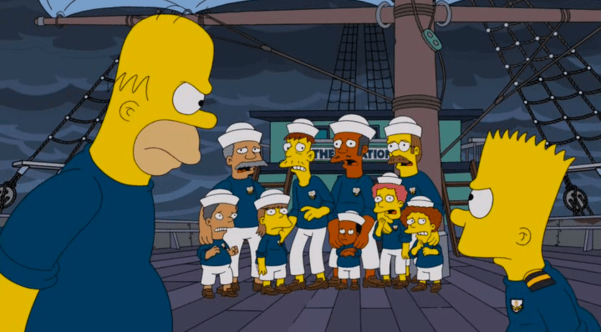
The reaction: Alright, a father-son episode! Surely this won’t be a repetitive, nonsensical affair bereft of characters acting like human beings. Homer is upset that Bart disobeys him, with the two getting into a stalemate regarding Bart eating a piece of broccoli at dinner. I like seeing these two so childishly obstinate about something so small, but they just drag it on and on and on. Fed up by this nonsense, Marge surmises there’s only one course of action left: she has her husband and son kidnapped in the middle of the night (why? Your guess is as good as mine) and hauled off onto a conflict resolution cruise called the Relation Ship. From that point, we got a montage, Bart grows an affinity to the sailor’s life, all the way up to being christened superior office, much to Homer’s chagrin. It really feels like we’re going nowhere fast, because, as usual, every scene is just the characters explaining what’s happening and what they’re feeling (“You’re my son and you will hate what I hate!” “I like being a sailor,” “He can’t order me around. I’m his father!” “He’s your superior officer, so he can and will order you around.”) For our big dumb ending, a storm comes out of nowhere, and Homer and Bart butt heads on how they should proceed (Homer is really adamant about dropping the anchor, for whatever reason.) Bart then presents a broccoli and eats it as a sign of peace with his father, which really surprised me that they actually tried to tie this nonsense back to the beginning, but it doesn’t really amount to much. What is the point? Everything felt completely empty to me, not that that’s anything new, though.

Three items of note:
– The B-plot is just as inert. Marge takes over Homer’s fantasy football team, and spends the first half of her story gasping repeatedly every time someone emails her some trash talk. Then she vows to beat the men at their own game, and then, over a montage with a sports announcer, she does. And that’s it. It’s just shameless filler, complete with a tiny sprinkling of fan service with Marge wearing Tom Landry’s hat from “You Only Move Twice” atop her beehive.
– The other families on the boat don’t fucking matter, they’re just set decoration. We’ve got Ned, Rod and Todd, Cletus and one of his kids (these two groups are the only ones with lines), Apu and one of the octuplet, Lewis and his dad, and… Arnie Pye and his teenage son? Boy, they must have been really desperate. Nameless extras are seemingly verboten in this series now. Seeing this line-up gave me flashbacks to “How I Spent My Strummer Vacation” with the crowd of familiar faces who paid a pretty penny to be a rock star, regardless of it makes sense for these characters to be there. How much strife could Apu possibly have with just one of his eight children, who is still a toddler? How could Cletus afford to be on such a cruise? Wouldn’t Chief Wiggum and Ralph be a more logical space-filler than Arnie Pye and his offspring we’ll never, ever see again?
– Nick Offerman plays the captain in an absolute waste of his talents. Giving him a character with a personality or some jokes I guess was too difficult. Also, he’s put out of commission in the last act after being tempted by some rum, where he desperately monologues just like Lionel Hutz back in the day, taken by the siren song of the brownest of the brown… what’s that? You want me to drink you? But I’m in the middle of a trial! …yeah, much more well done back then.

One good line/moment:
– I did like some of the sections of the broccoli stand-off. I found myself enjoying Dan Castellaneta and Nancy Cartwright’s interplay through most of it, especially when they were taunting each other to forfeit.

553. Clown in the Dumps

Original airdate: September 28, 2014

The premise:
Rabbi Krustofski kicks the bucket, and in addition to a comedy roast cutting him especially deep, Krusty has a crisis of conscious of what he should do with his life.

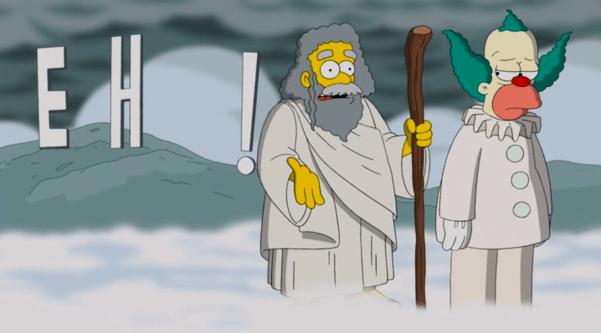
The reaction: Looks like it’s about time for Krusty to quit showbiz again. What’s this, the eighth time now? This episode is basically tenuously connected scraps of Krusty stuff we’ve seen before, most obviously “The Last Temptation of Krust” with him feeling alienated from modern-day comedians. Jeff Ross and Sarah Silverman are on the roster for Krusty’s comedy roast, and Krusty gets his widdle feelings hwut. But it’s not even like he goes through any kind of change where he’s game at first, and the jokes get too real and eat away at him. Instead, despite being a seasoned industry veteran, he seems bummed out the entire time, not understanding what a roast even is (“Nobody warned me this roast would treat me the same way as every roast I’ve seen and laughed at!”) What garbage writing. In “Krust,” we clearly saw that Krusty was a comic trapped in the past, whose old material didn’t connect with modern comedy sensibilities. Here, Krusty is sad just because. Bart appears later to go talk to his father to cheer him up for some reason, and when Krusty visits the rabbi at the temple, he ends up dying in mid-sentence. I guess like Mona Simpson dying with her eyes open, it was just regular old age, like God just came down and took ‘im. Krusty is haunted by his father’s interrupted last word of “Eh…” on whether he thought he was funny, and ultimately quits his show because of it. He spends the rest of the episode being sad and explaining why he’s sad over and over. How do we wrap this nonsense up? Bart takes Krusty to the temple of his father’s rabbi, which he just happens to know, I guess, and finds that he is using Krusty’s old jokes in his sermon, ergo, he did think Krusty was funny. Sure, that works for an ending, why not? Rabbi Krustofski was one of the show’s legacy characters who made one or two legendary appearances in the show’s prime, and then later was trotted out multiple times for fan service purposes. We’ve heard Jackie Mason’s increasingly weakening voice several times over (him straining to sing the poorly written Jewish Heaven song at the end was kind of sad to hear), but as we just saw with Glenn Close, not even killing the character will keep them from dragging them back for more. And really, what else have we learned about the good rabbi in these other appearances? Absolutely nothing.

Three items of note:
– This season premiere had a bit of buzz going into it that I recall, as the writers were incessantly teasing the “death of a recurring character who is voiced by an actor who won an Emmy for the character.” Al Jean and company were quoted a bunch, beating around the bush about how it could possibly be anyone, but I wasn’t buying that shit. I saw through this publicity nonsense fifteen years ago with Maude Flanders, and that’s when I still tolerated the show. Maude may have been a tertiary character, but at least she had a bunch of episodes under her belt, plus her direct connection to Ned, one of the main secondary characters. From the info they teased, and the fact that it was a Krusty episode, I thought it might be Rabbi Krustofski, and thought, wow, if this is who they’re killing off, that makes this gimmick even more hollow and meaningless. And that’s what they did. But I get it, at this point, every year or two, they’ve got to do something of note to get some minor press. They did the LEGO episode, and then every other season, they can acknowledge a milestone, like the recent 600th episode. It’s just a “Hey! We still exist!” where everyone pretends to still like the show, and then right afterwards goes back to avoiding it like the plague.
– The B-plot was very, very scarce, and felt very strange tonally. Krusty’s speech at his dad’s funeral about how death can come before you know it gets Lisa worried about his own father’s poor health and seemingly fast-approaching demise, and she, of course, narrates everything she’s feeling (“Dad, I’m worried about your health. I don’t want to lose you!”) Later on, we get a scene of Lisa overseeing Marge struggling to keep a breathing mask on Homer’s face as she sleeps, an overly long sequence that feels more depressing than slap-sticky fun. It makes me feel sad for all involved; compare this to Lisa’s similar worry in “Bart’s Friend Falls in Love,” instead of a light, absurdist touch with quick flinging jokes like the Good Morning Burger or a dream involving lowering Homer’s carcass into his burial plot with a crane, we get this depressing scene of a woman desperately trying to tend to her sick husband who’s gasping for air. This plot ends with Lisa wrapping Homer in bubble wrap to protect him (again, it’s really sad to see a little girl this paranoid in worry about her father dying), and then her precautions being vindicated when Otto crashes the school bus through the backyard and into Homer, and the bubble wrap buffering the blow. And then that’s it, I guess. What a waste of time. At least it was short.
– Minutes before the end of the episode, Krusty awakens from a drunken coma, having just had a vision of his father telling him to help people and do good unto others. Then we see him open up a new animal shelter. A reporter chimes in with an expertly written question (“Krusty, have you fulfilled the promise you made to your father in the dream you never told anyone about?”) It’s the equivalent of making a joke about how a joke they just did isn’t funny. Krusty responds, “Somehow, a brief act of uncharacteristic generosity solved nothing.” This is intolerable. It’s like the writers are incapable of pushing a plot forward without characters explicitly say exactly what is happening. Again, I might as well be listening to an audio book.

One good line/moment: Another guest couch gag, this time done by surreal independent animator Don Hertzfeldt, probably best known for the Rejected short films, which I remember being quoted ad nausea at my high school back in the day. The couch gag bears resemblance to that film, as we get a glimpse of the future incarnation of the series, where the Simpsons have been reduced to black-and-white, grotesque, barely coherent, catchphrase-spewing creatures. It runs a little long, but at least it was something different. Can’t they just let Don Hertzfedlt or Michel Socha or Bill Plympton make a whole episode?

552. The Yellow Badge of Cowardage

Original airdate: May 18, 2014

The premise:
Bart becomes a town hero for winning the annual last day of school race, but he’s wracked with guilt over it being a sham. He actually won by accident after Nelson attacked front-runner Milhouse, which Bart did nothing to try and stop. Meanwhile, Homer works with a childhood hero to create a magnificent 4th of July fireworks spectacular.

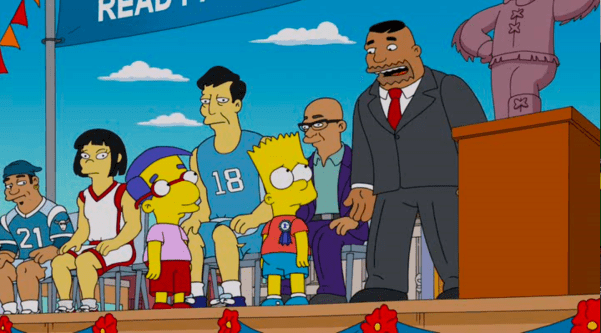
The reaction: Boy, what a whimper of an episode to have as your season finale. Springfield Elementary has an end-of-the-year race that the entire town holds in high regard for some reason. Remember when the school was a dumpy embarrassment? Milhouse trained hard for this, is in the lead, then the bullies, who had been taking bets on the winner, get worried that they’ll have to pay off Martin, who overheard Milhouse’s rigorous training and put down a huge bet on him, so they must sabotage the race. Why would they feel obligated to pay Martin at all? They’re fucking bullies. So Nelson corners him in the woods, beats him up, and Bart turns away and does nothing, as seen in an overly dramatic fashion. Then he ends up winning and feels guilty of taking the glory from Milhouse. It feels so belabored. Meanwhile, Homer teams up with an old hero of his, the man in charge of the annual fireworks display, to put on a big show, so that kills some more time. The two plots intersect at the show, when Homer and old man get into a fight for no reason, and the barge they’re on tilts perfectly ninety degrees, leaving the fireworks pointed directly at the crowd. How the hell is this happening? And is this supposed to be a moment of tension? You can’t have silly cartoon physics and expect us to treat this as seriously simultaneously. Bart views this as a way to redeem himself, and he drives a bus in front of the incoming fireworks, saving the day, and having Milhouse take the credit. Through this episode, we’ve seen two groups of crowds, one at the ceremony awarding Bart, and the other at the end on the beach. When Bart admits the truth about the race, the crowd fiercely boos. Agnes yells, “Bart’s a coward!” Krusty follows up, “He lied to us!” Forget why the whole town gives so much of a shit, but why are they saying this? Why the fuck does every single character just announce what they’re feeling or repeating what’s going on with the plot? It’s the same shit at the end. The crowd is saved from being set on fire, and Lenny, calm as can be, unprompted, to no one in particular, asks, “So who’s our hero?” When Milhouse exits the van, Sideshow Mel chimes in, “Milhouse is our unlikely savior!” Then a guy in the crowd yells, “Quit explaining everything!” Well, I guess we can chalk this up as an awful trope that the writers acknowledge is terrible, but will continue to use regardless. Is it too much to ask that maybe in the coming seasons, we’ll see a little bit less of this endless incessant over-explaining expository dialogue every single goddamn episode? Is it?

Three items of note:
– The couch gag features the family running into a panel at Comic-Con, and Comic Book Guy asking if there will ever be another movie. The joke, I guess, is we see that everyone but Maggie has fled after the question is asked, leaving her worried. Or embarrassed. I can’t tell. But it’s basically a joke stolen from a Futurama episode four years prior, where Bender asks the same question to Matt Groening’s head in a jar, who fires a laser at him in response.
– Lisa serves as narrator for two bland, down-to-earth stories, because I guess the characters always saying exposition is not enough, we have to have a narrator do it too. A perfect example of how shitty this is is near the start of the B-story. Homer seems particularly emphatic about demanding the fireworks show must go on despite town budget cuts. We flash back to a young, starry-eyed Homer watching the night time festivities, and behind him, out of view, we see his parents angrily bickering. Lisa explains, “It was the one night of every year that he couldn’t hear his parents argue.” Alright, fair enough, I can get behind this, I understand. But wait, let’s make it even more clear! Lisa continues, “He figured it was because they loved the fireworks just as much as he did!” Then we bring Glenn Close back to say a handful of words as we see Mona and Abe complain. Then later, she’s gone, and we get more sad, pathetic single parent Abe like we saw from that horrible dog show. And then it keeps going, and Lisa explains even more (“With his mother gone, Homer needed a hero, and no one was more of a hero than the magical little man behind the controls.”) I could watch this show with my eyes closed and understand most of what’s happening, it’s like I’m listening to an audiobook with all of the shit they openly explain.
– Another sequence ruined is when Homer and old man get boxes and boxes of fireworks from… somewhere, and they’re strapped to the hood of the car. “Now drive slowly and carefully…” old guy says. So we’re setting up this sequence where he drives through some rough and dangerous areas that could set off the fireworks. Alright, there’s some smirk-worthy comedic potential there. But, for whatever reason, the characters narrate what’s about to happen before each joke happens (“It’s in the cobblestone district.” “Oh thank God, a rickety bridge!” “We’ll be safe in the gas lamp district.”) Are they doing this show for radio? Why are they explaining everything we’re seeing? I keep asking this over and over, but I honestly don’t get it. Why? Why? For fuck’s sake, why. Toward the end of the montage, we see a barrel catch on fire, and then when they park, Homer throws his cigar on the pile, and then nothing happens. But it’s not even like the joke is that nothing happens, like Homer lighting the grill in “Lisa the Vegetarian,” they just move onto the next scene. Terrible.

One good line/moment: I kind of liked Homer’s enthusiasm about fireworks at the start, and like I mentioned, the idea behind his childhood nostalgia for it (“The Fourth of July is the one day a year our city puts on her high heels and tube top and leans into America’s car window! God bless her!”)

NOTE: I’m going to be taking a break next week, I’ve got a lot of really important stuff on my plate, so my holy crusade through yellow-toned muck will have to wait. I will return though, don’t you worry…

551. Pay Pal

Original airdate: May 11, 2014

The premise:
Marge melodramatically concludes she’ll never have any adult friends, and not wanting her daughter to suffer the same fate, she pays a little girl to spend time with Lisa and pretend to have similar interests.

The reaction: I feel like there have been a couple episodes of late featuring Marge acting kind of horrible and manipulative, but this is the worst of all. When she gets invited by some new neighbors to an adult game night, it starts off like “Scenes From the Class Struggle in Springfield,” begging and pleading with Homer to be on his best behavior. He’s been pretty restrained from his insane wild outbursts the last few seasons, so it felt like a little too much on Marge’s part. The man of the house (John Oliver) introduces an incredibly elaborate murder mystery game, then Homer unintentionally ruins it by reading his card and saying who the killer is. It was an honest mistake, but the host reacts by angrily slapping him, which Homer then retaliates, and after a very brief scuffle, the guy tosses the Simpsons out. Despite the neighbor physically attacking her husband, Marge is pissed at Homer, which then turns into passive-aggressive resignation (“I think it’s time we learned to live with being ostracized. I give up.”) Then, halfway through the episode, we switch gears to Marge wanting to get Lisa a friend. What happened to her new “Starving Games” friends from last episode? Lisa’s characterization waxes and wanes nowadays, she’s either a content, sometimes smug loner, or a sad girl desperate for attention. Here, she’s the former, so Marge’s efforts are really just a projection of her own yearning for companionship. One day, Lisa pairs up with some Asian girl (who is never given a name throughout the entire episode) who just so happens to share all of her interests, and a suspicious Bart discovers that Marge is paying this child to be her friend. This is really fucked up. Like, really fucked up. Can you imagine how humiliated you would feel if your mom did this to you? A teary eyed Lisa confronts her mother and runs off crying. So we got two minutes left, how do we resolve this? Abe conveniently tells a story about how he paid a young Lenny and Carl to befriend Homer, and still does to this day, to which Marge responds, “That makes me feel better!” Why? Because someone else did the same horrible thing you did? When she leaves, Abe admits his story was bullshit, but I’m not sure if he told it to make Marge feel better, or because he’s a senile crazy person. Okay, so our final confrontation. Marge goes to Lisa’s room, and she’s still pissed. Lisa angrily tells her mother she’s going to tell future psychiatrists what she did, which makes Marge cry. Then we get some inner monologue from Lisa, because even when the character’s aren’t talking, their minds will speak the exposition instead (“Wow, I made Mom cry! What unimaginable power! I could use this to get anything I want! But, right now, all I want is for Mom to stop crying.”) The dialogue on this show just keeps getting worse and worse. The two have a sobby reunion, Lisa apologizes with reasoning that makes no sense (“It’s funny, but hurting your feelings made me feel better,”) and Marge never apologizes or shows remorse or even understands why what she did was incredibly shitty and embarrassing to her eight-year-old daughter. And Lisa wishes her a happy Mother’s day! Marge is supposed to be the family rock, a never-ending source of love and encouragement for her husband and children, so seeing her deceive her own child, especially Lisa, and not even acknowledge how wrong it was, was pretty hard to watch.

Three items of note:
– Marge meets neighbor John Oliver at the Evergreen Terrace Block Party (“Two Bad Neigbors,” anyone?), where he tries some of Ned Flanders’s famous No-Alarm Chili (“You can only taste the spoon!”) I can’t think of a more apt direct compare and contrast for the degradation of a character. Of course, in “The Mysterious Voyage of Homer,” a crestfallen Ned must admit to Homer that his five-alarm chili is merely two alarm, two-and-a-half tops, and he just wanted to impress his two boys. What a wonderful moment; embellishing the truth to look like a big shot to his beloved children at a local carnival. It’s almost like he’s behaving like a normal, flawed human being. Nowadays, one of the only two or three legally acceptable jokes for Ned is that he’s a gigantic wuss, so the gag is that his chili is the blandest ever made. I thought back to “Viva Ned Flanders” for what we can blame for this character turn, with Ned preferring plain white bread in rejection of chunky or smooth peanut butter (with a glass of water on the side for dipping!) But the point of that episode was to exaggerate Ned’s overly cautious lifestyle, which led him to want to put some spice into his way of living. But, as we’ve seen with “Lisa the Vegetarian” with Lisa, “Homer’s Enemy” with Homer, “The Old Man and the Lisa” with Mr. Burns, and so forth, the writers pluck these character traits out of context and infuse them into the characters regardless. So now that’s just who Ned is. And it’s terrible.
– Shauna appears as a cashier at not-Trader’s Joe’s, and her scene ends with her forcibly making out with Gil. Sigh. This is the last time I talk about this awful character. The joke is she’s a little whore! She’s like a younger version of Mrs. Muntz. Also, I have to circle back to the age question again; she attends Springfield Elementary, and like the other bullies, her age is nebulous, but she has to be somewhere in her teens, and definitely under 18. It was creepy and weird to see her repeatedly suck face with Bart, but for her to make out with a sixty-something year old was incredibly disturbing. And also, why? What’s the joke here?
– There’s a scene in this episode that is just unbelievably bad. Homer and Marge are in bed, and Marge laments the fact that they have no adult friends. Firstly, it’s a carbon copy of a similar scene from “A Milhouse Divided,” which I don’t besmirch them for, except that instead of them talking like real people, they’re just sitcom joke spitting machines. But through the scene, we cut to Lisa, then Bart standing at the bedroom door. They appear, say the over-explanatory “joke,” and then leave the scene. It’s the worst version of this trope of characters randomly appearing I’ve seen yet. And all these characters aren’t having a conversation. They’re just saying dialogue. Lisa says she’s doing just fine without friends, then she leaves, then Marge repeats what she said to the audience (“Okay with no friends? That’s the saddest thing I can imagine my daughter saying to me.”)

One good line/moment: The opening Itchy & Scratchy starts as a parody of Ratatouille, where a little Itchy hides under Scratchy’s chef’s hat and puppeteers him to mutilate himself. I was pretty shocked, because for once they were actually doing a clever parody, and not just trying to get brownie points for making a culturally relevant reference (to a seven year old movie, but still). Unfortunately, the cartoon runs twice as long as it needs too, and as usual with Itchy &Scratchys these days, it becomes unnecessarily crude and gross with no real humor to it. Also, for some reason, Bart is watching this in the kitchen on an ancient looking portable TV that looks like this. I couldn’t understand why, but thinking back on it, I think I got it. They do a joke where Marge and Bart try to drown each other out, with Marge turning up the food mixer and Bart turning up the TV. But if Bart was using a tablet or a laptop to watch the cartoon like any modern day kid would, that joke wouldn’t be as easy to communicate visually than if it were an old TV with a knob on it. So, instead of thinking of another joke that would have made more sense, they give Bart an old TV to watch. But why did they give him such an old looking TV? I had a portable TV as a kid that just looked like a small tube TV. Was this an in-joke? I don’t get that bit. Hm. Looks like this section that’s supposed to be positive turned pretty negative. Oh well. It was a shit episode anyway.

550. Brick Like Me

Original airdate: May 4, 2014

The premise:
Homer wakes up in a world entirely made of LEGO, but he begins to get flashes back to his flesh-and-blood reality featuring he and Lisa finding common ground through building playsets together.

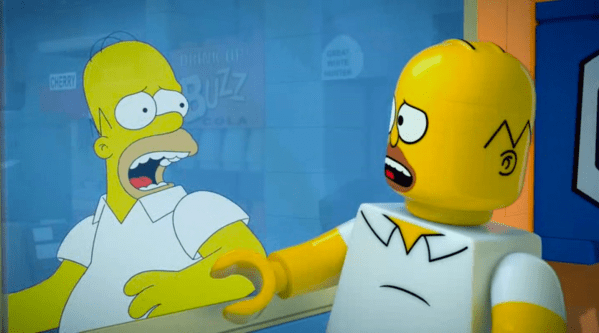
The reaction: “It’s not selling out, it’s co-branding!” Whatever lets you sleep at night, guys. This Homer line opens the show, as this episode was meant to coincide with the release of the new Simpsons LEGO figures and sets. But, to this episode’s simultaneous benefit and detriment, it also came right off the heels of the wild success of The LEGO Movie. Despite it being written and directed by super geniuses Phil Lord and Chris Miller, the brilliant minds behind Cloudy with a Chance of Meatballs and Clone High, most people weren’t really expecting the movie to be as absolutely astounding as it was. It surely reignited people’s love of LEGO, so that probably helped this episode coming out during the wave of it. But, it also leaves the episode in a weird place where all their cute LEGO jokes and sight gags are kind of unconscious retreads of material from The LEGO Movie, except not as sharp or gorgeous looking. But there’s no real point to comparing the two, so let’s drop that and look at this episode for what it is. With pretty great looking animation and a shocking amount of jokes that actually land, this is definitely the strongest episode I’ve seen in years, but a mostly shit script holds it back from any further notoriety for me. Even in CG-animated LEGO form, the never-ending problem of characters reiterating the plot and saying how they feel aloud is in full force here, in particularly obnoxious fashion. In the real world, Homer bonds with Lisa over her LEGO sets, but is hurt when she blows him off to hang with some older girls. So he takes refuge in his coma-induced LEGO world, where “everything fits with everything else and nobody ever gets hurt,” a line that is repeated verbatim at least five or six times. As he talks with others and bonds with Lisa, Homer continues to explain what’s happening and say exactly what he’s feeling over and over again. His epiphany comes from realizing “the fact that kids grow up is what makes time with them special.” How do I know this? Because he just says it, and in the previous scene, he monologues all of the things he’ll never do if he’s stuck in the toy world. We don’t see Homer getting bored with doing the same thing day in and day out, or have a realization based on something someone else says; the only thing the writers can do is have Homer literally say what his conflict is, what he feels about it, and how he can fix it. In the limitless imagination world of LEGO, the storytelling is still stuck in one dimension as always.

Three items of note:
– This episode also suffers a little bit in comparison to a similar episode of Community that aired around the same time, wherein a 40-year-old Jeff Winger goes into a coma, taking refuge in a G.I. Joe-styled dream where he can revel in his nostalgic youth forever. It features cartoon Jeff getting flashes back to his life-action self, as well as acknowledging that they’re all just action figures, similar to the moments in this episode where LEGO Homer gets flesh fingers and gets flashes of his ink-and-paint “real” world. “G.I. Jeff” is a thousand times better written than this slop, so that doesn’t help.
– The scenes in the real world are written even worse than the LEGO stuff. Homer finds himself enjoying playing LEGO with Lisa, and spends an entire scene expositing that fact. Later, he walks in on her hanging out with three older girls, who all get their own dialogue explaining why they’re there, because hell if I know. They’re bonding over “The Starving Games” book series, and boy, I wonder what that’s a parody of? Terrible, just fucking terrible. The ending tag features them going to see the movie, where they show it’s just a trifling love triangle that the girls are going apeshit over. I’ve seen the movies, haven’t read the books, and I’m not, nor have I ever been, a young girl, but I don’t know if that’s the biggest appeal of this series. I’ve seen a couple other parodies that hinge on Katniss and the two guys, but it was never really a huge critical part of the movies. Maybe one of the writer’s daughters are all about the romance angle and so they wrote it that way, but it felt a little reductive to have the only parody angle be that The Hunger Games is just like Twilight, part two.
– It really is impossible to watch this and not think about The LEGO Movie. The ending with Bart showing up in his giant robot, hodgepodged together out of various in-congruent styles and franchises felt exactly like the finale of that movie with Emmett and the gang building their machines to fight back against Lord Business. I don’t know the facts, but I’m pretty certain all of these similarities are unintentional, but it still stings a bit when they lampshade it at the end, as Homer describes his adventure (“I had this crazy dream where I was in a world made of LEGO bricks and learned important lessons about parenting!” “Isn’t that kind of the plot of-” “No it’s not! It’s a new plot.”) As usual, pointing out your shitty writing doesn’t make it any less shitty.

One good line/moment: This is always a struggle, at times an impossibility to pick out something I actually enjoyed, but as I mentioned, this is easily the best episode they’ve done in a while, with a lot of gags that worked. My favorite scene was the church with Lovejoy, which was strong through almost the whole thing (“What if everything isn’t made of plastic? I think there’s more to this world!” “You mean, like decals? The Orthodox don’t use them, but we are a reformed congregation.”)