599. The Town

Original airdate: October 9, 2016

The premise:
In the midst of a heated Springfield-Boston football rivalry, Bart’s Beantown allegiance infuriates Homer, prompting him to plan a family vacation to Boston to convince his son the town sucks.

The reaction: Vacation episodes normally have some kind of larger character story going on alongside the sights and sounds of dropping the Simpsons into new surroundings. As time went on and the family jumped from continent to continent, the stories became looser and looser as the aim became to just make a bunch of jokes and references to other places. This episode feels like the ultimate example, a Bostonian love letter that I hope the people of that good city enjoyed, because I barely understood any of it. I’ve never been to Boston, and there are just so many one-off characters and locations and lines of dialogue that I really don’t know what to make of, because I can’t tell if they’re Boston references, or just the usual breed of inane nonsense this show normally trots out. When Boston beats Springfield in football, Homer is shocked to find Bart wearing a Boston hat. Unable to sway his allegiance, Homer arranges a trip to fuel his hate fire. This episode feels so inside baseball, like I said, there’s a lot of this I can’t tell if they’re supposed to be jokes or not, and that’s not really a good sign. They sure got their mileage of funny accents though, as it seems like everyone they meet has the strongest Boston accent and they’re taking full advantage of it with the dialogue (“pahk my cah in the yahd” type stuff.) So Homer hates Boston just like New York City, except with a flimsier rationale, but all it takes is him to play candlepin bowling and he’s completely won over. Lisa is won over by their arts scene, Marge by their local healthcare, Bart is a fan from moment one… man, Boston is just so great, they decide to move there! Between the loving recreation of all the landmarks and the Simpsons talking about how great everything is, this feels more like something Boston can use for their tourism campaign than actual satire. Bart quickly learns Boston is not the criminal slum he hoped it would be from his favorite movie The Departed (???), so he wants out. He incites Homer’s rage at a parade, goading him to putting on a Boston hat, but he snaps instead. But why is Homer so mad? His hatred of NYC was irrational, but it was also very consistent, hilariously so up until the end. If his emotions can turn on a dime after learning candlepin bowling lets you bowl thrice instead of twice, then who cares? As I say again and again, we’re at the point where characters can just change emotions at the drop of a hat, so the show has completely lost its ability to have any sort of tension or emotional investment. When Homer struggles to put the hat on, and when Boston-loving Lisa growls at Bart for putting him up to it, why am I supposed to care? What’s at stake? Why is this happening? Who cares?

Three items of note:
– Even though I couldn’t pick out a lot of the references, I could still recognize that they weren’t really jokes. Bart shows Lisa a clip of a crime movie set in Boston, where three guys prepare for their heist, but not before they all take a swig of their Fribble shakes. Fribbles are a staple of Friendly’s, a diner/ice cream shop chain based in the Northeast, and having grown up in New Jersey, I recognized that. But that’s just it. The “joke” is literally, here a thing you know. So much of this episode felt like let’s just cram in as many identifiable Northeastern U.S. things as possible. It’s pushed to the limit at the end where we get a bunch of shots of a crowd at a parade as we see a bunch of pop culture figures hailing from Boston. Conan O’Brien, the cast of Cheers, Steven Tyler, Michael Dukakis (who I only recognize because he’s wearing a tank costume), Mark Wahlberg and Ted the teddy bear… there’s also someone who’s a ghost? There’s at least twenty others I can’t recognize, is this supposed to be like freeze frame fun? Count the references! We couldn’t think of any jokes, but we could look up “celebrities from Boston” on Google!
– Speaking of references, Homer’s love of Boston is cemented with him taking a roll at every bowling alley in town, in a montage set to Bob Dylan’s “The Man in Me.” You know, the song used at the beginning of The Big Lebowski, which also played as people bowled? Again, I ask, what am I supposed to laugh at here? That they’re using the same song in the same context? Comic genius!
– Bart’s love of Boston stems from him wanting to be a “Southie,” whatever that is, and wanting to join the Irish mob. He tries to get in detention at his new school to find a gang to run with and pull off jobs… it all felt very strange. And it’s not like they’re playing off his naivete with anything, or making any kind of point, other than Boston in this reality is sanitized and cultured. Seeing Bart be so eager to get into a life of crime felt kind of uncomfortable for me. We’ve seen dream bubbles of him being a drifter or breaking the law, but to dwell on it this much to make this ten-year-old’s main motivation to join a gang… something about that feels unseemly.

One good line/moment: There were a couple sections of this episode that sported some more fluid animation than we’ve seen in a long time, most of which being Homer getting angry at Bart, and later at the end as he twists with rage and tears the hat in two. I would say I liked it, but it was almost jarring seeing this greater animation after years of bland nothingness, and only for certain scenes. Plus the acting was all flimsily motivated, but that’s the script’s fault, not the animators.

598. Friends and Family

Original airdate: October 2, 2016

The premise:
Discovering the wonders of VR technology, Mr. Burns hires Marge and the kids to serve as his simulated family. With an empty house, Homer forms a friendship with a like-minded woman from the neighborhood.

The reaction: Last episode I kept wondering why Burns was being so accepting of the Simpsons. Now I find myself wondering the opposite. Burns auditions people to be his virtual reality family, and of course he chooses the Simpsons. But he only needs Marge and the kids, since he will be serving as the patriarch. Then we go right to it, suiting them up in mo-cap outfits to shoot their scenes. No discussion as to what he’s paying them, why Marge would agree to this, nothing. This gets even more ridiculous when Burns tells them he has an option to keep them with him for ten years. Cut to his guest house where Marge is talking to Homer on the phone, where she tells him how he can keep himself busy by cleaning the house. Are they indentured servants now? Can they never leave the house? Why did Marge not read over the contract we didn’t see them sign? And again, why on Earth would she agree to any of this? One of the VR scenes features Burns’ excitement to bring Marge to the bedroom for his birthday present, where we see her disrobe and him lustfully glaring at her virtual nudity. What in the ever loving fuck is this? This show has been so woefully broken for so long, but we’re at the point where they don’t even bother with set-ups anymore. Apparently those details don’t matter, because seemingly it’s just the excuse to get Homer alone in the house and to meet Julia, the woman who lives behind their house, and the two to form a friendship. Over half of the dialogue in their scenes is Homer wondering if it’s okay to have a female friend, and him repeatedly saying they’re just friends over and over to gawking on-lookers, because apparently in the year 2016, it’s a radically subversive concept that a man and a woman can be friends. Did Mike Pence write this episode? With the Burns plot going nowhere fast, the Homer story becomes our sole focus. When Marge and the kids return home after an indeterminate amount of time (it had to be at least a couple of weeks), the only thing they care about is who this woman is on the phone with Homer. Marge goes ballistic, but then Julia (just now being given a name at the end) shows up to exposit Homer out of trouble (“I just wanted to introduce myself and tell you you’ve got a great husband.”) And that’s it! What a fucking mess.

Three items of note:
– As much as I complain again and again on this show’s crippling reliance on over-explaining its jokes, there are still bits that make me shake my head in exhaustion. This is a perfect example: Smithers is explaining that the VR headset has limited software since it’s so new (“At the moment, it’s really just lots of pornography, a roller coaster, pornography, pornography…”) Already this joke is pretty old hat. Wow, people using the Internet to jerk off? What fresh satire! Smithers pulls up a fantasy setting where two dragons fly in, seemingly to duke it out, but then, the pink one addresses camera (“Dragon porn!”) and the two start making out. Wouldn’t it have been “funnier” if they had built it up like they were going to fight, and then you get the surprise of them kissing? They ruined their own set-up by prefacing it! And it that weren’t enough, after ten seconds of watching dragons mack on each other, Smithers cuts in, “Sorry, sir, this one is also pornography.” Why did they need to say it again? This entire thirty second bit is just them explaining what the joke is three separate times.
– As with last episode, Mr. Burns doesn’t go through any kind of story at all. His therapist urges him he needs a family to have a fulfilling life, which he scoffs at. Later, when he gets enamored by VR, Smithers repeats this, and they come up with the idea of a virtual family. Through all their scenes, Burns doesn’t seem all that thrilled with actually having family members who care, acting indifferent at best. Then, toward the end, he just decides he’s sick of it and fires the Simpsons. So, he never really cared about family, had one, then got rid of them. That’s not a story. He wanted to make up for his humiliation at the Bowl, suffers the same humiliation again, then just decides he’s over it. That’s not a story either.
– The ending is so artificially manufactured, it’s truly tremendous. There’s no emotional build-up for a Homer-Marge story throughout the entire episode. The family is gone from the house for weeks or months without any real discussion about them missing each other, or how often they stay in contact, or anything. So when Marge and the kids return home to Homer, they both seem pretty disaffected toward each other. Marge instantly locks on to the Julia scenario, and goes from zero to sixty immediately. She hustles the kids from the room, knocks over Homer’s TV tray, and angrily storms him around the house with him repeatedly backing up in terror (“Homer Simpson! After all I’ve put up with for all these years, if I’m not your best friend then what is this marriage about?!”) Stuff getting knocked over, Homer tripping over furniture and getting genuinely frightened at his wife… this is the point where the cops would get called. And this is coming from Marge! After that, Julia just happens to walk in and gives that exposition line I cited earlier, and the situation is quickly diffused. None of these characters have felt like actual characters for years now, and shit like this is the reason. Characters will just start and stop having emotions on a dime. Whatever plot contrivance is needed, they’ll just perform, like soulless marionettes.

One good line/moment: Nothing. I hated this one too. The season just started and these first two episodes honestly feel like the worst I’ve ever seen.

597. Monty Burns’ Fleeing Circus

Original airdate: September 26, 2016

The premise:
Following a town wide catastrophe, Mr. Burns agrees to foot the bill to rebuild Springfield in exchange that he put on a children’s variety show, hoping it will help him live down a traumatic event from his past.

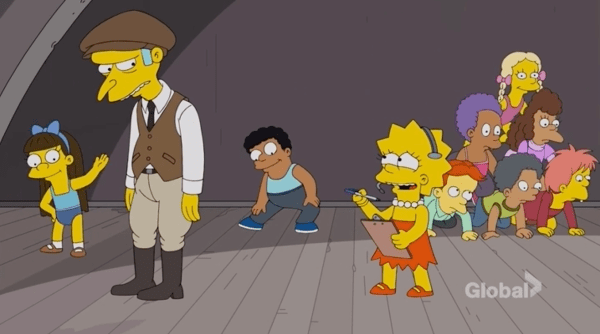
The reaction: To me, the biggest character casualty outside of the Simpson family over the years has been Mr. Burns. Springfield’s very own heartless plutocrat was once treated as an actual threat. Frail of body, but ruthless in spirit, he reveled in his superiority over all the slack-jawed troglodytes who live beneath him. The classic years made plenty of jokes de-fanging Burns, yes, but never at the expense of his formidable nature. But here we are now: the times where Burns is actually an antagonist, he’s easily foiled, sometimes even by himself (getting the plant shut down by incriminating himself, openly pointing out an unsigned form thwarting his fracking operation.) But even worse, he seems to have no real issue dealing with Homer, Lisa, or any of the other poor loathsome individuals he would never have wanted anything to do with over twenty years ago. The set-up here is that the entire town of Springfield is destroyed except for Burns’s mansion, and the Simpsons plea for him to help fund the rebuild. Burns had previously used a trap door on them, but now is perfectly fine with continuing to speak with them. He agrees to help on the condition he hold a variety show at the Springfield Bowl (why he didn’t just arrange this himself is not explained.) So we get Burns watching child acts and arranging this big production… it feels the farthest removed from this character we’ve seen yet. Lisa is suspicious, and eventually she’s shown the truth. As we see through various flashbacks, Burns performed at the Bowl as a child, which ended with his pants falling down to raucous laughter. Even though this was perfectly understandable from the first flashback we see, this point is reinforced again and again (“I think you’re trying to make up for what happened to you then by putting on a perfect bowl show now.”) In the end, Burns sets out to perform his same act from decades ago to redeem himself, his pants fall down again, to enormous derisive laughter. After that, he tells Lisa he’s over it. Makes perfect sense, right? He tells Lisa that he’s too old to hold a grudge. So not only does this feel completely alien to Burns’s fundamentally vindictive character, it goes against his characterization through this very episode. He harbored this painful memory for decades, let it fester and enrage him, and now all of a sudden, he’s fine? It’s also implied that that one event is why he’s been evil all these years? What a load of fucking shit. I just don’t get why they bother writing for Mr. Burns anymore, they’ve completely watered down or removed all of the great things about his character. When your show’s biggest villain happily interacts with your protagonists and is a big pushover, what’s the damn point?

Three items of note:
– The couch gag is a recreation of the Adventure Time opening title. As I say over and over and over, this is not a parody. When you recreate something shot for shot and change nothing but add in your own characters, that doesn’t count as a joke. You’re just making a reference. Also, the long opening shot traveling through the various different landscapes of Springfield is played almost at half speed compared to the Adventure Time titles. The theme music doesn’t kick in until 20 seconds in. And it’s not like it’s going slow to pause for jokes, it’s just moving really slow just to kill time, I guess? They also barely changed the character designs, it’s just the Groening-style heads slapped onto weird noodle arm bodies. Adventure Time creator Pen Ward sings the new “Simpsons Time” theme song; having just read the Art of Adventure Time book and learning he was a huge Simpsons fan as a kid and it being a big influence in his work, I’m sure this was a great honor for him. Stuff like this and the Rick & Morty couch gag are like a win-win for both parties: the creators of new and fresh TV are thrilled that a show they used to love is validating them, and The Simpsons gets to pretend they’re still relevant by crossing over with a popular contemporary show that is actually watchable.
– The beginning of the episode doesn’t really matter, it’s just the stupid excuse to start the Burns story. Lard Lad gets a makeover thanks to their Japanese holding company, transforming the mascot into a gigantic steel post-postmodern monstrosity. The reflective ring of the donut ends up acting as a gigantic magnifying glass, and as the statue is on a turntable, it ends up lighting huge fires, which due to some “hilarious” chain reactions, result in the utter decimation of the whole town. You’d think the Lard Lad owners would fit the bill for this, or at least have some kind of joke of them leaving town, but they’re immediately forgotten. I’m just guessing that Burns Manor is only safe because of its high elevation, but again, that’s me adding in details that the show just doesn’t bother with. Also, throughout the episode, we see the Simpson house, the power plant the school, the Springfield Bowl, all of which seem perfectly fine. We’ve gotten to the point where the entire destruction of the town can be turned into an afterthought. It’s just a dumb cartoon, who cares?
– The Springfield Bowl is obviously modeled after the Hollywood Bowl. They had a Simpsons live show there two years before this aired, I’m going to guess that was a big inspiration for this show. Burns’s show opens with a pre-recorded skit of he and Smithers getting to the Bowl, just as the real-life Simpsons one did. Burns walks out and his opening joke is about how hard it is to park at the Hollywood… I mean, the Springfield Bowl. It’s just more making Springfield into Los Angeles Jr. Why the hell does this jerkwater burg have a performing arts bowl that size?

One good line/moment: I got nothing, this episode was just awful. There’s still plenty of bad stuff I didn’t get to, like all the boring acts by the kids being played straight with no jokes at the end, or Amy Schumer as Burns’s mom licking his face over and over for no reason other than to be creepy as hell. Ugh, ugh, ugh.

596. Orange is the New Yellow

Original airdate: May 22, 2016

The premise:
After sending Bart outside to play unsupervised, Marge is put in prison, where she ends up thriving in an environment with no chores and no responsibilities.

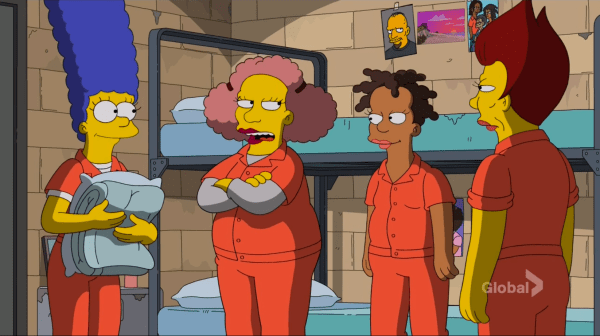
The reaction: Sometimes I try to avoid direct comparisons, but in episodes like these, it’s almost impossible. Marge in a women’s prison? Been there, done that. But now, there’s a popular Netflix drama we can pretend to be parodying. Make it the episode title, and perhaps we can glom onto another culturally relevant show! As pictured above, we get characters that look like Red and Suzanne from Orange is the New Black, but the “parody” stops there. The initial set-ups of this and “Marge in Chains” are identical: Marge is the beleaguered workhorse of the family who has a thousand things to do in a day, and one minor slip-up gets her in trouble with the law. Here, she gets Bart out of her hair by sending him outside, but when Wiggum finds him at the park without a parent, he promptly arrests Marge. I guess there’s some social commentary to be made here, but as usual, the surface is barely even scratched. Once in prison, Marge is naive at first, but later gets pushed too far and knocks out a brutish inmate with her hair (there’s barely any build-up to this.) After that, the plot shifts to her being a peaceful influence to the other prisoners by taking up gardening, and her being thrilled about early bedtimes and exercise time. So her knocking that woman out was just to get their respect? It doesn’t matter. In no time at all, she finds she loves it in prison, so much so that when Homer manages to have her sentence cut short, she steals a guard’s gun and fires it in order to get more time. Even if the plot were better developed, this would be a hard pill to swallow. “Marge in Chains” was one of those episodes more focused on wall-to-wall gags than its story, so I guess the core difference is this episode’s attempt to do the opposite. With Marge needing a break, it’s like they blended it with “Homer Alone,” but then that brings the tally to two classic episodes they’re retreading in a much poorer fashion.

Three items of note:
– Just like “Chains,” we devote time to Homer and the kids to see how they’re faring without Marge. But unlike the wonderful quick gag of the entire house going to shit within seconds, it’s multiple scenes of just bland nothingness. Neighbors chip in with gift baskets and baked goods to keep their spirits up, and eventually Homer decides he should probably get off his ass and do something, but not before envisioning a Ned/Marge hybrid to lust after. Between this and “Fland Canyon,” I guess these two are friends now? And like “Chains,” Marge makes friends with her fellow inmates, but none of the three pictured above have names or any real personality. Remember Philips? Tattoo Annie? And that was all within the last five minutes that Marge was actually in jail, compared to a whole two-thirds of this episode. Again, when the plots are this similar, it’s impossible not to think how fucking inept this is compared to the original.
– To kill time, we get an elaborate sequence of Homer envisioning himself as a retro 50s housewife, spurred by him vowing to step up as a parent. We then revisit it again for the end tag, which I promptly turned off. I’m still not sure why they do this four-act bullshit. Other FOX shows don’t, even comedies airing the same night. They’re just a waste of time. The story reaches a conclusion (in some cases, just barely), and then there’s just this worthless vestigial piece at the end of it.
– The ending involves Bart getting all the other kids to play without adult supervision, just in time for a tornado to roll into town and endanger them all. This occurs during a riot at the prison, where Homer just magically appears, having disguised himself a guard. But when the two of them hug and make up, the tornado magically disappears. And Marge is free to go just because. Why bother giving an explanation? We also see Wiggum talking to all the other parents, and I guess they get off with a slap on the wrist for losing their kids, unlike Marge. The very ending involves the family all hugging in the pantry, as Marge quips, “I want to say two things. I love you guys, and we’re out of peanut butter!” They all laugh. They end on a group laugh. And the line is a sub-par version of that awful sitcomy set-up for a group laugh. Once again, tired old tropes that the show mercifully skewered in the past are now embraced and played 100% straight.

One good line/moment: Michal Socha returns for another guest couch gag, featuring the family and the assemblage of the couch in the style of IKEA building instructions. A very cute and clever sequence.

595. Simprovised

Original airdate: May 15, 2016

The premise:
Homer combats his fear of public speaking by turning to imrov comedy. Plus, in the episode’s final few minutes, Homer appears LIVE to take a few audience questions.

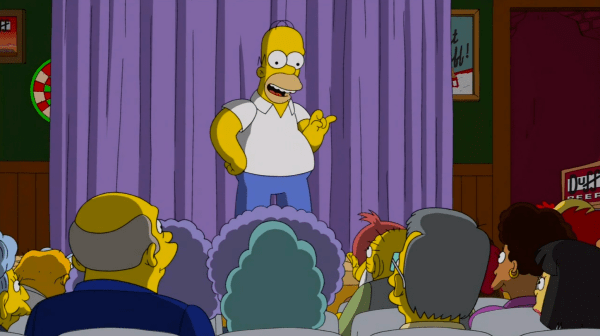
The reaction: Depicting stand-up comedy on your comedy television program is a pretty big challenge, since it kind has to be funny on multiple levels. “The Last Temptation of Krust” had the fresh new wave of comics do their set, but the humor came more from audience reaction and their being contrasted by Krusty’s old hacky material. Now, over fifteen years later, we have an episode about improv, where we’re forced to watch the troupe performers, and later Homer and company, go through these stupid, unfunny skits, to enormous applause and laughter, I might add. Homer gets enamored by improv and joins a class, and whaddya know, he’s an instant hit! He immediately “nails” the comic scenarios thrown at him, including the “one we could never crack,” so I guess this counts as a “Simpson-is-an-instant-success” episode. But here’s the big issue: Homer’s bits aren’t really that funny. Like, the entire show isn’t funny, but trying to be as objective as possible, his material is mildly clever at best, but the audience is just going apeshit over it. Soon, we see he’s formed a troupe with Lenny, Carl and Skinner, and they’re an instant success. After that, Lisa informs them they’ve been invited to perform on the main stage at the Springfield Fringe festival which I guess they have. Remember, all we’ve seen of Homer’s “talent” are three quick bits he did with the improv people, then him on stage doing a Paul Prudhomme “I guah-ron-tee it!” to monstrous cheering. But in the story, he’s an accomplished and respected improv performer. Still nervous, Moe proposes he feed him scenarios from the audience, but Lisa interferes, wanting to protect the sanctity of… improv comedy (“You can’t let your troupe down! They need your space work, your strong choices and scene-building skills!”) We saw Homer’s “troupe” in one scene, never saw them perform, and we’ve barely seen anything of what Homer can do. I’d say this feels flimsier that normal because they had to devote four minutes at the end for the live segment, but this episode also had a B-story with Marge fixing Bart’s treehouse that is so thin and superfluous I have nothing to say about it. The episode has no ending either, Homer just performs, camera pull out, gotta rush to get to the live section. I’m going to assume they came up with the live gimmick first and then figured they had to also write a main story to make it tangentially related. Maybe they shouldn’t have even bothered.

Three items of note:
– The impetus of the plot is that Homer has to give a speech for a seminar at the plant, one that apparently he gives one every year. What’s that about? He’s the safety inspector for one part of the plant, and a terrible one at that. They don’t even bother to make it into some kind of joke, or have Burns or anyone mention what the speech is about, it’s just “Homer has to make a speech.” Again, it’s just having the bare bones of a story in place so things sort of kind of make sense played in sequence. No need to develop anything, details are too much work and don’t matter.
– I guess since she’s been so underutilized this season, they crowbar Lisa into the story halfway, acting as “CREW” for the troupe’s show at Moe’s. At that point, I guess she’s their manager or main stagehand or something since she’s the one that gets informed that they’re gonna perform at Fringe (“This is going in my log! Yaaaayyy!”) At the festival, she’s in some kind of hipster get-up with a hat, vest and tie, and gushing about all there is to see and do… even when she’s not being bitter or smug, she really is just an insufferable character. And they try to cram in an emotional conflict with her in the little time they have left, I guess to try to give the episode some weight (“I need an occupation!” “A father I can look up to!”) It’s cheap, but no cheaper than the out-of-left-field, wholly manufactured emotional endings we’ve seen before. They’ve pulled the Lisa card to generate false sympathy many, many times before, and the fact that they think they can cram the same hollow nonsense in with so little time is just telling that they either think it’s a quick and easy solution, or they don’t care, or both.
– So, the live segment. Viewers were prompted to call in, and at the end of the episode, we cut to Homer seated behind a desk ready to answer some questions. This was done twice the night it aired, once for the east coast feed, once for the west coast. There’s a great article talking about how it was done, but explained simply, Dan Castellaneta performed live, and based on the audio coming in, Adobe Character Animate would register his words into phonemes linked to the proper mouth shapes to make Homer look like he’s actually talking. The result is kind of neat, but it’s more of a proof of concept than a polished piece. It feels too static; aside from a slight head tilt and a raised arm or two, Homer doesn’t move all that much. Perhaps a few different poses they could have switched between would have been neat. I guess the solution to this was to have characters randomly pop onto the screen to distract you, some with sign gags who just walk in and then leave after a few seconds, like Lisa (“We Parked in Bill O’Reilly’s Space”) and Kang with some more fan service (“Don’t Blame Me, I Voted For Kodos.”) I can at least give them credit for trying something new, though. For all the awful gimmicks we’ve seen from the show, this one at least feels like it came out of an earnest interest.

One good line/moment: Homer nervously walks to the stage for his speech, the entire room dead except for the sound of his footsteps. Not being awkward enough, Burns turns a dial on a speaker reading “Footstep Amplifier” to make it even louder.