620. Springfield Splendor

Original airdate: October 8, 2017

The premise:
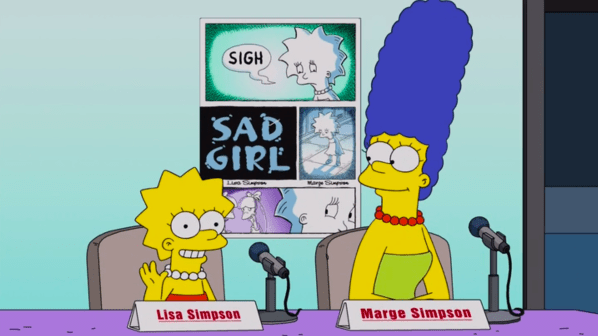
When assigned art therapy to help cope with her depression, Lisa, with the help of her mother’s artistic talents, creates the graphic novel “Sad Girl.” The comic becomes an instant hit, but conflict arises when Marge feels Lisa isn’t giving her due credit for her contributions.

The reaction: Marge-Lisa episodes in recent years have felt pretty sour to me. They’re two characters who don’t share many interests and sometimes don’t see eye to eye on things, but more than anything they have a deep love for each other. Despite this, the past few episodes of this type has seen Marge either acting horribly or being incredibly petty and catty, with no real apology or sincere reconciliation by the end. This time, we see Lisa as the thoughtless one, as the show shoehorns in a contrived conflict halfway through. We open on our eight hundredth episode about Lisa feeling miserable, and at the suggestion from a community college therapist, she takes to drawing out her life through comic panels. Finding her daughter struggling artistically, Marge lends her abilities, and the two end up creating a visually and narratively stimulating representation of Lisa’s sad lot in life entitled “Sad Girl,” which sort of looks like a blend of “Ghost World” and Alison Bechdel’s work (Bechdel voices herself later in the show). In a “classic” case of Simpson-becomes-instant-success, the comic gets out and is a wildly popular hit with women everywhere. Lisa was initially mortified to find that her work was published without her knowledge, but when she sees young women and girls clamoring over “Sad Girl,” the notoriety goes to her head. Do we find out why audiences are relating to Lisa’s story? Maybe she could have been the figurehead of disenfranchised youth? This isn’t delved into, as instead we see the likes of Lenny, Carl, Apu and Sideshow Mel reading the comic, and then instantly Marge and Lisa are at Bi-Mon-Sci-Fi-Con, where halfway through the episode, our character conflict shifts into gear, where we see Marge is discouraged that people aren’t giving her as much credit as Lisa. During their panel, they hammer this home multiple times (the scene ends with a booming announcement, “Lisa wins! Marge fails!”) Following this, Lisa smugly patronizes Marge’s request to include a storyline about her, and when Marge calls her out on her raw attitude, Lisa fires her. Act three introduces Martin Short as an eccentric flamboyant who wants to turn “Sad Girl” into a musical, but only takes inspiration from Marge’s visuals, discarding the story almost completely. So with the shoe on the other foot, Lisa proceeds to pout and moan about be unacknowledged, still not caring about her mother’s feelings. In the end, Marge is the one who extends the olive branch and sabotages the show for Lisa’s sake, while Lisa gets away with a paltry apology at the very end (following Marge’s own apology, of course). Character conflicts nowadays feel so manufactured and meaningless, and they feel even worse when they’re so one-sided like this. It’s not great when in episodes like this, “Pay Pal,” “The Marge-ian Chronicles” and so on where you come off not liking Lisa or Marge, as they should be the easier characters to get behind.

Three items of note:
– Shockingly, they actually utilized Comic Book Guy’s wife Kumiko in a plot line, after making only a few background appearances multiple seasons after her debut. She discovers the “Sad Girl” loose pages on the steps of the community college, and decides she’ll publish them herself. For no particular reason, mind you. It’s not like she thinks they’re great or anything, the dialogue is literally, “A graphic novel! I’ll sell this at my husband’s store.” She just decides to organize, clean-up, and self-publish this book within the span of a week. And I guess Comic Book Guy, despite knowing Lisa, didn’t really give a shit. When confronted by Lisa and Marge, Kumiko offers no explanation, makes a joke about harikari, and pledges she’ll burn the books “on a pyre and disperse them to the seven winds.” In her first notable appearance since her introduction, she continues to be nothing but a shallow, walking stereotype.
– Midway through the episode, we get a montage of Lisa and Marge working together set to a parody of Rod Stewart’s “Infatuation,” reworked as “Collaboration.” Interestingly, it’s performed by Kipp Lennon, who is most famous in Simpsons lore as the singing voice of Leon Kompowski/Michael Jackson in “Stark Raving Dad.” He also did the shitty 30th anniversary Big Bang Theory theme parody opening from last season as well (no fault of his own, of course), and I also saw him perform “Happy Birthday, Lisa” live at the Simpsons Take the Hollywood Bowl show. It’s pretty sweet that the show has kept a relationship with Lennon after all these years.
– The ending features an animated “Sad Girl” sequence of a lonely Lisa being picked up by a happy Marge, which lifts Lisa’s spirits. And then a dance number. It reminded me of the ending of “Moaning Lisa,” which featured a similar dilemma. Marge initially imparts Lisa with the same awful advice her mother gave her, to bottle up her emotions completely,  go along with what the other kids say, and “happiness will follow.” But, seeing firsthand how quickly Lisa is taken advantage of and gets undermined by her teachers and peers, Marge grabs her and takes it all back, telling her to feel whatever she has to feel, and no matter what, she will support her. And that’s all Lisa needed to hear. It’s a really emotionally complicated scene, and it feels like such a satisfying and earned ending. With this end tag, Lisa has a thought bubble, “I’m lonely.” Then Marge pulls up, and it’s changed to “I’m not lonely anymore.” I get this is a simplified end tag played after the story is over, but the resolution of most episodes is basically just like this. Plots start and stop with characters just announcing as simply and directly as possible what they’re feeling, with no real regard or care as to why. Of all of these junky sad Lisa episodes, “Moaning Lisa” is still the gold standard they all must stand before.

One good line/moment: I thought the artwork of “Sad Girl” was well done, especially the sequences where the drawings become animated. There’s also some pretty good animation with Martin Short’s character. As much as I love Film Roman, I feel like there’s been a noticeable shift in the visuals, with a couple episodes from last season and these first two episodes of this season sporting some bits of character animation and other sequences that feel like a little work was put into them. I guess the show is just being produced by FOX Animation now. I don’t know why Film Roman got the boot. Was it a financial concern (allegedly) like Alf Clausen’s firing, or something else? But either way, it’s not like it’s a humungous step forward visually, and ultimately none of that means squat if the scripts are just the same old slop.

Sorry this is so late, I’ve gotten wrapped up a bit in a new job. I’ll try and post new reviews sometime within the week a new episode airs. I’ll see if I can get to “Whistler’s Father” sometime in the next few days.
619. The Serfsons

Original airdate: October 1, 2017

The premise:
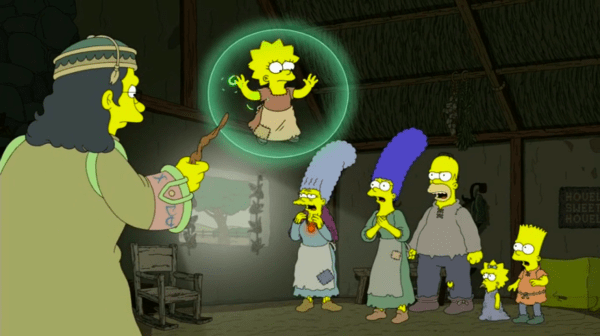
In a medieval fantasy world, Marge must face her mother’s impending death. Lisa conjures up the cash needed for a healing amulet, but her use of magic gets her imprisoned by the authoritarians of the land.

The reaction: There’s a reason that fantasy setting episodes are reserved for three-parters. Gimmicks like these tend to grow thin after a couple minutes, and then you’re left with just a regular story that just has different backgrounds and character designs. Even with Game of Thrones wrapping its seventh season, and the show already having recreated its opening title sequence at least twice over the last few years, amongst other references, I guess the show hasn’t glommed onto this pop culture staple enough, so let’s do a whole Thrones/Lord of the Rings/medieval fantasy hodgepodge episode, make it the premiere, and soak up some mild press because of it. I don’t watch or know much about Thrones, but to me, it didn’t seem like there was a lot of attempted referencing done here. In fact, most of the story up until the last act feels like it could have been done as a normal episode, and it would have been just as boring. Marge’s mother is turning into a White Walker… err, Ice Walker, and there’s not much the Simp… Serfsons can do about it. There’s a magical amulet that will cure her, but it’s way out of their price range. Nine minutes into the episode, Lisa reveals she has magic powers and turns a nugget of lead into gold, and laments she must keep her powers a secret lest she be imprisoned and exploited by the royal family. Prior to this, we hadn’t seen anyone using magic, or really even seen anything magical outside of some weird goblins and creatures. As always with this show, it’s tell, not show. There are two “stories” going on: Marge having to deal with her mother wanting to die, and the peasants rising up against the kingdom, led by Homer in the final act. The players storm the gates in an assault that felt like the end of the Futurama movie “Bender’s Game” but worse, and I didn’t care for “Bender’s Game” all that much. In the end, with her daughter’s blessing, Marge’s mother takes off the amulet, goes full-on White Walker and takes down the dragon and herself. I don’t get why she has such a big role in this. Does this parallel Thrones at all? Whatever. It’s a little weird how much of a failure this one was (well, not really.) Gimmick episodes like “The Man Who Came To Be Dinner,” and to a lesser extent “Brick Like Me,” removing the characters from their normal setting at least gave way to different kinds of jokes and situations. Despite its fantasy location, this episode just felt very… normal. And normal for this series now is “absolute trash.”

Three items of note:
– Unable to afford the amulet, Homer drowns his sorrows at Moe’s with the regular barflies there. Later, he works overtime at the plant by pushing a wooden power generator whilst being whipped, which we’ve already seen in the “real” world in “Rosebud.” Outside of minor accoutrements like Willie being a Warcraft orc slavedriver and Burns sprouting tiny magic wings (??), the story and the characters feel like it should just be taking place in the real world. The old Treehouse of Horrors, and even the earlier anthology episodes like “Bible Stories,” felt like they were different worlds through their tone and framing. This feels like really bad fan fiction or something.
– It’s a bit of a struggle for Julie Kavner to do a consistent Marge nowadays, let alone her much hoarser mother. Jacqueline sounds like Jackie Earl Haley’s villain character from The Tick in this episode (slightly obscure reference, but it’s fresh in my head since I just watched it. There’s a plug, go watch The Tick, it’s on Amazon Prime, it’s great).
– The high elder magicians or whoever thwart Homer from intervening with them taking Lisa by casting a spell on him, making his toenails rapidly grow and wrap themselves around, encasing him in a tangled toenail ball. Gross. This reminded me of an episode of the old Nickelodeon cartoon The Angry Beavers where the titular beavers try to look cool by letting their teeth grow out. The ending involves things getting out of hand when their teeth get exaggeratingly long, with brother Norbert being trapped in a giant toothy sphere. Anyone remember this? Ahh, nostalgia.

618. Dogtown

Original airdate: May 21, 2017

The premise:
Mayor Quimby passes dog-friendly legislation to attract tourists to Springfield, but the ultra-lenient laws result in all the dogs in town eventually turning feral.

The reaction: I find myself reminded of the Otto line, “What were you guys smoking when you came up with that?” Seeing as the writers are presumably big Rick & Morty fans, this feels like their version of “Lawnmower Dog,” except exponentially worse. As with some episodes (although fewer and farther between nowadays), there’s a good idea buried in there somewhere. The plot kicks off in a court case after Homer hits Gil with his car in an alley. His excuse was that his brakes failed, and ultimately he had to hit either Gil or Santa’s Little Helper. Homer is let off thanks to the jury, and everyone else’s immediate sympathy toward the situation and their undying love for dogs (and Gil’s hatred of the animals). That people would care more about a lovable mutt than a pathetic schmuck eating out of garbage, and then let dogs get away with anything because they’re so darn cute, that’s an idea I think has potential. But it’s not as developed as it could be, in favor of having character reiterate things again and again, similar to how I always make this same point in every single review. Do they think the audience has fucking Alzheimer’s that we need to reinforce what the plot is three or four times an episode? So all of Springfield’s dogs are just wandering around, and eventually without having to respond to their human masters, they all turn feral and start attacking people. So now it’s like “Night of the Dolphin” from Treehouse of Horror XI, except this is a “real” episode. In an act of redemption, Gil proposes he’ll save the day, but in the end, he doesn’t. It’s like they just forget about him, but not in a way where it was purposeful. Just… whatever. Not to say this premise couldn’t work in a somewhat grounded fashion, but they certainly don’t have the ability to pull it off here. It’s like a Saturday morning cartoon premise. Or that of a popular adult animated comedy they just lifted it from.

Three items of note:
– There’s a pretty astounding joke that happens midway through that boggled my mind a bit. Santa’s Little Helper crawls halfway through the doggie door, exhausted from his new unchained life. This prompts Homer to hold up Snowball II and attempt to get the cat to grab onto its collar, despite her struggles and attacking him, as Bart and Lisa look on. This goes on for literally fifteen seconds, and I was really confused. I couldn’t tell what was happening, and why we were devoting so much time to this. Eventually, Homer succeeds in his mission, all so he can smugly proclaim, “Well, well, well, look what the cat dragged in.” Bart and Lisa comment, dead-eyed, “Worth it.” “Totally worth it.” I can’t tell if they’re being sarcastic or not. But in case there were any niggling doubts, no. No, it was not worth it.
– Despite Santa’s Little Helper being featured throughout, Bart isn’t really that involved in this episode. You’d think there’d be a scene of him being grateful his dad didn’t hit him, or he would have more screen time worried about the dog and where he is and how they’re so disconnected now, but not so much. The ending involves he and Lisa going out after dark to look for him, and ending up being cornered by a feral pack. They’re saved by Marge, who becomes the alpha dog by standing up to the crowd of mutts, and drop-kicking their leader chihuahua clear out of the dog park. She just straight up kicks the shit out of that dog. It’s not even framed like the dog was a legitimate threat to the kids so her motherly protection instincts kicked in. She just sort of stared the dog down, growled at it, and then knocked it the fuck out. This reminds me of a Thanksgiving episode of Bob’s Burgers with a similar ending, featuring the town being overrun by turkeys, and Linda becoming the alpha by headbutting their leader, which was infinitely more enjoyable, and made my fiancée almost pee herself with laughter.
– I guess Michael York had time to kill on the FOX lot, because this is the third time we’ve seen his veterinarian character this season, in addition to playing that creepy fuck Nigel in the previous episode. He’s got a good voice, and I feel like I would really enjoy his performance in a totally different show with a script that actually has jokes and is well written. Is that asking a lot?

One good line/moment: Hey, not BLANK! At an emergency meeting at City Hall, all of the townspeople are fed up with their dog-infested town. Sideshow Mel addresses the crowd, and we see that his hair is sans bone. And, this is the shocker, he never acknowledges it. They just let a sight gag go by without explicitly pointing it out or anything! It’s a freakin’ miracle!

And there it is. Every episode has been covered… at least for now. It’s pretty incredible timing that I finished just in time for the dawn of season 29. So, will I be continuing on to covering new episodes? Well, I’ve gone this far, so I guess I can’t stop now. Yes, so much of this ground has been covered, yes, I find I end up repeating the same points several times over, and yes, this is basically self-inflicted torture at this point, but a tiny sliver of me is still interested in how much lower this show can possibly go. I’ve been especially stunned by this past season, containing episodes I can honestly say are the absolute worst, maybe even some of the worst narrative television I’ve ever seen (“Friends and Family,” “There Will Be Buds,” “Dad Behavior,” “Fatzcarraldo,” “Kamp Krustier,” “The Caper Chase,” “Moho House”)

617. Moho House

Original airdate: May 7, 2017

The premise:
Nigel, creepy British weirdo and an old colleague of Mr. Burns, seeks to win a bet by breaking up Homer and Marge, making Moe in charge of a new upscale bar in order to win over Marge.

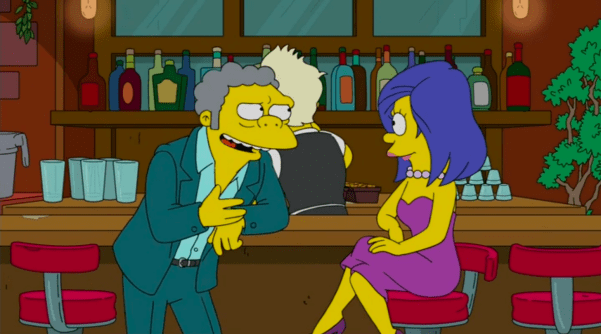
The reaction: Thankfully marriage crisis episodes have become further and far apart than they used to back in seasons 15-18 or so, but they’re definitely a lot more painful to me, due to how much poorer the writing has become. This is a pretty bonkers episode and I really have no clue what to make of it. We’re introduced to Nigel, an old schoolyard chum of Burns. He’s married to a young-looking eccentric woman, who we see sporting a pull-string veil, and later inflatable tentacles (???) He mentions she’s cheating on him, which leads to Burns championing true love, for some reason? Nigel formulates a bet: he’ll break up Homer and Marge, or give up five million dollars. So he drags Homer to Moe’s, but finds him seemingly unresponsive to the idea of other women. But, he finds out that Moe has a crush on Marge, so he gives him control of a fancy rooftop bar atop a huge hundred-story tower that he has a helicopter drop right into Springfield. This is one of those episodes I feel like I don’t even need to comment on. Just read the synopsis. This is real. This is happening. Marge is upset with Homer per usual, but still agrees to come to Moe’s new bar. Neither of them, or anyone else, asks Moe about what the hell is going on and how he got the bar, mind you. I guess it’s not that important. Moe talks up Marge and has a dance with her, and she is fairly receptive to all of this. Meanwhile, Nigel and Burns are like these perverse busybodies watching all this unfold, with Nigel upping his bet to his entire fortune versus Burns giving him Smithers, which he accepts. In the end, Moe can’t bring himself to bang Marge, so he gets her and Homer back together, because Homer shows Marge a flip book he drew in crayon as “Close to You” plays, as “The Way We Was” spins violently in its grave. This episode is really bizarre, and I’m kind of at a loss for words in discussing it as a whole, but it really felt like one of the worst of the entire series.

Three items of note:
– In the last five years or so, Homer/Marge episodes have shifted more from “Homer does something stupid and has to make amends” to “Homer is all around a horrible, irredeemable life partner.” Marge is a beaten down husk of a woman as our story begins, with her and the kids waiting at the dinner table for the drunken patriarch to return. Homer slams into the drive, catapulting Flanders’ mailbox through the window. Maggie then climbs out of the mailbox, and she tosses it onto a pile of Flanders lawn signs and ornaments in the corner of the room. I’m not quite sure what this is about. How did this happen? What was she doing in the mailbox? I don’t understand this joke, but regardless, Homer effectively almost killed his own infant daughter, and Marge is so dead inside she doesn’t bat an eye. Homer drunkenly stumbles inside, and the scene ends with Marge sadly going upstairs. Later, Marge surprises Homer at work with a picnic basket, wanting to give things one last shot. So things seem to be just fine, until Nigel keeps Homer from going home, leaving Marge disappointed once more. Homer returns home, but Marge is unmoved by her excuses (“I just have to accept that you’re never going to change.”) We then fast-forward through the night of Homer sleeping like a log and Marge crying her eyes out for hours. By morning, Homer happily awakens and asks Marge how her night was. Emotionless, she responds, “The usual.” And that’s our act break! Our hilarious joke going into commercial is this sad, beleaguered woman who thinks her marriage is dead. And it basically is. She’s right, Homer will never change because nothing in this show does. Nothing holds any weight, nothing has any meaning. For the last fifteen-plus years, the series has just been like watching a bunch of broken wind-up toys stumble about for twenty minutes. The same old routine, giving you nothing but waste your time.
– Toward the end, there’s a meta joke where Marge finally calls Moe out on calling her ‘Midge’ (“First of all, it’s ‘Marge.'” “No, I know, I don’t know what my deal is with that.”) This is the problem with the show’s unflinching devotion to the past. As I’ve mentioned numerous times before, Moe is a gross, depraved man who primarily sees Homer as an ATM he can serve cheap swill to. He really only knows Marge from afar, the two sharing just a handful of scenes in the first ten seasons or so, thus him not knowing the names of Homer’s family. Surely Homer’s talked about them a bunch of times at the bar, but Moe doesn’t give that much of a shit about what his customers tell him. On the flip side, Marge harbors a deep-seeded resentment toward Moe, his establishment being the reason her husband doesn’t come home most nights (as clearly explained in the wonderful line from “Lisa on Ice,” “You caught me at a real bad time, Moe. I hope you understand I’m too tense to pretend I like you.”) But now, we’ve seen a multitude of episodes where Moe is a close family friend to the Simpsons. Marge has acted as his life coach of sorts several times, and they’ve shared many cordial moments together. That being the case, Moe not knowing her name makes no sense anymore. So why does “Midge” still exist? Because that’s what Moe used to say, so we have to keep doing it. And now, we get a lampshading of it, and even that they can’t do properly. Moe doesn’t even give a joke explanation, he’s just like, whatever, who cares. I’m guessing the writers broke early for lunch and just left that line in the script blank or something.
– As Homer and Marge kiss at the end, Burns and Nigel are looking down on them, as the latter writes out a check. But Smithers comes in from behind asking him who he’s talking to. He convinces Burns that there is no Nigel, getting him to rip up the check (thinking it’s a yogurt coupon) and storm off. This was Smithers’ way of sticking it to Burns for agreeing to put him up as collateral for the bet, but for a good twenty seconds or so, I really thought they were going to pull this for real, that Nigel, despite having interacted with Homer, Moe, and setting the entire plot in motion, was a figment of Burns’ imagination. But when it’s shown to be a fake-out, it still feels just as bad, because a) it’s another shining moment of pathetic, easily manipulated Burns, and b) an insult to the audience for even implying that all of this was just a weird fantasy. The scene ends with Nigel coming back in and kissing Smithers, as there had been allusions to him being gay and interested in him the entire episode. Too bad it doesn’t actually mean anything.

One good line/mo… oh forget it, you know this is gonna be BLANK.

616. Looking for Mr. Goodbart

Original airdate: April 30, 2017

The premise:
Bart whores himself out to the elderly women of Springfield in need of a grandson to spoil. Meanwhile, the rest of the town is addicted to the phone game… *sigh*… Peekimon Get.

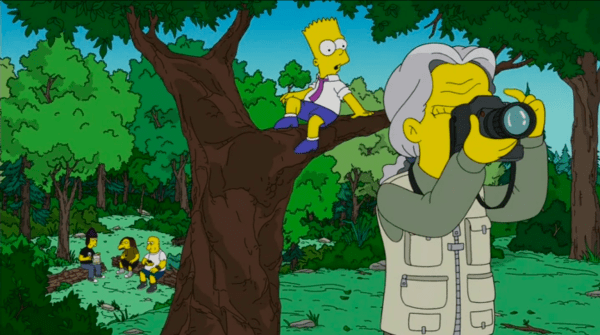
The reaction: Bart easily seems to be the hardest Simpson to write for over the last fifteen years, which I’ve talked about many times over. When they’re not throwing him in situations better suited for a teenage boy or older, they turn him into a sniveling wuss who seems to care less about causing mischief and acting like a normal rambunctious ten-year-old. This episode kind of covers both of these modes, at least when we get to the second half where the “real” “story” actually starts. Bart is tasked with walking Agnes to the bus stop, and for some reason, he poses as her grandson to show up Martin’s grandmother. They don’t even try to make it like he’s trying to play mind games with Skinner, or that Agnes has some sob story that he feels bad about, he just attaches to her. After the fact, she mentions that she can get him some free candy if he helps her again, and then after that, the story kind of begins, where Bart fulfills the emotional needs of all the neglected old biddies in town. The trade-off is that he’s spoiled rotten and gets lots of gifts, but we don’t really see much of any of that. He’s got a pocketful of candy, we see him watching Itchy & Scratchy at an old woman’s house (he can’t do that at home?) Most of first half of the episode is devoted to the B-plot (which we’ll get to later). So a lot of the “humor” comes from Bart acting like a gigolo to these women. I think this concept could have actually been amusing, but underdeveloped as it is, it just feels weird and strange. Without really seeing Bart swimming in his selfish rewards, it ends up looking like he genuinely wants to hang out with these old ladies. So that brings us to Phoebe, a woman who’s immediately wise to Bart’s charade, but pays him anyway to accompany her in her nature photography. After bequeathing him with his camera after a few days, and a not-so-cryptic monologue she gives about a dying deer, Bart comes to the conclusion that she might be planning on killing herself. This is a character who we’ve seen for under two minutes of screen time, and had no real connection or kindred relation with Bart, but despite that, I guess we’re supposed to feel bad? Or worried? It feels completely disingenuous, and that’s not even considering the multitude of tasteless suicide gags with Moe they’ve done for shock value over the years. But in the end, Phoebe is alive, and thankfully, she exposits aloud why, in one of the worst pieces of dialogues in the entire series (“I admit, I had some dark thoughts, and I used you to escape from the home. But once I got out here by myself, completely free, I realized there’s so much to live for, and I want my camera back.”) This show has hinged on quickie plot resolutions with characters explicitly stating aloud what’s happening and what they’re feeling for years now, but to do so with a supposedly suicidal woman talking about her change of heart feels like a whole other level of not giving a flying fuck.

Three items of note:
– The episode opens sans opening title, but with a snippet from the original Tracey Ullman short “Good Night,” in honor of the show’s 30th anniversary. How nice. Then we get a recreation of the Big Bang Theory opening to commemorate 600+ episodes and how fucking long this shit has been on the air. Not so nice. I really wish I didn’t recognize the reference. I’ve been fortunate enough to only see a very limited amount of that horrid show, and I wish to keep it that way. Anyway, this is just more of the show trying to glom on to another show’s success. What season is Big Bang on? Season 10? Timely as ever.
– Bart’s transgression to get him in trouble at the start is to sing “joke” lyrics during a grandparent’s day serenade (“Grandma, grandpa, you’re the best,” “Now you can be laid to rest!”) Even Skinner is aware of the laziness (“Simpson, those lyrics are unapproved and not that funny!”) During the song, Chalmers texts “SKINNNER!” because after over twenty years, the writers literally can’t think of any other joke for these two other than have him scream his name. This scene also illuminates how they seemingly don’t want to give Bart a new teacher, nor do they seem to care to. I thought Mrs. Krabappel’s absence would create a decent sized hole in the cast they would need to fill, but it seems they’re just fine with wallpapering over it. A classroom without a teacher and “SKINNNER!” are symptoms of the same problem: this is a show that has slavishly attached to the world created in the classic era, and will not budge even one inch. Why create new characters, new running gags, new sides to old characters when you can just regurgitate the same schtick over and over and over again and get paid either way? So really, there’s no need to make a new fourth grade teacher when they can get away with scenarios like this. It’s clearly a non-issue for the writers.
– Let’s get into that B-story. Pokemon Go released in July 2016 and was a red hot pop culture obsession for about a month or two. The popularity died down pretty quickly going into the fall, and by the time this episode aired, the game was pretty much irrelevant. In just about nine months, this is literally as fast as this show can go given its production schedule to capitalize on a current trend, and this is the biggest example of why they should never try to do it anymore. Not only are they incredibly late to the party, but every single joke here had already been made a million times on social media when the game was fresh and relevant. People wandering around stores and graveyards, not paying attention to where they’re going, thinking a real animal on their phone is a Pokemon… As usual, the writers operate on an obvious, base level of satire and don’t bother to reach any higher. The two plots tie together when Bart gets all the Peekimon players to help him look for Susan, and then we get a montage set inside the game with a parody of the Pokemon theme! We’re hip and with it, right, kids? It just felt incredibly embarrassing. The sequence is also a pastiche of different Japanese and anime references. Pokemon‘s been around for twenty years now, surely there’s a couple people on staff who are somewhat familiar with it, rather than what feels like a bunch of old writers who have no idea what they’re writing a parody of other than articles they read about the game.

One good line/moment: BLANK.