 Original airdate: November 8, 2020
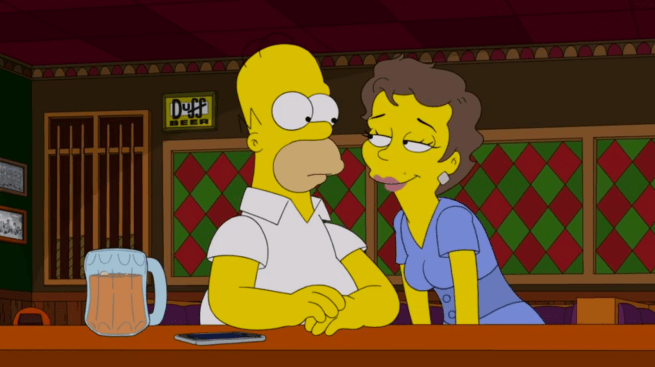
The premise: After Marge and the kids travel to Martha’s Vineyard without him, Homer meets Lilly, a fun-loving girl from England who falls head over heels for him.
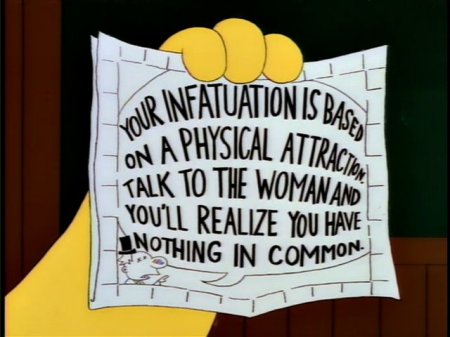
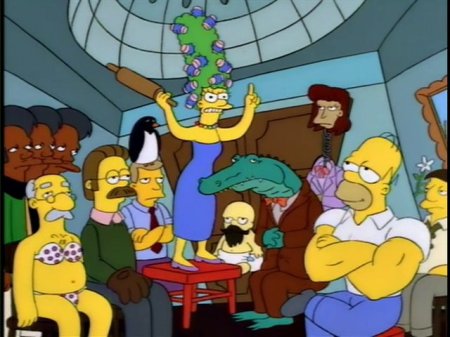
The reaction: It’s uncommon nowadays that a guest star playing a character gets a huge role in an episode. Last season Michael Rappaport played Mike, baseball enthusiast, anger management candidate, and Homer’s biggest fan, a character that absolutely baffled me as to what his motivations were. Here, we have the exact same problem. From the beginning, this is ostensibly Lilly’s story, as we meet her in England and see that all of the men are just obsessed with her, with her having a natural ability to make anything fun. In fact, she’s literally excised to America specifically because she’s too great of a person. So from the start, she’s really not so much a character than a representation of an exciting, carefree life partner, a literal manic pixie dream girl for the men of the world. Traveling to Springfield, she arrives at Moe’s Tavern, and with just one look at Homer, she’s absolutely captivated. Homer, meanwhile, is despondent from Marge and the kids leaving him home alone. Lilly is ostensibly supposed to be lifting Homer out of his funk, but she doesn’t really do anything for him. She sings him a song, they have a picnic at the plant with Lenny and Carl, there’s a pointless diversion where Homer chaperones a date with her and Mr. Burns, but Lilly doesn’t connect with Homer in any way, nor does she represent anything specific for him to connect with. For the first half of the episode, Homer is just completely oblivious to Lilly’s advances, but in the second half, he’s clearly aware of his growing attraction to her. He’s shocked to find Marge has returned home early, and finds himself captivated by Lilly’s literal siren song over the phone beckoning him to come over, basically just telling him she’ll make him food. Moments from reaching Lilly’s door, we see fantasy muses appear around Homer’s head beckoning him to her, holding scrolls reading different words. “Kindness” and “Boobies” are clear enough: she’s definitely a very nice, attractive woman, that would be appealing to most men. Then there’s “Humor,” which I don’t recall her making anybody laugh, especially Homer, despite Olivia Coleman doing her best in performing such a dull, empty character. But the killer is “Common Interests,” which we never, ever see. She likes to drink… and that’s really it. This feels especially damning to me as I just recently watched “The Last Temptation of Homer,” an episode all about Homer grappling with his feelings for a woman who shares his greatest vices. But forget about the classic era, season 28’s “Friends and Family” introduced Homer’s neighbor Julia. Although they were never romantically involved, it was a similar story of Homer forming a kinship with another woman, and it was all over their mutual love of overeating, drinking and hating Ned Flanders. It was a terrible show, but even that episode put in the necessary ingredients to attempt to have the story make sense. By the climax of this episode, we’re expected to believe Homer is seconds away from cheating on his wife for this absolute blank slate of a woman, and it absolutely does not work for that very reason.
Three items of note:
– I honestly don’t know what they were going for with the Lilly character. As I mentioned, she seems like just a manic pixie dream girl type, but since she doesn’t really affect Homer’s life in any real way, that doesn’t really check out. We see Lilly musing to herself, longing for Homer from afar, so are we supposed to relate to her in some way? That being said, we never know why she is specifically so turned on by Homer, outside of joke lines that give little insight (“Please let me win him, even briefly. It would be like having a lover and a child at the same time!”) (Wow that line is real creepy.) But Lilly isn’t a real character. We see she’s literally sought after by every single man who sees her, even being with and turning down Hollywood’s finest like Leonardo DiCaprio. Surely this could be an easy set-up for a story. She meets Homer, who is the only man who isn’t immediately smitten by her. She could take this one of two ways: either she’s relieved that a man could actually be interested as her as a person rather than just her looks, or she’s aghast that he’s not taken by her charms immediately, making him all that much more desirable. Homer’s a big lunkhead with not much of a wandering eye, so either of these scenarios would work with him, and both premises would communicate something different about Lilly as a person. Instead, we get nothing. Sometimes it really feels like these stories are half finished and they just throw in a bunch of jokes on top and call it a day.
– As Homer is seconds from grasping Lilly’s doorknob, she’s singing “la, la, la” into the phone, which then is replaced by Marge singing “la, la, la” as Homer’s mind switches back to the love of his life. It’s quite the contrast from Coleman’s sweet siren song to the elderly Julie Kavner’s aggressively grating voice. I know I literally just talked about it on the season premiere, but this may be the worst Kavner has ever sounded throughout the entire episode. All of the characters definitely sound different as their actors have gotten older over thirty years, but the perpetually 36-year-old Marge very much sounds like an old crone at this point. And again, I feel so awful saying this, as I’m sure Julie Kavner is still giving it her absolute all, but this is just what happens when you get older. As many times as I’ve pointed this out, I feel like this is the first time Kavner’s aging voice actually negatively affected an episode, considering what we’re supposed to be hearing is the saintly voice of Homer’s dear wife pulling him back from the edge of infidelity, but it sounds just like the angry floor buffer at the Capital City Hotel. Unless that was supposed to be the joke? It definitely feels extra-exaggerated, but it was still hilariously off-putting either way.
– The ending features a crestfallen Lilly returning to London, sure she’ll never find love again, until she meets Homer’s British doppelgänger (“Are you married, and would you shave off your mustache?” “Yes, and immediately.”) This reminded me of the ending of “Papa Don’t Leech,” the episode featuring Lurleen Lumpkin’s reappearance. Before Lurleen leaves the Simpson house, we see she’s now with a roadie Homer doppelgänger herself, an absolute lout who mooches beer money off her. In “Colonel Homer,” Lurleen was so taken by Homer because he was genuine to her, helping her with her career with no strings attached. In “Leech,” her realistic attraction is reduced to her just being super horny about men who look like Homer. In this episode, Lilly was attracted to Homer for absolutely no reason, so it makes perfect sense that she would find happiness with a Homer clone at the end, a pointless ending to a pointless episode.







 Me Blog Write Good