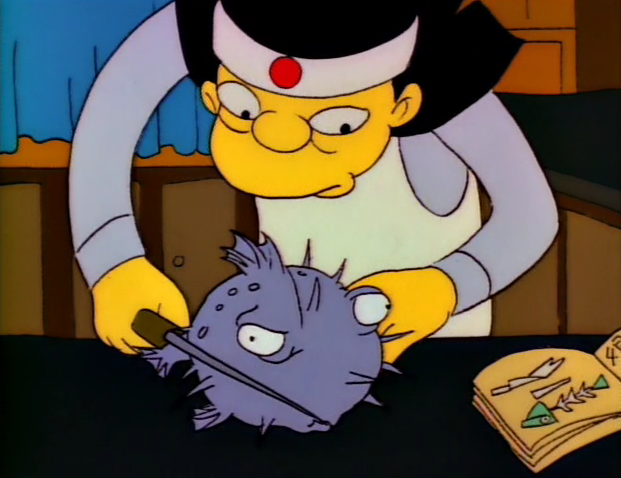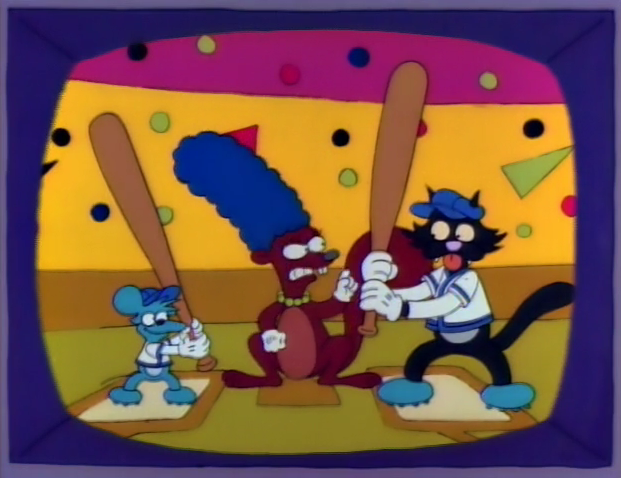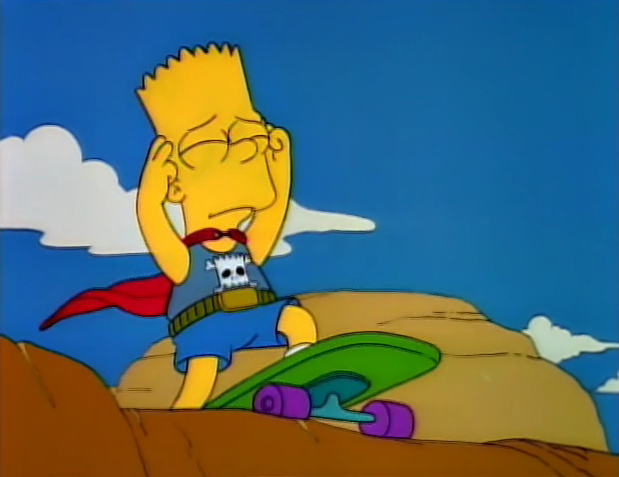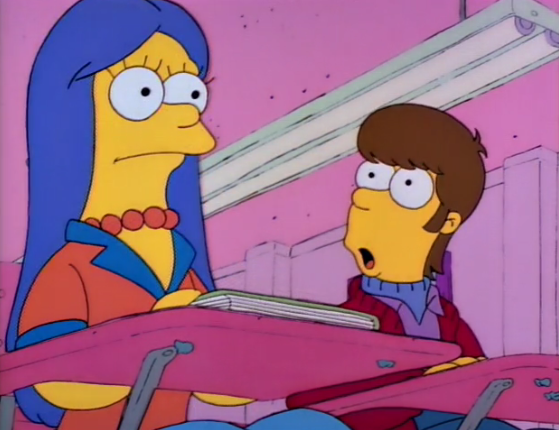
20. Bart vs. Thanksgiving

(originally aired November 22, 1990)
I was really surprised watching this episode by how leisurely the pace is. These first few seasons feel a bit slower than more recent shows, but this one in particular seemed like it was really taking its time. There’s an absolutely lovely scene where Maggie is sitting alone on the couch with the TV on, and Marge walks through the room into the kitchen, that lasts a good twenty seconds. That might not seem like long, but that’s a lot of time in a twenty-three minute show. Nowadays, episodes run for barely twenty minutes, so they could never save that much time to do something like this now. Anyway, the real “plot” of this episode doesn’t kick in until halfway through, with the first ten minutes being just the family getting ready for Thanksgiving, and it’s fascinating how amazing and funny the show can be. There’s no complex plot or real tension at the start; just the characters interacting and discussing this holiday. There’s a real beauty in that, and also a great sign that once the conflict arrives in the second half that it doesn’t lose its luster.

So yeah, the first act (maybe the longest ever at 10 minutes) is all the Simpsons preparing for Thanksgiving dinner. More accurately, it’s just Marge, as we open with a gorgeous shot of slimy turkey innards being scooped out. Homer is couch-bound watching the parade to start, later football, and then picks up his father from the retirement home (our first real look at the depressing residence). Marge’s focus is on the dinner, and is much chagrined when her sisters bring over food of their own (“Some people find your turkey a little dry, and if they want an option, they’ll have it.”) Lisa is busy preparing an elaborate centerpiece for the dinner table, a highly decorated cornucopia with figurines of trailblazing women. Also amidst this is the arrival of Marge’s incredibly hoarse mother (“I have laryngitis. It hurts to talk. So I’ll just say one thing… You never do anything right”), Bart’s lazy attempt to assist his mother, and the radio and television broadcast of the halftime show featuring those peppy youngsters of “Hooray for Everything.” There’s a lot of small stuff happening, but it all flows and feels like a real family on Thanksgiving Day. It takes a good nine minutes for the “plot” to begin, but I could have watched a lot more of this build-up.

As Lisa brings in her centerpiece, Bart butts in with the turkey. The two fight over center stage, resulting in the centerpiece being flung into the fireplace, which instantly sets aflame. Lisa is devastated, and Bart is sent to his room. Completely appalled at his treatment, Bart escapes through the window and, along with Santa’s Little Helper, hits the town in search of food. Winding up donating plasma for twelve dollars (and a cookie) and passing out, Bart is assisted by two homeless people, who take him to the soup kitchen. Kind of like the Christmas episode, this holiday special injects a bit of sentimentality into the mix, but never sinks into overt sappiness. The two hobos are kind and helpful to this ten-year-old, but aren’t above quickly accepting money from him. We also get the first appearance of Kent Brockman, who is doing a fluff piece at the mission. He’s clearly a seasoned professional, delivering an extremely pandering speech about the grimy, unloved patrons of the soup kitchen (“So every year, on one conscious-salving day, we toss these people a bone. A turkey bone. And that’s supposed to make it all better.”)

Finally able to express her heavy emotions through a poem, Lisa is once again interrupted by Bart as the family sees him on Brockman’s report on TV. While the family is in a panic, Bart realizes how fortunate he is to have those who care for him and decides to return home. He has second thoughts about how they’ll react to his absence however, in another fantastic dream sequence that starts out normally, but turns into a psychotic nightmare. Heavy red lighting shadows over a deformed Simpson family, insanely laughing at a repeatedly apologetic Bart, blaming him for every problem in their lives. It’s a great sequence, with fantastic direction and drawings from David Silverman. Bart opts to climb the roof and chill for a bit, but is taken aback hearing Lisa crying in her room, and calls her up. Here, we get a beautiful sequence between the two siblings, as Lisa somberly seeks answers for Bart’s actions (“Was it because you hate me? Or because you’re bad?”) while Bart remains adamantly defensive for reasons even unbeknownst to him (“I don’t know why I did it! I don’t know why I enjoyed it! And I don’t know why I’ll do it again!”) With Lisa’s urgings, Bart uncovers a nugget of remorse within him and gives a sincere apology, much to the delight of an on-looking Homer (“You know, Marge? We’re great parents!”)

That’s two-for-two with great holiday episodes. We recognize the Simpsons as a real family, one we can both laugh at because of their exaggerated personas, but also feel for because they’re so rooted in reality. We also can relate to crappy Thanksgiving Day balloons, enduring holiday visits from extended family members, and everyone wanting to bite each other’s heads off in lieu of a peaceful holiday meal. We also briefly see the family at a vulnerable standstill as the search for Bart seems futile, they’re genuinely worried about him. In the end, though, as the family sits at the kitchen table at night, dressed in their pajamas, Homer gives his second shot at a prayer before they chow down in turkey sandwiches (“Oh Lord, on this blessed day, we thank Thee for giving our family one more crack at togetherness.”) The Simpsons are an irrefutable family unit; we love to see them squabble, and we love to see them reunited just as much.

Tidbits and Quotes
– Following the great opening with Marge gutting the turkey, Maggie enters the living room, which pans to a silent Homer… then to Bart smothering his sister with a couch cushion over a glue bottle. Homer takes charge (“Stop it, you two! This is Thanksgiving, so glue friendly or I’ll take your glue away and then no one will have any glue to glue with!”)
I love the rapid-fire, but ultimately incoherent commentary on the parade by KBBL’s Bill & Marty (their first appearance?) It captures those types perfectly, always quick to get a witty retort or comment in, but not thinking it through to see if it made any lick of sense before saying it. Also, Homer’s observation (“If they start building a balloon for every flash-in-the-pan cartoon character, you’ll turn the parade into a farce!”) followed by a shot of a Bart Simpson balloon on the TV is a nice reference to the Bart balloon that flew in the Macy’s Thanksgiving Day Parade in 1990.
– I like Maggie crawling up the stairs past all many, many dangerous objects. It’s almost like a throwback to that one Tracy Ullman short where Maggie was off on her own (and put a fork into the electrical socket).
– My favorite line in the whole show, maybe one of my favorites ever, is during that scene with Maggie alone at the TV, the announcer at the football game (“In the Silverdome, now ablaze with flashbulbs, as ‘Hooray for Everything’ leaves the field! Of course, a stadium is much too big for flash pictures to work, but nobody seems to care!”)
I don’t know if Homer’s ever gotten through a mealtime prayer without either gossiping with the Lord or moaning and crying about his station in life.
– Great stuff at Burns’s mansion, with Burns eating barely a slice of turkey and asking Smithers to dispose of the insanely bountiful feast prepared. I also love the winged angel statue in the garden with a security camera where the head should be.
– I loved the line, “Operator! Give me the number for 911!” as a kid, and you know what, I still laughed at it now.

19. Dead Putting Society

(originally aired November 15, 1990)
Homer’s undying disdain for his neighbor Ned Flanders is one of the show’s long-standing hallmarks. Hell, “Shut up, Flanders” is basically one of his catchphrases. The two have a great dynamic; it’s almost playing off of the lovable neighbor character who stops by the core sitcom family’s house, except here, the patriarch can’t stand them. But here in the first episode to examine their relationship do we see what’s really going on. Homer’s antagonism stems from a deep-seeded jealousy. The Flanders are an affluent, caring family to which no wrong seems to befall them. As lazy and uncaring Homer seems in many aspects, he is truly envious of that. He and Ned could actually be good friends (which they would be in one fantastic episode to come), or at least somewhat amiable, but Homer’s sense of pride won’t let him. This episode is a real showcase of Homer’s blind emotions, starting off angry and getting progressively more irrational as the show goes on, and it is ever so hilarious.

We start with Homer being invited to Ned’s house for the first time, where he is blown away with his lavish rumpus room, his doting wife and loving son, and the newly installed beer tap with imported brews. With the small exception of his penchant for alcohol here (though maybe he has it exclusively for his guests), Ned is pretty much the man we know and love him as today: selfless, cheerful, and always willing to help out a neighbor-eeno. All these things slowly eat away at Homer, until he finally explodes in an angry rant. Ned responds in the crossest way he can think of: politely but firmly asking him to leave. Following this, we get the two men talking the spat over with their wives. Homer is unable to articulate how Ned was rude to him (because he wasn’t), while Ned feels awful at “erupting” and calls up Reverend Lovejoy for guidance. We also get a better glimpse at their relationship, with the Lovejoys clearly exasperated by Ned’s constant pestering of him over every little thing (“Probably stepped on a worm…”) But as I mentioned before, Lovejoy isn’t a cynical character, as he manages to give Ned some good Biblical advice, at least how he takes it. And Ned isn’t the insane Bible-thumper caricature he would later lean towards: he’s just an honest man who holds religion very dear to him and his family.

The two families later cross paths at the miniature golf course, where Homer invariably creates a rivalry of skill between Bart and Ned’s youngest son Todd. When the two boys express interest in a mini golf contest, Homer is quick to sign Bart up, hoping he can vicariously best his goody two-shoes neighbor. Bart is a fine golfer in his own right, but not so much when Homer is loudly coaching/berating him in the background. Lisa takes pity on a despondent Bart (“It’s times like these that I’m thankful Dad has little to no interest in almost everything I do”) and helps train him, enhancing his mind with age-old proverbs and examining each of the 18 holes to find the perfect angles to hit the ball (“I can’t believe it. You’ve actually found a practical use for geometry!”) Meanwhile, Homer’s unabashed goading has raised the stakes of the event: a bet is forged, where the father of the loser has to mow the winner’s front lawn in their wife’s Sunday-best dress. I always found this plot point hilarious: it’s introduced toward the end of the second act, followed by a short bit of Homer’s berating Bart at the course causing him to widely miss his shot, then the act ends with Homer mournfully looking at his options in Marge’s closet. This wildly ridiculous addition to the bet that he insisted on has backfired on him within minutes.

Civility wins out in the end as a deadlocked Bart and Todd realize this manufactured competition is stupid and call it a draw at the last hole. However, Homer is still unmoved that the father of the boy who doesn’t win has to suffer the embarrassment, so he and Ned both end up going through with the ridiculous bet. This is Homer at his most psychotic: completely blinded by anything except his petty grudge. Some of the best scenes here are Homer attempting to motivate and encourage (in a loud, obnoxious way) a completely indifferent Bart. This episode sets up the Homer-Flanders dynamic absolutely perfectly, something we’d come to love from the show years to come.

Tidbits and Quotes
– The scene where the Simpson family are laughing over Ned’s note is beautiful. Not only is it one of those few times all the actors are clearly in the same session, but it’s always so great whenever the family can get together and have fun in unison. Even Marge gets in a giggle, albeit out of the rest of the family’s sight.
– I love Sir Putts-a-Lot. I remember wishing that I had a mini-golf course as lavish and fun as this one, but alas, I was stuck with mere rock obstacles and water traps. I also like the bit where a frustrated Homer is jumping about similarly to the giant mechanical ape.
– Homer gives Bart some very gentle words of encouragement (“Son, this is the only time I’m going to say this: it is not okay to lose!”)
– I love Todd happily waving to Bart’s window, his pose mirroring the photo Homer gave Bart to glare at angrily. By itself, it’s funny, but as the finale to a fantastic scene where Homer is giving Bart an angry pep talk, it’s hilarious.
– Always good to see the ol’ card catalog. I’m just old enough to have remembered using it as a kid before they put computers in the libraries.
– I’m all for Bart in his technique for one-hand clapping. And if a tree falls in the woods, it does make a sound. Come at me, fools.
– There’s two great bits where Homer misunderstands Lisa. First, in act one (“I’m studying for the math fair. If I win, I’ll bring home a brand new protractor.” “Too bad we don’t live on a farm.”) And then later as Lisa begins to train Bart, starting with his breakfast (“Oats are what a champion thoroughbred eats before he or she wins the Kentucky Derby.” “Newsflash, Lisa! Bart is not a horse!”)
– The final hole with a stone-faced Abraham Lincoln mechanically swinging his legs back and forth revealing the hole… there are no words. How amazing that is.
– The announcer for the competition is fantastic. I have no idea why he’s taking a kid’s event so seriously, but I’m glad he is. Upon Bart and Todd’s decision for a tie, he fights back tears and reports, “This is the most stirring display of gallantry and sportsmanship since Mountbatten gave India back to the Punjabs.”

18. Dancin’ Homer

(originally aired November 8, 1990)
Perhaps “Dancin’ Homer” suffers from following an episode that tackled so much and felt so epic in scale. Here we have a decidedly smaller, more low-key and leisurely saga featuring Homer’s trials and tribulations at a brand new job, the first of many many MANY occupations he would briefly hold over the next twenty years. There’s something about this story that doesn’t quite ring true with me, though. There are elements that are spot-on, a lot of funny bits, but it doesn’t pack the punch that it feels it does.

We start at Moe’s Tavern, where a despondent Homer spins his tale of woe, a wrap-around that I never thought was too effective. The story begins at the ballpark during the “Nuclear Plant Employees, Spouses, and No More Than Three Children Night.” In a bit of a reprisal from “There’s No Disgrace Like Home,” we get Mr. Burns’s contractually obligation to warm up to the lower, less financially well-off life forms that are his employees. Homer fears that being seated next to his boss will ruin his good time, but shockingly, Burns proves to be good company, buying them beers, heckling players and doing a two-man wave. Even though last episode showed Burns straining to smile and his vow to destroy Homer’s life, we can still believe these characters can get along in some degree. Their banter back and forth is charming, it’s like the oddest of odd couples. Attempting to rouse up the crowd to aid the failing Springfield Isotopes, Homer cavorts and dances about like a fool in the dugout, sparking a rise out of the crowd, including the batter, who hits a home run, winning the game.

Homer is hired by the team to be their official mascot. Dubbed “Dancin’ Homer,” his crowd-pleasing buffoonery carries on the Isotopes winning streak, and he gains greater and greater popularity. Perhaps part of why I’m not so into this episode is I don’t understand the in-universe Dancin’ Homer phenomenon. I get that that’s part of the joke, and the character is partially based off of overenthusiastic fans’ chants and rituals becoming fan favorites and stadium institutions, but really, Homer’s act is not all that rousing. The big finale where the Capital City folks don’t “get” him is not so much a letdown as it was a logical conclusion for me. Sure, I felt bad for Homer, but at least my feelings were vindicated. But I’m skipping ahead here…

It isn’t long until Homer is called into the big leagues: Capitol City. The true savior of the episode is the Capitol City montage. First off, it establishes the Simpsons as small-town rubes in the face of the big city, full of mystery and wonder. Accompanying their drive in is an ode to the city in song, sung by the great Tony Bennett, kind of a riff on “New York, New York.” It’s the first instance of a celebrity playing themselves as Marge points him out singing the song, and he gives a quick aside, “Hey, good to see you!” It’s a sweet little moment, and the song is so brilliant. It really sets the mood, of a city that makes a bum feel like a king, and makes a king feel like some sort of nutty coo-coo super king. Also brilliant is the Capitol City Goofball, the mascot Homer is filling in for, an bizarre, mismatched whatchamacallit mascot design, a weird Muppet-type creature with deely boppers, a baseball torso, a giant horn nose, and a smooth, mellow voice performed by Tom Poston. Part of the fun is the two sitting and talking about their acts very seriously. It’s where I most buy the premise: as preposterous and stupid as this game is, Homer is taking it to heart and trying as hard as he can. However, his best efforts don’t cut it for the Capitol City crowd, and he and the family are sent back from whence they came.

I like the basic premise of chronicling the story like it’s of a pro athlete’s rise and fall, but it’s just of the goofy mascot. We even get a great play off of Pride of the Yankees, wherein Homer considers himself the luckiest mascot on the face of the Earth, is comforted by a Babe Ruth lookalike, and stumbles into the dugout on his way out. There’s plenty of parts that work in it, but all-in-all, it doesn’t resonate with me as a whole story. The wraparound device and Homer’s interruptions about the seriousness of the story feel so out of place. Perhaps if they had stuck with the story playing out on its own, it wouldn’t have had that odd story bit over its head. But with “Capitol City,” Bleeding Gums Murphy’s 26-minute national anthem, and “little baby batter can’t control his bladder,” this episode is still deserving of classic distinction.

Tidbits and Quotes
– A true classic Homer line: “Marge, this ticket doesn’t just give me a seat, it also gives me the right, no, the duty to make a complete ass of myself.”
– Another call-back to “Disgrace” with Smithers giving Burns cards with his employee’s family’s names. Homer seems to have grown a bit more backbone in correcting his boss’s erroneously referring to them as “The Simps.”
– All the bits at the ballpark are really funny: washed out played Flash Baylor’s baseball coming onto Marge (and Homer’s immense pride about it), the Jumbo-tron, and, as mentioned, Bleeding Gums. I like how sweet it is that Lisa remains standing and attentive to her hero’s whole performance.
– Here we get the first real great “Burns talk,” where he speaks of shaming and taunting Satchel Paige and Connie Mack, players who were in the leagues, back in 1990, over eighty-some-odd years ago.
– Marge’s line upon seeing a Dancin’ Homer shirt (“A Simpson on a T-shirt? I never thought I’d see the day.”) is a great remark about the rampant Simpsons merchandising at the time.
– Kind of shocking to see Homer concerned about seeing if he can get time off from work, when in recent years he mostly doesn’t even show up. We get a great quick scene where his supervisor is more than happy to give Homer as much time away from the plant as possible (“Sure, what would you like? Four years? Five years.”)
– Homer and The Goof talking shop is a very lovely scene (“What exactly do you have planned for us?” “Well, I get up, I dance, I spell out the name of the city, all to the tune of ‘Baby Elephant Walk.'” “Ah, Mancini. The mascot’s best friend.”)
– For some reason, I always love Homer’s assertion that the Dancin’ Homer costume is buried. Like he felt so ashamed, he couldn’t even bear disgracing his trash cans with it.

17. Two Cars in Every Garage and Three Eyes on Every Fish

(originally aired November 1, 1990)
The series shows some growing up this episode both in size and scope: we go from one boy’s concern on passing a test to an entire gubernatorial race from start to finish in just a few episodes. We continue to see the show’s evolution in its greater showcasing of the world of Springfield, and a more extended look at our favorite heartless billionaire C. Montgomery Burns. This episode is a real tour de force, working as a character examination, a riff on smarmy political tactics and the media feeding into it, and some parody worked in with pieces of Burns echoing Charles Foster Kane. Even with all this, we still work in the Simpson family, who provide running commentary from the common man’s perspective, and inevitably become the undoing of the greedy, wealthy ruling class.

This episode feels so current, but has classic, old-timey elements to it: the media circus we see in the third act is as accurate now twenty years later, but we begin with a 1930s reporter coming to town looking for a hot scoop. Against the hokey Americana scene of Bart and Lisa fishing at the ol’ swimmin’ hole, it looks perfectly at home, and absolutely reeks of the touch of writer John Swartzwelder (just look at his comedy novellas for more of this kind of stuff). The reporter hits the jackpot in the form of a three-eyed fish (its second appearance, now dubbed Blinky; the creature would sort of become the show’s unofficial mascot), which clearly has been contaminated by run-off from the nuclear plant. After a great sequence of inspectors examining the egregious safety violations, they demand Burns bring the plant up to code with a $56 million price tag, or they’ll shut it down. We see Burns at his most vulnerable (and a tad inebriated) after this, as does Homer, who has managed to sleep in at work past closing time. The two share an odd emotional moment as Burns explains the dilemma, and Homer inadvertently gets the plot rolling by off-offhandedly mentioning that if Burns were governor, he could do whatever he pleased.

And so the Burns campaign begins. Everything about it is so spot-on in so many ways. His team seems to be broken into two halves: one to elevate his public image from despicable monster to respectable human being, and the other to make his opponent, the incumbent Mary Bailey, do the reverse. The episode mocks the ham-fisted, pandering nature of political promotion by managing to spin a widely hated man like Mr. Burns into a Samaritan. We start with a PSA hosted by Burns explaining the phenomenon that is Blinky. It starts with the classic gag of Burns badmouthing the public, unaware that the feed is going out live. On a shitty show, this would be the climax of the third act, and Burns’ sshameful undoing, but here, we just gloss right over it. As long as Burns makes a convincing-ish argument, the short-attention-span-adled public will forget all about it. And what an argument, complete with an actor portraying Charles Darwin giving his expert opinion on Blinky’s rapidly accelerated, but completely natural evolution. Ending with a catchy jingle (“Only a moron wouldn’t cast his vote for Monty Burns!”), the public is instantly swayed. Brilliant.

I love how Burns not only is clearly tortured that he must act open and approachable, but he has nothing but absolute contempt for the common man. His actions are purely self-serving, and he’ll put up with whatever he has to to get what he wants, but throughout the entire episode, he treats the normal actions and behaviors of regular people like they’re aliens from another planet. There’s also the overt parallels to Citizen Kane, in Burns’s rise to power, in the characters themselves, bold, powerful men who are dwarfed by their crippling loneliness, and obvious references to the film, such as Burns’s campaign speech before a giant photo of himself, and his breakdown at the very end. For many people like myself, The Simpsons was our introduction to classic films like this, The Godfather, It’s a Wonderful Life, and many others; I remember watching them exclusively to see the origination of the parodies (and who’d have known that they’re actually pretty good films?) But the references are actually worked into the characters and the situations; the joke works because Burns works as a Charles Foster Kane type. It’s the correct way to do a parody, rather than expect the joke to be the reference itself, like another FOX animated show that I will not speak the name of here.

Burns’s campaign would have gone off without a hitch had it not been for those meddling Simpsons. Homer is in full, unwavering support of his boss for obvious reasons, but Marge remains steady in her opinion of Burns being pure evil. In one final pandering publicity stunt, Burns has dinner at the Simpson house the night before the election, an event full of cameras, cue cards and a total lack of anything genuine in nature. But Marge puts an end to that last bit: inspired by a off-hand comment Homer made about how she can express herself through the house she keeps and the food she cooks, dinner comes in the form of a three-eyed fish, and Burns finds he can’t swallow his own hypocrisy, spitting out his first bite, ruining the election (odd how two absent-minded comments Homer makes both start and complete the plot). Burns throws as big a tantrum as he can, weakly managing to topple a few things at the Simpson home, promises to destroy Homer’s dreams and takes his leave. Marge reassures her husband with a sweet ending (“When a man’s biggest dreams include seconds on dessert, occasional snuggling and sleeping in til noon on weekends, no one man can destroy them.”) While the aim of this show reaches so high with the Burns stuff, it never loses sight of the emotional core, the Simpson family, who are given equal attention and merit in the episode without feeling shoehorned in. It’s a shining example of showcasing a minor character while allowing the main characters their own time to shine as well. This is the first episode I would label as perfect, the definition of classic Simpsons

Tidbits and Quotes
– I love Lisa’s response to Dave Shutton’s inquiry about she and Bart’s fishing (“My brother’s using worms, but I, who feel the tranquility far outweighs the actual catching of fish, am using nothing.”)
– The plant inspection is a forebearer to the goofier the show would become later (“Gum used to seal crack in cooling tower… plutonium rod used as paperweight…”)
– Burns’s arrogant and ruthless behavior is revealed early on, when he is completely aghast that the inspector isn’t taking his bribe. He doesn’t know much about the common man, but they’ll shut up if enough dough is thrown their way, but not this time.
– This is the first episode that the question of what state Springfield is in really starts to present itself. The state flag really nails this pointless debate right away: stripes, a star, and the slogan, “Not Just Another State.”
– I love Dan Castellaneta’s performance as “Charles Darwin.” I can’t even place that accent, I guess it’s sort of English… I guess?
– The foreshadowing is so subtle here, where Burns claims that Blinky is “a miracle of nature, with a taste that can’t be beat!”
– Abe has a great comment following Burns’s PSA (“That Burns is just what this state needs: Young blood!”)
– I don’t think Smithers says a word in this episode; he’s basically replaced by Burns’s campaign manager. But I love seeing him in the background, standing and smiling wearing pro-Burns paraphernalia.
– Burns is so pandering in his political jargon, all he ever rants about is how he’s going to show those bureaucrats what for and he’ll lower taxes. He doesn’t care about any of that, he just chose an issue he thinks the public will respond to, and, as established earlier, the only thing he knows is that he can mollify others by promising them more money. It’s purely contemptuous of these lower life forms, aka the non-wealthy (“The voters now see you as imperial and god-like. But there’s a down-side to it. The latest polls indicate you’re in danger of losing touch with the common man.” “Oh, dear! Heaven forbid!”)
– I love the absolutely synthetic nature of the question Lisa is forced to read (“Mr. Burns: your campaign seems to have the momentum of a runaway freight train. Why are you so popular?”) and the great deadpan read Yeardley Smith gives it.
– A fantastic, daring joke of Bart saying grace (“Dear God: We paid for all this stuff ourselves, so thanks for nothing.”) I also love Mr. Burns’s save (“Only an innocent child could get away with such blasphemy. God bless them all!”)
– There’s so much bizarre animation associated with Burns eating the fish, be it his disturbed, disgusted look chewing and spitting, the cameramen and political team looking shocked (the dropped jaw guy is an all-timer drawing), and the great slow-mo bit where the media circus has their fill of the spitted up fish and leaves (“Ruined before it hit the ground.”)
– “Ironic, isn’t it, Smithers? This anonymous clan of slack-jawed troglodytes has cost me the election, and yet if I were to have them killed, I would be the one to go to jail. That’s democracy for you.” “You are noble and poetic in defeat, sir.” …huh, I guess Smithers had lines in this episode after all. My mistake.

16. Treehouse of Horror

(originally aired October 25, 1990)
While I was still sitting through the show’s later seasons, what always killed me most was the decline in quality of the Treehouse of Horror specials. They were always a season highlight: for one special episode a year, the Simpsons universe’s rules and regulations would be thrown out the window, and the family be dropped into a spooky situation or classic horror parody to fend for themselves. The series would riff on scary story conventions, but also had the potential of being genuinely creepy and unsettling themselves. I love the idea for many reasons, a main one being these specials bring the Simpsons back to their cartoon roots: having characters so established that they can be put into any situation, and the entertainment is seeing how they react. As we love seeing Daffy Duck attempt to be Robin Hood, we love to see the Simpsons fend off a zombie apocalypse. They used to be some of the greatest episodes of any given season, but when it got to the point where they would be parodying Mr. & Mrs. Smith and Transformers, two things not even remotely Halloween-y, it got pretty depressing. These segments must be hard to write, no doubt, but it was always worth it.

This very first Treehouse of Horror starts with a brief disclaimer from Marge on the show’s slightly more mature content, which she claims to have totally washed her hands of. Not only is it a great mimicry of the opening of the original Frankenstein, it refers directly to the audience who might not be prepared for a silly primetime cartoon delving into serious horror parodies. We then get into the show proper, featuring Bart and Lisa in their treehouse telling scary stories (the only Treehouse of Horror to actually use the treehouse). First up is “Bad Dream House,” where the Simpson family move into a suspiciously cheap mansion. Come to find its price point is due to it being built on an Indian burial ground, so they must endure bleeding walls, floating objects, and a brief possession or two. Homer is unmoved in his assertion that these minor quibbles are worth the great deal, but finding the basement cemetery is the last straw. In one of my favorite scenes in the entire series, he angrily calls the realtor to yell at him about it, but then his rage subsides and he retorts, “Well that’s not my recollection!” He hangs up and says to the family, “He said he mentioned it five or six times.” The segment ends with a nice subversion where the house reveals its consciousness to the family, but chooses to implode upon itself rather than live with them. The Simpsons were the unwelcome guests; Lisa surmises, “It chose to destroy itself rather than live with us. One can’t help but feel a little rejected.”

The second segment has our family abducted by Rigelians Kang and Kodos. Before they were annual regulars to the show with normally nefarious purposes, they quite cordially offer the Simpsons a fantastic banquet, but Lisa remains suspicious of their true intentions. It’s a great “To Serve Man” riff when Lisa reveals the “How to Cook Humans” cookbook, but a back and forth swiping of dust between her and Kang reveals “How to Cook For Humans,” “How to Cook Forty Humans” and finally “How to Cook For Forty Humans,” confirming them to be benevolent all along. It’s one of those hilarious-in-hindsight bait-and-switches: why were the aliens so suspicious sounding to begin with? So impressed by how much weight they’d gained and the chef droolingly telling Homer his wife is “quite a dish,” none of it makes any sense, but that’s why it’s so funny. Of course Kang and Kodos would become firm members of the Simpsons canon, for good reason: their grotesque alien design like something out of a classic comic book, with tentacle appendages and giant heads encased in helmets, booming, self-competent voices, and their braying evil laughter. Perhaps they were kindly all along until meeting the Simpsons, and a simple misunderstanding turned them to want to enslave the human race. Nice going, Lisa.

The final segment is an odd one: a retelling of Edgar Allen Poe’s classic poem, “The Raven,” featuring Homer as the visualized narrator (with James Earl Jones actually narrating), and Bart as the eponymous raven. What seems like a tedious exercise on paper is actually quite riveting, from the rousing score and the wonderfully choreography of the sequence. David Silverman does an amazing job (as usual) spicing up the segment, visualizing ghostly hands caressing Homer’s face, odd sweeping scenes of a ponderous nature, and quick cuts to rise the tension of Homer finally snapping and yelling at the raven. Dan Castellaneta also deserves credit for his performance, keeping the intensity and passion of the read, but always remaining true to Homer. The seriousness of the sequence eventually gives way to a brief silly ending where Homer frantically tries to catch the bird, but it becomes his own undoing as it comes to a close. I always praise Silverman for his direction, so I apologize for overlooking the other great Simpsons directors. Wes Archer and Rich Moore, who did the other two segments, are fantastic in their own right, doing fine work for this series, as well as many others.

I like how we end with Bart mentioning how the poem wasn’t scary, and Lisa justifying that since it was written over a hundred years ago, maybe people were easier to scare. It really reflects with these Halloween specials too; the bit with the family trying to kill each other in the first segment was a bit rough, but compared to how much darker and bloodier these shows would become, this truly is tame by today’s standards, as Bart puts it. Later, we would delve further into the macabre greatness that these specials could be, but this is a grand first outing signaling things to come. Spoooooky things.

Tidbits and Quotes
– A long-deserted Halloween tradition we first see here are the scary tombstone names. They’d get funnier as years went on, until the writers got sick of writing them. I do like the one for “Casper the Friendly Boy” though.
– I like how James Earl Jones is in all three segments, as if he’s the weaving thread for the three stories. It’s also cool that his roles increase in size, from one line as the mover in the first one, Serak the Preparer, a minor role in the second, and the main event as the narrator in the third.
– I remember loving the vortex gag as a kid. For some reason, I thought I remembered Homer thinking it was some kind of new-age dishwasher. Guess I imagined it.
– Kinda subtle bit with Marge telling the kids to get their coats, and they just float onto them.
– The house seducing the family to kill each other is pretty grim. Perhaps the disclaimer really was necessary. And why the hell would Marge need THAT big of a knife to spread mayonnaise on her sandwich?
– I love how the house physically emotes by changing in color, light and shape with its dialogue. Kudos to Wes Archer for that. See? I can compliment other directors.
– I know the series has had two different gags with Homer pouring the entire can of gasoline onto the grill before turning it on. This one has a mini-inferno go off, but I know another episode does the same thing but the grill turns on normally. I forget which one it is though… guess I’ll find out soon enough.
– Brilliant glossing over of the language barrier between humans and aliens by Kang (“I am actually speaking Rigelian; by an astonishing coincidence, both of our languages are exactly the same.”)
– I love the sequence where the family derides Kang and Kodos’ crowning achievement that is Pong. The aliens get so defensive, while even Marge finds it hard to sound genuine in her patronizing.
– Homer kind of mirrors the supposed worrywart audience, while Marge (the writers) dismiss the episode as “just children’s stories.” Then he’s frightened by a bird out the window. Classic.