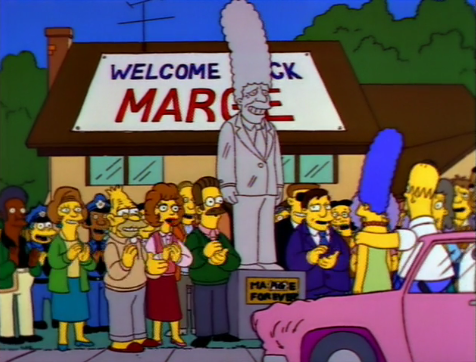
74. I Love Lisa

(originally aired February 11, 1993)
Lo, it is written on giant stone tablets, that on this date, the world was first blessed with the indelible presence of Ralph Wiggum. He had existed as just another kid on the schoolyard in the past, had a choice line or two, but this is when he was cherry picked to be an actual character, and also genetically tied to Chief Wiggum. Ralph would soon become one of the most popular characters on the show, and as the years progressed, he would become further homogenized (just like most of the rest of the cast), becoming merely a wall-eyed non-sequitur machine. What surprised me most re-watching this is that Ralph is an actual person here; he’s still eating crayons and picking his nose like we expect him to, but his emotional plight carries a big portion of the episode, and we buy it. It’s one of the sweetest episodes of the series, and by having one of the most relatable story lines, one of the most memorable.

It’s Valentine’s Day in Springfield, so we get some great customary gags to start with: Ned Flanders serenades his wife in a heart costume with a G-rated version of Rod Stewart’s “Do You Think I’m Sexy?” and Homer, of course, has forgotten the holiday completely. Our story really begins at school where Miss Hoover’s class is ready to hand out valentines. Now I remember as a kid we had to write out cards to every student so no one felt left out, but alas poor Ralph is left with an empty paper mailbox. A sympathetic Lisa gives him one of her cards hastily re-addressed to him, and that’s all Ralph needs to send his heart all atwitter. The scene of him walking Lisa home is perfect, with his inability to come up with conversation unrelated to the only tenuous connection between them: repeating the pun on the card she gave him. Ralph is ever persistent, however, managing to score tickets to Krusty’s 29th anniversary show. The Krusty stuff in this episode demands its own analysis, and once again calls into question what exactly his show is and who it caters to, as we see clips from past shows mirroring The Tonight Show and Laugh-In. It’s there that Lisa finally breaks and admits she only gave Ralph the card out of pity, and his heart is broken.

I thought it would be weird at this point to watch Ralph actually conscious of his emotional being rather than stuck in ignorant bliss, but we absolutely buy his sorrow. There’s a wonderful scene in the third act during the President’s Day pageant, with Ralph as George Washington and Lisa as Martha. A despondent Ralph mournfully gazes into the fireplace, missing his cue to toss the valentine into the fire, then channels his emotions to give an impassioned performance. Shockingly, it works; the story has built to this point, and we not only buy Ralph in his transformation, we cheer for it. Lisa’s “Let’s Bee Friends” card is an absolutely perfect end, her way of communicating her intentions in a way that Ralph can understand. The episode deals in real emotion without ever become sappy, because it comes from a pure source: unrequited childhood romance. It’s a story we can all call back to, and we connect with it because we’ve all been in Ralph’s shoes at one point or another. We know how it feels to have lost love, even if we never really had it to begin with. Ashley, if you’re out there, call me. We can make it work, I swear!

Tidbits and Quotes
– The “Monster Mash” bookends are hilarious. The intro is great, as Marty feebly attempts to defend playing the wrong record (“It’s kind of a love song. All the monsters enjoying each others company… dancing, holding their evil in check…”) Then at the end when they prepare to play a record on President’s Day, you know it’s going to play again, and in some instances like this, knowing the joke is coming makes it even funnier.
– The Valentine’s stuff at the front is great, where Abe scoffs at the calculated coldness of the holiday until he breaks upon seeing Jasper got a card from his granddaughter (“Can I have the envelope?”) and Homer getting bilked a hundred bucks from Apu for his last, incredibly dusty heart-shaped box of chocolates. After Homer vows to never shop there again, Apu must act quick to keep one of his best customers (“Nickel off on expired baby food!” “Sold!”)
– We get our first Vietnam flashback from Principal Skinner, and a rather grisly one at that. Between his post traumatic stress and issues with his mother, Skinner is a really disturbed man.
– Lisa’s card is, of course, absolutely perfect. We all know what it is, but it bares repeating: “I Choo-Choo-Choose You!”
– I think this is the first appearance of Lunchlady Doris, voiced by the great Doris Grau. She’s a classic character right out of the box, smoking while mixing a broth and urging a truck-load of beef hearts be dumped onto the floor (“Just do your job, heart boy!”) Not quite sure what the school will be doing with them all, but it gives Bart license to pull a great prank with one.
– A particularly great Itchy & Scratchy where Itchy presents Scratchy with a valentine of the cat’s own heart. He admires it, places it on the mantle and sits to read the paper. Upon reading an alarming editorial (“You Need a Heart To Live,”) he scrambles to put the organ back in his chest, but expires before he can reach it.
– I love Homer’s eavesdropping on Lisa’s situation with Ralph (“Ah, sweet pity. Where would my love life have been without it?”) and his multitude of suggestions of one-liners (“‘I no speak English,’ ‘I’m married to the sea,’ ‘I don’t want to kill you, but I will’…”) and of course, “Six simple words: I’m not gay, but I’ll learn.”
– Great quick moment where Lisa mentions the only way they could get tickets to Krusty’s show is if their parents were part of Springfield’s cultural elite. Cue Homer walking in (“Can you believe Flanders threw out a perfectly good toothbrush?”) He then proceeds to use it.
– Our first, and only appearance ever, of Rex, the second-grade thespian, who loses the part of George Washington to Ralph. Rex is incensed at Miss Hoover (“Someone’s gotten to you, you deceitful cow!”) Then we see Hoover subtly gives the signal for Wiggum to remove the boot from her car.
– Wiggum’s story of how he got the tickets, running into Krusty at an adult theater, is amazingly smutty. When Lisa mentions that story is not appropriate to tell children, Wiggum comments, “Really? I keep my pants on in this version.” That just raises further questions.
– The clips from Krusty’s show are all great: Sideshow Mel’s drunken confession, Krusty’s psychedelic 70s period (“What was I on?”), Sideshow Raheem, but the best is his humiliation of Robert Frost (“Hey Frosty, you want some snow… man?!”) Frost’s deadpan reaction under a pile of snow is priceless (“We discussed this and I said no.”)
– “Mediocre Presidents” is one of my favorite songs from the series ever. It’s so absolutely perfect (“We are the adequate, forgettable, occasionally regrettable, caretaker presidents of the U-S-A!”)
– The finale of the pageant is unusually well done technically, with Washington’s bed rising to the rafters unfurling an American flag, and a gigantic Mount Rushmore lowering down in front of it. The spectacle of it is immediately dashed by Skinner’s voice through Teddy Roosevelt’s head urging the audience to buy orange drink.

73. Brother From The Same Planet

(originally aired February 4, 1993)
Homer may be completely out of his element with Lisa, but he’s got a better chance of building a somewhat substantial relationship with Bart, as they seem to operate on similar wavelengths. However, his laziness and ineptitude often creates him more problems than he intended, leaving him at a loss on how to repair things. As in “Saturdays of Thunder,” Bart seems to rarely need any sort of parental figure, but in this episode, when Homer fails to remember to perform a simple task, picking him up from soccer practice, he realizes he’s in dire need of one. The idea of Bart finding comfort in a surrogate father, and Homer, in petty vengeance, getting a surrogate son, is a pretty interesting one, but I don’t know if this episode delved into the material thoroughly enough, and missed a chance to further explore Homer and Bart’s relationship in lieu of a relatively limp B-story.

Thanks to some healthy abuse of the local big brother agency, Bart is introduced to Tom, coolest guy ever, voiced by very cool guy Phil Hartman. He’s attentive, athletic, full of wisdom and knowledge, basically everything Homer is not. In turn, Homer “adopts” a little brother, a pathetic wide-eyed little boy named Pepi. The episode plays up the betrayal angle quite a bit, with Homer bitterly (and drunkenly) accuses Bart of “adultery” a la Who’s Afraid of Virginia Woolf?, and later, in one of the most bizarre scenes in the show’s history, Bart admits to having feigned enthusiasm on the swings in the past almost akin to faking an orgasm. The dynamic between the two is tested; Homer attempting to one-up his son is in-character enough, but its climax doesn’t seem to amount to much given the emotional stakes. Homer and Tom have an all-out brawl, which ultimately results in the resolution of the story for some reason. Bart is concerned for his father’s safety, and impressed by his cowardly fighting style, but does that really solve the conflict? It felt more like they couldn’t arrive to a sensible ending and just had the episode end anyway.

I don’t have much of a problem with the B-story of Lisa addicted to the teen call-in hotline, which is given a lot of screen time despite the potential richness of the main plot, other than it’s not all that engaging. I like the running gag of the ambiguous teen heart throb Corey we’ve heard mentioned in previous episodes, and the ridiculous pre-recorded messages on the hotline, but nothing from this plot ever seems to stick. I buy Lisa’s infatuation with the teen idol, as she’s still a young girl, but I think it works better in smaller gags as we’ve seen in the past; seeing her obsessed to this great a degree kinda doesn’t work for me. I think a lot of stuff in this episode just came up short; it has its moments, and a fair share of great gags and laughs, but given the concept, I’d expect more emotional plumbing from a show like this, especially following a very rich episode like “Selma’s Choice.”

Tidbits and Quotes
– I love the kids excitement over sneaking into an R-rated movie: Barton Fink. Fantastic movie, but not at all what a kid wants out of an R-rated flick.
– Classic line from Flanders when Homer leaps out of the tub and dashes outside (“Hey Homie! I can see your doodle!”)
– I think the A-story could have been helped with some intervention with Marge, motherly advice to Bart and scolding Homer about getting Pepi. It could have given the story some more solid emotional ground, but Marge seemed to have been wrapped up with Lisa’s B-plot.
– I love Homer’s immediate response to receiving an alarmingly high bill (“Oh, it’s that record club. The first nine were only a penny. Then they jacked up the price!”)
This episode does have its great share of fantasy scenes of Homer and Bart spinning negative stories about each other: Bart with Homer’s seedy gambling and not knowing when to say when, and Homer with Bart smashing grapefruit in his face like James Cagney (“Mmmm… grapefruit.”)
– The Ren & Stimpy segment is kind of strange, considering they hired people from the actual show to help with the segment. It’s not really a parody of the show, it’s just Ren & Stimpy randomly plopped into a Simpsons episode. It could just as easily been Itchy & Scratchy Bart and Tom were watching. I do like Dan Castellaneta’s take on voicing the two characters though.
– More of Homer being at odds with his brain: asked why he wants a little brother, his brain urges him not to say “revenge,” but he does it anyway. His brain is fed up: “That’s it, I’m out of here.” Followed by footsteps and a door slamming. Brilliant.
– Very disturbing parody as Skinner gazes out his office window at the Psycho house talking to his “mother” (“Mother, that sailor suit doesn’t fit any more!”) Marge and Lisa quietly make their exit.
– Homer teasing a dolphin at Marine World and laughing goofily is a great callback to similar antics he pulled at the zoo in the Tracey Ullman shorts, complete with slightly off-model laughing.
– Oblivious Homer is always great: Tom finally meets Homer, and it stops him in his tracks (“His father, the drunken gambler?”) Homer cheerfully responds, “That’s right. And who might you be?” right before getting punched in the face.

72. Selma’s Choice

(originally aired January 21, 1993)
Patty and Selma are pretty tragic characters: they have developed a long-lasting co-dependency on each other thanks to a world that can barely tolerate them, let alone accept them. While Patty is pretty comfortable with their situation, Selma yearns for more: a man who loves her and a baby she can lavish her love unto. Even at their rawest, we still feel for these characters because they feel so genuine, their struggles so relatable and sympathetic. That being said, I’m sure these episodes must be a bitch to write, but the show keeps its theme consistent throughout, even with two big set pieces in the front and back end. We start at a funeral parlor where the Simpsons and Bouviers pay respect to the passing of dear great aunt Gladys. Her video will includes a warning to her nieces to raise a family and not die alone like she did, which really hits Selma hard. Her gift to them of a grandfather clock pushes it even further: time is ticking for Selma, so if she wants a family, it’s now or never.

The second act is devoted to Selma’s attempts to find a decent catch, which very quickly devolves into nabbing any male with a heartbeat. While seeing her attempt to seduce bag boys and her freakish date with Hans Moleman is amusing, there’s an underlying sadness to her fruitless endeavors. While at times they come close to clashing, the gags mostly work as relief from the dour side of the plot. There’s a scene where Selma has decided she wants to be artificially inseminated, and Marge and Patty discuss it with her that feels like it’s from another show, so raw and emotional. Also great kudos to Julie Kavner, who gives a different nuance to all three roles, each with their own ideas and opinions, all distinct despite their shared gravely nature (the scene ends with them murmuring in three-part harmony.)

Set up early in the episode is Homer and the kids excitement over Duff Gardens, an amusement park sponsored by the brewery, similar to how Sea World and Busch Gardens are under the Anheuser-Busch umbrella. When a sandwich-related incident leaves Homer too sick to go, Selma steps in to take Bart and Lisa for the day, and gets her first hands-on experience with tending to children… and everything goes wrong. The third act is full of potent satire toward Disney theme parks: the Seven Duffs, the drunken Hall of Presidents, and of course the insufferable It’s a Small World-inspired boat ride (“Duff beer for me, Duff beer for you, I’ll have a Duff, you have one too…”) Lisa’s freakout after drinking the ride water is a real highlight, as I’ve always wondered how absolutely rancid theme park water must get. In the end, Selma finds an outlet for her matronly desire: Gladys’s iguana Jub-Jub. This was a sweet show, with a lot of satisfying elements. While it’s not quite as tight as other episodes, it’s still got a lot of great character study and humor to keep it going.

Tidbits and Quotes
– A welcome, albeit brief, return of Captain Lance Murdoch, celebrity sponsor of Duff Gardens, who appears very immobilized after a stunt gone wrong, but is continuously thrashed around and injured by the park’s rides. Regardless, Homer is sold (“Bart, warm up the car. We’re going to Duff Gardens!”)
– A spectacular moment where Homer appears to have been tricked by his own brain: the voice in his head comes up with a mean-spirited witty retort, and he repeats it out loud and laughs, causing him to get scolded.
– Homer is a man of quiet dignity: he fails to complete a place mat maze for children for the umpteenth time, and when asked by a waitress if he’d like another, he modestly responds, “Please.”
– Lionel Hutz has a brief appearance as executor of Gladys’s estate, and his voicing over the video will in an attempt to get inheritance money is lovably sleazy (“You’d be surprised how often that works, you really would!”)
– Selma’s dating tape featuring her doing the cherry stem trick with a cigarette is so disturbing, so that’s exactly why I used it as the header image. Even someone as grizzled as Willie is disgusted (“Back to the loch with you, Nessie!”) Speaking of, I love his leisure shirt and chains; an odd side of him we’ve never really seen since.
– A great bit where a phony gypsy tries to sell Selma a love potion, but falls victim to her own truth serum. But if the truth serum seems to be legitimate, then why would the love potion be fake?
– I always found it a little unsettling that Lisa, an eight-year-old girl, suggests Selma consider artificial insemination, but it’s immediately forgiven by Homer’s giddy response (“You gotta be pretty desperate to make it with a robot.”) Also, the sign at the Springfield Sperm Bank is, without question, the best sign joke in the entire series: “Put Your Sperm In Our Hands.”
– The sandwich saga is pretty amusing, where Homer continuously can’t say no (“Marge, I’d like to be alone with the sandwich for a moment.” “Are you going to eat it?” “…yes.”)
– Lisa’s freakout is amazing, with the monstrous version of Selma featuring some fantastic animation. Also some great blurring effects in the POV shot when Lisa’s swaying her arms to the music of the electrical parade.

71. Marge vs. the Monorail

(originally aired January 14, 1993)
The Simpsons
started as a rather low-key, “realistic” subversive sitcom that just happened to be animated. Over its first few years, the tone and scope of the show slowly began to take shape, and limits were pushed: gags became more outlandish, and plots got a bit crazier. We had “Homer at the Bat” feature nine famous baseball players get put out of commission in the most ridiculous of ways. But “Marge vs. the Monorail” is particularly egregious: compared to the seventy episodes before it, this one is downright nuts, and even after twenty years it remains one of the show’s most insane episodes ever. Full of overly crazy gags, a spectacularly bizarre premise, guest star Leonard Nimoy literally teleporting out of the show, and much more, this episode basically opened the flood gates for the series in terms of what they could get away with. However, as off-the-wall as this show is, it has a very tight structure, has a perfect flow, and gives us great insight into mob mentality in the city of Springfield. And it’s hilarious, of course.

Things are pretty nuts right off the bat as we see Mr. Burns personally disposing of drums of toxic waste in public areas, stuffing them under sandboxes and in tree trunks. Busted by the EPA, he is forced to pay the town of Springfield three million dollars in damages, and a town meeting is held to determine what to do with the money. I may be mistaken, but I believe this is the first town meeting of the series, and it really sets a great precedent. Not only do we see the denizens of Springfield as a better collective, we get a great examination of how quick they find themselves devolving into a mindless mob. Acting as the voice of reason, Marge suggests the money be used to repair Main Street, which has been tattered and destroyed by the town by their reckless driving. Abe attempts to issue a sarcastic response, but the town completely misreads it and immediately celebrate Marge’s proposal. Enter Lyle Lanley, a smooth-talking shyster who claims he’s got the perfect solution: constructing a brand new monorail. Lanley is Hartman’s greatest one-off role; he exhibits all of the smarm of his other characters, but has a lot more charisma. He’s well aware of his dangerous product, but sells it with as much sincerity as he can muster. Having a musical number doesn’t hurt either.

The townspeople are completely overtaken by this stranger’s candor, and immediately go forward with his proposal. With time, Homer is even swayed into becoming a conductor. This further emphasizes Lanley’s power: Homer barely has any idea what a monorail is, but after his razzle dazzle performance and a flashy ad, he claims being a conductor to be his life-long dream. Meanwhile, Marge, the only doubter of the bunch, discovers Lanley’s shady ways and travels to the site of his previous fiasco North Haverbrook, a town deserted and virtually destroyed, a dark vision of Springfield’s potential future. The third act becomes almost like a disaster movie when the monorail malfunctions and Homer must figure out how to shut it down. This episode is full of ineptitude from supposed authority: Judge Snyder gladly sells the statue of justice to Mr. Burns, Kent Brockman shamelessly over-promotes the monorail with a smile, and Chief Wiggum and Mayor Quimby have a proverbial dick-measuring contest whilst lives are at stake. In the end, the common man (Homer) saves the day, thanks to his favorite snack treat (giving us the immortal line, “Donuts, is there anything they can’t do?”) While this episode pushed the bar much higher in terms of outlandish content, it never lost sight on the show’s themes and social satire. And laughs. Lots of laughs.

Tidbits and Quotes
– Even before the plot set-up with Burns, the episode is silly to start with a loving tribute to the Flintstones opening, with Homer leaving work singing a hilarious reworking of the famous theme song. And smashing his car into a tree.
– Mr. Burns’s piss-poor disguise always cracks me up (“Hello, my name is Mr. Snrub, and I come from… some place far away! …yes, that’ll do.”) I also like that even considering how unbothered he seemed about paying the three million in the first place, he still wants it back just for its own sake.
– The scene with Homer driving with chain-link tires and hoisting a grand piano, gleefully ripping up the pavement behind him makes me laugh; a man so giddy at his rampant and mindless destruction.
– Lanley is truly a master manipulator. We get some insight on how he resonates: as Marge bemoans how her proposal was usurped, Homer responds, “Well, you should’ve written a song like that guy.” He doesn’t even remember his name, but knows he had a song, and that’s good enough for him, and the rest of the town. Lanley is so crafty he even manages to silence Lisa’s justified complaints. Damn, he’s good.
– I love the end of the Lanley Institute of Monorail Conducting commercial (“Actual institute may not match photo.”) Later when we see the class, we see a hastily written name on a piece of paper taped to a door.
– More great test questions akin to the driver’s test in “The Otto Show”: “True or false? You can get mono from riding the monorail.” Homer surprisingly picks false, but unsurprisingly backpedals, thinking it may be true.
– The one bit we see of Lanley teaching is very telling of what his class must have been (“Mono means one, and rail means rail. And that concludes our intensive three week course.”)
– Another classic line from Homer regarding the family of possums living in the compartment of the monorail that should house a fire extinguisher: “I call the big one ‘Bitey.'”
– This episode is silly enough, but Lanley’s notebook of childish stick figure drawings of himself running off with bags of money and the monorail burning are truly insane. It really signals that there’s something seriously wrong with this man. I love when Marge appears to be in hot water upon discovering them, but Lanley just lets her leave (“I don’t know why I leave this lying around!”)
– Leonard Nimoy is an amazing guest star right off the bat, with his indignation over Quimby not knowing who he is (“I think I do. Weren’t you one of the Little Rascals?”) Every bit of his is great: breathlessly telling behind-the-scenes Star Trek trivia to an uninterested fellow passenger, saving Krusty from leaping out of the runaway monorail (“The world needs laughter”), and giving the best line in the whole show, one of the best in the entire series: “A solar eclipse. The cosmic ballet goes on.” The seriousness of the read is so amazing.
– I always liked Bart sticking his head out of the window, pulling it back in mere moments before he would have been struck and killed by a telephone pole.
– Lanley, armed with two suitcases overflowing with money, gets his comeuppance when his plane to Tahiti has a layover in North Haverbrook. Not only can the townspeople see him on the landing plane, but they identify his seat number, and all charge on board to beat him senseless.
– More things that spectacularly explode, but shouldn’t, as Homer’s ‘M’ anchor cuts through Springfield’s oldest tree, which lands on the birthplace of Jebediah Springfield, which bursts into flames.
– We end just as silly as we start with the Popsicle stick skyscraper, the giant magnifying glass, and the escalator to nowhere, which I guess is a city-approved suicide venture. It’s almost too crazy for the show. Almost.

70. Homer’s Triple Bypass

(originally aired December 17, 1992)
In this week’s hilarious episode of The Simpsons, our lovable hero, husband and father of three, has a heart attack and must get a triple bypass operation. Rather heavy subject matter for any show, let alone a comedy. Such a serious premise could have created a dour tone to the entire episode, while treating it too lightly would have betrayed the premise. The magic of this series is its ability to have it both ways: we get as many laughs as we can get, more than you think you could squeeze out of an episode about a heart attack, but the episode remains sincere, emotional and so very real. This blend is so effective, the episode can flawlessly go to a heartfelt moment with Homer and the kids to an over-the-top gag with Dr. Nick. It’s a crowning achievement, and one of my favorite episodes of the series.

After a great quick TV parody (“COPS… in Springfield!”), we delve right into our story, in showing how Homer’s poor eating habits and sedentiary lifestyle has finally got the better of him, with him having several major chest pains during the day. Massive props to David Silverman, who took a task as monumental as making a heart attack funny and succeeded tremendously. We still feel the tension (also helped by great dramatic stings by Alf Clausen) of Homer’s pain, but also are amused by them, particularly due to his complete lack of acknowledgement of what’s happening. You can tell fairly quickly it’s a Silverman show because of the great acting: one moment sticks out when Marge offers Homer a healthy bowl of oatmeal, to which he patronizingly responds, “Oatmeal! What a delightful treat!” The small dainty movement corresponds perfectly with the great performance, so flowing and meaningful. Homer may be grossly overweight, but there’s still a very flighty air to him that allows him to act with occasional grace, like his fairy dance in “Flaming Moe’s.” This all builds toward our tipping point, one of the greatest scenes in the show’s history, as a fierce scolding from Mr. Burns finally triggers Homer’s heart attack. With a picture-in-picture of Homer’s heart going mental, and the hilariously off-model fluctuations of Homer, it’s an absolute wonder to behold. Again, we’re talking about a man having a heart attack.

Following Dr. Hibbert’s diagnosis (and a high price tag for an operation), the story briefly becomes another money crunching episode where the family tries to scrounge up funds. Things take a turn upon seeing a commercial for local quack Dr. Nick, who will cut anyone open for a mere $129.95. We get some absolutely beautiful scenes from then on: Homer praying for God to look after Marge if anything should happen, Bart and Lisa whispering Homer his possibly last words to them, they’re all very touching. Similar to “One Fish, Two Fish, Blowfish, Blue Fish,” we know Homer will survive his operation, but we’re so invested in these characters and their emotions that we feel connected to the story. This also helps with the humor; because we care about what’s happening, we’re able to laugh at it. We feel pained as Lisa tears up about her father’s situation, and Homer’s reassurance that only bad people die, and just like that, we laugh when Homer makes up a story about Abraham Lincoln giving poison milk to school children. This episode exemplifies the show at its very best, at its peak of emotional resonance and prevailing humor in the face of any subject matter.

Tidbits and Quotes
– I like Bart’s antics at the breakfast table: we all know the “see, food” trick, but Bart goes one step further by scraping the goop into Lisa’s cereal bowl. It’s the perfect trigger for another of Homer’s chest palpitations.
– We get the first time that Hans Moleman dies spontaneously, going off road whilst towing the birth home of Edgar Allen Poe, which bursts into flames for no real reason, and almost immediately after he hits the guard rails.
– I’ve already said the scene is perfect, but Harry Shearer does an amazing performance as Burns during the firing scene, seamlessly alternating from cordial to raving. The capper on this scene is great, of course (“Your indolence is inefficacious!” Homer is confused. “…THAT MEANS YOU’RE TERRIBLE!!”)
– Another great cheek slap: after Marge runs out announcing Homer’s at the hospital, Patty finds a coupon for five cents off wax paper. Selma is stunned.
– Absolutely great sequence of Dr. Hibbert torturing Homer; slightly out-of-character for him, but it’s so hilarious, with great ad-libbing between Castellaneta and Shearer, and the great final line, “Remember your hippopotamus oath!” I love the tests with the radioactive dye and the fat analysis (“Woo-hoo! Look at that blubber fly!”), and Hibbert’s numerous attempts to dumb down his medical jargon for Homer (“We’re going to cut you open and tinker with your ticker.”)
– Homer once again displays his occasional knowledge base in reassuring Marge (“America’s health care system is second only to Japan, Canada, Sweden, Great Britain, well, all of Europe, but you can thank your lucky stars we don’t live in Paraguay!”)
– The scene at Happy Widow’s Insurance is another amazing one, with great acting, pacing and execution. Homer just can’t wait to get his insurance plan and rub it in the poor clerk’s face that he screwed them, thinking his scheme is completely fool-proof. Every second of the scene is gold (“Now, under ‘heart attacks’, you crossed out three and wrote zero.” “Oh, I thought that said ‘brain hemorrhages'”), and the finale of Homer fighting another chest pain and his back-and-forth with the clerk is so hilarious (after collapsing, Homer weakly asks if he can have a free calendar. The clerk says that’s fine.)
Desperate, Homer turns to houses of worship for money, but has no luck with Reverend Lovejoy, Rabbi Krustofski, or Surdrudinma Baradad (host of his own yoga show, as seen in “Kamp Krusty.”) No luck with funding, but Homer does get a nifty souvenir from the rabbi (“Son, it’s called a doodle.”)
– So many great Dr. Nick moments, right off the bat with his call number 1-800-DOCTORB (“The ‘B’ is for bargain!”)
– I can’t quite put into words the great feel of this show: you totally feel the sense of drama the story needs. The scene where Lisa asks her Sunday School teacher what will happen if her father dies is one of those scenes; they’re played straight when they need to, and when we do get the joke at the end where Lisa imagines angel Homer in the clouds (“Cloud goes up, cloud goes down!”) it doesn’t lose that tone, since you’d imagine Lisa to be thinking of that.
– The scene of Krusty visiting Homer has some amazing animation, particularly on Krusty. The animation of him lighting his cigarette and unbuttoning his shirt is so full of life, it helps so much with the great performance. And we close with one of the best Krusty quotes ever: “This ain’t makeup!”
– Unfortunately for Dr. Nick, the videotape tutorial for the operation has been taped over with a talk show featuring the segment, “People Who Look Like Things.” Fortunately for us, it’s a hilarious scene. A man with a pumpkin-like head speaks his mind, “All we ask for is a little dignity and a little respect.” The host slyly responds, “And a new candle every now and then?Pumpkin guy is suitably grumpy and the audience applauds. Hysterical.
– Dr. Nick is hilarious during the operation, saying the worst possible thing anyone could hear before they go under anesthesia (“What the hell is that?”) There’s also the great bit at the end of him being accosted by one of his botched patients (“If it isn’t my old friend Mr. McGreg, with a leg for an arm and an arm for a leg!”)
– The ending is perfect, showing picture-in-picture of Homer’s heart back in working shape… mostly. I heard on the commentary there was an alternate ending showing Homer having a horrible creaky wooden heart, or another joke of him eating a pizza, mirroring an earlier flashback of a newborn Homer doing the same, but I think this ending works a lot better played straight, with a minor joke.