323. Diatribe of a Mad Housewife

(originally aired January 25, 2004)
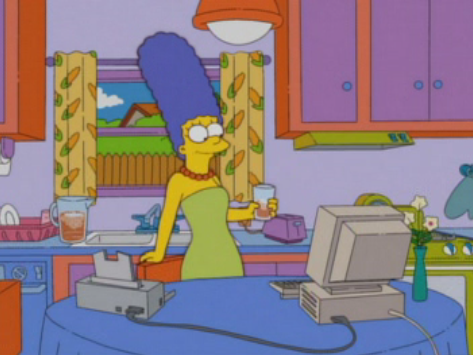
It seems I’ve been doing a lot of comparisons to classic episodes this season, due to Al Jean’s attempts to either drag back old one-off guest stars or tread through familiar emotional ground, except in a less successful way. Here we have Marge channeling her dissatisfaction of her husband through a creative outlet, a la “A Streetcar Named Marge,” but rather than star in a play, she writes a trashy romance novel, the kinds housewives read that typically have Fabio on the cover. Her characters are thinly veiled surrogates for people in her life, the long-suffering wife to a lecherous seaman falls for the kindly, rugged gentleman next door, inspired by the always helpful Flanders. Before that, we have a profoundly stupid opening where Homer mows down a nuclear inspector in Burns’s office with his car, seemingly killing him, an action which is impossible since the office is several floors off the ground. Terminated, Homer falls into a job as a car salesman, which lasts all of two minutes before he gets another job driving an ambulance. Or rather, he just buys the ambulance and automatically becomes an ambulance driver. It’s almost like a parody of Homer-gets-a-job at this point. I just don’t know what to make of it.

I feel like some people could point at an episode like “Streetcar” and cry, “See? See?! Jerkass Homer existed in the classic era!” But, as always, it’s all about context. “Streetcar” is one of my favorite episodes, and the handling of Homer’s character to keep him likeable despite his inconsiderate behavior is stellar. He remains distant and oblivious to all of Marge’s plights, but never in a way that seems mean. He flat-out admits to her that he has absolutely no interest in any of her outside interests, and when Marge asks him why he never told her this, he responds as earnestly as possible, “You know I’d never do anything to hurt your feelings.” And you believe it. Homer’s a believably dense and dim man whose bubble of ignorance is only popped after actually seeing the play. In this episode, Homer isn’t exactly antagonistic, but when he lumbers home demanding Marge cook him dinner and chastising his kids who he forced to work for him, it pretty much seems like it. And when Marge writes about potentially finding happiness with another man, it feels so sad to me, as well as disturbing that it’s about Flanders. Thank God I jumped ship on the show before they did that episode where she considered actually having an affair with him. Man oh man, how fucked up is that?

Homer-Marge relationship episodes were dodgy in the past since it was always a bit of a leap of faith that Marge would ever take back Homer, but nowadays, they’re really complete fantasies. Homer’s such an out-of-control maniac, as we’ve seen, but this episode strikes an even more sour tone since we see Marge’s point-of-view on the subject. Her book is really the subject of her inner feelings, and as we see it play out that Homer is this complete sloven degenerate (“I’m free to be selfish, drunk, emotionally distant, sexually ungenerous…”), it becomes depressing that this is how Marge sees her husband. For all their scrapes and scuffles, what always felt so comforting about this show is that the family truly cares about each other, particularly Homer and Marge, who felt like two people who were very much still in love. Nowadays Homer is a complete cartoon character, and Marge is either a total doormat, or reveals her true devastating feelings like in this episode, or “Brake My Wife, Please.” It’s just kind of depressing.

Tidbits and Quotes
– Marge attends a book signing of a romance novelist, and then all of a sudden she decides she wants to be a writer. Just like that. Here’s what sells her on it (“If I write a book, will they tell me when it comes out?” “Well, they should, yes.” “Then I’ll do it!”) I’m very confused.
– Marge has got to be really hard to write for, especially when she’s all by herself. Her dialogue here is pretty… bad (“This story is as dark as those new Milky Way bars!”) She attempts to find inspiration for her book by looking at the sailboat painting over the couch, envisioning a glorious, whale-ridden seascape (“A novel about whaling! That’s something you haven’t seen before!”) Not a bad joke. But wait, let’s explain it in case some people didn’t get it (“Thank you, ‘Scene from Moby Dick’!”) Sigh. Plus this betrays a past joke where Marge reveals that she painted that for Homer. I try not to be a big continuity stickler, but I always thought that moment was very sweet.
– The in-novel scene between Marge and Flanders is quite unsettling, considering this is all in Marge’s mind.
– Another episode, some more throwaway guest voices, from Thomas Pynchon to Mary Kate and Ashley Olsen. I did like Tom Clancy’s bit though (“Would I say, ‘If you’re hunting for a great read this October, Marge Simpson’s book is a clear and present danger to your free time’? Hell no, I wouldn’t. …what do you mean I just said it? That doesn’t count!”)
– Ah, the reappearance of Dr. Marvin Monroe. So completely unnecessary. Why would they name the fucking hospital after him if he wasn’t dead? Whatever.
– Homer furiously chasing Flanders across town, cornering him at the top of a steep cliff… then getting down on his knees to beg him for help his marriage. Such a huge mislead.
322. I, D’oh-bot

(originally aired January 11, 2004)
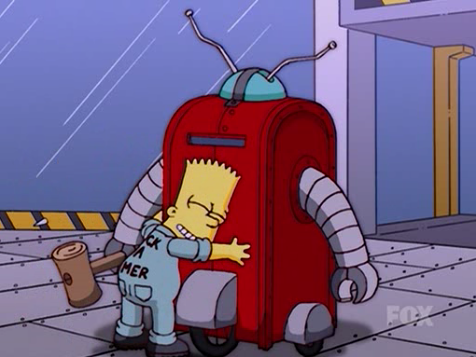
What I initially figured would just be a poor man’s “Saturdays of Thunder” actually ended up surprising me. That description is somewhat apt, but it’s still a really sweet and effective Homer-Bart show, unfortunately saddled with a bizarrely grim and uncomfortable B-plot. We start with Bart modifying his old bike with rad decals and accessories, but soon finds there’s no substitute for a real ten-speed. Homer buys and assembles one himself, which quickly falls apart, leaving Bart disappointed. It’s almost like a set-up from the classic years, where Homer makes a bungled attempt to help one of his kids in the first act and must make it up over the next two. In this case, inspired by Bart’s interest in a BattleBots-type show, Homer attempts to build his own fighting robot. Failing miserably, he does the next best thing: create an empty shell of one that he controls from the inside, unbeknownst to Bart. Dubbed “Chief Whack-a-Homer,” he competes on the robot fighting show, winning the love of his son, as well as several nasty injuries and lacerations.

It’s not perfect, but what a breath of fucking fresh air this episode is. After slogging through so much of selfish asshole Homer as of late, seeing him actually risk life and limb, literally, for the happiness of his son is so heartening to see. This is the Homer we love, trying to do what’s best for his family in the most asinine way possible. Even in the climax when he goes up against Professor Frink’s mechanical killing machine, he’s completely brazen, and stupid, all for Bart’s sake. The scene where Homer is exposed and Bart expresses such enthusiasm over his father’s actions is really sweet and feels completely earned (“Any poindexter can throw some nuts and bolts together. You risked your own life, even though you’re a sole provider for a family of five!”) On top of the emotional core, the episode also has a lot of laughs, be it in parodying the fighting robot shows popular at the time (“Can robots feel pain? If so, we are horrible, horrible people!”) and in regards to Homer’s plights, like using a magnet to extract all of the shards of metal from his body.

The B-story… oh dear, the B-story… Snowball II is struck and killed by a car in act one. Now, the cat may not have been a prominent character, but she dates back to the first episode, and to see her bumped off in a storyline callously relegated to a B-plot doesn’t feel right. But the premise is that Lisa buys another cat, who swiftly deies, then another, and another, all dead. For an eight-year-old girl, this would be absolutely traumatizing. It’s played off for laughs, but it just feels so saddening and wrong for a sweet girl like Lisa to go through so much anguish. It couldn’t clash more tonally with the main story. Our resolution is just a final kick in the teeth: coming across one last cat that actually evades danger rather than get killed, Lisa dubs her Snowball V, but to make things convenient, decides to call her Snowball II and forget anything ever happened. Totally makes sense for a little kid to do. Come on, guys, I know you think you’re being clever by being meta, but it just doesn’t work here. But despite the B-plot, this one’s definitely a gem buried amidst a pile of shit.

Tidbits and Quotes
– The opening bit of Milhouse rushing to the Simpson house is fantastic, a shockingly great piece of animation, with more life in it than I’d seen on the show for many seasons. Sure enough I see Lauren MacMullen’s name pop up as director. It seems that every time I notice the show is looking exceptional visually, it’s a show she did. She only has two more episodes left, unfortunately. They would have been wise to keep her around.
– The Domino’s shot, Flanders actually swearing, the bullies taunts actually feeling legitimate and not jokey, Hibbert’s Kool & the Gang air freshener (“Celebration’s over, boys,”) Homer being a bonehead (“A ten-speed bike? What did your mother say?” “She said yes.” “I said no!” “I’m confused, which is it?!”) I was completely stunned at how much was working in the first act, and continued to work through the entirety of the show. If not for that goddamn B-plot, this one would be top of the heap of latter-day episodes. Not even the spring-loaded first aid kit could sully my mood out of act one.
– There’s something endearing about Homer riding around on a tricycle inside that suit making robot noises. It’s so shocking that in basically every episode now I either hate Homer or am bewildered by him, but here, for once not only am I on his side but I’m enthralled by him and his efforts.
– Nice banter between the “Robot Rumble” hosts (“He’s killing him softly with his saw!” “Killing him softly?” “With his saw!”)
– One of the only things I hate about the main story is the montage sequence where we see Homer’s other competitors: Reverend Lovejoy and Jessica, and Chief Wiggum and Ralph. The former I don’t buy condoning this type of show, and I don’t see either of them having the technical know-how to build a functional robot, especially the latter. Why not have it be random families like the first match? The end does bring back Frink’s son though, apparently not killed after the incident way back in “Brother, Can You Spare Two Dimes?” I like that he doesn’t speak a word, he just mimics his father’s look and movements, like he’s some kind of clone or something.
– I don’t even want to talk about the B-plot anymore. Not even the mention of Armin Tamzarian. I will say that I definitely wouldn’t trust any cat given to me by the Crazy Cat Lady. The myriad of diseases it must carry…
– I love the animation of Homer squeezing out of the robot frame like a tube of toothpaste, and the twist that Frink programmed the robot to abide by Asimov’s rules to never harm humans. So Homer is declared the winner by default (“Show me where in the rule book it says a human can’t be a robot!” “Right here. Rule one.”)

321. Marge vs. Singles, Seniors, Childless Couples and Teens and Gays

(originally aired January 4, 2004)
Storylines are getting thinner and thinner nowadays, but it’s an entirely different case when I have no idea what’s going on. This episode concerns two lobby initiatives getting on the town ballot, except we’re never really told what exactly they are and how they affect anything. Everything is kept incredibly vague to make room for lame, forced gags about self-righteous anti-motherhood women and mud-racking ads. But first, our dumb opening. Maggie becomes obsessed with children’s musician Roofi (see, like Raffi, but spelled differently!) and Marge takes her to his concert in Springfield, a completely packed affair taking place in Cletus’s backyard. It’s a veritable baby Woodstock, with kids dancing around naked, passing around laced pacifiers and suckling on any breast in sight. It was more than a little disconcerting to me. A sudden storm causes all the babies to throw a tantrum, resulting in Roofi cancelling the show. They then cause wonton destruction, destroying the stage and Cletus’s home, with a reported one million dollars in damages. Forget exactly how two year olds managed to cause so much havoc with their mothers present, but a million dollars for Cletus’s crap shack? Come on.

Despite the fact that Springfield has had many mob-related incidents involving adults, this latest one caused by toddlers is a whole other story. Quimby sides with Lindsay Naegle, who forms an anti-youth group hellbent on making the lives of families more difficult, from cancelling school bus service, burning all children’s toys, and ordering police to lightly tase kids acting up in public. This all sounds like insanely vindictive and cruel behavior… because it is. The most disappointing thing is that there’s a shred of a good topic within this episode, on how some laws cater to the safety and well being of children to the annoyance and possible detriment of adults, and Marge coming to the defense for the sake of her family. But this episode doesn’t have a brain in its head, and is more content with silly montages than crafting a thoughtful story.

Marge enacts her own initiative to be put on the upcoming ballot. What is it for? I’ve no clue, but I’m guessing it’s for the opposite of Naegle’s. But what is her’s? The problem is that everything’s been made so jokey and unrealistic that I don’t understand what the stakes are. Marge is really all in on this and is emotionally invested in her cause, except I don’t know what exactly she’s fighting for or what the ramifications are if she loses. Will people be banned from procreating? Will all people under eighteen be banned from Springfield? Those are extreme examples, but at least I can be on board for the story if I know the risks. The ending is just as bewildering, as Bart and Lisa spring their own plan along with the kids of Springfield to hug dissenting voters on the way to the polls, causing all of the child-less citizens to collapse to the ground in a diseased fit, as Lisa comments that all the single people had no immunity toward the love of children. So what, is this like the dumb ending to “Bye Bye Nerdy,” that kid germs are toxic to people who hate kids? Is that why, it’s chemical? I don’t know if that’s it, and frankly I don’t care. Another episode I just can’t hate because I’m just confused by it. The writing on this show continues to fall apart.

Tidbits and Quotes
– We open with a parody of Steve Irwin, and all I could think of is how much better South Park dealt with him on an episode five years prior (“So what I’m gonna do is sneak up on it, and jam my thumb it its butthole! This should really piss it off!”)
– Flipping through channels, we hear a bit of King of the Hill (“Bobby, I got propane in my urethra.”) Hank Azaria (I think?) does Hank, a pretty shoddy impression to be honest, but it’s kind of a hard voice to get right.
– The entire first act focuses on Maggie, who then disappears for the rest of the episode. Couldn’t she have been involved somehow? Like maybe her cuteness ultimately melts the hearts of those cold, soulless single people and changes their minds? Anything? Wait, actually, she does appear later, she throws up in Marge’s handbag, which causes Naegle to scoff at her more. Wonderful.
– The baby riot is just way too fucking silly: the reporting on the event (Babies to Mayor: ‘Wah Wah,’) Kent on the phone with their “leader,” it’s too fucking stupid to take seriously at all in what’s supposed to the catalyst for our story.
– Smithers holds up the banner at the end, representing the ‘gay,’ of course. Honestly, just come out and say he’s gay. Don’t keep feeding us this bullshit, it’s clear they just want him to be their gay stereotype now, just be fucking honest about it.
– The whole anti-kid thing makes no sense how they present it: instead of listing off some real problems, Luigi complains about having to give out children’s menus, and Sideshow Mel gripes about the quality of the school plays, which he doesn’t have to pay for, or attend at all because he has no kids.
– I chuckled at Pimply Faced Teen joining the mob, his voice finally lowering (“It’s time to throw away childish things… and become a man.“)
– The gag of people keep disappearing from Luigi’s is alright: everyone but Marge bolts when she announces her campaign needs money, then Marge bolts when Luigi tells her she’s stuck with the bill, then Luigi bolts when the Department of Immigration arrives with a few questions.
– Dreadful bit with the devil shyster from big tobacco wanting to sign Marge’s initiative. This show has done impossible, fantastical gags in the past, so it’s not like I can bitch about that, but every gag has its context and rhythm, and if it works, I laugh, and if it doesn’t, I don’t. But here, the man handing over a pen with human souls in it, and literally descending into the depths of hell right in front of Marge was just too much. Reminds me of The Critic when a sickeningly saccharine replacement critic for Roger Ebert is revealed to be Satan, but it works within that show.
– Burns ends up signing Marge’s petition, in support of children’s organs (“Oh, unfenced backyard pools, where would I be without you?”) This for some reason causes other people to sign up, thinking that if rich people support something, then it must be good. But rich, diabolically evil people? Whatever.
– I like Homer standing up for Marge (“No one messes with my Mrs. I’ll come down on those guys like the garage door on Bart’s bike!”) but his commercial is pretty laugh-free and kinda stupid (“Visit our web site: http://www.aljazeera.com. We’re not affiliated, we’re just piggy-backing on their message board.”)

320. ‘Tis the Fifteenth Season

(originally aired December 14, 2003)
I still remain bewildered as to why the writers seem content in writing Homer as an asshole. But it’s not even like his character is consistently dicky, from scene to scene he can run the gambit of being insensitive, callous, ignorant, infantile… now, these are traits that classic Homer also inhabited, but the key difference here is the lack of a human soul. Homer may fuck shit up at home, or allow horrible things to happen due to his inattentiveness, but he’ll always work tooth and nail to get it fixed for the good of his family. He may go about it the entirely incorrect way, but his heart is always in the right place, fueled by his love for his wife and kids. Look no further than the very first episode “Simpsons Roasting on an Open Fire,” where we see Homer do everything within his power to provide a perfect Christmas for his family. That Homer is long dead, as now we have selfish Homer, who upon falling into a bunch of money, splurges it on an extravagant, worthless gift for himself. When Lisa asks why he did it, he responds, “If I’m happy, I’m less abusive to the rest of you!” He’s less of a patriarch and more like the family’s jerkoff housemate at this point.

Watching “A Christmas Carol” on TV convinces Homer to change his selfish ways, so he vows to be the nicest guy in town, doing good deeds everywhere he can, which sparks some jealous from New Flanders. So, basically it becomes a low rent version of “Homer Loves Flanders.” None of Homer’s actions feel genuine whatsoever, it seems it’s more of obligation to save his own ass from scorn. He engages in dueling collection plates at mass with Flanders, collecting a much bigger till, and has the smuggest fucking look on his face when he walks off arms crossed with Lovejoy. This couldn’t pale more in comparison with “Homer Loves Flanders,” which featured Homer unintentionally stealing Ned’s thunder and it slowly eating away at him, which is so much more interesting. Here, Homer is Mr. Wonderful and succeeds at all his charitable efforts because the story demands it, even going so far as building a fucking ice rink in his backyard. Homer had two dollars to spend on a Christmas tree, now he has the money to build that?

There’s really not much story to be had, as a lot of this episode is filled with TV parodies and extended music montages, none of which are particularly funny. As a final charitable effort, Flanders gets gifts for everyone in town, and misconstruing Lisa’s words, Homer decides to steal all the gifts so the people can enjoy a non-commerical Christmas, basically just an excuse for them to do a Grinch parody. The town is out for Homer’s blood once they find out, Flanders defends him, claiming he’s partially responsible, which I’ll buy because he’s Flanders, then Homer distracts the crowd with a bright shining star in the sky, Flanders reads from the Bible, they get their presents back, and that’s the end. So despite having committed hundreds of burglaries, Homer gets off scot-free in the end, of course. I really don’t understand the ending. Or most of the episode, for that matter. Homer was once a character you truly cared about, who felt real and you hoped would succeed. Then he started to do stupid, reckless shit and you started to hate him. But now we’re at the point where a lot of what he does just plain confuses me. He’s just this anything-goes character they can have do whatever they need for whatever scene. But none of this is new information. At some point these reviews are going to become somewhat redundant, because all this shit’s going to start running together.

Tidbits and Quotes
– Comic Book Guy dumping out his entire register for the Joe DiMaggio card is not nearly as funny as the backpedaling of his excitement about Mrs. Prince’s box of priceless Star Wars memorabilia from “Worst Episode Ever.”
– Lots of claymation in this episode, with the Jimmy Stewart Xmas special and the California Prunes commercial. The ending of lifting prune baby Jesus in the air, complete with cool shades reaching towards the heavens, made me smile.
– You really don’t like Homer for his actions in act one, don’t believe his strive for redemption in act two, and are just flabbergasted by his criminal behavior in act three. In the end, I’m just left very confused.
– Instead of her star suit, Maggie is wearing a white jumper with a little ear nub, sort of like Bongo the rabbit from Life in Hell.
– Homer is swayed by “Mr. McGrew’s Christmas Carol,” where they basically just do Mr. Magoo straight, with no subversion or twist. And we spend a while on Homer watching it, it all feels like time killing. I like the Star Trek version of an Xmas Carol though (“Mr. Scott, fire photon torpedoes!” “It’s no use, captain! He’s showing visions of me future! God, I’m so fat!”)
– Homer gets Lenny a photo cube with rounded off corners, then proceeds to jab his eye with it repeatedly, because I guess now, eye injury is a “thing” with Lenny.
– The only laugh I got from the episode was the retouched photo of Homer used on the news, of him looking like a maniac lunging at Marge and Lisa, with a bouquet of flowers in his clasped hands. Now that I look at it again, I guess they blurred out Bart where he’s strangling, but I always envisioned that he was holding a knife or a gun or something.
– Another joke about Nelson missing his father. And another joke about Moe committing suicide. Any topic can be made funny, but the show really misses the mark when it comes to these two subjects. The former is presented as far too sad, and the latter plays off the serious subject so callously that it’s almost offensive. Merry Christmas, everybody.

319. Today, I Am A Clown

(originally aired December 7, 2003)
In a similar fashion as “My Mother the Carjacker,” this episode drags back a classic guest star for a repeat performance, without any of the emotional resonance or sensibility that made them great in the first place. This instance might be worse, actually; “Carjacker” just repeated the beats of its predecessor, whereas here, Rabbi Krustofski is pretty much absent for the second half of the episode in favor of a completely nonsensical and ridiculous B-“plot.” There’s a beginning involving getting rid of Santa’s Little Helper’s bastard puppies, but it’s inconsequential to the story completely, as Krusty adopts one and we never see it after the first act. Krusty is surprised to find himself absent from the Jewish Walk of Fame, and discovers he is ineligible due to having never had a bar mitzvah. He consults his father about it, who tells him he never had the ceremony out of fear that his son would make a mockery of it. Krusty vows to truly embrace his religion, and to finally, at long last, become a man.

Rabbi Krustofski was the most highly regarded holy man in his village, and his son was never bar mitzvahed? Krusty clowned about his whole life, but in “Like Father, Like Clown,” we see through flashback the rabbi gushing about how his son is at the top of his class, implying that as he got older, Krusty managed to keep his antics from his father’s prying eyes. At least that’s just the way I see it, so I don’t entirely buy this premise. Krusty begins to adhere to his long ignored Jewish customs, which ultimately costs him his show (more on that in a bit). Desperate, he pitches to FOX that they air his bar mitzvah live, a sensationalist event featuring the Beach Boys Experience, Mr. T, and other glitz and glamor to undermine any shred of seriousness the ceremony might have. This segment of the episode is the only part that works, Krusty selling out his faith for the artificial televised thrill, with a spinning wheel Star of David and bad Jewish puns (“I can’t schmear you!”) Except earlier we see that Krusty’s old Jewish village is filled with puns too (L.L. Beanie, I Can’t Believe It’s Not Trayfe!) So context doesn’t matter here. As “The Regina Monologues” featured nonstop easy British jokes, here we have the same with Jew jokes.

Now that he observes the Sabbath, Krusty can’t record a show on Saturday, so he needs a replacement host. Who will it be? Homer, of course. Why? Because he was right there when Krusty was talking about it. The crowds cheer as the curtains open to reveal Homer, Moe, Lenny and Carl sitting around a table, talking about stupid topics like tight seats on airplanes and lame oldies stations. Surely this audience of kids don’t give a shit about this show, but apparently adults do, and within one minute, Homer’s show is the headline of fucking Variety magazine. Why is his show a big success? Why do they like it? The plot is just fast-tracked: Lisa urges Homer to use his newfound power to talk about real issues, which of course gets him swiftly cancelled. Too bad none of the story works whatsoever, and moreover, it completely takes over Krusty’s plot. We go right to the crazy bar mitzvah without any word in edgewise from Rabbi Krustofski. It would make perfect sense to have scenes of Krusty planning all the sacrilegious stuff and the rabbi urging him not to, leaving Krusty to have to choose between his fame and his faith. Instead, we get whatever the fuck that Homer story was. It’s the worst B-plot we’ve ever seen, and completely kills an episode that wasn’t holding up too well to start with.

Tidbits and Quotes
– Santa’s Little Helper’s last night on the town of animal porn theaters and doggie prostitutes is so uncomfortable and disturbing. Really, this show is just not the place for this type of humor. At least done in such a brash manner. In the end, Homer doesn’t have SLH neutered, so he effectively caused the problem, and should be the one to fix it. Instead, he strangles the dog, and Marge forces Bart and Lisa to give away the puppies. So Homer’s completely off the hook again! God bless that man!
– I like how Krusty’s lax Judiasm is summed up early on, scoffing at Sandy Koufax (“I lost ten grand when he wouldn’t pitch on Yom Kippur. I did five shows that night!”)
– Because Arnold Schwarzenegger, who was running for governor at the time, was also being accused of being an anti-Semite, that means Rainier Wolfcastle is one too!
– Know-it-all Lisa is an expert on the Jewish faith and the wordings of the Torah. Why? Some bullshit explanation about having a Jewish imaginary friend. Solid writing, guys.
– The Itchy and Scratchy is pretty boring, but I did chuckle at “Mouse-el tov!”
– I don’t even want to talk about the Homer plot anymore, because I just can’t make heads or tails of it. If anyone would like to ponder about it themselves, be my guest. All I know is not only do we get no explanation why Homer isn’t at work, Lisa and Bart apparently skip school to work as production assistants and engineers.
– Rabbi Krustofski dictates the rules of Judaism to Krusty, basically what everyone knows about them not mixing meat and milk and not eating pork. He also includes that all Jews must eat Chinese food on Christmas Day. What a hilarious stereotype! It really is like the England episode, the cheapest and easiest Jew jokes they could come up with in an afternoon.
– Mr. T is pretty enjoyable in the show as Krusty’s beleaguered special guest. Stuck on the spinning wheel of David, he laments, “I wish I had invested my money better…”