646. Werking Mom

Original airdate: November 18, 2018

The premise:
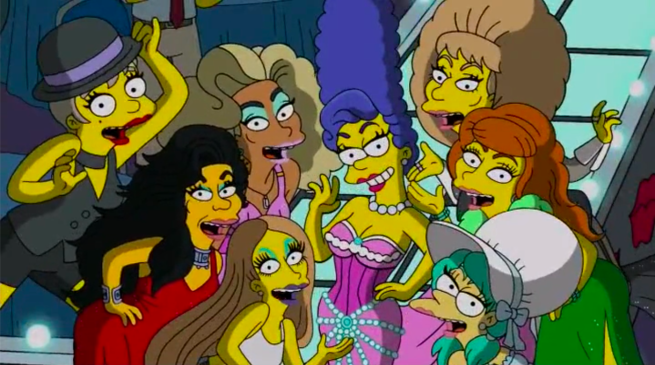
An extreme makeover by Julio gets Marge mistaken for a drag queen, and while she initially is horrified, she ends up embracing the drag scene, seeing it as a confidence booster. Meanwhile, Lisa is inspired by French cinema to make the world a better place, one good deed at a time.

The reaction: Right off the bat, I gotta be honest, the conceit of husky-voiced Marge being mistaken for a drag queen is one of the most humorous ideas this show’s had in a good long while. A story about Marge finding acceptance in drag culture while having to hide who she is could have been interesting, but that pesky poor writing just can’t support it. With Lisa’s B-plot eating up time, we only get one quick scene of Marge getting introduced to a bunch of drag queens, then a musical number, and that’s basically it in terms of developing her relationship with these people and the subculture. As usual, any further scenes would require them having to make Shantae (voiced by RuPaul) or the others actual characters be able hold a conversation, and that’s just too hard, man. Remember how well developed John from “Homer’s Phobia” was? Even as a caricatured gay man (and John Waters surrogate), he still felt like a real person who was actually emotionally affected by Homer’s ignorant homophobia. Here, none of these drag queens feel like they’ve gone through a story, they’re just there to say their joke lines and react to things on cue. The climax involves Homer’s discovery of Marge’s new identity, ruining her good time with a terrible self-aware line (“You didn’t tell me you were tricking all these people into thinking you’re a drag queen when you’re really a regular housewife in need of empowerment… and now that I say it out loud, it doesn’t seem so bad.”) I feel like they should have stuck with either extreme: have Homer wildly ignorant and belligerent and not understand why Marge is doing this, or have him be totally supportive and make the story about Marge worrying her friends will find out she’s really a woman. Instead, Homer’s emotional outburst was an impromptu mistake, one he’s genuinely sorry for and immediately tries to make up for. But this is apparently the last straw for Marge, who by the ending seems one sentence shy of wanting a divorce (“What hurts the most is I can’t imagine there’s anything he could say or do to make me come back.”) There was a long period of seasons during the 2000s which featured Homer being such a flaming, selfish asshole that it teetered on Stockholm syndrome as to why Marge would allow this awful, awful man back into her life. But in the last few years, Homer hasn’t been so bad, but we’ve seen a lot of episodes where Marge seems very quick to up and almost end their marriage. In addition, Marge claims Homer’s “selfishness” stands in direct contrast to the love and support the drag queens have given her, so this moment would have actually held some emotional weight if, again, we knew anything about these people or why we should care. When Marge tells them that she’s not a man, they all admit that they already knew, and that’s all. No one’s upset that a straight woman tried to co-opt their culture? Or, conversely, no heartfelt line about them being fine with helping a poor soul in need increase her self-worth? Again, if these were actual characters, we could have moments like those. After Marge says the above line, Homer appears on stage in drag himself, and that’s enough to win Marge back because we have less than one minute of show left before the worthless tag. Despite the potential of the story line, and for having some genuinely humorous moments throughout, the episode is still missing that emotional core that keeps me at arm’s length from actually giving a shit about what’s happening.

The reaction:
– I don’t have much to comment on Lisa’s story. I think it’s supposed to be a parody of Amelie, but I’ve never seen it. Complete with a French narrator, she performs small kindnesses for the likes of Jasper, the Van Houtens, and Principal Skinner, but becomes discouraged when the happiness she’s bestowed on Skinner and his mother doesn’t last. The ending features all the people she’s helped showing up on the school roof so she’s finally have someone to eat lunch with. This feels like a conclusion the show in its prime would have viciously made fun of. The entire B-story is so lame and ham fisted, and time I wish was spent better developing the Marge plot. Also the green tint over all the scenes in the story made everything look ugly and washed out.
– Among the group of drag queens is “the mysterious Waylon,” pictured on the far left. I guess I shouldn’t be surprised they threw Smithers in there. Sure, I suppose someone formal and straight-laced like him could be into drag, an extravagant outlet for his repressed every day life, but he’s just part of the set dressing here. Instead, it feels a lot like what the show has done in the past with him, where he acts as catch-alls for all non-straight jokes. Past “jokes” involved him taking estrogen, or hinting that he wants a sex change operations (just last season we saw a “joke” about Smithers planning on becoming a woman. Do the writers know that being gay and being transgender are two different things?) Smithers being into drag isn’t necessarily offensive, but given their history of just ascribing him all these different contradictory identities because he’s the gay of the series, it just felt incredibly eye-rolling to me. Hell, I’d watch a whole episode about Smithers getting into drag, why not? It’d be more daring than this crap.
– The tag features a disheveled drag Homer at Moe’s fielding questions from Moe (“So, you’re a drag queen now?” “I dunno. I guess these days it’s okay for everyone to be everything.”) I guess you could read this as a tired, forty-year-old man trying to make sense out of a new social culture he doesn’t understand, but it reads more like the fifty-plus-year-old writing staff grappling with all this gender expression/identity nonsense the youths are up to. For an episode trying so hard to be open and accepting (as seen with Homer’s almost immediate acceptance of Marge’s drag life), this felt like a weird, snarky note to end on. There are ways to make jokes and construct humorous scenarios out of topics like this that don’t come off as mean or back-handed (i.e.: the ridiculous comedy of errors involving the asexual Todd meeting his girlfriend’s hyper-sexualized family from the recent season of BoJack Horseman.)

One good line/moment: Like last week, there are surprisingly a handful of smirk-worthy moments: Old Jewish Man’s banter, Marge imagining the Tupperware speaking (“Did you just high-five that bowl?”), Dewey Largo and his boyfriend (“I’m not leaving until I find my butter tub!” “Look in the mirror,”) but the best moment was a rarity for the show nowadays: a successful set-up and pay-off. Earlier, Homer is befuddled at the idea of using Tupperware to store leftover lasagna (“Whoever heard of leftover lasagna?!”) Later, Marge is raking in so much money doing drag she takes Homer out to a lavish meal at Luigi’s, leaving him so stuffed that he actually gets to take lasagna home with him! Then later that night when he takes it out of the fridge to eat, all he finds in the box is a note telling himself he already ate it at the restaurant. Hey, writing with some thought behind it!

645. From Russia Without Love

Original airdate: November 11, 2018

The premise:
Bart pulls a prank on Moe by ordering him a Russian mail order bride. Moe is hesitant about opening himself up to love again, but when he drives Anastasia away, he decides he needs to get her back.

The reaction: Sad Moe finds love again… when the series revisits the same wells, it’s a little tough to figure out how to talk about it without repeating yourself. Despite being one of the show’s more lovably lecherous characters, Moe’s tender heart has shone through in a good way on several occasions, most notably “Moe Baby Blues,” but only when it’s balanced by his typical lowlife nature. Here, Moe is a pathetic sadsack from moment one when Homer dis-invites him to Thanksgiving dinner at Marge’s behest. When Moe manages to humiliate Bart during a prank call attempt (an actually humorous moment), Bart gets revenge by sending a mail order bride to his door. The core of the rest of the episode is Moe not wanting to take a chance on another woman who might potentially break his heart. The story, up until the twist at the end, really has nothing to do with her being a mail order bride at all, which is strange. A lot of the episode isn’t really that bad. There’s a few bits of life that come through at points, but the story is very dull and lifeless. The Moe stuff is nothing we haven’t seen multiple times over, done better in other episodes. Eventually, he gets Anna to go through with the wedding, only for her to be exposed as an American con artist. Moe is in shock at this reveal (“You’re a scam artist! And one who didn’t aim too high!”) Anna asks him to clarify, to which he replies he’s in severe debt. Yeah, no shit. When Moe tried to win her back, we see that Anna is now with Krusty, a major TV celebrity, surely a much bigger catch financially than a dirty old bartender. The episode abruptly ends as Anna adopts a Scottish accent to court Willie, seemingly having learned nothing about picking your marks carefully. Rather than lean into a deep emotional place with Moe’s anguish, or something more comedic in the mail order bride material, the episode just kind of sits right in the middle: nothing flagrantly terrible, just very bland. Which makes it the best episode of the season by default.

Three items of note:
– Herman makes a reappearance after I don’t know how long as the one who aids Bart in his revenge mission by introducing him to the “dark net.” He proceeds to freak Bart and the boys out by flicking the lights in the basement, and then seemingly rips his one good arm off, only for him to pull out his good arm from inside his jacket. It was actually kind of charming to see him messing with the kids, even if outside his typical hardened characterization. But he was always a tertiary character at best, so why not mess with his personality a bit?
– Moe thinks back to his past lady loves, which includes his fling with little person Maya, and Laney Fontaine, aka not-Elaine Stritch. It’s a rare instance of the show recalling back to events within the past decade. It’s not necessarily fan service, but it requires one to actually remember these old, disposable characters. I recall liking the Maya episode, it actually had some heart to it, certainly more than we get here. And while I don’t care for Laney, I liked the reveal of her wringing Moe out as being part of her one-woman show (“She won a Tony tearing me apart, yet I left humming the songs.”)
– The always worthless tag features Nelson going to Mars to find his long-lost dad (he alluded to the lie his dad gave him about going into space earlier in the episode), only for him to abandon him once more by blasting off the planet. I always found these Nelson bits to be pretty uncomfortable, be it him pining for his worthless runaway father or just making fun of him for being poor. I remember one bit of him being thrown off the bus for not having money for a field trip, ending with him tearfully seeing his reflection in top hat and tails with him sadly assuring, “Someday…” Are we supposed to laugh at this poor pathetic kid? It’s like in South Park when Cartman rips on Kenny for being poor, but in-universe it’s acknowledged by the other characters as being a dickish thing for him to do. Here, I guess we’re supposed to bust a gut at this stuff? Same with Moe’s regular suicide attempts. There’s gallows humor to be made on topics such as these, but more often than not, we’re seemingly supposed to laugh directly at the characters’ plight, which is weird to me.

One good line/moment: There are actually a couple moments that could work here, but I think Moe sabotaging Bart’s prank call was actually pretty great, especially the casual manner he does it in (“I’m looking for a Mr. Buttface, first name Ima.” “‘Ima’? Nobody’s been named that in like a hundred years. And as for the rest, why don’t you double check that name? Try saying it out loud.” “Ima Buttface?” “Mistakes are how we learn there, young fella. Good luck in your journey into adulthood.”)

644. Baby You Can’t Drive My Car

Original airdate: November 4, 2018

The premise:
Homer and Marge get hired at a new, trendy self-driving car company with a fun, laid-back work environment, but become conflicted when they find the company is stealing personal data from its drivers.

The reaction: Sometimes I do actually feel bad for this show, since it’s gotta be so hard to come up with new ideas that not only the series itself hasn’t done, but also social satire topics that haven’t been tackled sufficiently by other shows either. This isn’t to say different shows can’t deal with the same subject matter, but if you’re going to double dip, you’ve got to have something new to say, and pretty much every time this show goes to an already frequented well, it brings back swill. The fun business campus of CarGo (is that even a joke name?), corporate espionage and taking advantage of consumer data, even the self-driving car itself, are all topics covered by HBO’s Silicon Valley, in much greater detail, and much more cleverly and intelligently. As usual with this show, the targets here feel so much like a first draft: lavish office toys and doo-dads that never get used, nerds talking nerd talk, the elements that other shows like Silicon use as their base to build upon, this show is content with using them as is for their actual big jokes. This outing is also ostensibly a Homer-Marge episode; when Marge rouses the coders’ spirits with a hearty game of foosball, she’s hired as some kind of morale booster for the company, despite one of Marge’s core character traits that she’s a no-nonsense worrywart fuddy-duddy. When it’s revealed the self-driving cars listen in on your conversations and transport you directly to the company’s corporate sponsors, Homer flies off the handle while Marge is not too quick to abandon the company she loves for whatever reason. This seems like it should be reversed, but no real explanation is given why either character reacts or feels the way they do about the situation. Meanwhile, Mr. Burns investigates CarGo after the plant goes understaffed to see the secret to their success, and despite being wowed by their business model of keeping employees at work for no substantial extra cost, he doesn’t decide to actually do anything about it. In the end, he, Homer, eventually joined by Marge, shuts down CarGo, and the episode just abruptly ends. Watered down satire seen much better in other shows, and a Homer-Marge story that tells us nothing new or interesting or funny about the two of them, but it killed another twenty minutes, so throw that episode up on the board!

Three items of note:
– We start with a prime example of the show’s bad habit of taking potentially amusing quick jokes and elongating them, thus ruining them. Homer goes through the Krusty Burger drive-thru, where he is presented with his nuggets. “Chicken nuggets?” Homer inquires. Cashier Shauna’s eyes darts. “Yes…” she responds noncommittally. That, alone, would be decent. But then we keep going. “Including things that ate or were eaten by a chicken!” Belabored line, and unnecessary, but not awful. But then, we get a thought bubble from Homer of what those animals or things might be, an elephant, a rat, a boot, basically just a repeat of the hot dog bit from “Lisa the Vegetarian.” Homer contently drives away, chicken nuggets on his dashboard, and he sings a song about them, a sort-of parody of a Jim Croce song that’s not really amusing at all. This nugget bit could have been more than sufficient if left alone after the first five seconds, but it just kept on going, eventually being part of the impetus for Homer losing his job, choking on his nuggets, careening into a construction area at the plant and flying his car upside down through Burns’ office window. Later, during a montage with the self-driving car, we open with seeing a Krusty Burger box labeled “Chicken” Nuggets as Homer sings the Jim Croce song again, in case you weren’t already sick of those two jokes from before. Unbelievable. I assume the writers and staff just love to hear Dan Castellaneta sing, but did they really think they struck gold with the chicken nuggets bit?
– Homer is gobsmacked to discover the lavish cafeteria at CarGo is free of charge to employees. As “Pure Imagination” plays, he’s overcome with emotion and goes on a binge. A lot of the posing and camera movements are pulled straight out of the classic “Land of Chocolate” sequence (I guess as a tribute?), but as usual with all references to the classic era, all it does it reinforce how empty and shallow the show is now. “Chocolate” featured Homer at his most deliriously happy, in this fantasy paradise made entirely out of chocolate, skipping merrily down to Fudge Town and marveling at the “CHOCOLATE HALF PRICE” sign in the store. Here, Homer’s just excited he gets to eat a bunch of normal food. Do we need to devote an entire minute to this bit? Homer already said he loves working there, he doesn’t need to be sold anymore. It’s just unfunny nonsense that adds nothing.
– The coders at CarGo act very much like classic Revenge of the Nerds type nerds, making those crazy nerd noises (can’t think of how to best describe them) as Marge calls on them to power down and have some fun. Also part of the staff are the old college nerds, but with different sounding voices, because who gives a shit about looking that crap up to make sure the voices are correct, right? But it all feels so easy, and at this point, so detached from reality. Silicon Valley shows us a wide variety of different types of tech nerds, from the traditionally socially awkward, to the over compensating, to the overtly weird and creepy. This show has no interest in delving into anything of the sort. They’re just a bunch of fucking nerds.

One good line/moment: Homer’s “Holy crap!” taking the self-driving car to the church with its drive-thru confessional (Lovejoy immediately closes the window upon seeing Homer.) Marge surmises the company must be up to some monkey business, then cut to the two of them returning to work flanked by monkeys, with Homer wearing a “Marcel’s Monkey Rentals” shirt. Contrast with the fucking endless nugget bits, these jokes are quick, aren’t overstated, do their job and get out.

Just as a heads up, next week’s review is definitely gonna be late. Getting married tends to make one a little tardy, or so I’ve heard…

643. Treehouse of Horror XXIX

Original airdate: October 21, 2018

The premise:
In “Intrusion of the Pod-y Snitchers,” strange alien spores start to infect Springfield residents, replacing them with pod people . In “MultipLisa-ty,” a crazed, dissociative Lisa enacts her bloody revenge on Bart, Milhouse and Nelson. In “Geriatric Park,” Mr. Burns opens up a scientific facility rejuvenating the elderly with dinosaur DNA, which of course goes horribly wrong.

The reaction: These Halloween reviews are somewhat of a slog to write, mostly in that I’ve had the same two major criticisms of them for the last twelve or so installments. First off, most of the segments are parodies of contemporary films, but light on the actual “parody” aspect. The second segment I think is supposed to be based on the movie Split, except it’s just Lisa talking in goofy voices for five minutes until we get the tired “explanation” of why she snapped. Bart wrote on her paper and got her an F on a spelling test! What a knee slapper, huh? Moments before the reveal, we see her snarl and growl as she pushes Milhouse into a newspaper crusher and has Nelson impaled on a forklift. None of it is shocking or scary, it was just uncomfortable watching this young girl murder her classmates for no reason. “Geriatric Park” came as a result of spending a couple minutes listing what words rhyme with “Jurassic” and building a flimsy story atop that. What monetary gain does Mr. Burns have for opening this facility, where he spent $30 million on giant doors alone? Surely it would be exclusive to those who can pay through the nose for this experimental treatment, not open to elderly riff-raff like Jasper or Hans Moleman. But none of that matters, they all turn into dinosaurs where we get some bloodless decapitations and limbs getting ripped off for some tepid gags (Willie shoves Kirk’s head in the “Heads” bin! What a riot!) But the bigger problem that’s hung over these annual events for a while now is the lack of any sort of dramatic or scary tone. Characters react to terrifying and deadly situations with no regard for the danger they’re in to spout off their labored jokes. Moments before her demise to the pod spores, Lisa gets in a lengthy jab about YA dystopian movies. Despite being chained to the wall and terrorized by the love of his life, Milhouse gets in a couple random humdingers (“I think encores are a ridiculous tradition! Just sing your songs and go!” “Careful, Lisa! If you keep yelling like that, you’ll get vocal polyps! Like Adele!”) Think back to the classic Halloween segments. Though they had their goofier moments, the characters always treated the scenarios seriously. The kids at school were terrified that Willie would kill them in their dreams. Seeing his happily lobotomized family, Homer fearfully escapes Flanders’ Re-Ned-Ucation facility. Bart was ultimately driven mad at the gremlin on the side of the bus. Here, after seeing Willie’s corpse with an axe through his head, Milhouse reacts to an effigy of himself burning with, “Wish I could burn the calories off that easy.” You can almost hear the laugh track playing. I’ve said it many times before, if the characters don’t give a shit about the stories they’re in, why in the hell should the viewer? This is a problem that plagues the entire series now, but it’s especially an issue in the Halloween shows where the life-or-death stakes are so much higher, but the characters don’t seem to care in the slightest.

Three items of note:
– We’ve actually already seen a parody on “Invasion of the Body Snatchers” in one of the first Treehouse of Horror comic books I read as a kid. Not that the show can’t encroach on territory the completely unrelated comic series did, but it doesn’t help when they do it much, more worse. The comic starts in media res with Homer being hauled off to the insane asylum screaming about pod people, then telling his story from the beginning how everyone in Springfield slowly got replaced by emotionless pod copies who preferred tepid tap water to beer, much to Homer’s horror. The story wraps up at the end when Homer is vindicated, but everything goes off the rails as other post-apocalyptic cliches appear, and Sideshow Bob destroys the fourth wall, revealing their entire existence is a fictional comic book. Re-reading it, it’s filled with a lot of fun moments, humorous lines, and even in a comic, a sense of real danger and risk. In “Pod-y Snitchers,” the alien species runs Mapple, and are able to infect the planet from above because everyone is busy staring at their phones. Wow, what insightful social commentary for 2018. The twist ending has everyone’s consciousness being transported to an alien utopia, but then what was the purpose of the pod duplicates staying on Earth? Bah, who cares.
– Upon finally being “snatched,” Lisa goes into full 2001: A Space Odyssey mode, seeing flashing images of plant-related things. We then get a reprise of Homer and Bart’s “You don’t win friends with salad!” conga line from “Lisa the Vegetarian.” Is this supposed to be an ironic echo? Or yet another instance of the show reaching into their past for positive recognition points. We also get a short clip of Luci the demon from Disenchantment smoking, so maybe this is just all random, because that ain’t plant related. And I still couldn’t care less about a season 2.
– On the helicopter ride to Geriatric Park, the aircraft flies past five other facilities for each of the five Jurassic movies, with the brilliant punchline of the final one having the subtitle “This Time It’s Safe.” Later, when Burns reveals his grandiose facility, there’s a song set to a soundalike of the Jurassic Park theme touting how suspiciously safe this all is. What a clever critique on the franchise, huh? “Itchy & Scratchy Land,” which aired a year after Jurassic Park was in theaters, completely nailed this category of joke with the helicopter pilot’s “possi-bly” blunder. Why did they even make this segment? Everyone’s made their jokes about this series at this point. Jurassic World: Fallen Kingdom was an even more absurdist take on the franchise than this segment, and I actually laughed during it too. A lot.

One good line/moment: Eh, I got nothing for this. I don’t know what I would consider the worst Treehouse of Horror, but this one has got to be up there. They’re just so completely unremarkable and disposable. The only segment in the last decade or so that actually felt like it took some kind of creative risk was that one from last year where Homer ate himself, but even that was just more gross than shocking.

642. My Way or the Highway to Heaven

Original airdate: October 14, 2018

The premise:
Seeing a shortage in the population in Heaven, God and St. Peter decide to lower the bar for entry a bit, observing three tangential stories of non-traditionally virtuous Springfielders.

The reaction: I’ve never been fond of these anthology episodes. While the Halloween specials are (well, were) finely crafted horror parodies with a distinctly darker tone from the series itself, these episodes just felt like plug-and-play re-tellings of other stories with a few paltry jokes sprinkled throughout (Lisa as Joan of Arc, Bart as Batman, Homer as Paul Bunyan, etc.) We actually haven’t had a proper one in almost a decade (season 20’s “Four Great Women and a Manicure,”) and I can’t say I’ve missed them. These three tales aren’t exactly copying public domain or documenting historical figures like in episodes past, but the inane, pointless feel of the segments are present all the same. The wraparounds feature God and St. Peter debating what sinless non-Christians they should allow into Heaven. First up is Ned Flanders, who talks of his prior debaucherous days as a door-to-door salesmen of kids trampolines which turned out to be incredibly dangerous. After saving a young Homer from getting struck by lightning, he has a vision of seeing Jesus and vows to turn his life around. He talks about his godless life performing depraved jobs like painting dots on dice and putting bikinis on mannequins, but he’s clearly uncomfortable about doing all of it in the flashbacks. He acts like the exact same Flanders, so what’s the purpose of the story? Next up is something about Marge’s French grandmother hiding American troops from the Nazis, which feels exactly like a “Simpsonized history” segment from the old anthology shows (a younger Abe and the barflies as the Americans, Rainier Wolfcastle as the head Nazi.) Grandma Bouvier is an atheist, and she lets you know it (“Because I don’t believe there is a God above, we must make our own Heaven.”) Then they stop the Nazis. Part three is Lisa telling a fantasy story about a princess who rejects her gross materialistic life to make peace with herself through Buddhist teachings. And in the end, she does. These last two stories are so, so boring. There’s no investment, no stakes, it’s just so bland and meaningless. I always want to give this show a little bit of credit when they try to do something different, but it really only counts if they actually, y’know, try something once they decide on a non-traditional format.

Three items of note:
– We get to see Flanders’ hippie parents at the start of his story, indoctrinating him with their carefree, rule-breaking, color-outside-the-lines rhetoric. From “Hurricane Neddy,” we saw young Ned was a little hell raiser, why not lean into that in this story? You could make a whole episode about a young, amoral Flanders and how he eventually came to be one of God’s favorite apple polishers. But like I mentioned, he acts really no different in the segment than he normally does. In his near-death experience, Jesus proclaims him a sinner who, in his selfless act of saving Homer, took his “first step” on the road to redemption. Wouldn’t this line hold more weight if he was a complete dick before this? It’s also revealed that Ned got a hideous scar above his lip from this event, which I guess gives us the answer to the question that fans have been feverishly asking for decades: why does Ned have a mustache? Boy oh boy, what a treat!. Wouldn’t he want to keep his lip bare if he viewed the scar as such an important marker of this divine intervention?
– I was really checked out of this one by the halfway point. The WWII segment was so uninteresting. It ends with the Nazis getting beaten up in a big fight set to “Non, je ne regrette rien,” which I’m sure the show has used multiple times before in a French setting. And not even in any funny ways, unless you consider Abe shooting a photo of Hitler or Lenny opening up the Ark of the Covenant in the middle of the tavern to be hilarious jokes. Lisa’s segment features a grand song about her desire for less, but none of it seems like it’s trying to be funny. It’s sort of parodying Disney princess “I Want” songs (Lisa cutely titles her story, “The Princess-Not-Affiliated-With-Disney, unless we’re now owned by Disney.”) But it just doesn’t go anywhere or do anything interesting with this set up. She sets off to find enlightenment, and then she does. That’s all.
– As much as I try not to think back to the classic era, an episode like this immediately makes me recall the likes of “Homer vs. Lisa and the 8th Commandment” or “Homer the Heretic.” Episodes like these were like morality plays, with characters discussing and debating serious questions about faith, humanity, and the difference between right and wrong. Homer stealing cable for the family made him grapple with real moral dilemmas, whittling away at his excuse making until he descended further and further into a paranoid panic before finally doing the right thing, saving his soul in his daughter’s eyes. What are the stakes in these stories? What are they trying to say? Two of them aren’t even technically about our characters, so why should I care what happens to these fantasy people? It’s not like the episode has given me any reason to.

One good line/moment: Wherein the show once again gloms onto the success of a more contemporary cartoon (Rick & Morty, Adventure Time), Homer is flung into the Bob’s Burgers dimension for the couch gag, viewing their opening titles from inside the restaurant, then attempting to hide when the Belchers turn around to observe him through the glass. This seems to have been animated by the Burgers crew as Homer looks and moves a little differently, and we get an amusing back-and-forth between the Belchers as they watch this crazed jaundiced man flounce about their restaurant (“If he’s robbing us, I feel sorry for him.” “No, don’t say that! We’re fun to rob!”) It’s just sad to go from this segment to the episode itself. The Belchers feel even more authentic, humorous and full of life when immediately followed by a sterile, shambling corpse. Even entering its 9th season, Bob’s Burgers is still a joy to watch, the closest to a spiritual successor to The Simpsons as we’re ever going to get, in my opinion.