
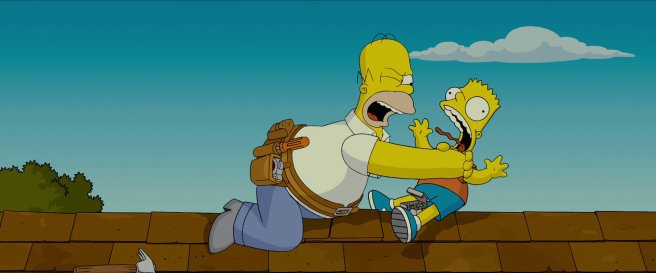
This is most likely the last time I will ever watch The Simpsons Movie. I saw it twice in the theaters, twice on DVD, once for the blog nine years ago, and now once more for a total of six viewings. There aren’t a whole lot of movies I can say I’ve seen over six times, and I feel somewhat embarrassed that this is one of them. Four of those initial viewings were within a year of the film’s release, when I was in my final stages of devotion to the series. The movie felt like a shot in the arm to a lot of fans, thrusting the show into the cultural spotlight for a brief moment, but when I finally came back to Earth and returned to the series as it was, I barely made it two more seasons before calling it quits. But I really enjoyed the movie when it came out. A lot of people did. A Simpsons movie was something everybody was waiting for. It was special. There was a greater air of importance to the idea of a feature film back then, so surely The Simpsons Movie would bring us something completely new, maybe even recapture the magic of the classic era. But here’s the issue: movies aren’t TV, and TV isn’t a movie.

Movies based on television shows are a tricky thing. You can think of a movie as just an extra-long episode, but it really is a completely different animal. What’s great about a certain show isn’t necessarily going to translate to a longer format, so one might reconsider the kind of story you want to tell, but if you change things too much, then you start to lose what makes the show so special. It’s a very difficult balancing act, and I can think of very few success stories. The SpongeBob SquarePants Movie is probably the best example I can point to: while still feeling mostly like an extra-long episode, it weaved in an actual emotional journey for the title character and added a whole live action section (and a wild celebrity cameo) in the third act, giving the movie something truly unique for the big screen (the two ensuing sequels range from alright to pretty terrible). Beavis and Butt-head Do America thrust our two imbecilic protagonists into a big movie story as best as it possibly could, with the joke throughout that they’re mindlessly drifting through a larger plot that they have no awareness or interest in. I really enjoy the movie, but the simplistic magic of the show’s small-minded stories was inevitably lost in the feature film adaptation. As for The Simpsons, it has in its favor a stable of episodes that practically feel like mini-feature films (“Marge vs. the Monorail,” “Who Shot Mr. Burns?”), as the show was no stranger to telling larger stories and utilizing a more cinematic eye. Every fan of the show speculated what a Simpsons movie might be like. One could try and imagine what a movie made during the show’s apex of quality might have been, but honestly, I don’t even know if a movie would have even worked even back then. But all that pontificating aside, 2007’s The Simpsons Movie is what we got. This is it. It exists. And watching it one more time, I gotta say, I can’t think of another movie that I am this indifferent about.
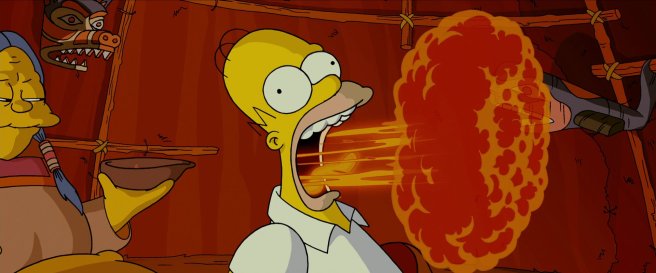
Last time around, I gave the movie “the most apathetic recommendation ever,” and I feel like I still share those sentiments. Except for the recommendation part. Now, there’s no need to even give a recommendation at all, considering I don’t see any possibility that anybody reading this hasn’t already seen the movie. But if by some bizarre happenstance, someone stumbled onto this blog and is wondering whether or not they should watch The Simpsons Movie, I would say no. That’s not to say the movie is bad, not at all. There are a fair share of jokes throughout that are genuinely funny. The whole cast is definitely giving it their all, with some pretty solid individual performances throughout. And while I don’t care for the overly polished HD look of the film, there are still scenes featuring some pretty great character animation, and director David Silverman takes full advantage of the cinematic format with unique shots and visual flairs that you wouldn’t normally see on the show. But for all that positivity, there’s an overwhelming disappointment hanging over the entire film that I just can’t shake. For as much undeniable hard work went into this movie, there’s so much of it that feels rushed and ill-conceived. And for a Simpsons movie that at times tries to cater to lifelong fans, there’s an unusual amount of it that feels like it’s being made for people that have never even heard of The Simpsons, which seems incredibly bizarre to me. There’s so much about the movie that feel incredibly off, it makes it that much more difficult to enjoy what actually does work.
I truly don’t understand why a Simpsons movie barely features the many beloved denizens of Springfield, opting to separate the Simpson family from the rest of the town at the end of act one. The film is ostensibly about the town of Springfield and its rescue, but it doesn’t play much of a role at all outside of the first thirty minutes or so. The colorful characters of Springfield are such a core element of the series, and here they’re treated as cute little add-on jokes. Why in the hell isn’t Mr. Burns the villain? We don’t step foot inside the power plant, the school, or the Kwik-E-Mart. Major characters on the show since the beginning like Apu, Skinner and Willie barely get one line. I understand trying to work in moments and roles for so many characters is difficult, but that makes it all the more bizarre why they would isolate so much of the movie outside of the town. It’s like they thought they needed to make the movie bigger than Springfield, with a big trip to Alaska and a massive government conspiracy leading all the way up to the President. That’s what makes this worthy of a movie, that we go beyond the scope of the show. But if doing so robs your film of such a rich vein of connection to what makes the show great, maybe you’re going down the wrong path. There really isn’t any reason Burns couldn’t have been the one to drop the dome over the town, excising himself from the rest of the riff-raff, and the other characters rallying to stop him. As great as Albert Brooks is in the role (as he always is), I don’t give two tits about Russ Cargill, and neither does anyone else. Hell, the writers only remembered last minute that they should actually write a scene where he confronts Homer to get our “hero and villain face off” moment, but it means nothing because they have no connection to each other whatsoever.
Homer is a huge dick in the movie. The writers talked about how they didn’t want to make him too unlikable, rewriting the script endlessly to soften him more. So, this is the softer version? From minute one, Homer is an unpleasant jerkass, calling everyone at church morons and praying for Ned Flanders to admit he’s gay (glad to see that the latent homophobia present in the series in the 2000s seeped its way into the movie as well!) If you really knew nothing about The Simpsons and went into this movie blind, if such a person could even exist (the writers seem to believe so), what is there to like about our protagonist from the start? He puts a hornet’s nest in his neighbor’s mailbox, allows his son to be charged for public nudity and forces him to walk around pants-less, repeatedly ignores and dismisses his wife… he’s a fucking asshole. My best friend doesn’t like The Simpsons, and when I first asked why, she told me she thought Homer was a huge jerk, and y’know what, considering she’s seen the movie, and I assume a handful of post-2000 episodes, I can’t really discredit her claim. I understand the movie is about Homer’s emotional journey and redemption, but he can’t be a jackass for the first 60 minutes and learn his lesson for the last 15. Homer is a likable character because he’s a lovable loser. He’s driven by his impulses, can be selfish and closed-minded at times, but his negative attributes are usually always passive. His lack of intelligence prevents him from seeing how he’s unknowingly affecting people until it’s pointed out to him, but when he finally gets it, he always tries his best to make things right. The Homer in this film is not that Homer. He bears some similar attributes, but his heart isn’t there. He’s an aggressively moronic and pitiful man who garners absolutely no sympathy throughout the film. Maybe the writers thought that seeing him get hurt so many times would feel like karmic payback. Or score some easy laughs.
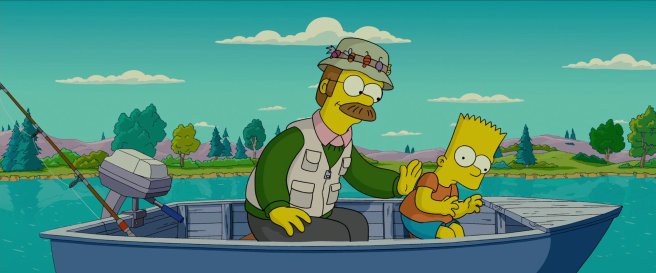
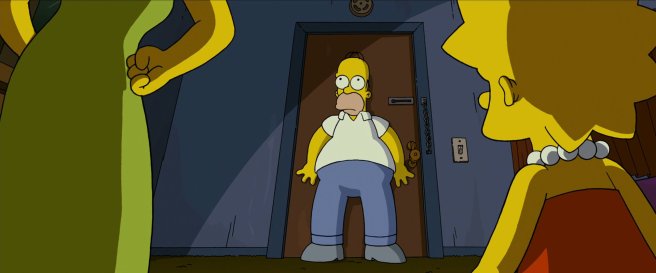
The other Simpsons are there too, I guess. Marge doesn’t have much to do outside of take Homer’s abuse (“Isn’t it great being married to someone who’s so recklessly impulsive?” “Actually, it’s aged me horribly.”) She gets her big scene where she once and for all “leaves” Homer, and between pairing it with the revisionist history wedding video and the producers forcing Julie Kavner to perform it five thousand times, it’s doing all it can to try and pack an emotional wallop… but it just comes off as empty since we’ve seen these two on the rocks dozens of times before, and on top of that, I don’t even care if they get back together considering how huge a prick Homer’s been through the whole movie. Lisa spearheads the environmentalist efforts in the first act, and has what I can’t even call a subplot in her romance with Tress MacNeille doing an Irish accent. Like Russ Cargill, Colin is a completely disposable movie-only character. They originally wanted to make Lisa falling for Milhouse, which I wouldn’t have wanted to see either, but maybe we can give the eight-year-old girl a storyline that isn’t about what boy they like? Bart gets the meatiest material of all, being reduced to a sniveling mess wanting Ned Flanders to be his Daddy, a man who won’t physically assault him or force him to go around in public with his genitals exposed. It’s very strange, borderline uncomfortable stuff (Bart instinctively preparing to be choked and his confused, euphoric reaction to being patted on the back.) But this story kind of conveniently removes Marge from the equation, who mothers Bart to death every chance she gets. Where is she in all this? As far as the Simpson family goes, Bart is easily the character the writing staff has struggled with the most as the series has gone on (and on and on and on…), and the movie is a pretty clear example of that. Bart nearly in tears begging to be a part of the Flanders family? Come on.
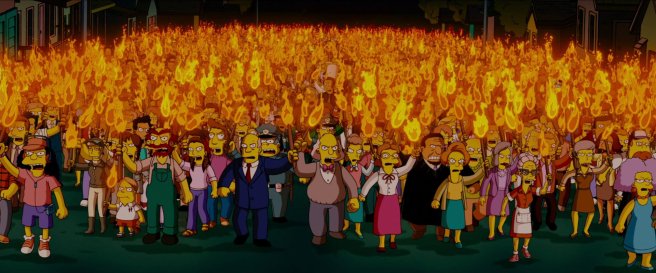
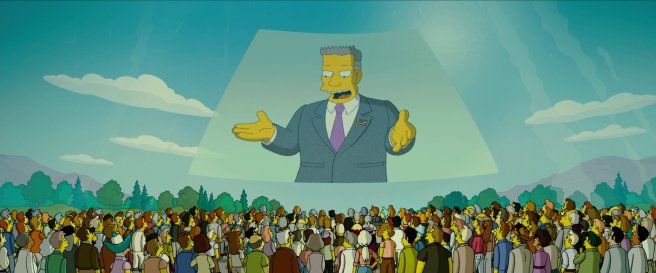
Presented in marvelous anamorphic widescreen, the movie is trying its damndest to feel worthy of its format. There are most definitely some fun visual moments and pretty nice looking shots and cinematography throughout the film, but its overall look is kind of bothersome to me. The more pristine and polished the show became as it got on in years felt more and more off-putting, and this is basically the ultimate version of that. The squeaky-clean varnish makes all the characters feel flatter than their early 90s counterparts. I also don’t care for the fact that literally every single character, object and background has a shadow layer on it in every single scene. I guess it’s supposed to make things pop more off the screen, but they just feel extraneous, and at worst distracting in more benign scenes that don’t necessitate any dramatic shadows. Another visual issue for me is the CG integration in the movie, which is pretty shaky on the whole. Cel-shaded 3D objects will stick out from the 2D elements, and the instances where 2D characters are placed into 3D environments for certain shots feel incredibly awkward (the family driving home from church in a 3D car, Bart almost falling off a 3D roof.) Some shots fare better than others (Homer smashing through the blockades at the lake before dumping the pig crap silo looks pretty damn smooth), but most of these more ambitious shots don’t quite hit the mark, like the above scene of the gigantic mob; as the camera passes through the 3D environment, all of the characters end up looking like paper cutouts. It’s a bit befuddling to me how within the same decade, Futurama managed to integrate 2D and 3D so well, but a big part of that is they would render entire shots in 3D, characters included, and would shoot and cut them in such a way that drew attention away from any unconvincing elements. Here, the mixture of 2D and 3D isn’t quite up to snuff yet, which ends up becoming distracting. Since 2007, there’s been incredible technical advancements utilized in wonderful films that toe the line between the two dimensions (Klaus, The Peanuts Movie, Spider-Man: Into the Spider-verse), but here, it’s in that iffy in-between stage where the effects kind of work, but also kind of don’t at the same time.

A big portion of my original review was about the behind-the-scenes stories on the commentary, how Al Jean and the writers were wholly reliant on test screenings to decide whether to keep, change or remove scenes, jokes and entire characters. Give it a listen if you want to feel depressed. The writing staff once famous for having a James L. Brooks-signed golden ticket protecting them from network notes, completely unheard of in the world of television, is now, completely voluntarily, at the beck and call of some schmo in Portland who didn’t laugh at Homer getting hit in the nuts or whatever. There’s just so many things about the mindset in the creation of this movie that are so incredibly disappointing. The biggest, of course, is the complete lack of creative confidence, which I feel I don’t have to belabor too much. This is a series that thrived solely because of its writing staff who created stories and characters that they enjoyed, and as a result, we the audience enjoyed too. Almost twenty years later, this slavish dependence on audience approval makes the staff feel like scared and tired old men who can’t stand by their own convictions. All of this constant rewriting and rethinking based on focus group response resulted in a movie that not only feels completely watered down, but with a confused plot with things that don’t quite connect. The “thousand eyes” in the prophecy used to refer to an entire forest full of mutated creatures, but since that was reduced to one multi-eyed squirrel in the final cut, it doesn’t make sense. Despite being incredibly important to kicking off the plot, Plopper just disappears from the movie after the first act. The Simpsons are in hiding at the motel from a wide sweeping manhunt, then go to a carnival in broad daylight with no issue. In Alaska, Bart and Lisa’s clapping avalanches Homer back into the house during the day, then it’s immediately nighttime for he and Marge’s Disney sex scene. When you rip your script to pieces so many times so close to the film’s release date, you’re gonna end up with some scattershot elements left in your finished film.
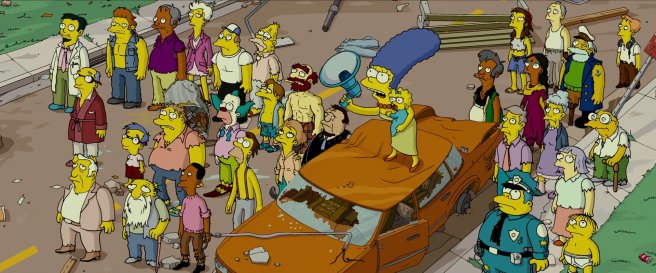
What’s most baffling to me is why the writers felt they had to do any of this. With eighteen years of public awareness and good will toward The Simpsons, they basically had carte blanche to do whatever the hell they wanted. FOX knew that they could open The Simpsons Movie and it would be a huge box office success by its name alone, so I’m sure they gave fuck all about what the movie was actually about. You would think this would be incredibly freeing creatively, lending you the ability to do whatever you wanted, so it’s very odd how the writers seem to have hobbled themselves in kowtowing to public response in such an extreme manner. I get that writing a film is a whole other ballpark than a TV script, and you want to make sure everything is working for an audience, but the endless amount of scenes pointed out on the commentary that were completely reworked after test screenings really speaks to a bizarre lack of confidence on their part, and that unsure attitude works its way into the movie itself. It’s impossible for me to separate the film from the behind-the-scenes stuff, but I can say this is one of those movies I remember liking less each time I saw it, for reasons I can’t entirely articulate (despite me being at like three thousand words at this point). But there’s definitely an overall malaise I get from it, a film made with good intentions and a lot of effort, but still a conflicted mess in what it wants to be. Is it social/political satire, or emotional character piece? PG-13 edgy, or genuine, saccharine emotional? For super fans of the show, or people who never watched it? In trying to be everything, and cater to as many people as possible, you end up with a movie for basically nobody, and that’s a sad fact.

I remember hearing Mike Judge talk about Beavis and Butt-head Do America, how he wanted to make the movie as best a representative of the best qualities of the series as he could, figuring the film would be more readily available than the series itself, sitting on video store shelves. And at the time, he was right. In the 1990s and 2000s when Blockbuster was king, movies were the big dogs, and TV was secondary. A TV show getting a movie was a huge coup, being viewed as a step-up in mediums. But over time, things changed. With the rise of premium cable channels, and later, streaming services, TV series became more prestige and valued. At the same time, video stores shuttered as streaming TV started to become more and more peoples’ first choice for home entertainment. As different streaming services continue to emerge, beloved TV series have become hugely hot commodities, as these services have to promote how they’re just exploding with large amounts of content for people to binge, much more than individual movies. A sizable piece of Disney+’s launch marketing was the inclusion of thirty seasons of The Simpsons, and I would think that was a pretty huge selling point for a lot of people that they could watch the entire series. The Simpsons Movie was also available, but just as a minor addendum to the series itself. And that’s basically what the movie is: a disposable vestigial limb to a once-great series. It had its brief moment in the sun when it came out, everybody was singing the Spider-Pig song for like a couple weeks, but now, fourteen years later, there really isn’t much of a reason to go back to it at all.
Author: Mike!
Just some guy who loves cartoons trying to figure out his purpose in life. Currently watching television and poking around at bugs in the garden.
Season Eleven Revisited (Part Four)
 18. Days of Wine and D’ohses
- All the garbage scavenging stuff is just to kill time until Homer ends up at Moe’s and the plot actually starts. A few gags work (Cletus and Brandine, CBG shooing nerds away from his trash bins), but then we get to Homer and his fire-breathing Talky Tiki, who flees the scene as the flames spreads too quickly. We see the fire traveling back through the shoddily rerouted gas line back inside the house, and Homer just runs off to a bar as his wife and kids stand there aghast right before their house could fucking blow up and kill them.
- In a season filled with unnecessary series changes, this feels the most unnecessary of them all. Barney’s entire character is being the drunk at the bar. That’s his primary function. If you’re going to make him sober, you’d better have an actual story in mind to tell, and give the character something new to be their thing that’s interesting and makes sense. Neither of those things happen here. Barney goes to AA to get sober and he learns to fly a helicopter. That’s it. We learn nothing else about him, and between a B-plot and Homer monopolizing almost every single scene, Barney doesn’t feel like he has a lot to do in his own episode.
- Case in point, the first thing Barney does in act two is ask Homer for help. I’d say this is somewhat better than Apu and Ned Flanders coming to him for guidance since Barney used to be Homer’s best friend, but that role has basically been completely diminished at this point, so it just feels arbitrary. Homer takes Barney to AAA by mistake to make a joke, he sits in on Barney’s AA meeting and does his little comedy routine as Barney just stands there… like I said before, this season is filled with “When Homer’s not on screen, everyone should say, ‘Where’s Homer?’”
- The B-plot of Bart and Lisa trying to win the phone book picture contest is pretty dull. You’d think that an episode about a major life change regarding one of the oldest, most iconic characters of the series would warrant the entire plot being about him, but I guess not.
- Act two ends when Homer acts like a petulant child to Barney and runs off crying, which is fucking annoying. Barney talks about how he values his memories at Moe’s, but “I don’t want to do that stuff anymore.” Well, what do you want to do, Barney? Now that you’re sober, what life do you want to lead? New job? New hobbies? Anything? He learns to fly, maybe he decides he wants to be a pilot? Something, anything I can latch onto here as an actual plot.
- The two plots merge at the end when Barney has to pilot the helicopter to save Bart and Lisa from a forest fire, but so much of it makes no sense at all. Bart and Lisa were walking away before the fire started, how did they get trapped? Barney is nervous about flying, but then lands the helicopter on a bridge perfectly? Also, just like in “Faith Off,” we have Homer getting completely wasted, then sobering up when the need calls for it. He drinks an entire six pack in seconds, getting totally fucked up, then later when a bear tries to climb up the rescue ladder, he’s totally cogent as he cuts the ropes, then immediately afterwards he’s wasted again as he walks out of the helicopter, hooking his leg on the rail and flipping it around in a circle, with no real consequence.
- Barney trading one addiction for another with coffee is an amusing idea, but again, if this episode were actually about Barney, maybe it would have been interesting to actually put into the story, like that he’s got an addictive personality or something. But it’s all a completely pointless exercise anyway. Giving Apu kids and killing off Maude didn’t change much, but they were changes that the writers had to address in some way. With Barney, despite his lamenting his wasted years at Moe’s, we’d still see him perched at that bar stool for seasons to come, only with a coffee mug in his hand in place of a beer stein. Then in season 14, they did a joke about him relapsing, because why the hell not. Absolutely pointless.
- Simpsons Archive retro review: “It’s great to finally see an episode with a logical story. This episode had a nice, believable storyline and a nice Bart and Lisa sub-plot. It was a good experience to see an episode that revolved around Barney for the first time. I liked the many good alcoholic jokes in this episode and the entire beginning sequence was nice. It’s good to see an episode where the story works nicely. The Simpsons writers need to continue writing episodes of this quality.”
19. Kill the Alligator and Run
- I honestly wasn’t expecting to laugh out loud at the very start of this episode, but I forgot all about Homer’s Montana Militia money (“It’ll be real soon enough…”)
- Here we see the “great” running joke to come out of Maude’s death: Homer repeatedly forgetting she’s dead. Just like Frank Grimes, he has a very short memory when it comes to the people he’s inadvertently killed.
- Re-watching “Wizard of Evergreen Terrace,” I forgot they had inched Homer’s age up even further from 38 to 39, with Marge telling Homer his birthday was coming up, and now this episode “confirms” his new canonical age is 39. I know this was the result of the aging writing staff feeling horrified that they were becoming as old or older as the originally 34-year-old Homer, but I don’t like that he’s that old. Marge found out she was pregnant when the two of them were directionless young adults, turning their carefree lives upside-down, but now Bart would have been born when Homer was pushing 30.
- Mr. Burns acting nervous around the health inspector and giving him kiss-ass compliments feels incredibly wrong. The real Burns would have insulted him while stuffing bribe money in his jacket pockets by now.
- Structurally, this episode is totally broken. Homer is an anxious mess fearing death, then he instantly becomes a spring break party animal, then the family become fugitives and temporarily adapt to being country folk. There’s nothing to hold onto. Right after Homer’s insomnia is miraculously cured after they arrive in Florida at the end of act one, George Meyer pipes up on the commentary, ”You’re usually in trouble in a story when you don’t take your own premise seriously.” Well, shit, that statement applies to the majority of episodes nowadays.
- Kid Rock just performs what I assume is a typical concert for him, in another boringly normal guest appearance. Even his schtick with pouring a gigantic 40-gallon on a curb they wheel onto the stage doesn’t feel ridiculous enough. “Homerpalooza” featured some pretty big-name bands who all brought their own quirks to the party, while here, it’s just a Kid Rock concert played straight.
- I really like the idea of the local sheriff being paid off to look the other way during spring break, but I wish it had worked its way into a more effective joke than him just bluntly saying it aloud.
- Falling asleep in the car being dragged by a train, working at a diner in the middle of the woods, catering a fancy dinner party in shackles… they really had no fucking idea what to do in the third act and decided to just throw everything and the kitchen sink in.
- The magical whipping man thwarts the Simpsons’ escape by trapping them in a ring of fire, and their response is to be impressed and applaud. Then a few seconds later, the fire is just gone. This is a great episode.
- As someone who lived in Florida for five years, the biggest sin this episode commits is completely wasting their shot to rip apart what an awful state it is. Large portions of act three made it just seem like they were in the deep South, while Florida folk are a whole unique breed of Southern maniacs. Months after this episode aired, the 2000 election would result in Florida becoming a national punchline, but they could have beat them to the punch, but per usual in this era, they didn’t even try as far as satire is concerned.
- Simpsons Archive retro review: “This episode is so crazy, it’s SUPERCRAZY! I mean, Homer has yet ANOTHER mid-life crisis, so he goes to see the plant shrink. Shrink tells him to go to Florida with his family. Then it starts getting funny. Very funny. The humor went a bit south in Act 3, but it’s no big deal. Heck, I think ALL 233+ episodes are funny, and I’m not going to sugarcoat that thought for the sake of sounding like a critic. In that wise, my grade for BABF16 is A+!”
20. Last Tap Dance in Springfield
- Homer screams his lungs out getting laser eye surgery, just as he did with the leprosy treatments earlier this season. I recall a later episode where he screams while going to the dentist. Anytime they can get Dan Castellaneta to yell himself hoarse, it’s comedy gold to the writers, I guess.
- “Tango de la Muerte” is pretty excellent, both as a piece in itself and Lisa’s adorably childlike enthusiasm watching it. Even something ridiculous like Mexican Milhouse is pretty funny. This exchange always makes me laugh (“Only one man was crazy enough to dance that dance, and he is dead! “My twin brother, Freduardo. But where he died, I shall live… in his apartment.”
- This episode is held up on the shoulders of Little Vicki, a very funny and entertaining character. I feel like I grumble a lot at Tress MacNeille’s overuse on this series, but she’s obviously an incredibly talented voice artist, and she’s just fantastic as Vicki. Almost all of her jokes land, and her discouragement-with-a-smiling-face to Lisa is great throughout (“You’ve just got to turn that frown upside-down! …that’s a smile, not an upside-down frown. Work on that, too!”)
- The Little Vicki sign of her rotating finger against her cheek scraping a dent into the metal is fantastic too.
- The mall subplot is some light fun. Bart and Milhouse clowning around the mall at night feels similar to them messing around the abandoned factory in “Homer’s Enemy.” I’m not completely clear on the timeline though; the cops are called after their first night trashing the mall, then they stick around while the mall is closed and the police are bumbling around? Why wouldn’t they just leave since the heat was on? The mountain lion chase and Lou thinking the yarn in his mouth is the giant rat’s tail is kind of a whimper of an ending, but everything leading up to it was mostly enjoyable. Even Wiggum getting slammed with the ACME anvil got a laugh out of me.
- Homer and Marge unknowingly pressuring Lisa to keep dancing even though she hates it still feels pretty contrived. It’s like they needed a reason to explain why Lisa just doesn’t quit but didn’t bother weaving it into the story.
- I feel like I’ve used “This plot is hard enough to follow as it is!” a number of times when I’ve had friends over to watch a stupid movie and they talk over it.
- Even a simple story about Lisa taking up dance of course needs an over-the-top climax where her self-tapping shoes go out of control and she freaks out the audience. It’s certainly not bad by Scully-era standards to be fair, and I like how it’s resolved by Homer just sticking his leg out and tripping her, so that’s good. But then we get our actual ending where he gets shocked by Frink’s weasel ball and screams in agony. Man, those writers love to hear that man scream!
- Looking back at my season 11 recap, why in the hell did I leave this out of the top 5 in favor of “Pygmoelian”? Did I hit my head or something?
- Simpsons Archive retro review: “This is a lousy episode disguised as a neo-classic, using the formula of giving ATSers what they keep saying they want (more Lisa, less Jerkass Homer, Baby Gerald, etc.) to hide the fact that the writing is lazy and the script is a schizophrenic hydra spliced together by committee writers. Vicki is inconsistent and unlikable and the plot follows the road most traveled by. ‘Tap Dance’ reminded me of that old Alaska Airlines commercial where cheerful stewardesses on a competitor’s airline serve hungry passengers a measly bag of peanuts surrounded by plastic garnish. Bon appetit, my fellow Lisa lovers.”
21. It’s a Mad, Mad, Mad, Mad Marge
- Otto’s engagement to Becky is pretty solid: the flashback to Woodstock ‘99, Otto’s skull ring, and the kids cheerily wildly out the windows as the STOP sign waves back and forth. The first three minutes of this episode are actually pretty good… until it isn’t.
- Who is Becky? Does she have any family? Any friends? She appears to have no one meaningful to her present at the wedding, and is reliant on this family of strangers to take her in. She’s just an amorphous figure in the Simpson house to drive Marge off the deep end for no discernible reason. It’s not Parker Posey’s fault; at least she got to be in a much better Futurama episode around the same time.
- Act two opens with a joke about Moe leaving Otto’s wedding. You remember all those great Moe & Otto scenes of seasons past? Man, those two work great off each other.
- Why does Marge believe Patty and Selma’s bullshit about Becky wanting to kill her and steal Homer? The whole second act is this increasing build-up of Marge’s paranoia, but it honestly feels like we’re supposed to feel a bit uncertain about it too, with Marge’s cut brakes not going explained until the end by Homer. We do see him working on the car earlier, so it does connect, but maybe instead of making sure their bullshit mystery all connects, they could have focused on making Becky an actual character.
- Wiggum is this episode’s MVP, with all of his appearances being genuinely funny, from when Marge first comes to her and he refuses to help (“How about this: just show me the knife… in your back? Not too deep, but it should be able to stand by itself,”) to later when he apprehends her (“I thought you said the law was powerless.” “Powerless to help you, not punish you.”)
- The third act is so bizarre, with Marge getting declared insane and her going on the run within a minute of screen time. While she’s on her own journey to dig up dirt on Becky, we cut back to the Simpsons twice just sitting on the couch doing fuck all to try and find or help Marge. Bart and Homer talk about schoolyard rumors about Marge, and Krusty does a whole sketch about her, so how many days have passed that they’re just sitting on their asses not giving a shit about Marge’s safety?
- The bait-and-switch-then-bait-again ending is so fucking terrible. The Simpson living room gets transformed into a dungeon… somehow? Where’d they get all those props? Complete with wallpaper that looks like cobblestone, I guess. Also, Marge would have been staring right at Lisa, who is revealed to be holding a video camera. But hey, I’m glad we paid off the running plot of Bart finding just the right thing to film for his school project. It’s so shitty that I can’t even muster energy to care about the reveal that Becky was planning on killing Marge. Like, who gives a shit?
- And the final moment of the last “canon” episode of this re-watch is Homer tranquilizing his wife, who’s been on the run and missing for multiple days. And so ends another episode I will be glad to never watch again.
- Simpsons Archive retro review: “Talk about a perfect Marge episode. I have not seen anything like this since Marge went on the Lam. The way that Marge got in trouble is great, but including Patty and Selma, by having them make Marge paranoid, is classic. Becky’s upstaging of Marge at dinner, Marge being the victim of a cut brake line, how Marge stopped the wedding of Otto and Becky, and the Video tape project in Bart’s class, all happen to be Highlights of this episode which gets a perfect A+++ from me.”
22. Behind the Laughter
- I really wish this episode had no opening title sequence and just went straight to the Jim Forbes opening. You even have a fake out where you start with the Simpsons clouds and then it goes into the beginning of the documentary, it would have worked so much better if it didn’t start like a normal episode.
- Jim Forbes just absolutely sells this episode, taking the gig as seriously as any other Behind the Music episode and performing his role to a T. Referring to Homer as a “penniless peckinpah,” his insistence on “figurative” storm clouds, there’s so many small little moments throughout the episode that he just nails.
- I love all the different lower third identifiers for each interviewee (Krusty: Embittered Comedy Legend, Moe: Local Hothead, Abe: Coot)
- Simpsons Boogie obviously refers to “Simpsons Sing the Blues,” and I have to say, despite my lifelong obsession with the series and my engagement of all sorts of related media, I’ve never listened to that album. I randomly found “The Yellow Album” at a Best Buy as a kid and listened to that, being very confused as to why Homer and Linda Rondstadt were singing a ballad. I can’t imagine how much better “Blues” is compared to that. I’ve heard “Do the Bartman” and “Deep, Deep Trouble” thanks to the inclusion of their music videos on the season 2 DVD. “Trouble” is actually pretty damn catchy, it’s got a great hook, I guess thanks to DJ Jazzy Jeff.
- “I want to set the record straight: I thought the cop was a prostitute.” I feel like there are a number of ways you can interpret this joke, and none of them come out well for Homer.
- The joke about Lenny and Carl being paid to kiss is okay, but Jim Forbes coming in afterward referring to the Simpsons family’s “reckless spending and interracial homoerotica” made me laugh out loud hard. I tell you, Forbes just killed it here.
- The only big wince I give this episode is the Homer getting hurt section, with the narration about how his addiction to painkillers “was the only way he could perform the bone-cracking physical comedy that made him a star.” The clips shown are all post-season 9. I don’t recall much bone-cracking physical comedy out of the first few seasons, do you? It’s all terrible recent shit of Homer screaming in pain like an annoying asshole. Funnily enough, when we cut back to Homer talking, the clips we see on the TV behind him are of older seasons (Homer clung to the wrecking ball in “Sideshow Bob Roberts,” Homer hit by the chair in the tub in “A Milhouse Divided.”) Now why are those bits so funny and the other clips suck? Why indeed.
- Marge’s scolding, personalized diaphragms is definitely a gag I did not understand watching as a kid.
- Ah, the “gimmicky premises and nonsensical plots” bit. Really sticking it to Oakley, Weistein and Ken Keller, just shouting “fuck you” at them for that Armin Tamzarian episode. In what must be a purposeful joke, I like how the “trendy guest stars” list includes the likes of Butch Patrick and Tom Kite. We also get our second instance of reusing Gary Coleman’s karate noises (or Sir Gary Coleman as he’s credited).
- They reference a Simpsons newspaper comic at the end that Homer allegedly writes, which I guess is just a joke, but a few years after this episode, Bongo Comics actually did syndicate a Sunday comic strip that lasted I think barely a year. I remember seeing it advertised in the Simpsons comics but it never made it to my local paper, sadly.
- “This’ll be the last season.” If only, Homer, my friend. If only.
- This episode is still great, especially given the season it’s in, but as a gimmick episode, I feel like it’s slightly diminishing returns each time I watch it. I remember when I was younger, I just loved this episode because of how unique and high concept it was, but now, I just see it as a pretty solid and entertaining experimental episode that would have made a damn good series finale.
- Simpsons Archive retro review: “What the hell was that? Why do they expect us to take them seriously when they no longer do so themselves? As a parody of the documentaries about old TV which is now the rage, this was passable, but as a canonical episode of OFF this was an abomination. When has it ever been suggested that the Simpsons are actors playing themselves on TV? This treatment of the Simpsons cast is not faithful to the dramatic context. I give it an F.”
Season 11 episodes I wouldn’t kick out of bed in the morning: “Brother’s Little Helper,” “Treehouse of Horror X,” “E-I-E-I-D’oh!,” “Grift of the Magi,” “Last Tap Dance in Springfield,” “Behind the Laughter”
706. The Last Barfighter
 Original airdate: May 23, 2021
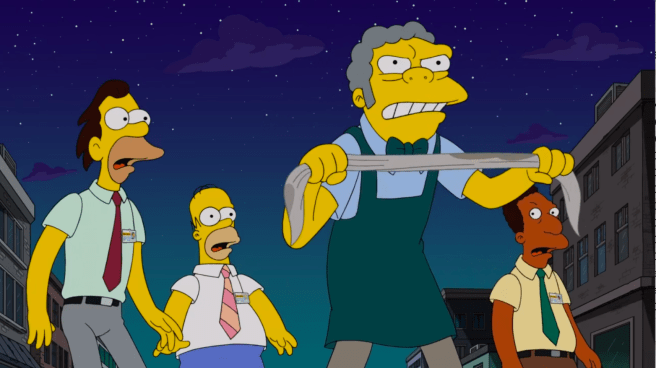
The premise: Moe participates in Homer and the gang’s drunken night out for the first time ever, breaking the sacred bartender-customer oath of the secret society he belongs to, resulting in every bartender in Springfield being out to get them.
The reaction: Season 28’s “Treehouse of Horror XXVII” featured a segment with Moe in a secret society of bartenders in a half-baked Kingsmen parody. Four years later, we’re doing John Wick, except it’s a normal episode and it’s three times as long. The concept of “The Confidential” is kind of interesting: a place where bartenders can share their woes, but always must keep the secrets told to them in confidence by their clientele. We open with Moe toasting to the grand institution, which begs the question, why is Moe such a lonely, miserably sad sack when he has all of these other bartenders who are open to talk with him? Instead, he’s touched that Homer and the guys ask him to drink with them, and they go all out on a raucous, drunken night, during which Moe blabs a bunch of secrets told to him by other bartenders (again, indicating he belongs to a social circle), breaking the Confidential’s code. Not only is Moe expelled from the organization, his best customers are being hunted by other bartenders to be injected with “anti-booze,” which will make them sober forever. All of this is absolutely ridiculous, and has the feel of an extended Halloween episode. It’s also a “parody” in the usual sense that it just recreates visuals and plot elements from a film without even trying to satirize it. Just as the Kingsman “parody” featured a sequence imitating the elaborate church fight scene from the first movie, this episode has Moe fighting like John Wick in the street against a bunch of bartenders, subbing a gun for his trusty bar rag. None of the fight choreography is particularly entertaining or creative, especially when stood up against the exhilarating and fun action sequences of the John Wick movies. Homer, Lenny, Carl and Barney all end up getting de-boozed, but flash forward three months, we see that they’ve all greatly improved their lives now that they’re sober. They track down Moe to gloat about it, but when they find him miserably working at an omelette bar, they make amends and return to Moe’s (which Moe still has, I guess), wanting him to be their bartender again, even serving just water. Then the Confidential head magically appears in the bar, offering them all an antidote to the anti-booze because the episode is almost over and we need to reset the world. For an episode supposedly parodying an exciting action film series, one that I very much enjoy, this felt particularly boring, and a really tired way to close out the season.
Three items of note:
– After the opening with Moe, Bart and Milhouse end up in the audience of Bumblebee Man’s late night talk show, an exciting affair filled with ridiculous game show segments and Horchata sponsorships. It felt kind odd that we get entire lines of dialogue from Bumblebee Man and the audience in Spanish with no subtitles. You can still follow what’s going on (and Milhouse helpfully shouts explanations to Bart from the audience when he’s brought on stage), but none of it felt particularly funny and was mostly just time wasting. Bart’s prize from the show is a crystal skull bottle of tequila, which Homer eventually gets his hands on (through a Raiders of the Lost Ark opening parody, inevitably reminding me of the superior “Bart’s Friend Falls in Love” sequence) and shares with everyone at the bar. A credits scene features the broken bottle magically regenerating and speaking ominously to the kids in Spanish. It’s not like a bilingual bonus joke, where you understanding the language is an additional joke. In the case of the Bumblebee Man scene and the ending, it’s just full Spanish dialogue and that’s it.
– Ian McShane voices Artemis, the leader of the Confidential, appearing in a similar role as his John Wick character. I really don’t even know how you would parody a series as ridiculous and over-the-top as John Wick. You could comment on its gratuitous, exaggerated violence, I guess, but it kind of feels redundant to what the series does anyway, and certainly not something you could do on a network show. Maybe something on Adult Swim could do it. Or maybe Robot Chicken will do a shitty John Wick sketch. They probably already have, but I don’t care to look it up.
– In the end, Homer is the only one who chooses not to take the antidote, prompting Artemis for some reason to put out a Confidential hit for him to be re-boozed. Sober Homer is shown to be a wonderful husband and father, fully functioning at work after his new promotion, noticeably thinner, with everything going great for him. I was expecting him to be as quick to jump on the antidote as the others and that being the tired joke, but him choosing to keep his new, better life, only to be doggedly chased down and forced to be an alcoholic again felt a little bit sad, even if it really doesn’t even matter.
And with that, that’s a wrap for yet another season, and boy howdy, can you believe it was a real stinker? This honestly may have been the worst season yet, but ranking anything within the past decade of this show feels so unnecessarily granular to me, since it’s all been pretty terrible. I always held season 28 to be the worst, with the ensuing few seasons after feeling not quite as bad, but looking back at the episode list this year, this felt like a particularly sorry crop. Season 31 had the surprisingly enjoyable “Thanksgiving of Horror,” while this season, I can’t point to one episode I even halfway enjoyed (the closest being “The Road to Cincinnati,” enjoying the impulse of an honest Skinner/Chalmers episode, but not the execution.) Meanwhile, my worst episode list is bursting at the seams (“The 7 Beer Itch,” “Sorry Not Sorry,” “Diary Queen,” “Yokel Hero,” “Do PizzaBots Dream of Electric Guitars?,” “Manger Things,” “Burger Kings,” “Mother and Child Reunion.”) But one thing I can say, I’m genuinely curious about the future of the show for the first time in years, only because of the world outside the show itself, thanks to their new corporate overlords. The Fox acquisition by Disney has been over and done with for a few years, and the upcoming 33rd production season is the first one actually ordered by Disney. Meanwhile, The Simpsons still airs first-run on FOX, who has no ownership of the show anymore, while Fox Entertainment, the FOX-owned media branch that formed after the Disney buy, is busy creating their own slate of new animated series, starting with Housebroken, which premieres next week, as well as Dan Harmon’s Krapopolis, and I’m sure more to come. Despite the dwindling popularity of The Simpsons and Family Guy, it’s probably still very important for FOX to hold onto them to anchor their Sunday nights, but I imagine their goal is to create their own new animated hit that they can reap all the financial rewards of. When (and if) that happens, they might see less and less need to air shows that their major competitor owns. Meanwhile, who’s to say that Disney might not want to move The Simpsons onto FXX? Or Freeform? Or cancel the series as it is and revamp it in a new streaming format altogether? I’m not aware of all the ins and outs between Disney and the FOX network airing the show, and at what point that might change, but suffice to say, I have to imagine sometime in this next decade, there’s going to be a major shift in the show for sure. Whether that be a channel hop, a new movie, or the end of the series, it all remains to be seen. And seen it shall be come this fall, when we dive headfirst into season 33. That’s right, for yet another year, it’s back into the toilet I go.
As for the blog, there’s the last few Revisited posts to come: the finale of season 11, The Simpsons Movie, and a small conclusion post for the 10th anniversary of the blog. Stay tuned!
Season Eleven Revisited (Part Three)
 12. The Mansion Family
- This episode came out at the height of Britney Spears’s popularity, and they just gave her normal lines to read, in a tremendous display of a total lack of creativity. Why in the living hell is one of the biggest pop artists of the time hosting a local awards show in a nowhere town like Springfield?
- Probably this episode’s only significant cultural export is this frame grab of Lenny.
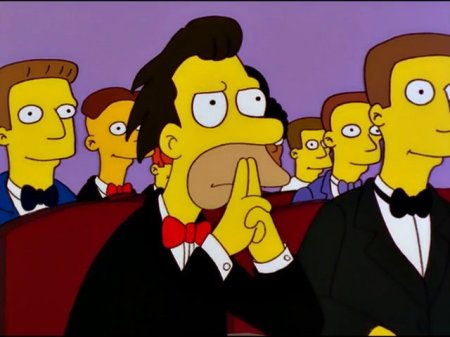
- Why is Mr. Burns even at the Springfield Pride Awards? I kind of thought it was weird he was at the Chuck Garabadian seminar in “Thirty Minutes Over Tokyo,” but it makes a little sense if you don’t think about it too long. But here, it makes no sense at all.
- “Who’s that fellow who always screws up and creates havoc?” “Homer Simpson, sir?” “Yes! The way I see it, he’s due for a good performance!” And just like that, reality is broken. The show has done meta commentary about how all relevant events of Springfielders lives seem to always come back to the Simpsons, but this is just the writers throwing their hands up and going fuck it, we don’t care if it makes sense, we just want to write a story where Homer pretends to be a rich guy. Also, why does Burns even need house sitters at all? The Simpsons don’t have any specific duties to tend to during their stay. How many days does he need to just go to the Mayo Clinic and back? And why are Burns and Smithers taking a normal taxi? Aaaaaagggggggh.
- There’s no story to be had whatsoever in this episode. Homer wants to be a high-rolling rich guy, pretends to be one, then some crazy shit happens, and then he’s back home lamenting he’s not rich. That’s it. His international waters boat party is just a crazy random thing that happens in our third act, as a crowd of recognizable faces joins him to hoot and holler. Moe, Apu, Krusty… it’s like the Super Bowl mob in “Sunday, Cruddy Sunday” all over again.
- The only scene I like in this episode is Burns’s diagnosis of having every disease ever, but them all existing in “perfect balance.” It’s a bit of a silly conclusion, but it’s a humorous explanation of why a decrepit old skeleton like Burns is still alive.
- We get a bunch of pirates as our ending. And one of them has four shoulder parrots. They capture everybody in a giant net ball, plummet them into the ocean where we see shark fins, then the sharks are gone as the net ball magically floats and over two-thirds of the people drowned, I guess. I can’t wait to never watch this episode again.
- Simpsons Archive retro review: “More proof OFF’s writers still have it. Except for a few ludicrous moments during the last act (the ‘net in the water’ gag, for example), nothing was horribly wrong. Both of the ‘in-jokes’ were excellent. I liked both Homer’s gang in international waters, and Burns at the Mayo Clinic. Even Britney Spears’s appearance was pretty cool.”
13. Saddlesore Galactica
- I like the brief bits we see of Mr. Largo at the beginning and his startling lack of imagination (“I thought for once we could play a song that wasn’t written by Sousa.” ”You mean something just arranged by Sousa?”)
- At least the state fair is kind of fun, right before the episode starts to careen off a cliff. OmniGogs and the punchline with Lenny is good, and Homer yelling at BTO to play their two hit songs is alright.
- Why does Bart care so much about Duncan right away? They tried to pepper in a few moments of him encouraging and bonding with the horse, but it doesn’t play at all. But I guess his quick plea is enough to convince Marge to take the damn horse with them. Why not? We also have the meta Comic Book Guy scene, which honestly, isn’t really that necessary. The two episodes are about the Simpsons getting horses, but the set-ups and executions are so wildly different, I may not have even put the connection together if the writers hadn’t shone a big spotlight on it and directly told the fans to shut the fuck up. It certainly feels like the first big moment (of many) of trying to excuse shoddy writing by highlighting it as a “joke.”
- Act two ends with a sad beat of Duncan loses his first race, and I’m wondering why exactly I should give a shit. There’s zero investment to be had in Homer and Bart’s racehorse plan, other than I guess it’s like a Honeymooners-esque get rich quick scheme. But to what end?
- Furious D acting like a human sucks. There have been a few times where Matt Groening’s “animals should only act like animals” rule has been broken that have been funny (the pets attempting to speak in “Bart Gets an Elephant.”) This is not one of them.
- The fucking elves. The fucking elves. Jockeys are short, so they’re elves who live in a Keebler elf-style treehouse. They keep themselves secret until they fire a cannon in broad daylight and chase Homer and Bart through town. Then they’re sprayed with water, shoved into a trash bag and left on the curb. What more could I possibly add?
- I kind of liked how peeved Lisa was at the Ogdenville band’s glow stick-assisted win, but the President Clinton ending is just terrible. Also, his final lesson he gives to Lisa (”If things don’t go your way, just keep complaining until your dreams come true”) aged like milk considering the 2000 election fiasco nine months after this aired.
- Simpsons Archive retro review: “Coming just days after a Salon article outlining the growing rift between the show’s writers and many internet fans is a rather blatant attack on this newsgroup. The show responded to criticism that the show is no longer realistic with one of the most outrageous episodes ever. And to be honest, I laughed so hard through most of it — especially the frequent appearances by the Comic Book Guy — that I really don’t mind having been slagged in this manner. Say what you like about the character development and outrageous plots of late, but the show has rarely been this funny.”
14. Alone Again, Natura-Diddly
- Marge is a-OK with her and the family crossing a busy racetrack, and with Bart riding along with a race car driver whose car just flipped over and burst into flames. Alright.
- Before he inadvertently causes Maude’s death, Homer gets the pit crew to work on his car before booking it, causing a big pileup of cars on the track. What a wonderful man.
- It’s pretty sad that the impetus of this entire episode was FOX being too cheap to keep paying Maggie Roswell. At the time, she was commuting from Denver to Los Angeles to record her lines and asked for a couple thousand per episode raise, and FOX countered with a measly $150. This sucks shit, but Roswell leaving resulted in the unceremonious killing off of Maude in the bluntest way possible. It’s honestly pretty awful how she just gets flung off the bleachers to her death, it feels so tonally improper for this show.
- The funeral filled with meta references about Maude’s role on the show and the few “permanent” changes the series has made like Apu’s kids and Kirk and Luann’s divorce is early proof that the writers don’t give a shit about treating this serious in-universe event with any sort of realism. This show has done so many touching and poignant episodes about death, with this one feeling like the drooling, inbred stepchild of the bunch.
- In an episode ostensibly about Maude’s death, it really isn’t dealt with at all. To be fair, we really barely knew anything about Ned and Maude’s relationship, so you can’t dive too deep into specifics, but if that’s the case, then just don’t bother doing the episode. Rod and Todd disappear after the wake until the very end, we don’t even see Ned talking to his boys about their dead mom.
- “Do you even have a job anymore?” “I think it’s pretty obvious that I don’t.” Great writing, guys. Again, this is an episode about a significant character’s death, and Homer’s having a giddy old time shooting and editing a videotape and hiding in mailboxes.
- We see that Lisa is the one who edited Ned’s dating tape, so I guess that means Homer had his daughter review and cut footage of Ned naked in the shower with his enormous dong. Now that’s parenting!
- I forgot that one of the women Ned goes on a date with is Edna, so I guess Nedna was planned all along! Or maybe it’s because this show has incredibly few women characters, and even fewer single ones. They had to invent a new third woman; if this episode had aired a few seasons later, they would have had Ned go to dinner with the Crazy Cat Lady.
- The back half of this episode has shades of “Viva Ned Flanders” where Ned keeps going to Homer to find out what the next part of the episode is. Again, where are his children? Who’s watching those boys during his father’s dates? It would take almost two decades to get to an episode where one of the Flanders boys deals with their mother’s death, and it was fucking horrible.
- Rachel Jordan’s song is so long and boring. She would return the following season and then never again, leaving Ned more or less a permanent bachelor until Edna twelve years later, except for that one episode where he dated not-Marisa Tomei. Like all the “permanent” changes this show executed during this era, the series didn’t change at all. Neither Ned nor his sons acted any differently after this, and as I’ve mentioned before several times, killing off Maude completely ruins Ned as the subject of Homer’s envy for the perfect family. It’s an episode pretending to be emotional and serious, but if you look closely at it, you’ll clearly see that it’s actually a steaming pile of horse shit.
- Simpsons Archive retro review: “This was a surprise. I think this episode is comparable to season 2: mostly realistic, emphasizing character, and disappointingly short on laugh-out-loud humor. Flanders is portrayed more like a real person than in any previous episode centering around him, while Homer is a well-meaning schemer who (gasp!) actually helps Ned out. The first two minutes were weak and the last two minutes were rushed, making it seem as if Rachel Jordan will return (most likely she’ll be voiced by Tress Macneille). Rachel seems much more interesting as a character than the relatively bland Maude, and I hope we shall see her again. It was also wonderful that they didn’t have a cheesy scene where Maude reappears to Ned as a ghost. I didn’t think they could pull this episode off with dignity and maturity, but they did!”
15. Missionary: Impossible
- “Do Shut Up,” the PBS drive (with prizes like a tote bag and an umbrella with a picture of the tote bag), the Pledge Enforcement Van, all of that stuff is alright, if not stretched out a bit too much. Then we get the PBS mob with Yo-Yo Ma and Big Bird swooping in like a hawk and I start thinking of those damn jockey elves again. It’s all just a big pointless time sink because they only had two acts of material for the missionary plot (and could barely even fit that).
- This episode is almost entirely disposable, but it did give us “Jebus.” I guess we can be thankful for that.
- For so much of this episode, we’re stuck with annoying Homer on the island on his own with no one to challenge or rebuff him in any way. Over the ham radio, Marge mentions that Ned is jealous of Homer’s mission work. Why couldn’t he and Homer have gone to the island together and have butted heads on how best to help the natives? Instead, it’s just Homer let loose to lick toads and kill pelicans by pouring cement down their throats.
- Bart posing as Homer at work and at home is another joke that’s kind of cute in concept, but just serves to further deteriorate the reality of the series.
- This is gonna be my shortest write-up yet, because I really don’t have a lot to say on this one. Like I said, with Homer functioning solo on the island, it doesn’t feel like a whole lot happens. He introduces sin to the natives, makes good by building the chapel, and then we get our cop-out ending. I feel like in a much, much better episode, they could get away with this kind of meta slap-in-the-face, but based on the crap I just watched, Rupert Murdoch working the FOX telethon isn’t enough to redeem this mess.
- Simpsons Archive retro review: “I was really impressed with this one. It had satire, cultural references, and an overall feeling that was reminiscent of the best seasons of the show. It also incorporated the silliness of recent seasons, but in an interesting way that I did not find disagreeable. I loved the way the writers played with the conventions of the television industry, especially the Fox telethon cutting off the Homer plot. Anyway, by adding up all of the positive points, and subtracting a couple for the gratuitous and relatively unfunny chase scene, my final grade for this episode is an A.”
16. Pygmoelian
- I don’t care for Homer’s fake fire alarm getting us to Duff Days, but there’s some pretty good bits while we’re there: Marge stuck in the Designated Driver Fun Zone (“When I get home, there’s gonna be a lot of open pickle jars,”) the drunk simulator (Milhouse’s dizzy “This is the guy…” always cracks me up), and the grand return of Duffman, who hasn’t worn out his welcome yet. Moe’s two opponents are also great bartender stereotypes, and I absolutely buy Duffman as the type of guy who would sleep with a woman and walk back on his promise to help her win (“Duffman says a lot of things! Oh yeah!!”)
- The first act break with Carl talking to camera is strange (“See, this is why I don’t talk much.”) Aside from the fourth wall breaking which I usually always hate, Carl has never come off as soft-spoken to me. He and Lenny seem to talk just as regularly, so the joke that Carl usually keeps his hurtful opinions to himself doesn’t make sense. On top of that, immediately into act two, everybody makes rude remarks and observations about Moe, so everyone is just as mean as he was.
- “There’s too much emphasis on looks these days. That’s why they won’t let Bill Maher on TV before midnight.” Goddamn, I forgot how fucking long Bill Maher has been allowed on TV. Can he just go away already?
- The elephant balloon “subplot” is so strange, since we introduce the balloon at the end of act one and then it gets two scenes to conclude in act two. It’s more of a runner than a story, and is pretty transparent filler. By the time Moe gets his plastic surgery, there’s only eight minutes of show left. It’s literally the plot of the episode, and they couldn’t even fill time for half a show? The punchline with the gay Republicans is fine, I guess, but it felt like a long, unnecessary road to get there.
- After the surgery, Homer basically becomes attached to Moe, be it gleefully attempting to commit arson or just hanging out backstage with Moe at the soap opera for whatever reason. It’s literally, “When Homer’s not on screen, everyone should ask, ‘Where’s Homer?’” On that note, Moe gets on the soap opera by just wandering onto the set with the good fortune of arriving just when another actor was about to be fired, and then he just gets hired on the spot. It’s all just so slapdash and random. We never really get into why Moe likes acting or what he gets out of it, he just does it because that’s the plot that they wrote.
- I’m sure I bitched about this last time, but they’re apparently shooting the soap opera live and the producer just lets Homer keep running his mouth instead of cutting the feed, despite her horror at spoiling a whole year’s worth of storylines. Is this really the best fucking conclusion they could come up with? Considering they didn’t even bother writing how Moe got his old face back and decided to just comment on how nonsensical it was instead, I guess they just didn’t care about any of it.
- Simpsons Archive retro review: “A little extreme wackiness is occasionally a good thing, but it’s always good to come back to a solid plot-line with good quasi-reality-based humor. I saw this solid performance in ‘Pygmoelian,’ and it made me happy. There were several laugh-out-loud moments, such as the return of Duff Man and Moe’s liquor license. However, I do have one complaint. Where did the balloon subplot go? I would’ve liked to have seen the balloon show up in the later scenes back at home. Anyway, keep ’em coming. Season 11’s turning out all right!”
17. Bart to the Future
- “Hey, an Indian casino!” Why bother trying to write set-ups in your script when you can just have a character announce a location and they just go to it?
- I feel a little bad that this awful episode has the unceremonious return (and only reappearance, I think?) of Arthur Crandall and Gabbo. It makes total sense that the two are washed up has-beens playing small venues, though. And while Gabbo did display some degree of “sentience” in “Krusty Gets Kancelled,” it’s still weird that Crandall reacts to Bart like Gabbo’s turned human.
- Future Bart and his 10-year-old voice sucks. I’ve said all this stuff before, but I don’t like future visions of Bart as a childish loser. It feels less creative and believable than him either straightening up his act, or just being a blue-collar slob. He also lives with Ralph, because why not, I guess, whose voice is also the same.
- The biggest “Lisa’s Wedding” contrast I can make is that while almost all of the future gags in “Wedding” were mostly believable and achievable technological and societal advances, the future gags here are all goofs that would be rejected from Futurama scripts (virtual fudge, BrainVision News, etc.) There’s also a couple meta gags about how characters seem aware that they’re in “the future,” which tears at the reality as well.
- Obligatory President Trump mention. He really invested in our nation’s children, didn’t he? It’s also not an “accurate” prediction, since Lisa mentions she’s the first “straight female President,” implying an LGBTQ President before her. That almost ties into the “Gay President in 2084” joke from the last episode, which sadly still feels like too generous of a prediction. And speaking of predictions, they might have accidentally hit on Trump, but the Chastity Bono shout-out was a big swing and a miss.
- The Lincoln’s gold subplot is just completely boring filler, as the episode itself even acknowledges.
- There’s no emotional narrative to latch onto in this episode, considering that Bart is a directionless mooch who’s just kind of floating around Lisa’s orbit and ruining everything during the second act. The Secret Service can’t lock this guy in a closet while Lisa’s doing her address to the nation? Then we’re supposed to feel bad when Bart’s at Camp David, and his “redemption” is that he buys Lisa maybe a day’s worth of time to repay America’s debts? And that’s the happy ending? As bad as this episode is, I would most definitely watch it over the recent future episode “Mother and Child Reunion.” Of the eight future episodes so far, this one probably falls in the lower-middle somewhere, as sad as that may be.
- Simpsons Archive retro review: “When you compare this episode with ‘Lisa’s Wedding,’ this episode was a little better for me. Despite a so-so first act, the episode really picked up when Lisa became president. Bart’s behavior during Lisa’s speech was very funny. I liked the way Bart uncovered her lie so very much. Another highlight was the search for Lincoln’s Gold, and how Bart got the foreign leaders to think that America paid its bills.”
705. The Man From G.R.A.M.P.A.
 Original airdate: May 16, 2021
The premise: After fifty years of searching, a British spy arrives in Springfield to unmask the Russian agent known as “The Grey Fox,” who he believes is Abe Simpson, enlisting Homer in planning his capture.
The reaction: There’s been a couple episodes this season where the lead character is a one-off guest star (Olivia Coleman in “The 7 Year Itch,” Ellie Kemper in “A Springfield Summer Christmas for Christmas,” Megan Mullally in “Uncut Femmes,”) and they’ve all come off very confusing and awkward. There’s varying levels of attempt to develop these new characters into someone you actually give a shit about following through a story, but this show can barely create engaging stories with its lead characters, let alone brand-new ones. Our focal point this time around is Terrence, an M15 agent who’s been hunting for a Russian spy for fifty years, finally arriving in Springfield to take down our very own Abe Simpson. First he must get Homer to help him, working to convince him his father is actually a spy, for reasons I’m not really sure about. How hard is it to apprehend a doddering old man like Abe? This is also one of those episodes where it’s treating its story a bit more seriously than most. Both acts end on dramatic moments with no jokes, there’s tense music as Homer considers whether his father is actually a spy, the two end up tied up in Terrence’s trunk and make tearful amends… but as usual, there’s literally nothing specific for me to latch onto to make me care. Terrence believes Abe, the Grey Fox, is getting nuclear secrets from Homer, but how? And to what end? He’s been doing this over fifty years and nothing of note has happened because of it? He implies that Abe’s influence is why Homer’s never been fired for his years of negligence, but how does that make sense? Also, Homer’s only worked at the plant for ten years, so what was Abe doing for the other forty? There’s no attempt to give us any information that might make us interested. Terrence gathers the barflies around to tell his life story, but then we just get a music montage of him talking. In the end, Terrence’s daughter reveals that his father is retired and is just deluded in his own senility, and Homer and Abe are saved before any tension can escalate or anything that might possibly be interesting happens. This one was a real snoozer. So many episodes feel like there was so little effort given in the writing, but this one seemed to completely fall asleep at the very premise. Abe is suspected of being a spy… that’s good enough, when’s lunch?
Three items of note:
– In the M15 flashback from fifty years ago, Terrence knows that the Grey Fox was part of the Flying Hellfish battalion and is in a small town with a nuclear plant. Wouldn’t there be some available recorded list of all the Hellfish soldiers? It’s not like it’s a secret. Springfield Cemetery has a Hellfish monument, that’s where they all were from. We also see from Terrence’s dossier that the Grey Fox is confirmed to be living in a town called Springfield. He doesn’t mention it aloud in the flashback, but it seems like this is the original report as the paper is all aged and ripped. So how many small towns with a nuclear plant are Springfields? How the hell did it take Terrence fifty goddamn years to find Abe?
– It’s really jarring anytime the show uses live action footage, which seems to happen at least once or twice a season now. In the Retirement Castle rec room, we see an old black-and-white live action movie playing on the big TV. I don’t know what it is, but I assume it’s some kind of old spy movie. Later, on the boardwalk, there’s a sign gag, “Joseph Cotten Candy,” featuring a real photo of old film star Joseph Cotten. I don’t know how many people actually know who Joseph Cotten is, but I’ll tell you what’s not going to help sell the joke: putting his actual fucking picture on screen. Was it worth it just to sell your awful pun? I guess he was in some old spy pictures? Both of these inclusions feel like another example of this show sometimes doing plot lines or extended references to source material that feels way too old for anyone in the audience to get. I really don’t know what the demographic breakdown of this show is anymore, but I would hazard a guess a lot more younger people watch it than senior citizens, who are the only people who could appreciate a Joseph Cotten reference, or a whole episode about the 1962 To Kill a Mockingbird film.
– Speaking of old references, Orson Welles (voiced by Maurice LaMarche, of course) makes an inexplicable cameo at the boardwalk getting on a Ferris wheel. I have no idea why he’s there. He just is, because why not. There was another recent episode within the last few years that featured Welles, and it feels weird that they’re still trotting this impression out. LaMarche’s Orson Welles is impeccable, without question, but both Pinky & the Brain and the infamous “green pea-ness” scene from The Critic are almost thirty years old. If you’re going to re-use the character so many times, you should have something new or interesting for him to do. The first time The Simpsons used LaMarche was in a Halloween episode fifteen years ago that recreated Orson Welles’ War of the Worlds broadcast, which was actually a pretty creative idea. Here, the joke is that Orson Welles was fat so they put a bowling ball on his Ferris wheel seat to balance the weight. Worth it!

