60. Kamp Krusty

(originally aired September 24, 1992)
So we begin our fourth season with the final episode of the third production run. The writers and producers have talked about how in the early days, they ran themselves ragged making the show, and by the end of a season, they felt incredibly burnt out. How they managed to keep the quality of the show so high despite their tiredness is astounding; “Kamp Krusty” is of the same ilk of “Dog of Death,” where it’s not focused on a solid, emotionally driven story, but how many gags they can cram into twenty-odd minutes, and by God does every single one get laughs. Making this the season premiere is sort of a sign of the show’s entering into goofier territory, which some may not have liked at the time, but I’m all for it. The series is certainly richer and more meaningful due to its realistic characters and ideas, but above all, The Simpsons needs to make me laugh, and some of the best episodes are the most insane ones.

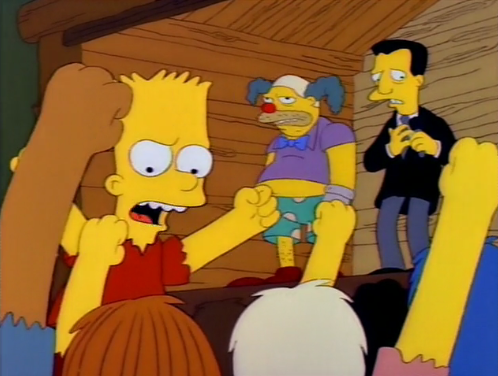
Our September premiere begins on the last day of school, where Bart is, for once, nervous about his impending failing grades, knowing without a C-average, his parents won’t let him go to Kamp Krusty, a summer camp run by his beloved idol. Bart’s nervousness leads to a classic conclusion where Homer lets his son go to the camp anyway regardless of grades (“I didn’t want you hangin’ around all summer anyway,”) making our first act seem all for naught. Anyway, the excitement for camp dissolves immediately when they find Kamp Krusty is truly Hell on Earth: run by the school bullies, the kids sleep in rundown, snake-riddled cabins, live on Krusty Brand Imitation Gruel (9 out of 10 orphans can’t tell the difference), and are forced to stitch fake Gucci wallets for Hong Kong scalpers. It’s a little disconcerting to see the kids in this much despair, but the exaggeration is so high that it remains funny. The best joke in the show depicts the bullies and their boss, Mr. Black, in their luxurious cabin, with celebratory brandy and cigars all around. Black toasts, “Gentlemen, to evil.”

Hovering throughout the show is Bart’s unwavering faith that Krusty will show up and save them, almost like the coming of the Messiah. When Mr. Black tries to pass off a drunken Barney in a cheap costume as the clown himself, that’s the last straw for Bart, and the kids proceed to take over the camp. There’s great side stories running alongside the main plot, featuring Homer and Marge’s love life being better than ever without the kids, and Krusty being obnoxious at Wimbledon, as well as being knighted (even though he’s an American). It’s strange how it still works that Krusty is so horrified by the conditions of the camp, but we’ve seen him approve plenty of clearly malfunctioning and dangerous products with his face on it (regarding the camp, he wails, “They drove a dump truck full of money up to my house! I’m not made of stone!”) Lastly, I will say that these sillier episodes are normally less memorable than ones with more of a emotional punch; I didn’t remember this episode being this funny. But it’s still a classic episode with an enormous bevy of laughs. Welcome, season 4. I’m gonna like you.

Tidbits and Quotes
– Bart’s dream of destroying the school is a classic sequence, with “School’s Out for Summer” playing as Skinner runs about trying to find someone to torch the permanent records.
– Great Homer bits at the breakfast table: his promise to the children (“When you’re 18, you’re out the door!”) and his fatherly advice to Bart (“Son, if you really want something in this life, you have to work for it. Now quiet! They’re about to announce the lottery numbers.”) The first three missed numbers elicits a three “D’oh!”s. He actually gets the fourth number, prompting a “Woo-hoo!” Like it matters at that point he gets one. Last number, no match, and of course, another “D’oh!”
– A bit shocking to say, but Miss Hoover may be less enthusiastic a teacher and sadder a person than Mrs. Krabappel (“I have nothing left to say to any of you, so if nobody minds, let’s just quietly run out the clock.”) I also like that she seems to have given Lisa a B+ in conduct out of sheer spite (“Everyone has a blotch on their permanent record.”) A wigged out Lisa then proceeds to crush her hand for it.
– I love Bart’s attempts to sweeten Mrs. K by telling her all of his textbooks are being returned mint, some in their original wrapping. Edna is not swayed, of course (“Have a D-lightful summer.”)
– Great Kamp Krusty ad, especially with the fat kid turning skinny, and Krusty slapping his cheek. I don’t know if this show invented this gag, the completely shocked and speechless cheek slap, but it does it better than anyone.
– I like even someone as dull as Homer can figure out Bart forged his grades, probably since he probably pulled the same trick with his dad (“You know a D turns into a B so easily. You just got greedy.”) Also his continued good fathering of asking Bart to reach inside the lawnmower blades to recover a roller skate, only to have them fire back up right before his hand is under them.
– Bart and Homer’s mini-war with the pickle at dinner is a great sequence, with a rare moment of pure reverence from Bart to his father (“Always thinking two steps ahead.”)
– I love Homer’s follow-up advice off of Marge’s “Leaves of three, leave them be”: “Leaves of four, eat some more!” Not sure what it means, but I love that Homer amused himself so much with such a stupid expression.
– The Kamp Krusty song is classic, of course, blending its funny lyrics with funny sight gags (particularly the kids running from Mount Avalanche).
– I like this exchange between Bart and Lisa, shivering in their cabins (“I feel like I’m gonna die, Bart.” “We’re all gonna die, Lis.” “I meant soon.” “So did I.”)
– Gotta love the Ben Hur reference where Kearney beats the drums as the kids stitch wallets.
– Barney posing as Krusty is great of course (“I am so Crunchy the Clown!”) as is a panicked Mr. Black yelling at the bullies for not breaking the kids’s spirits (“You broke nothing!”) They worked really hard to abuse these grade schoolers, for reasons that escape me, but dammit, they did their best.
– I want to see more of “Sadrodin Muraradad’s Yoga Party.” That’s it.
– I love Kent Brockman’s opening to his “Krisis at Kamp Krusty” segment (“Ladies and gentleman, I’ve been to Vietnam, Afghanistan, and Iraq, and I can say without hyperbole that this is a million times worse than all of them put together.”)
– We get a glimpse at Krusty’s three identifying body marks: his pacemaker scar, his cattle skull birthmark, and his superfluous third nipple. Of course they’re never seen again when he’s shirtless, except for “Bart the Fink,” where Krusty’s identity needs to be proven once more.
59. Brother, Can You Spare Two Dimes?

(originally aired August 27, 1992)
Herb Powell dug his own grave in “Oh Brother, Where Art Thou?,” but it still felt bad seeing such a great character destroyed like that. The writers apparently thought so too, thus we have a sequel where Herb returns, this time entering the Simpson family’s home turf a disheveled bum. Before we get that far, we have a typical sitcom set-up: discovering our protagonist is sterile, thanks to years of working at the power plant (visualized by seeing his flailing, uncoordinated Homer sperm). Burns’s damage control is to offer Homer a pithy two-thousand dollars in exchange for signing away any right to sue. Homer, for once, isn’t so easy to trick (“I’m not signing anything until I read it, or someone gives me the gist of it.”) Burns explains the form is for him being awarded the First Annual Montgomery Burns Award for Outstanding Achievement in the Field of Excellence, a title he pulls out of his ass on the spot. This snowballs into a giant awards ceremony, an absurd affair with theme music by the Bonita DeWolf and the Nuclear Plant Soft Shoe Society. It’s a ridiculous set piece, but in the most wonderful way possible, complete with Smokin’ Joe Frazier presenting the award (“Webster’s Dictionary defines excellence as ‘the state or condition of being excellent.'”)

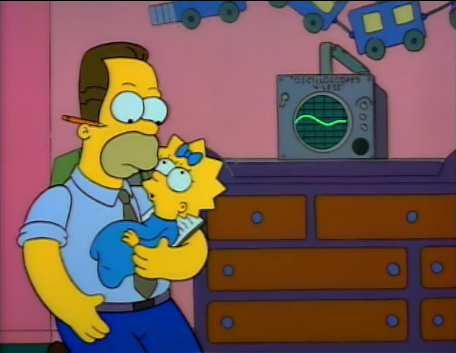
News of Homer’s big cash prize brings Herb to Springfield. The Simpson family are thrilled to see him, but Herb still has reservations toward the half-brother that ruined him. The dynamic between the two brothers is an interesting runner through the episode which I felt could have been explored a little more. In its place is Herb’s new big idea to reinstate his fortune: a baby translator that will interpret baby garbling into coherent English. Somehow, he manages to create an astoundingly sophisticated prototype with only two thousand dollars, doing all the programming and engineering all by himself. The man’s an automobile magnate, but I don’t know how much of a genius the man is in regards to a machine this sophisticated. Plus, this is a landmark invention; you’d think that it would be talked about more later in the series, or at least Marge would have one. There’s lots of questions and concerns connected to this idea, but all of them dissolve thanks to Danny DeVito’s hilarious reading on the baby translations (Lisa covers Maggie’s eyes: “Where did you go?” Lisa exclaims, “Peek-a-boo!” “Oh there you are. Very amusing.”)

Also throughout the episode is Homer’s lament after his beloved couch is destroyed. His fond memories of landmark programs he’s watched lends to a great brief montage, ending with Homer switching off footage of the Berlin Wall collapse to watch Gomer Pyle instead. He toys with using the money to buy a lavish vibrating chair, which at its full power setting puts him into a 2001: A Space Odyssey-style stupor with flashing lights and colors. Herb gets the money instead, with Homer further bemoaning the bitter treatment he receives from him. The end of the episode is sweet with Herb giving each family member a personal gift, with Homer’s gift being his forgiveness for the troubles he’s caused… and getting him the vibrating chair. It’s a great moment where Homer is unsure about hugging his brother (“I’ve never really hugged a man before,”) followed by him wildly kissing him after finding out about the chair. Though not quite as solid as the first Herb episode, this is a fine farewell to the character, with plenty of funny bits and memorable moments.

Tidbits and Quotes
– The plant physical is a great way to start, from Lenny’s nonchalant attitude to being stark naked to Homer eating chicken in the tank (which does… what exactly?)
– Smithers is so efficient that even his sperm swim in lock-step alignment.
– Burns’s tirade against his lawyers seems a bit out of character for him, but I still enjoy the sequence, with him continuously having to restrain himself.
– Burns’s greeting when Homer walks in prior to the settlement is great (“Ah, Simpson, you big virile son of a gun!”)
– Bart and Lisa’s swipe against the Emmys seems very bitter, as this was the season the show first lost the Emmy for “Radio Bart” against a Claymation Easter special. Having watched it later, their anger was pretty justified.
– Herb running aside the train to Springfield and the hazardous railcars is a classic Simpsons gag: toxic waste, no, lion cage, no, Krusty Brand sulfuric acid, no, Emil’s Famous Pillows (“That’s the one!”)
– Having Herb stop at the Flanders house and get cleaned up seems to work to soften the blow to the Simpsons that Herb is really in desperate need of help. It’s also a great sequence, with Todd visibly upset that he is not allowed to anoint the sores on this poor soul’s feet.
– Herb’s advice on being homeless to Bart is probably my favorite quote of the show, and one I try to quote whenever I get the chance (“Discarded pizza boxes are an inexpensive source of cheese.”)
– I love Homer’s one-track mind in his obsession over Herb’s drinking bird. He’s in such awe of it, like it’s the greatest thing he’s ever seen. The bird would make a comeback in a big, bad way later on in “King-Size Homer.”
– Homer’s initial reaction to the baby translator is… not so cordial (“I can’t believe we spent $2,000 on this when right now rollers could be kneading my buttocks!”) Herb retorts, “Homer, would you stop thinking about your ass?!” Homer sadly replies, “I’ll try, but I can’t.”
– First, and only (?), appearance of Professor Frink’s child, and mention of his wife, who I assume divorced him after seemingly killing their baby boy in that plane accident.
– All of Herb’s gifts are great, from Lisa’s Greater Books of Western Civilization (“At last, a copy of Ethan Frome to call my own!”), Bart’s NRA membership (when asked if he can get cyanide-tipped bullets, Herb replies, “It’s in the Constitution, son!”), Maggie, who isn’t picky (“I want what the dog’s eating!”) and Marge, a new washer and dryer, with the old ones sold to do races at Moe’s Tavern (“Stupid dryer!”)

Season 3 Final Thoughts
If season 3 suffers in any regard, it’s that I underestimated the greatness of season 2. It’s astounding watching these again just how perfect those early episodes were, and how they hold up so damn well. That being the case, season 3 felt like more of the same greatness. The one thing I can say is that we saw more of the wackier, crazier elements of the series start to emerge here; from “Homer at the Bat” and stuff like Spinal Tap’s bus exploding, the show began to become more exaggerated and silly, drifting a bit from the more serious, realistic tone it had in the first two seasons. It’s a delicate balance the show would end up servicing: going big and brash for its outlandish gags, but still maintaining a true-to-life tone and emotional core with the Simpson family. I have no worries that season 4 will do just that.

The Best
“Lisa’s Pony,” “Saturdays of Thunder,” “Flaming Moe’s,” “I Married Marge,” “Dog of Death”

The Worst
Not one episode fell short. Some were better than others, of course, but none deserve to be mentioned here.

58. Bart’s Friend Falls In Love

(originally aired May 7, 1992)
As much as a rambunctious rapscallion as Bart is, he’s still very much as vulnerable as the next kid. This episode is able to show him at his lowest point without feeling cloying or sappy, mainly because it mines from a pure realistic source with its story. Here, we see a girl getting in between Bart and Milhouse’s friendship, a young romance story that we can all connect to. The title is not only a very early burn on Milhouse, but refers to the main meat of the story involving Bart’s desperate attempts to hold onto his best friend before he “loses” him, and his eventual extreme measures to getting him back. The girl in question is Samantha Stanky, a timid transfer student with a shy voice and braces. She doesn’t have too much of a personality, but it fits the story, and also how ten-year-old romances aren’t really too deep to begin with. The material she is given is great though, and is still infinitely better than the parade of girlfriends voiced by celebrities Bart would get once a season down the road. Here, Stanky is voiced by Kimmy Robertson, whose biggest credit is being the receptionist on Twin Peaks, and she does a great job in her role here.

Before this prepubescent drama begins, we have a fantastic opening parodying Raiders of the Lost Ark as Bart nabs Homer’s penny jar just as Indy stole the idol. The reference works, and is funny here, as Homer proceeds to take a dual role as the ball rolling after Bart down the stairs and the angry natives as he runs out onto the lawn in his undies (a hilarious, grotesque sight) and screams after his son in gibberish. The cultural reference is given context and meaning within the show’s universe, and is elevated, and thus, is very funny. Later in class, we meet Samantha, and Milhouse is taken with her almost immediately. The two’s affection grows further after watching an educational video, perhaps the best ever shown in the entire series, “Fuzzy Bunny’s Guide to You-Know-What.” Hosted by Troy McClure (of course), it’s a child’s guide to abstinence and true romance and marriage, with an apparently grotesque sex scene (complete with porno music) spliced in. The shot of kids watching this in a darkened classroom, audibly disgusted, with their teacher standing in the back, smoking, commenting, “She’s faking it” is alternately hilarious and disturbing.

As shown in “Homer Defined,” Bart and Milhouse have a co-dependent friendship, since they really only have each other as friends. But this episode is kind of a window to a future that shows that eventually, they will part ways, perhaps due to one falling in love, and Bart is visibly hurt by it. He ends up breaking the two up by exposing the torrid romance to Samantha’s prudish father, who enrolls her in an all-girls school run by Canadian nuns. Bart and Milhouse eventually make up, but not before a brief intense scuffle when Bart reveals the truth. The fight ends when Bart whacks Milhouse in the noggin with a magic 8-ball, which breaks, which is kind of cool since it’s what predicted the dooming of their friendship at the beginning of the episode. This episode has classic film reference bookends as we close Casablanca-style with Bart claiming this is the start of a beautiful friendship. Well, not quite, but it’s basically like that.

Tidbits and Quotes
– Great sequence of Skinner looking over Samantha’s records, only to go in and out of grim Vietnam war recollections, complete with excellent lighting through the blinds and Skinner gripping tightly against his chair arms.
– Samantha’s introduction to the class is really sweet, tinged with nervousness and a general lack of confidence that a kid would have in that situation. Excellent explanation of her move to Springfield: her father owns a home security company, and moved to the town because of its high crime rate and lackluster police force.
– No one but Phil Hartman could have voiced the educational film. The emphasis he gives on certain parts, like “they never ruined their fun by giving into their throbbing biological urges” is just hysterical. Also the line, “Nine months later, Fluffy gave birth to fourteen beautiful bunnies. Eight survived.” Additionally great is the randomness of Fuzzy Bunny being Jewish, crushing a glass at his wedding (with no shoes, I might add. That had to have been painful.)
– A small moment I like is where Bart asks about creating a half-man half-monkey creature. Mrs. K claims would be playing God, which is retorted with the well-delivered line, “God schmod! I want my monkey-man!”
– The B-story involves Lisa’s attempts to have her father lose weight with subliminal message tapes played for him at night, but the company accidentally sends vocabulary building tapes instead. Similar to the swear jar plot in “Bart the Lover,” it’s its own little story divorced from the A-plot that has a lot of great moments, starting with Kent Brockman’s report on obesity (“Did you know that 34 million American adults are obese? Putting together that excess blubber would fill the Grand Canyon two fifths of the way up. That may not sound impressive, but keep in mind it is a very big canyon.”) Lisa imagines her father’s funeral, dead at over 400 pounds and having to be lifted down into his grave in a piano crate. Hearing Homer speak exclusively in college-level vocab is pretty funny, ending with him throwing out the tapes “A pox on thee!”
I like Bart’s answer when Mr. Stanky on the phone asks for his identity (“Let’s just say I’m a concerned prude with a lot of time on his hands.”)
– Of course, the best line of the show comes from a broken Milhouse (“How could this happen? We started out like Romeo and Juliet, but ended up in tragedy.”)

57. The Otto Show

(originally aired April 23, 1992)
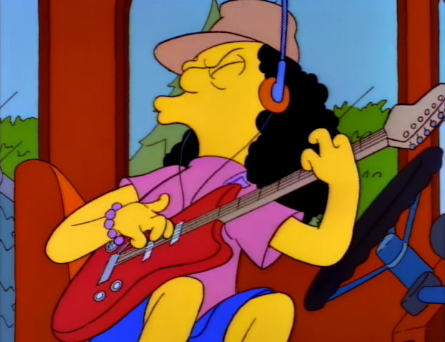
One of the show’s greatest assets is its cast. There is no other series that has such a large number of regularly recurring characters, who are all somewhat developed, and always hilarious and interesting in their own way. There’s so many different kinds of stories and angles you can work with with all these crazy personalities. This is one of the big reasons why it’s so disappointing that in later years, the show became so derivative, repeating old storylines and keeping a hyper-focus on the family, especially Homer. This season, we had episodes about Mrs. Krabappel, Krusty, Moe and a few other minor characters, where we got to see more of their normal lives apart from their interactions with the Simpsons. This time, we get a better look at the sad story of Otto Mann, the school bus driver. This is really his only episode, but I see no reason why he couldn’t have had at least one more. Instead, they keep him in the background until they need to make a drug use joke (most egregiously in the movie. “LOOK WE SHOWED SOMEONE USE A BONG ISN’T THAT GREAT?!”)

Our show opens with Bart and Milhouse attending their first concert, Spinal Tap. It’s kind of an odd choice, but I suppose a fictional band can be real within the confides of a fictional show. When multiple stage malfunctions cause the band to leave early, a riot breaks out, which inspires Bart to want to be a rock star. You may notice none of this has to do with Otto. His story doesn’t really even start until about halfway through. I’ve heard some people cry fowl about earlier episodes structured like this, claiming, “See! Classic episodes had disjointed first acts too!!” Well, this may be correct. This episode doesn’t have the most stream-lined story, but who’s to say they all need to? The show flows perfectly well to me; Bart’s interest in guitar sparks Otto playing on the bus, which causes him to be late, then crash the bus and lose his job, then live with the Simpsons. There’s a natural, realistic flow. Later, we get tire fire fumes melting Springfield’s ice caps to thaw a frozen mailman, giving the family a letter that starts the plot. I can’t think of anything more contrived or ridiculous.

Anyway, Otto isn’t the most interesting of characters, but it’s kind of fun to see him out of his element, lounging about the Simpson house, yearning for a can of corn and books written from the vampire’s point of view. Bart gives up his guitar, which works as a call-back to how the writers never really resolved that story, a comment about how kids, and some adults, start things on a whim and don’t finish, and gives us some great indispensable Homer advice (“If something’s hard to do, then it’s not worth doing.”) The latter half of the episode blends Otto’s story with the Simpsons perfectly, allowing ample time to Homer and Marge’s displeasure over Otto living with them, and then to motivating the burnout to get his license. The resolution of winning over Patty over their mutual distaste of Homer is also set up earlier on. Even without a “complete” twenty-two minute plot, the episode works completely, and gives us a new look at a familiar character. I only wish the show would have kept making episodes like these, instead of homogenizing every side character.

Tidbits and Quotes
– When Homer found the can of Billy Beer in his old jacket, I was waiting for the “We elected the wrong Carter” line, but nope, not this episode. Guess I’ll wait for it later.
– We get our second look at an oddly off-model Comic Book guy hawking T-shirts outside the concert. I don’t even remember at what point he became a regular character… season 5, maybe?
– The Spinal Tap members were really funny, which I guess makes sense since they’re a mock group to begin with. I love their interview with Bill & Marty, talking about how they’re big in Bulgaria, “and what’s-it’s-name, the other -garia” and about how they can’t think of anyone who’s benefited more from the fall of communism (except those who actually lived in those countries). Also great is how irked they get about the stage complications (“This is a rock concert, not a bleedin’… splish-splash show!”) and their outro (“Good night, Springton! There will be no encores!”)
– Kent Brockman’s two cents over the riot is great (“Of course, it would be wrong to suggest this sort of mayhem began with rock-and-roll. After all, there were riots at the premiere of Mozart’s The Magic Flute.. So, what’s the answer? Ban all music? In this reporters opinion, the answer, sadly, is `yes’.”)
– Another weird Bart fantasy where he imagines himself a famous rock star, as well as his washed up druggie future as one. As always, Bart finds these horrifying future visions awesome.
– Otto playing “Free Bird” on the bus is a great moment, complete with the children inexplicably pulling out lighters to hold up.
– An amazing “fuck you” to the gracious guest stars as Otto knocks their tour bus off the road, which flips over and bursts into flames.
– I do like seeing a bit more of Otto, but he’s got to be one of the dumbest characters on the show. It takes real talent to misspell “bus.” I like his complete shock over his landlord claiming he had mustard, and his musings over his new living arrangements (“Dumpster-brand trash bins are top-of-the-line. This is just a Trash-Co waste disposal unit.”)
– Otto living with the Simpsons is filled with lots of great little moments, like Bart’s tape recording pretending to be his mother giving him permission to let Otto stay (which Homer falls for), Homer’s fake Bible verse (“‘Thou shalt not take… moochers into thy… hut”’) and Homer quieting down racket so he can think about important matters (“I want some peanuts.” “That’s better.”)
– I always laugh at Otto’s attempt to do the driver’s test (“‘Alcohol increases your ability to drive.’ …false?! Oh man…”) and his sheer rage over being reminded that Homer called him a sponge that he slams his fists again the walls of the DMV, putting cracks in them. Either that’s some shoddy worksmanship, or Otto has some bizarre super strength.
– It makes no sense, but I love that for no reason, Skinner gets the final line, seeming pleased that Otto is back to work. Perhaps due to that when Skinner drove the bus, he was unable to merge into oncoming traffic? For many, many hours? That’s good enough. It’s a forced happy ending, but it almost seems like it’s making fun of itself, so I think it’s great. At least that’s how I see it.

56. Black Widower

(originally aired April 8, 1992)
I look at Sideshow Bob episodes sort of like Treehouse of Horrors: they usually come around annually, and they’re always a treat (like TOHs, later seasons would screw them up too, but still). Bob is the closest thing the series has to a true villain, and this is really the episode that gave him that title, his return from prison to marry and murder Selma. But this is Bob we’re talking about, so he is completely convincing through the entirety of his scheme. It seems almost too easy for Bob to present himself a reformed model citizen (Lisa comments, “You’re living proof that our revolving door prison system works.”) Kelsey Grammar’s voice works wonders as he narrates his time in prison, and how he turned his life around upon Selma responding to his pen pal letter. Even Krusty seems willing to forgive Bob, in a tearful reunion reminiscent to Dean Martin and Jerry Lewis’s rekindling. Only Bart remains suspect that Bob’s motives are impure.

This episode is full of great moments, a fair share involving Bob’s growing annoyance and impatience awaiting the final culmination of his plan, and having to put up with Selma, a woman on the opposite end of his high-minded spectrum. The best scene is where he cannot contain his sheer contempt of MacGyver, much to Selma’s horror (Grammar’s read of “That was a well-plotted piece of non-claptrap that never made me want to retch” is wonderfully seeped with patronizing sarcasm). As much is done to make Selma particularly repulsive (excessive focus on her hairy legs here), there’s also a sweetness in showing her genuinely happy. The episode is also a unique mystery, in that we know who the killer is, we just don’t know how he’s going to do it. All the pieces fall into place, and Bart manages to figure them out before it’s too late. Super-director David Silverman does a phenomenal job here, with lots of dynamic shots, angles, shadow work; the slow-motion sequence of Selma lighting the match is dripping with tension. The episode balances these moments of humor and real drama perfectly.

I think Simpsons fans can all agree that Sideshow Bob is one of the greatest characters the show has ever known, and by extension, Kelsey Grammar is one of the best guest stars (really only rivaling Phil Hartman, in my mind). Bob has committed many heinous crimes in his time, including multiple attempted murders of our ten-year-old protagonist, but he remains one of the most affable characters in the entire series. Grammar’s smooth, intellectual performance, a voice I could listen to all day, plays a huge part in this, but there’s more to it than that. Bob favors high society, and believes in cultural and mental standards. Most of his criminal activity revolves around his attempts to better society: usurping Krusty’s show to make it more educational, running for public office, eradicating the brain rot of television. “Black Widower” is a peculiar exception, where Bob’s motives of marrying Selma aren’t exactly clear. He wants her money? To what end? I thought about this a while before I watched the episode, then I tried to put it into some perspective. This is Bob’s second outing, and previously, we didn’t see him in a criminal light until the end of the episode. This is the episode that made Bob an actual threat, a true original kind of villain. The plan may be extreme, but future greats like “Cape Feare” and “Sideshow Bob Roberts” wouldn’t work unless we establish Bob for who he is: the most highbrow attempted murderer the Simpsons universe has ever known.

Tidbits and Quotes
– I love when Bob tells Homer’s he’s forgetting the first two noble truths of the Buddha, Homer indignantly responds, “I am not!” Like he’s genuinely offended at the accusation.
– Great Cool Hand Luke reference with the chain gang, and Bob picking up a slew of discarded Krusty shake cups just adds to his seething rage.
– The Daytime Emmy segment is pure genius. First off, the category (Outstanding Performance by a Sidekick in a Children’s Show) is ridiculous. Then the nominees are even more ridiculous: Droopy Drawers, a sad-sack lanky clown who has a very hot date, Colonel Coward, a jittery panicked mess, Pepito the Biggest Cat in the Whole Wide World, Sideshow Bob (live from prison), and Suck-Up the vacuum, who could not attend, as he (it?) is shooting a movie in Spain. That’s like six jokes done just in six seconds reading off those nominees. Even better is Pepito holding his hands over his eyes in shame when he loses. Topped off with Krusty and Bob’s bantered, and the latter’s sedation by guards, and you got yourself a classic Simpsons scene.
– I always love the bit where Bob muses, “In our overcrowded cell, we became little more than beasts…” Cut to the cell in question: “Who used my chapstick?” “I did. Here you go.” Then, in the most disturbed, shuddered voice possible, “I don’t want it.”
– Bob playing violin for the rocking conjugal visit trailers is mildly disturbing, but a brilliant dirty joke.
– A Bob show wouldn’t be complete without having Grammar sing a song, this time karaoke with Selma to “Something Stupid,” which has a wonderful reprise that Bob croons after he believes he’s succeeded with his plot.
– Krusty’s Jerry Lewis-like telethon is a great sequence: the ridiculous relief cause of motion sickness, his response to Bob’s apology for putting him in prison (“Hey, if they ever open the books on this telethon, I’m right back in there!”), his insulting of Sideshow Mel (a visibly hurt Mel watching at home says, “All I can be is myself”), and the great silly animation of Krusty kicking Bob in the ass repeatedly in clownish fashion.
– Bob’s motives are hinted at in a few scenes, which are still funny enough to excuse. He asks Selma if they can afford the wedding (“I’ve already run through eight of the ten dollars they gave me when I left prison.”) Selma assures them they’re fine (“I got money. I bought stock in a mace company just before society crumbled.”)
– Bob’s hatred of MacGyver is the best thing in the show. After their “fight,” he still can’t bring himself to say one nice word about it (“I can’t do it! Even that car chase seemed tacked on!”)
– I love Lisa’s bitterness toward Maggie being made the flower girl over her (“if you want to go for cutesiness instead of competence, fine.”)
– This episode is filled with fantastic animation, by the way, particularly the telethon and Sideshow Bob assaulting the bellhop.
– In the third act, Bob gets progressively more sinister; upon gazing at the fireplace (“Ah, fire. Scourge of Prometheus, toaster of marshmallows… eradicator of deadwood…”) and the scene of covering murderous murmurings as foreign sweet nothings.
– I do like how Bart normally figures out Bob’s plans, showing he’s not a dumb kid, just one who’s not book smart. The sped-up sequence of him repeatedly trying to explain the plan to Homer is hilarious (“I explained it to Mom and we were on our way.”)
– I’m going so long here, there’s just so much great stuff… the Psycho reference at the end with the lightbulb, Selma wanting a separation after almost being murdered, Wiggum begging Bart to explain Bob’s plot, and the reason behind why the room exploded. I guess I’ll end with the immortal ravings of Bob as he’s being hauled off (“I’ll be back! You can’t keep the Democrats out of the White House forever. And when they get in, I’m back on the street! With all of my criminal buddies!”)