125. ‘Round Springfield

(originally aired April 30, 1995)
Bleeding Gums Murphy really does have an iconic presence as an all-time classic character, despite only appearing in two episodes (and the opening titles every week.) He’s this kindred spirit to Lisa, a mentor in the ways of music and life. Though being voiced by guest star Ron Taylor probably hindered it, I wish we had seen him a few more times before now, his grand reintroduction… where they kill him off. Well, we do get an interesting look of Murphy’s life before he goes, his days working in jazz clubs, his big break performing on The Tonight Show with Steve Allen, and his only produced record, “Sax on the Beach.” Lisa is fittingly thrilled to have her mentor back in her life again, and even though we only get a few scenes with them, the level of connection really gets across between the two characters. Lisa sees Murphy as her musical idol, and a family-less Murphy is touched to have a fan. Even to someone as learned as Lisa, death hits hard, and with someone as important to her as Murphy, she’s absolutely crushed. Yeardley Smith deliver a powerhouse performance here, wringing every bit of emotion she can from her scenes. There’s something about Lisa crying that immediately garners the utmost sympathy.

We also have our B-story, where Bart accidentally swallows a jagged metal cereal prize from a box of Krusty O’s and gets a meager cash settlement from Lionel Hutz for his troubles. I’m a little conflicted as to how this sillier story meshes with the tone of the main one, but they mainly stay separated. It’s most of the first act which leads us to Lisa reuniting with Murphy in the hospital, with the plot line dropped following his death, up until Bart gets the check, which leads to the sweet moment where he buys Murphy’s album for Lisa (reasoning that she was the only one who spoke up for Bart at the breakfast table when he first got hurt.) I more have a problem with some of the jokes taking place within the serious storylines, like both instances of the hot dog vendor showing up. First Homer acts incredibly cavalier at Bart’s operation, then the hot dog guy shows up, which feels wrong given the situation, which is the point, I guess, but still didn’t sit right. Then we have the second act break with the hot dog guy at the cemetery. It’s almost like they felt nervous to maintain the serious tone, when you can just as well get your jokes from the story itself (Lovejoy misreading the eulogy is funny, and fits to inspire Lisa to maintain Murphy’s legacy.)

Despite a few off-tone jokes, the episode maintains its meditative tone with each family member attempting to help Lisa with her grief, all within character. Homer starts off strong, until he completely blows it (“All we have to do is go down to the pound and get a new jazzman,”) Marge tries her best to remain supportive, and Bart reveals his theories of reincarnation, and wanting to come back as a butterfly (“Because nobody ever suspects the butterfly.”) As mentioned, he gets Murphy’s album for Lisa to play on the local jazz station, which gets its signal amplified thanks to divine intervention zapping the radio tower. The final scene between Lisa and cloud-force-ghost Murphy is incredibly touching, and we get a great play-off for the character in “Jazzman,” which is well performed by Smith. This is another episode that I saw in reruns a lot, but as many times as I saw it, I’d never turn it off. It may not be the funniest, but it’s got a lot of heart, and I really enjoy it.

Tidbits and Quotes
– Great bit of Krusty’s show, who seems to be having a particularly bad set, thanks to a new court-ordered sidekick, Ms. No-Means-No, in response to his sexual harassment suit. He’s quickly ganged up on by her and Sideshow Mel, and tries to defend himself (“It wasn’t my fault, it was the Percodan. If you ask me, that stuff rots your brain. And now a word from our new sponsor… Percodan?! Aw, crap!”)
– Bart claims he’s all set for his history test. Marge tests him (“Who was George Washington Carver?” “Umm… the guy who chopped up George Washington?”)
– I like how abjectly cruel Krabappel is toward Bart here (partially warranted thanks to the many pranks he’s pulled), bringing his attention to the school charter (“”No teacher shall be held accountable if Bart Simpson dies,”) and the great scene where she hums and buffs her nails for an extended period before letting Bart be excused.
– Second appearance of Lunchlady Doris as nurse, who can only offer Bart chewable Prozac for kids, either Manic Depressive Mouse, or the Bluebird of Unhappiness. I also love the animated bit where an unconscious Bart is motionless, save a single leg twitch.
– Quick, classic scene of Willie teaching French. His line “Bonjoooooouur, yah cheese-eating surrender monkeys!” strangely got new life at the advent of the Iraq War when France opposed America’s military efforts. It’s even got its own Wikipedia page, for God’s sake.
– I love love love Bart’s mooning bit (“Hello, I’m Dr. Cheeks. I’m doing my rounds, and, uh, I’m a little behind”) and the timing of it as the act break.
– Hibbert seems to have a lot of estranged relatives: first the orphanage director, now Bleeding Gums Murphy. I love how they both wax nostalgic about their brothers who match each other’s descriptions perfectly… and nothing comes of it.
– More great timing with Blind Willie Witherspoon, who after thirty years of a stalled jazz career, gives Murphy his old saxophone… which is actually an umbrella. Willie asks why no one told him, Murphy says they all thought it was funny, and laughs. Quick beat. Unamused, Willie responds, “That’s not funny.”
Brilliant performance by Dan Castellaneta as Bill Cosby in an episode of The Cosby Show guest-starring Murphy (“You see, the kids, they listen to the rap music which gives them the brain damage. With their hippin’, and the hoppin’, and the bippin’, and the boppin’, so they don’t know what the jazz… is all about! You see, jazz is like the Jello Pudding Pop… no, actually, it’s more like Kodak film… no, actually, jazz is like the New Coke: it’ll be around forever, heh heh heh.”)
– Krusty really is a corrupt businessman; at a press conference, he contends “those tourists were decapitated before they entered the KrustyLand House of Knives.” Also, why the hell would a jagged piece of metal be a cereal box prize, unwrapped, inside the box of cereal? It’s the dumbest thing ever, but we get the great scene where Krusty stumbles and writhes in pain after eating what he’s later told is just a regular Krusty-O (“It’s poison…”)
– I like how Murphy gives Lisa his saxophone, like he knows he doesn’t have much time left and bestows his prized possession to someone he knows will use it well.
– We have another unflinching, uncaring Springfield mob who’s quick to violently boo the performance of three eight-year-olds five seconds into their musical performance (even Grampa yells, “This sucks!”) Of course the crowd quickly turns to cheers when Lisa does a great solo piece.
– More great advice from Homer: get a tattoo to preserve the memory of a loved one. He then notices his own and is less than pleased (“Starland Vocal Band? They suck!!”)
– Great bit with Hans Moleman as the K-JAZZ morning man (“Hello. This is Moleman in the morning. Good Moleman to you. Today, part four of our series of the agonizing pain in which I live every daaaaaayy.”)
– Nice bit with Comic Book Guy who is quick to raise the price on Murphy’s record upon hearing of his death. I also like his immediate suggestion on how to blow Bart’s money: the Ultimate POG! Complete with Steve Allen’s face on it. Not only the most worthless purchase one could make, but a nice call-back to the previous scene with Allen.
– The humorous bits in the end scene weave themselves in and don’t feel intrusive. Murphy appearing in the clouds apes off of The Lion King, so we see Mufasa pop up (“You must avenge my death, Kimba… I mean, Simba,” a great reference to the Kimba the White Lion controversy,) then Darth Vader, then James Earl Jones himself as the CNN announcer. Murphy tells the others to get lost. Then we have “Jazzman” over the credits, a great way to end, with a great final joke (“One more time!” “Oh, come on, Lisa! I got a date with Billie Holiday!”)
124. The PTA Disbands

(originally aired April 16, 1995)
It’s interesting to see how well the social commentary of these episodes has held up after all these years. And by interesting, I mean frightening. Though exaggerated to comic effect, Springfield Elementary still looks like your typical underfunded school with its long outdated textbooks and poor cafeteria options (“There’s very little meat in these gym mats.”) Even the typically apathetic Mrs. Krabappel has had enough, following a particularly disastrous (and hilarious) field trip on a pitiful shoestring budget. So the inevitable happens: the teachers go on strike, leaving the kids to fend for themselves. This is another one of those freeform episodes that’s pretty loose on plot, with the second act largely focused on Bart and Lisa. Bart, of course, couldn’t be more thrilled to be free, spending his days pulling pranks about the town. More interesting is Lisa, who without a structured learning environment begins to unravel at the seams.

With no reconciliation between Skinner and the teachers in sight, PTA head Ned Flanders proposes townspeople fill the roles as substitutes, which gives us many classic moments from Professor Frink teaching complex equations to preschoolers utilizing a children’s toy (“No, you can’t play with it; you won’t enjoy it on as many levels as I do!”), Moe’s self-consciousness about his “big ears,” of all things, and of course Jasper (“Talking out of turn… that’s a paddlin’. Looking out the window… that’s a paddlin’. Staring at my sandals… that’s a paddlin’. Paddling the school canoe… ooh, you better believe that’s a paddlin’.”) Bart runs all the teachers out of class until he meets his match: his mother. This reveal is at the second act break, but there’s not really much further this story could have gone. It really serves as the final straw for Bart of all people wanting Skinner and Krabappel to reconcile.

The very ending feels like a last ditch effort, like the writers sat around a table for hours and hours trying to come up with a suitable ending, and this is what they landed on: the school gets extra revenue by co-oping with the local prison. It’s kind of amusing… I guess, but feels like a kind of bizarre and out-of-left-field conclusion to the story. I dunno, just didn’t gel for me. This episode feels pretty thin, but it’s got plenty of great bits and laughs to keep it going the whole way through. …hmm. I appear to have ended early. Look at that.

Tidbits and Quotes
– I like the fake-out where we see the fate of the old bus, which is even more dilapidated than the current one, propped up on cider blocks resting in the school parking lot. A single leaf begins to fall, seemingly to knock it off the blocks and topple over or something. Instead, it immediately bursts into flames upon impact. Like entirely engulfed in flames. And another great fake-out with the tour guide talking about the old war cannon being very sensitive as the bus with no brakes careens over and taps it… and nothing happens (“Of course, for safety reasons, we don’t keep the cannon loaded. It’s just common sense.”)
– I love the well-funded school from Shelbyville and its chrome, double-decker bus, and the debonair Principal Valiant, whom Skinner resents (“He thinks he’s so hot ever since he swept the Princy Awards. Those things are rigged.”)
– Great line from Otto, who’s stuck manually siphoning gas for the bus (“Damn! I shouldn’t have eaten the mint first.”) The students barely make their escape, save Uter, who is beaten mercilessly by Civil War re-enactors. Skinner isn’t too dismayed (“God bless the man who invented permission slips.”)
– Great moment where Skinner loudly tells Krabappel the children have no futures in the crowded cafeteria. When a deafening silence results, Skinner attempts to cover himself (“Prove me wrong, kids! Prove me wrong!”)
– The (almost) act break with the little girl stuck on the gymnasium rings is fantastic. Having seen this one many times in syndication, that’s when it usually ends. How surprised I was seeing it on DVD there’s another scene where the music class can now play the forbidden music: “Pop Goes the Weasel.” …yeah, not the most devastating syndication cut.
– Great bit with Bart messing around with workers at a construction site, then revealed they only obeyed because the foreman strangely has the exact same voice (“Hey! Can’t you tell my voice from a ten-year-old kid’s? Aye carumba!”)
– Classic Homer line in response to the strike (“If you don’t like your job, you don’t strike: you just go in every day and do it really half-assed. That’s the American way.”)
– Lisa starts to crack (“Relax? I can’t relax! Nor can I yield, relent, or… only two synonyms? Oh my God, I’m losing my perspicacity!”) She runs off screaming, and Homer observes, “It’s always the last place you look.”)
– The teacher strike signs are hilarious (“A is for apple, B is for raise”) Hoover’s is more blunt (“Gimme! Gimme! Gimme!”) and I also like how cold she is toward Lisa (“Get away from me.”) Bart attempts to prolong the strike, passing on a message via telephone, which hilariously gets through perfectly with one small addition (“Skinner said the teachers will crack any minute purple monkey dishwasher.”) Krabappel responds in kind (“Well! We’ll show him, especially for that ‘purple monkey dishwasher’ remark.”)
– My favorite scene in the episode is probably Bart wrecking havoc at the bank, spreading rumor that they only have money for the next three customers. A Jimmy Stewart-type bank manager attempts to calm the crowd by passing the buck (“I don’t have your money here. It’s at Bill’s house! Or at Fred’s house!”) An angry Moe turns to the guy next to him and yells, “What the hell you doing with my money in your house, Fred?!” and punches him out. A fight ensues, and Bart is pleased.
– Homer displays some of his fleeting moments of intelligence being baffled by Lisa’s perpetual motion machine. He calls Lisa in to chastise her (“In this house, we obey the laws of thermodynamics!”)
– Great scene of ad-libbing actors as Krabappel and Skinner go back and forth to sway over the crowd of parents: the well-being of their children vs. taxes. Eventually it’s reduced to Krabappel’s “C’mon!” and Skinner rubbing his fingers together, resulting in a great ad-lib from Dan Castellaneta (“The finger thing means the taxes!”)
– Second and last appearance from Leopold, who basically serves the exact same purpose as he did in “Sweet Seymour Skinner’s Baadassss Song.”
– I love how Bart’s “prank” of rigging a gigantic wooden pole to swing forth at the substitute is both preposterous in that no one noticed it set up above the classroom, and it seemingly would have crushed the skull and killed whoever was sitting at the teacher’s desk.
– Marge is exhausted after her first day teaching (“It took the children forty minutes to locate Canada on the map.”) Homer responds, “Marge, anyone can miss Canada, all tucked away down there.”

123. Two Dozen and One Greyhounds

(originally aired April 9, 1995)
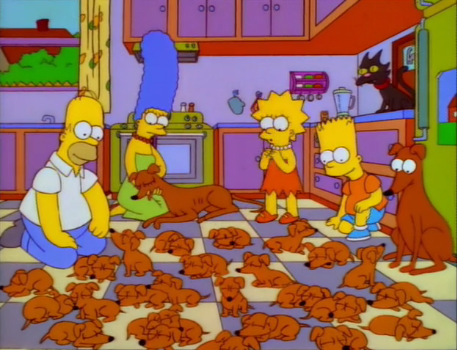
This is another one of those episodes I’m finding it hard to analyze, because it’s another of those “a bunch of stuff that happened” shows. No consistent theme or message, just good, crazy Simpsons fun. The clean, wholesome fun begins with the family dog eager to get his hump on, and he manages to do so escaping back to the dog track, mating with a female dog mid-race. And that’s just the first act! It’s a nice nod to the first episode that Santa’s Little Helper’s new lady, She’s the Fastest, took his “No. 8” title at the track. Rampant doggie sex leads to the inevitable: She’s gets pregnant, and has a litter of twenty-five little puppies. The greatest stuff here is, as is the case with similar depictions in the past, the animal behavior is all very realistic. The very conceit is animalistic in itself: these two dogs are in heat and just need to screw. I also love the look of the puppies, who when first born can barely open their eyes and are very docile, and their dumb little expressions as the episode goes on makes them very adorable.

Living with two dozen and one little mongrels takes its toll on the family, leaving them with having to make the hard decision to give them away. But no one seems to be willing to take up so many pups… except Mr. Burns, who of course has an evil scheme: slay them to make a furry tuxedo for himself. Rather monstrous of him, making his character completely unlikable and irredeemable, yes? Not unless he’s got a catchy song to go with it. “See My Vest” has got to be in the top 3 songs of the whole series, such a rousing, upbeat number to contrast the horrific animal abuse theme. They say you can make your villain likable if he’s an affable showman, and boy does Burns go all out in this number. That and a lot of it is just silly (“Try my red robin suit, it comes one breast or two!”) Also, this show seems to have a Disney reference trifecta. “See My Vest” is obviously a riff on “Be Our Guest” from Beauty & The Beast. We have the great Lady & The Tramp reference where rather than pull away bashfully when the two dogs meet for a kiss with spaghetti, they viciously fight over it. Then the main thrust of the story is pure One Hundred and One Dalmatians, along with other references like the puppies in front of the TV.

The final showdown between Burns and Bart and Lisa is pretty insane. I really don’t know what to make of it. We set up that Burns has grown a liking to one particular puppy who can stand on its hind legs (a regular Rory Calhoun), so Bart saves the dogs by manipulating them all to stand up. It feels so obvious and contrived, but it’s saved by Burns’s dialogue blatantly stating the fact that it’s so obvious (“This can’t be happening! They’re all standing. I can’t tell them apart!”) Then he decides he’s just going to kill them all, which he pulls back from doing. Then he decides he’s going to kill the children, which he also pulls back from. All of this is so stupid, but I feel like it’s so self-aware so it’s funny. And then the very ending is the biggest, greatest cheat in the entire series, where it looks like Homer’s hung himself, but of course, he hasn’t (“Marge, you know that batting this lightbulb is the only thing that cheers me up after giving away those million-dollar greyhounds!”) It’s a dumb ending to a dumb, lovable show.

Tidbits and Quotes
– The bit where Bart and Lisa play ball with SLH to try and tire him out is really cute, the two kids playfully taunting the dog, then the time lapses of the two getting increasingly exhausted when the dog has lost no energy.
– SLH wrecks havoc in the backyard, ripping up underground wires. Homer is aghast (“Oh my God! He’s got the precious cable TV cable!”) The aerial shot of the dog running down the block with the straight lines of the cable ripping out of each house is extremely well animated. The Wiggums are in bed when the TV goes out (“Your cable TV is experiencing difficulties. Please, do not panic. Resist the temptation to read or talk to loved ones. Do not attempt sexual relations, as years of TV radiation have left your genitals withered and useless.”) Clancy looks under the covers and confirms this.
– I love the bit with the pet shop clerk and his “mind-meld” (“It’s an incredibly rare psychic power possessed only by me and three other clerks at this store.”)
– Great names on the other dogs at the track: She’s the Fastest leads, followed by Always Comes in Second and I’m Number Three.
– Brilliant staging on how SLH chases after Fastest… then raises up in frame a bit… and is in prime humping position. Homer clarifies the situation (“So that’s what’s been wrong with the little fellow: he misses casual sex.”)
– I like Bart seizing the opportunity to properly use the word “bitch,” kind of like him continually saying “hell” out of Sunday School. When he defends that it’s the proper terminology for a female dog, Marge retorts, “Well, I’m going to write the dictionary people and have that checked. Feels like a mistake to me.”
– Great fake-out after twenty-four puppies are born, we get a long time lapse until finally… a twenty-fifth is born. And great timing with placing the last puppy in an oven mitt attached to the fridge by magnet, which slowly falls to the floor.
– There are a few funny bits with Snowball II, first at the start of the second act where it can’t believe its eyes and bats the catnip away. Then later the family is enamored by one of the puppies pawing at the TV, but not so much when Snowball does it (“Get that cat out of the way!!“)
– Hilarious sequence with the puppies continually eating Homer’s chips. I could watch that on loop all day.
– The sitcom riff sequence of the very important people coming to dinner which gets sabotaged is pretty good, but it almost feels like too much. I do love Lovejoy’s outro line though (“See you in hell! ….from heaven.”)
– As shoddy as it is, I love the questionable staging at the second act break. Homer, Marge and Lisa are clearly standing right next to the box of puppies, then next shot they’re a considerable distance facing the house as Burns puts them all in a sack. Makes no sense, but that’s kind of the point.
– I love how Wiggum is beyond incompetent on finding the puppies. He peeks under a napkin and inside the blender (“I’m sorry, kids, I don’t think we’re ever going to find your greyhounds. Maybe Mr. Burns will sell you one of the twenty-five he got last night.”)
– Great bit with the eternally turning door knob, which eventually just turns all the way around to build the suspense.
– I like how Burns’s taunt (“Here’s a phone. Call someone who cares!”) backfires immediately when Lisa dials 911, so he yanks the phone out of her hand.

122. Lisa’s Wedding

(originally aired March 26, 1995)
As with all cartoons, the Simpsons don’t age, and it’s perfect that way. If studio executives could place its sitcom actors in a time-stasis field to prevent them from getting older, don’t you think they’d do it? The status quo can be retained forever. But then that raises the question: what does the future hold for our characters? On one hand it could lead to some interesting stories, but on the other, perhaps things are best left to our imagination. Considering how well we know these characters at this point, we can all speculate as to what they’ll be up to years down the road. It’s a tricky tight rope that “Lisa’s Wedding” must traverse, but ultimately it manages to depict a believable future that shows a lot more than it tells, gives us glimpses of a latter-day Springfield and allowing us many opportunities to fill in the blanks for ourselves. On top of that (and having a lot of laughs, of course), it ends up becoming one of the most emotional episodes of the entire series. It set the bar pretty high for anyone foolish enough to do another future episode down the road (more on that train wreck later down the road…)

The first problem is how do we segue into the future story? Attending the local Renaissance Fair, Lisa chases an escaped bunny (Esquilax) into the deep dark woods and encounters a mysterious fortune teller, who spins a tale of her future true love. I think it works very well, almost reminiscent of Alice chasing the White Rabbit into another reality. Future Lisa has an antagonistic meet-cute with proper Brit Hugh Parkfield, a learned, distinguished gentleman with a shared love of the environment and Jim Carrey movies. He works perfectly as the sort of intellectual man Lisa would have an affection toward, and as a great foil to the Simpson family, who remain as low-rent as ever. A balder, more bloated Homer is still rocking the same console at the power plant, a more grizzled Bart is working in construction, and teenage Maggie is apparently quite the talker and singer (though, brilliantly, she’s always cut off from speaking.) The glimpses we get at other characters range from the logical (Otto owning a cab company, with a downtrodden Quimby as chauffeur) to the hilariously bizarre (Martin as the Phantom of the Elementary School), and the setting of the future is a blend of fantasy Jetsons material like flying cars, and logical progressions like technology going digital with picture phones and LED clocks (the blinking display of Big Ben proves that human incompetence will still exist with ever-progressing technology.)

Hugh comes to Springfield to meet the Simpsons, and Lisa is terrified of how he’ll react to them. What’s great here is that the Simpsons are not overly wacky or over-the-top, they’re still genuine characters. Homer takes Hugh out to Moe’s and bestows onto him a family tradition: kitschy pig cuff links. Later at the wedding, we see Homer give perhaps his most coherent and impassioned speech on how proud he is of Lisa, which like all great emotional Simpsons moments, is beautiful and humorous at the same time. It’s got to be in the top 3 emotional moments of the series. The cuff links appear to be the deal breaker; Homer found them on Hugh’s night stand, and while I think latter-day Homer would stupidly think he forgot them and make a huge scene, Homer reacts with a muted humility (“Guess they weren’t his cup of tea.”) Lisa confronts Hugh about it, who openly admits that he wants nothing to do with her family, leading to a great back-and-forth where Lisa admits that despite their foibles, she still loves her family, and can’t be with someone who doesn’t feel the same. This leads to our final bit after the story, where Lisa is glad to run back into her father at the fair and hear about his boorish exploits. There’s really just so much to love about this episode. It’s a wonderful and satisfying representation of a potential future for our characters, still not much further from where they were, but happy all the same. Despite her intellect and ambition, Lisa knows she’s still a Simpson, and what that means to her. I could go on, but then I’d be babbling. God, I love this episode. We’ve had two future episodes since then, one horrendous, one average, but really, what episode could beat this one? None of them. That’s the answer.

Tidbits and Quotes
– Great bit on the misleading cards: the “Death” card is positive, meaning transition and change, but God help you if you get the “Happy Squirrel.”
– Pigeonholing one’s self in the past as this show has is fine, since I view the series as having a floating timeline, but not so good for doing it in the future. To be fair, I don’t think any of the writers could have possibly imagined this show would still be running in 2010.
– I like how for the most part, the future gags are really more suppositions of what the future could actually hold, from the hologram tree in remembrance of actual plant life, digital clocks replacing analog, Jim Carrey films being labeled as classics (which kind of has happened), and the Rolling Stones still being on tour (true, except for the wheelchair part.)
– Very appropriate that Hugh describes himself and Lisa as “utterly humorless” in their humanitarian efforts. Oh, and great name of their dormitory, “Dr. and Mrs. Dre Hall.”
– I love the scene at Parkfield Manor where Lisa worriedly ponders how to respond to what may or may not be Mr. Parkfield’s dry British wit. She lands on a quieted nervous laugh (hilariously done by Yeardley Smith), to which Parkfield responds, “Oh, it’s good to hear a boisterous American laugh!”
– Classic bit where Hugh’s electronic, overly wordy proposal sign malfunctions, leading to Plan B: someone shoves a cow from behind a bush with a “Marry Me” sign.
– I haven’t even mentioned the future character designs, which are really fabulous. Lisa with her stylishly pointed hair, Marge with slightly grayer blue hair, Bart sporting a beard line like his father, and Homer who is stouter with only one hair on his head and the one wrapping around thinning. Teenage Maggie is a great design too. I also love Nancy Cartwright’s older Bart voice, something she seemed to have forgotten about in the next future episode.
– I like Marge’s fake-out (“If only your father were still with us… but he left for work a few minutes ago”) and her forgetting she’s on a picture phone.
– At the plant, we see Lenny and Carl in management positions, and Milhouse now being Homer’s supervisor. This gives us a great scene of his past romantic failure with Lisa and his taking it out on Homer (“I think I’ll write your performance evaluation now, Simpson!”) I like how when he leaves, Homer tints his fingers with a big grin, hopeful of how it will turn out, none the wiser.
– I like how well Homer takes being court ordered from planning Lisa’s wedding (“Well, these seem to be in order. I’ll be out back in the hammock.”)
– Great look at the future of school systems, once again not far off from the reality: grossly overcrowded (triple decker desks) with a corporate sponsored curriculum (“If you have three Pepsis and drink one, how much more refreshed are you? You, the redhead in the Chicago school system?” “Pepsi?” “Partial credit!”)
– The British flag catching fire by accident is a great act break, but come on, what’s a bug zapper doing that high up a tree?
– The adapted Simpson house is fantastic, with Homer’s shoddy building additions (“If the building inspector comes by, it’s not a room, it’s a window box.”) Hugh quickly becomes victim of shoddy workmanship as he falls through the floor (“Fortunately, the compost heap broke my fall. Be a dear, run a bath.”)
– Adult Bart describes his station in life (“Hugh, there’s more to my life than just the wrecking ball: I also crush cars into cubes. And on the side, I promote local tough man contests. Basically, I’m getting out all my aggression ’till I go to law school.”) I love how he’s wearing a wife beater, and his punked-out Krusty tattoo, which is such a wonderful small detail.
– Marge and Lisa giggling on how Lisa can wear white because Milhouse “doesn’t count” is a delightfully dirty joke, but shockingly, only the second dirtiest joke regarding white dress virginity in a cartoon (that crown goes to The Critic: young debutante Margo agrees to wear white-white… except for the gloves.)
– I like the moment with Bart and Lisa at the wedding, which starts out sweet, and quickly deflates when discussions of a bachelor party comes up (“We had one in his honor. …I had one in his honor. …I went to a strip club.”)
– Great scene where Hugh prepares for the worst when Homer meets his parents. Homer attempts to cut through the awkwardness (“You know what’s great about you English? Octopussy. Man, I must have seen that movie… twice!”) Hugh concedes that’s probably the best he could have hoped for.
– Slight oops having Maude Flanders at the wedding. Maybe she was… umm… yeah, I got nothing. Also suspect why Mrs. Krabappel, Smithers and Burns and others are at Lisa’s wedding, but I don’t care much since it’s fun to see them.
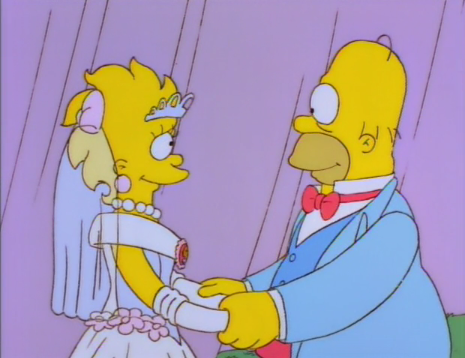
– Homer’s speech is so beautiful, I’m just gonna write it out in full (“Little Lisa, Lisa Simpson. You know, I always felt you were the best thing my name ever got attached to. Since the time you learned to pin your own diapers, you’ve been smarter than me. I just want you to know I’ve always been proud of you. You’re my greatest accomplishment and you did it all yourself. You helped me understand my own wife better and taught me to be a better person, but you’re also my daughter, and I don’t think anybody could have had a better daughter than-” “Dad, you’re babbling.” “See? You’re still helping me.”)
– I like how Hugh’s admissions to Lisa, and attempts to smooth things over, just digs him in a deeper and deeper hole (“I’ve attempted to enjoy your family on a personal level, on an ironic level, as a novelty, as camp, as kitsch, as cautionary example… nothing works.”) Lisa asks if she’ll never see her family again, Hugh tactlessly responds, “Possibly your mother will come when the children are born.”
– Lovejoy is quite petty when the wedding is called off (“This is very sad news, and it never would have happened if the wedding had been inside the church with God instead of out here in the cheap showiness of nature.”)
– Great outro to the fortune teller; when Lisa questions the story, being set up that it would be about her true love, the teller responds, “Oh, you’ll have a true love, but I specialize in foretelling the relationships where you get jerked around.” She gives a maniacal laugh, disappearing into a puff of smoke… but then she’s still there. Lisa backs away slowly from the crazy person and back to the fair. The Renaissance ending theme music is lovely as well.

121. A Star is Burns

(originally aired March 5, 1995)
I remember as a kid, I thought Jay Sherman was a real person. Considering the huge amount of celebrity guests on The Simpsons, I just assumed Jay was another one of them. It wasn’t until later in middle school I saw The Critic late night on Comedy Central and discovered he was merely a refugee from another show. The story with this episode was The Critic was starting its second season on FOX, premiering right after The Simpsons, and James L. Brooks proposed this crossover episode to help launch the show. Matt Groening was upset at this for sorted reasons, mainly that he felt the crossover defied the rules of the Simpsons universe, and that he felt fans would be upset that the episode would basically be one big commercial for The Critic (which ultimately, it kind of was.) Whether he didn’t want to raise a big stink about it, or he just had no real power to halt production of this episode, he chose to just remove his name from the credits, the only Groening-less episode to date. Now, The Critic is an absolutely fabulous show in its own right, and the idea of a crossover doesn’t feel too alien a concept. I think this episode works perfectly well as a Simpsons episode, just featuring a character from another show.

How do you bring Jay Sherman to Springfield? Host a local film festival and invite him as a judge, obviously. It’s a fair enough premise, paired with Homer feeling undermined in his own house by an intellectual Jay. Even with an acknowledged nod to the cheap nature of the crossover (“I really love your show. I think all kids should watch it! Eww… I suddenly feel so dirty,”) the show is pretty unremarkable up until the middle mark, where Burns attempts to submit a movie to improve his heinous image. The result is an absurd fluff piece, aping off classic films like E.T. and Ben Hur to elevate Burns to sainthood. The prize film of the night comes from Barney, an incredibly heartfelt and artfully produced film of his alcohol-induced sorrows. With it getting Marge and Jay’s vote, and Quimby and Krusty paid off by Burns, it’s up to Homer to break the tie. He, however, is enthralled by another film, Hans Moleman’s “Man Getting Hit By Football,” whose name pretty aptly reflects the content.

The various films from our beloved Springfieldians are pretty much the only thing of note here, but they’re so strong that they make up for any slack the episode might have carried. There are other select funny bits, but overall, it’s not quite a strong Simpsons episode, perhaps because it had to cater to its specific purpose of promoting The Critic. Was it a bit shameless? Yeah, maybe. But Jon Lovitz had done so many voices on the show, Jay just feels like another one of them, so it’s not so jarring to see him here. And how could I be completely down at an episode that gave us George C. Scott getting hit in the crotch by a football? It’s a pretty fine show. So is The Critic. You should watch that. Like, right now, go watch it. I’ll be here when you get back.

Tidbits and Quotes
Simpsons characters and references popped up on The Critic from time to time. My favorite is probably when a low-brow family switches off Jay spouting intellectual platitudes in favor of Homer stepping on a rake and saying “D’oh!” (“Now this I understand.”) I can’t find that clip though, but here’s another good one.
– I like the Eye on Springfield opening. It’s reused footage with new bits sprinkled in, but it feels like something a local news station would do, cycling in new clips with the old. The new bits are really great: Brockman in the winning locker room getting dumped with Gatorade… then with cement, and Krusty leading hoards of wild animals into Krusty Burger, presumably to slaughter.
– I love Krusty performing as FDR. Not only does he get out of the wheelchair, but he’s still in full clown make-up as always. What kind of a production is this?
– The scene with Ned’s movie gone awry with Todd getting caught up down stream is pretty crazy as is before God takes a literal hand in saving the child, giving Ned an A-OK sign from the heavens and a cordial “Okily-dokily!”
– The “Coming Attractions” segment really does feel straight out of The Critic, almost as if Rainier Wolfcastle was a guest on his show. “McBain: Let’s Get Silly” looks like a fantastic film (“The film is just me in front of a brick wall for an hour and a half. It cost eighty million dollars.”) Rainier later confronts Jay on slyly insulting him on the show, only to be tricked into believing his shoes are untied as Jay makes his escape (“On closer inspection, these are loafers.”)
– It’s really really dumb, but I always laugh at Homer erasing and re-writing “Simpson” over and over at the airport.
– Once Burns gets in the episode, the jokes really kick in: his response to market research showing people see him as an ogre (“I ought to club them and eat their bones!”), his liking toward the idea of making a film (“A slick Hollywood picture to gloss over my evil rise to power like Bugsy or Working Girl,”) and of course Steven Spielberg’s non-union Mexican equivalent, Señor Spielbergo.
– What more can be said about “Man Getting Hit By Football”? It’s perfect: the title card and jangly piano intro feels like something someone as old as Moleman would include, and the premise itself is like an old slapstick bit. Homer’s over-reaction is priceless of course, reminiscent of the similar incident in “Homer Goes to College” (“The ball! His groin! It works on so many levels!”)
– Smithers does damage control when everyone boos Burns’s film: they’re actually saying “Boo-urns.” Burns consults the crowd about it, who then boos him further. Hans, however, was saying “Boo-urns.”
– Great newspaper headline (“Incontinent Old Man Wins Miss Teen America”) with an equally disturbing picture.
– Hilarious reading from Krusty when asked why he voted for Burns’s movie (“Let’s just say it moved me… to a bigger house! Oops, I said the quiet part loud and the loud part quiet.”)
– Homer watches Barney’s film a second time to give it another chance, and is so moved by it he vows not to ever drink again. Then of course, a man walks by selling beer and he takes ten. Very easy joke. Why was he there in the first place when Homer was having a private screening? Then we get basically the same joke later when Barney wins and vows to be sober, and the prize is a life supply of Duff. The reading of “Just hook it to my veeiiiins!” saves it though.
– Minor stupid quibble: Itchy & Scratchy wins for best animated short, but this was a film festival for local residents. Why would a studio production be eligible?
– Really great biting goodbye when Jay starts to propose if the Simpsons ever want to come on his show, Bart cuts him off (“Nah, we’re not going to be doing that.”)