139. Marge Be Not Proud

(originally aired December 17, 1995)
Six years following the first Christmas episode, now we get our second: a show with an Aesop-heavy vibe, but it never gets too seeped in unearned sentimentality. Bart is hell bent on getting the new Bonestorm video game, but Marge believes it’s too violent. Out of options and tempted by a recklessly open display case, Bart swipes the game from the local Try-N-Save (is there any Simpsons store that doesn’t have an brilliant name?) His efforts are thwarted by gruff no-nonsense security guard Don Brodka, voiced by Lawrence Tierney (of Reservoir Dogs fame.) Eventually Marge finds out and becomes very disillusioned about her son, unsure how she should treat him from now on. This creates a sizable rift between mother and son, and Bart has to find a way to make things right by her.

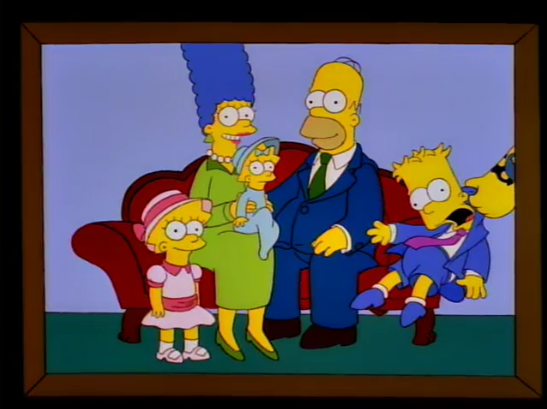
If you read this blog then you’re probably familiar with Dead Homers Society, and their viewpoint that this is the sole blemish on seven flawless classic seasons. I can’t claim some of their points aren’t valid; when you boil it down, this is a “very special episode” played fairly straight, with no real twist or subversion. But what keeps it engaging and effective is its honesty. When you’re a kid, you’re afraid if a parent getting angry at you, but then you find the worst thing they can be is disappointed, especially your mother. The characterizations are perfect here; Bart isn’t a bad kid, he was tempted, as we all were to steal a little sumthin’ sumthin’ in our childhoods. When his actions are exposed, Homer can only get mad, but Marge basically shuts down emotionally, not believing her special little guy could steal. Bart, who complained about Marge’s over-mothering earlier, is surprised that he misses it, and starts to yearn any kind of parental affection, even if it’s not from his own. The overtly emotional moments of the episode work because they feel genuine, and we are completely invested with these characters we love. Some may feel Marge getting the portrait and hugging her son is too saccharine, but I thought it was totally earned.

Besides all that, this show has just as many laughs and incredible moments as any other classic episode. Most effective are the video game parodies: the excessively violent Bonestorm is a ten-year-old boy’s wet dream, complete with an aggressive marketing campaign (“Tell your folks, ‘Buy me Bonestorm or go to Hell!'”) In contrast to this gore-fest is Lee Carvello’s Putting Challenge, which Bart has to feign interest in to appease his mother at the end. The game footage over the credits is absolutely one of the funniest bits of the series. Everything is perfect, the digital effect and choppiness of the voice, and the fact that the game developers included a parking lot setting at all. Even when things get heavily emotional in the third act, there’s still lots of jokes, like Homer’s list of punishments and Bart somehow managing to improperly combine marshmallow with cocoa. So I’m not bothered at all by this episode, I think it’s got a lot of great bits and a good heart. What’s a little bit of schmaltz every now and again, huh?

Tidbits and Quotes
– Gotta love Krusty’s horrible Christmas special, “A Krusty Khinda Kristmas,” sponsored by ILG chemicals, and Li’l Sweetheart Cupcakes (a subsidiary of ILG). Of course the show is half-assed, with an open window exposing the fake set, and Krusty’s inability to pronounce the name of one of his guests. Lisa questions why Krusty, a Jew, would be doing a Christmas show, to which Bart wisely responds, “Christmas is a time when people of all religions come together to worship Jesus Christ.”
– A tour de force performance by Comic Book Guy (this is really his shining season), overflowing with mockery in Bart’s belief he can purchase Bonestorm for 99 cents (“Net profit to me, negative $59. Oh, oh, please, take my $59. I don’t want it. It’s yours.”) Not getting his obvious tone, Bart reaches for the money, but CBG stops him short. (“It seems we are unfamiliar with sarcasm. I shall close the register at this point.”) Hank Azaria does such a fantastic job, each line of his just drips with utter contempt for his customers.
– Bonestorm is one epic game, as when Milhouse plays it, it seems that it creates a wind tunnel in his living room. Also great is his game handle, “Thrillhouse,” which thanks to character limits only appears as THRILLHO. We also get a great end to the scene with Milhouse getting Bart out by yelling to his mother that he’s swearing, which gets repeated again later, claiming he’s smoking.
– Arriving at the Try-N-Save, Bart comes up with a logical plan on getting the game (“Maybe if I stand next to the games looking sad, someone will feel sorry for me and buy me one.”)
– I love the bratty kid and hot uncaring mom, who happily buys her son a Bonestorm (“Get two. I’m not sharing with Kaitlin!”) Bart overlooks in awe (“That must be the happiest kid in the world.”)
– Great daydreaming with Mario, Luigi and Donkey Kong convincing Bart to take the game (“It’s the company’s fault for making you want it so much.”) Lee Carvello shows up to protest; that game’s not going to help his putting. Then a manic Sonic the Hedgehog seals the deal (“Just take it! Take it take it take it take it take it!!”)
– More foolproof logic from Bart, when Detective Brodka stops him on his way out of the store and asks him to unzip his coat (“I don’t think this is the kind of coat that opens.”)
– Another great tape for the Troy McClure video library, “Shoplifters Beware!” where he openly admits his involvement with the production is part of his plea bargain with the good people at Foot Locker of Beverly Hills. He explains stealing originated in ancient Phonecia (“Thieves would literally lift the corner of a shop in order to snatch the sweet, sweet olives within. Oh, Shakazaramesh, will you ever learn?”) Before he goes on to ancient Babylonia, Brodka angrily shuts off the tape, a dual joke in showing Brodka’s impatience and contempt for showing the tape, and that the video must be incredibly lengthy.
– I love Tierney’s performance, a man of absolutely no mercy, taking his job at a lame retail store very seriously (“You know, that kind of mush might fly at Lamps Plus, but don’t peddle it here.”) His monologue calling the Simpson house, only to be revealed that he was just talking to the answering machine, is hysterical.
– Homer is puzzled at his answering machine (“We didn’t have a message when we left. How very odd.”) But Bart had managed to switch the tape to Allan Sherman’s “Camp Granada,” which only confuses Homer further (“Marge! Is Lisa at Camp Granada?”)
– The steam out of Bart’s ears actually being two teapots is such a cheat, but I’ll give credit where it’s due.
– I love Bart’s paranoia in the car, with the car locks sounding like prison doors, and imaging Brodka on the seat back, complete with his continued ignorance of “Capiche.” (“Catfeesh?”)
– I really like that the Simpsons are excited at a fun day out at the Try-N-Save, basically the equivalent of a WAL-MART now. It speaks to their upper-lower-middle class roots.
– Wonderful bit with Marge gazing at a watch, and Homer implying maybe somebody will get her it for Christmas. He obliviously thinks that’s a great cover; now she’ll really be surprised when she opens the iron board cover he got her. Also great is Homer being annoyed at the photo center’s fake TIME magazine cover, with Flanders as man of the century (“Must have been a slow century.”)
– Kind of like Homer having knowledge of Supreme Court justices, I like that Bart apparently knows who Ansel Adams is.
– God, I love Detective Brodka, he’s one of my favorite one-off guest stars. Every line of his is great (“Sure, now he’s just a little boy stealing little toys. But some day, he’ll be a grown man stealing stadiums and… quarries.”)
– Homer’s angry rant at Bart is hysterical. First he can’t remember Reverend Lovejoy’s name (“Captain Whatshisname,”) then he gets side-tracked in his second blast against Police Academy of the series, then caps it off with, “Stay out of my booze!”
– I like how Lisa is able to decipher Marge’s emotions (and cute bit where she admits she hasn’t known Mom as long as Bart has), but is still kid-like in giving a meek shrug when Bart asks if she’ll be mad at him forever. In a later show, Lisa would just flat out tell Bart (and the audience) exactly what to do with the decorum of a forty-year-old.
– I love Homer’s list of punishments (“First, he’s grounded. No leaving the house, not even for school. Second, no egg nog. In fact, no nog, period. And third, absolutely no stealing for three months.”) We then find the paper he’s been writing actually just contains a drawing of a robot grilling a hot dog.
– I like the subtle dig at the limited appeal of video games, that Milhouse quickly gets tired of Bonestorm in favor of a cup and ball game (“Man, you never know which way this crazy ball’s going to go!”)
– “Welcome to Lee Carvallo’s Putting Challenge. I am Carvallo. Now, choose a club. You have chosen a three wood. May I suggest a putter? Three wood. Now enter the force of your swing. I suggest feather touch. You have entered ‘power drive.’ Now, push seven eight seven to swing. Ball is in: parking lot. Would you like to play again?  You have selected ‘no.'”
138. The Simpsons 138th Episode Spectacular

(originally aired December 3, 1995)
No one likes doing a clip show. They’re studio-mandated to get more airtime for less money. This show has had varying degrees of success with its clip shows, but for the most part they always seemed to at least try to make it worth the viewer’s time. This one is definitely the best example. There’s no trickery on the show’s part, as right away we’re told by Troy McClure what we’re going to see and what to expect. He takes us through the history of the show, showcasing various clips from the Tracey Ullman shorts. In the second act, we answer some “viewer mail,” where some long-running mysteries about the series are finally answered… kind of. Lastly, we get a fair share of deleted scenes, including the various alternate endings to “Who Shot Mr. Burns?”

This clip show seemed pretty unique for the time. Most of the material used was either un-aired or the Tracy Ullman clips, which hadn’t been on TV for many years. That and the normal clips used were arranged in such a way that they were fantastic, like the Smithers montage or Homer’s increasing stupidity. It really kind of felt like a love letter to the fans, including the deleted scenes and all the silly nods to obsessive fandom with the trivia between commercial breaks. Phil Hartman is always fabulous as McClure, who hosts the special with varying degrees of enthusiasm,on the seemingly fake Simpsons living room set. We also get a behind-the-scenes look at series creator Matt Groening, depicted as a grizzled, trigger-happy drunkard. The writers made the best of their predicament and gave us the most self-aware clip show ever, filled with new material and dressing up the old in a new way to keep it engaging. It’s the best clip show, bar none.

Tidbits and Quotes
– I love the other FOX specials Troy hosted: “Alien Nose Job” and “Five Fabulous Weeks of `The Chevy Chase Show.'”
– Great portraits of Groening, James L. Brooks (in an office adorned with awards looking like Mr. Moneybags) and Sam Simon (a Howard Hughes type with long fingernails, empty pill bottles, and prattling on a typewriter.)
– It’s always great to see the original shorts again. I really like how crude and primitive they are, especially in the very first one how the eyes of the characters warble and continually deform. And great stunned reaction by Troy after the first short (“They haven’t changed a bit, have they?”) Also, if they could get the rights for these clips, why the hell haven’t we got a DVD set of the entire collection of shorts?
– The two trivia bits at commercial are hilarious. What does the cash register say when Maggie is scanned in the opening? Turns out it’s NRA4EVER (“Just one of the hundreds of radical right-wing messages inserted into every show by creator Matt Groening.”) And what two popular Simpsons characters have died in the past year? “If you said Bleeding Gums Murphy and Dr. Marvin Monroe, you are wrong: they were never popular.”
– Great subtle joke that all the letters Troy reads are from professors or doctors, who you’d think would have more important things to do than write a silly cartoon show.
– “Get out of my office!” The Matt Groening scene is so damn funny. I like how Troy feebly tries to cover for the almighty creator (“Of course, what Matt meant to say, according to his attorneys, is that he couldn’t possibly do it alone. And he insisted that we make time to acknowledge the hard work of everyone who makes The Simpsons possible.”) Cut to an incredibly fast scroll of unreadable names, set to that great music from “Last Exit to Springfield.”
– I love Hartman’s whiplash attitude change at the start of the third act (“Right about now, you’re probably saying, ‘Troy, I’ve seen every Simpsons episode. You can’t show me anything new. …well, you got some attitude, mister.”)
– All the deleted scenes are pretty damn good, though most were removed for good reason. They’re funny on their own, but probably would have interrupted the story. Look no further than the robotic Richard Simmons bit from “Burns’ Heir,.” Very, very funny, but it would basically have stopped the show in its tracks. I also like the bit from “Treehouse of Horror IV” with Lionel Hutz (“Well, I didn’t win. Here’s your pizza. “But we did win!” “That’s okay, the box is empty!”) When we cut back to Troy, he’s fallen asleep on the Simpson couch and is poked with an off-stage stick (“If that’s what they cut out, what they leave in must be pure gold!”)
– I like the montage of perpetrators shooting Burns in the same spot, with Burns’s death moans repeated again and again. It’s also great how the true alternate ending is purposefully bad and nonsensical, with Burns giving Smithers a 5% pay cut for shooting him (Smithers’s sad groan is hysterical) Troy comments on this (“But of course, for that ending to work, you would have to ignore all the Simpson DNA evidence. And that would be downright nutty.”)
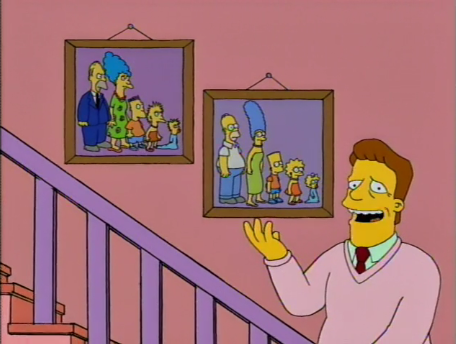
– Troy closes the episode in front of portraits of the Ullman-era family and their modern day counterparts (“Yes, the Simpsons have come a long way since an old drunk made humans out of his rabbit characters to pay off his gambling debts. Who knows what adventures they’ll have between now and the time the show becomes unprofitable?”) Well, that statement couldn’t be truer given the recent debacle of FOX almost cancelling the show. Who cares whether the show’s good or not if it can make a buck? What was a joke fifteen years ago is now reality. But enough of that, here’s what we came to see: hardcore nudity! The end montage is hilarious. Also, there’s that clip from “Grampa vs. Sexual Inadequacy” that apparently is missing a cel layer, as we see Marge basically completely nude along with Homer. Scandalous!

137. Sideshow Bob’s Last Gleaming

(originally aired November 26, 1995)
I kinda feel this one’s kind of underrated, but it’s my favorite Sideshow Bob episode. It just contains so many of the elements that makes Bob great: his heightened intellectual air he gives himself, his intense loathing of low-brow culture, and his long-standing rivalries with Krusty and Bart Simpson. We open with Bob decrying his fellow inmates for uproariously laughing at Krusty’s antics on TV. His tenure on the show was a period of his life that brings him much humiliation and chagrin, enough to frame his employer for armed robbery and make him a dangerous criminal in the first place. As a man who yearns for the days when men were more well-read and high-minded, he’s veritably disgusted of the hypnotic effect television has on the intelligence of the masses. The final straw is overhearing distinguished English actress Vanessa Redgrave guest-spotting on a moronic FOX sitcom. TV kills everything it touches, and for that, Bob must put an end to it, by any means necessary. It’s my favorite Bob plot, as it ties in so well to the motivations and beliefs of his character, as a snooty criminal mastermind.

Bob manages to make his escape and plot his master plan at a local air show, an event he isn’t too thrilled about either (“Buzz-cut Alabamians spewing colored smoke from their whiz jets to the strains of ‘Rock You Like A Hurricane’? What kind of countrified rube is still impressed by that?”) Said rubes are of course the Simpson family, who are in attendance. Bob manages to get his hands on an atomic weapon and delivers a message via the Jumbo-tron that if all television signals aren’t silenced in two hours, he will detonate it. Who will stop this madman? We all know who, it’s those lovable Simpson kids. I like that instead of playing Nancy Drew like in “Krusty Gets Busted,” they end up locked in the air base by accident, and Lisa’s quick-witted nature pretty much leads them right to Bob. Also great is the secret underground conference of Mayor Quimby and the various local TV personalities, who all agree they must stop broadcasting for the good of the people. Krusty stands as the lone dissenting voice, but afterwards realizes if he manages to stay on the air, he’ll be the only game in town. It’s half his instinctive duty as an entertainer, and half him just wanting to monopolize the ratings.

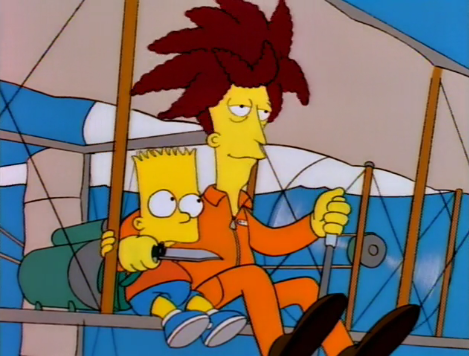
Bob is horrified to find his nemesis is still on the air (“Live from the civil defense shack in the remote Alkali Flats of the Springfield Badlands!”) As his agreement has been broken, he detonates the bomb… only to find it had expired thirty-five years prior. Foiled, he grabs Bart and takes off in the Wright Brothers plane, which proves to be another symbol of his classical ways, musing about how flight used to be a gentleman’s pursuit (“…back before every Joe Sweatsock could wedge himself behind a lunch tray and jet off to Raleigh-Durham.”) Truly unhinged, he claims he’s going to kill Krusty in a kamikaze mission, but the craft is so light it merely bumps off the broadcast shack and falls to the ground. Bob is apprehended, and all is well in the end. And even though he pretty much threatened a nuclear holocaust, he’s heading right back to Springfield Minimum Security Prison. It’s an episode that has a lot of silliness, with the bits at the air show and the police pursuit of Bob, but has a very grounded story that, again, feels very true to Bob. It’s one of my favorite all-around episodes.

Tidbits and Quotes
– I loved watching Double Dare when I was a kid, so I love Krusty’s version of it, setting up a canned food drive just to send Sideshow Mel through a slippery slide of rancid Bearnaise sauce, pickle brine and detergent. Mel howls in pain, much to Bart’s amusement watching at home (“Just think, Lis: that’s our pickle brine burning Sideshow Mel.”)
– Our intro to Bob sets the stage perfectly: he’s created a scale model of Westminster Abbey in a bottle, and must carefully set the clock to Greenwich Mean time… only to be startled by braying laughter, causing it to fall apart (“My dear Abbey!”) The source, of course, is other prisoners laughing at that wacky Krusty using Mel as a mop. Bob’s fellow inmates are quick to point that he was on that show, a fact he wishes to forget (“Don’t remind me. My foolish capering destroyed more young minds then syphilis and pinball combined!”) His heavy criticism of television almost gets him in a fight with Rupert Murdoch, who appears to be incarcerated too, for some reason.
– I like the Simpsons family’s various reasons for being excited about the air show. Even though she bombed seventy mosques in Iraq, Lisa is excited to meet the first female stealth bomber pilot who shares her name, Bart wants to see birds get sucked into jet engines (“Rare ones!”), and Marge has prepared homemade ear plugs made from biscuit dough.
An example of fine police work. Wiggum goes through the list of convicts, but finds he’s missing two: Bob, and that guy who eats people and takes their faces. A cordial, normal-looking prisoner shows up accounting for the latter, but no Bob. Wiggum is slightly annoyed by the absence, then establishes a cover (“If anyone asks… I beat him to death.”)
– I like the stages of Bob’s plan. First he locks himself in the Colonel’s private washroom to agitate him, just so he can get down his voice and mannerisms. The Colonel is voiced by R. Lee Ermey, who does a great job, as always. I also love Bob’s dumb rube voice he uses to goad the Colonel further, and Ermey delivers ridiculous lines with total severity (“I’m going to come in there and corpse you up! Corpse you up and mail you to mama!”) Later Bob mimics the Colonel’s voice to gain access to a restricted area, but he hesitates slightly at the crudity of one of his written exclamations (“Get moving or I’ll tear you up like a Kleenex at a… snot party!”)
– The least excited Simpson to be there, Marge can’t catch a break. She asks Homer to get her aspirin, but all Homer could find are cigarettes. Her headache is only exacerbated more as she’s seated directly behind a giant speaker at the top of the bleachers.
– The box kite parade is made as painfully dull as possible, led with great pride by Martin (“The common box kite was originally used as a means of drying wet string.”)
– Great quick joke by the Colonel (“Get ready for the pride of the United States Air Force: the British-made Harrier Jump Jet!”) Also just as great is that the performance is to “Rock You Like a Hurricane,” like Bob sarcastically quipped earlier.
– Bob appears on the Tyrann-O Vision (another genius Simpsons name, either meaning like ‘Tyrannosaurus’ in its humongous size, or like ‘Tyrant,’ being the sole decider of what you should see), calling for the end of television. The crowd of course is not on board (Hibbert comments to his wife, “Surely he’s not talking about VH-1.”) There’s no choice in the matter of course, as Bob makes his ultimatum and ends the transmission. Then he comes back to one quick addendum (“By the way, I’m aware of the irony of appearing on TV in order to decry it. So don’t bother pointing that out.”) I also like how you can clearly tell Bob’s voice is higher, and we saw the Duff blimp earlier, so you could guess where Bob is if you were paying attention.
– After evacuating the airbase, guards search every nook and cranny for Bob. They check the port-a-johns, only to find Abe in one (“This elevator only goes to the basement. And somebody made an awful mess down there.”)
– Hilarious line from the Colonel down in the bunker (“Bob is not here. We have searched every square inch of this base and all we have found is porno, porno, porno!”) Which is then followed up by Krusty coming in and seeing the magazines (“Hey hey! This is my kind of meeting!”)
– I like how Bob was outdone by his affinity toward the classics (“There were plenty of brand new bombs, but you had to go for that retro 50s charm.”) And of course the old “stall the villain with flattery” scheme, which Bob references himself. Bart claims he must be too smart to fall for that, which stops Bob in his tracks (“Really? What type of smart? Book smart? Because there are a lot of people who are book smart but it takes a special type of genius to…”) And with that, the blimp is surrounded, as Lisa used the time to type a message into the blimp’s marquee, complete with animated symbols.
– Lisa’s overenthusiastic claims to her mother is really cute (“Mom! I found Sideshow Bob’s hideout and I got a secret message to the police and I had a blimp fall on me and I was in an atomic blast but I’m OK now!”)
– The police slowly pursuing Bob with their arms passively raised, and the blockade of tennis rackets and pool skimmers is hilarious.
– My favorite moment watching when I was younger is when Bart warns Krusty to clear the shed, so he dramatically leaps through the window and ducks for cover. Beat. Krusty looks up, sees the plane is still slowly approaches, gets up, lights a cigarette. “What is the freaking hold-up?” And the plane tapping the shack and grounding itself is so pathetic. And then a tank runs over the historic icon (“Ooh, sorry. We don’t normally drive these in the Air Force.”)
– We end with a great call-back to the horrible show Bob heard earlier as he bemoans his capture (“How ironic. My crusade against television has come to end so formulaic, it could have spewed from the PowerBook of the laziest Hollywood hack.”) Cut to Abe showing up acting like a horny grandparent archetype. The Simpsons exclaim, “Here we go again!” (Marge half-heartedly) and then the FOX logo shows up. What a stellar ending.

136. Mother Simpson

(originally aired November 19, 1995)
We’ve learned a lot about the different events and characters of Simpsons past, but there’s one glaring omission: what happened to Homer’s mother? She’s been seen incredibly briefly in maybe two flashbacks, but where is she now? Well, here we learn the answer, in an episode that sheds a lot of light on Homer’s past, has plenty of big laughs, and one of the most emotional endings in all of television. When Homer fakes his own death to get out of work, most townspeople believe that he has actually passed. One such person is Mona Simpson, who shows back up in town to pay respects only to find her son is still alive. Homer is quick to welcome her back into her life, but Marge and Lisa are suspect of her mysterious absence. After some prodding, Mona comes clean about why she left home all those years ago: she was a radical activist protesting against germ warfare in the 60s. During a raid at Mr. Burns’s germ laboratory, she is the only one of her group to be identified and is labeled a criminal, forcing her to leave her family to protect them.

Mona, wonderfully performed by Glenn Close, and her back story seem to reveal a lot about our characters. First, she’s a very smart and mindful woman, quickly developing a rapport with Lisa (“You didn’t dumb it down! You said ‘rapport’!”), who is relieved to find a genetic origin to her intellectual gifts. Going along these lines, you realize how tragic Homer’s upbringing was. He was left to be raised by Abe, who as we’ve seen multiple times, is belligerent, demeaning, and an overall total ass. If Mona had been in Homer’s life growing up, he might have been a smarter, wiser person because of it. The man also has some deep seeded insecurities and damaging because of it, for obvious reasons (a particularly devastating moment when Homer, back to the camera, solemnly asks his wife, “Why did she leave me?”) It’s as relieving to us as it is to him for Mona to reveal her story, and for the two to have a heartfelt reconciliation.

The mother-son reunion is unfortunately cut short when Burns recognizes a disguised Mona and calls in the FBI after her. But thanks to an anonymous tip, Homer and his mother are forewarned and manage to escape. The tip came courtesy of Chief Wiggum; back when he worked security for Burns’s lab, the sabotaged explosion caused by the hippies inadvertently cured him of his asthma, allowing him to enter the police academy. This is fantastic because not only do you get your jokes from young Wiggum (“Listen to me breathe!”), but it also pays off in the plot in a believable way, as Wiggum was present during the investigation and was able to take advantage to help someone who helped him. Before she leaves her son once again, Mona tells him what Homer has probably wanted to hear since the day she left (“Remember, whatever happens, you have a mother, and she is truly proud of you.”) When she’s gone, all Homer can do is sit on his car trunk and gaze up at the stars, perhaps wondering if his mom is doing the same. It’s the most gorgeous single shot in the entire series, and perhaps the most emotional moment period. An absolutely beautiful episode in every respect.

Tidbits and Quotes
– We start on familiar territory, with power plant employees forced to clean up the highway. Burns hogs all the glory with a phony photo shoot, then heads off to his limo. Lenny bemoans his situation (“I can’t believe I’m spending half my Saturday picking up garbage. I mean, half these bottles aren’t even mine!”) That’s when Homer springs his prank, throwing a dummy version of him down a raging waterfall downstream, eventually getting sucked into a turbine. I love Lenny and Carl’s back-and-forth on how the dummy Homer gets in and out of peril, especially when Lenny posits some friendly beavers will help Homer, but instead they bite him and steal his pants. Also, great animation of the limp dummy Homer falling down rocks, floating pathetically down steam, then him just bobbing up and down until he shoots into the turbine.
– Great moment when Lovejoy and Flanders come to pay their respects to Marge. She of course has no idea what they’re talking about, claiming Homer’s out back in his hammock. But he’s not there (in a glorious shot with great color design). Ned and Maude humor Marge, and when Lisa happily skips by, Lovejoy slips Marge a card for a juvenile counselor.
– The last straw for Marge is when the electrician cuts their power, who seems very compassionate (“Your electricity’s in the name of Homer J. Simpson, deceased. The juice stays off until you get a job or a generator. Oh, and, uh, my deepest sympathies.”) In a great sequence in the dark with just moving eyeballs, Marge demands Homer straighten this situation out.
– I love how belligerent Homer is toward the town records bureaucrat, ranting about inaccurate and secret government files, when the man is more than happy to accommodate Homer’s requests.
– I always found it really shocking that Abe told Homer his mother died while they were at the movies. Like there’s no other delicate way he could have brought that up? Having a phobia of cemeteries, Homer never visited what he thought was his mother’s grave, only to find it’s Walt Whitman’s, which enrages him (“Leaves of Grass my ass!!”)
– I love the various Simpson reactions to Mother Simpson: Lisa’s calm surprise (“It’s like something out of Dickens…or Melrose Place,”) Marge’s nervousness (“I finally have a mother-in-law. No more living vicariously through my girlfriends!”) and Bart looking to make a quick buck for missed birthdays, Christmases and Kwanzaas. Homer is not amused (“I’ll Kwanzaa you!!”)
– Great moment when Lisa brings Bart downstairs to talk about their grandmother’s suspicious behavior, turning on the dryer to conceal their conversation. Bart can’t hear (“What?”) so Lisa turns off the dryer, but Bart still apparently can’t hear (“What?”)
– I love the scene where Marge has to lay the facts out for her husband that he shouldn’t get his hopes up about the woman who abandoned him for twenty-five years. Homer has two rebuttal points: it was twenty-seven years, and she must have had a good reason. Marge asks what that might be, and Homer’s damaged soul comes out (“I guess I was just a horrible son and no mother would want me.”) His upbringing is so, so devastating if you really think about it.
– L’il Homer is so adorable, as is his young mother, swatting away the electrocuting Operation game from him and singing him a bedtime song, the Fig Newton jingle.
– Every 60s story has the turning point for their characters, when they become opened up to a world of rebellion and freedom. Mona’s was Joe Namath’s wild unkempt sideburns. Abe, “stuck in his button-down plastic-fantastic Madison Avenue scene,” is not impressed (“Look at them sideburns! He looks like a girl. Now, Johnny Unitas, there’s a haircut you could set your watch to!”) I still use that expression, “that’s a [blank] you can set your watch to.”
– I love Dan Castellaneta’s frenzied hippie character right before they set off the bomb (“When this baby goes off, Burns’s lab is going to be history, man! Germ history! Oh man, I got the munchies.”)
– Only to make Mona even more sympathetic, she’s made a fugitive because she’s the only one of her group to go back to help a trampled Burns out of concern.
– Burns attempts to utilize the post office (“Yes, I’d like to send this letter to the Prussian consulate in Siam by aeromail. Am I too late for the 4:30 autogyro?”) but the squeaky voiced teller has trouble consulting his manual (“This book must be out of date: I don’t see ‘Prussia,’ ‘Siam,’ or ‘autogyro.'”)
I love the aspects of Burns’s investigation: his outdated usage of phrenology, the cab driver and gravedigger’s back-and-forth “I saw/seen her! That is to say, I seen/saw her,” and Wiggum’s brilliant reading of Homer J. Simpson upside-down (“Put out an APB on a Uosdwis R. Dewoh. Uh, better start with Greektown.”) To top it off, he was actually talking into his wallet.
– I love Abe’s reaction to seeing his long-lost wife for the first time in decades (“Now here’s a piece of bad news!”) After a heated spat and chewing her out (“You were a rotten wife, and I’ll never ever forgive you!”), we get a brief beat, and then… “Can we have sex? Please?” When he’s instantly shot down, he cuts his losses (“Well, I tried! What’s for supper?”)
– Great quick joke with Bart, wearing a tye-dye shirt, acting like a hippie for his grandma, spouting 60s catchphrases, not even knowing what they really mean, or that some don’t fit the hippie lifestyle at all (“Peace man! Groovy! Bomb Vietnam! Four more years! Up with people!”)
– Hilarious moment when Homer proposes Mona move in with Abe, and the entire family has a heartily laugh, Abe included (“Oh, I’m a living joke.”) Unbeknownst to them, Burns and the FBI are outside. Burns intends the relish the moment, playing “Ride of the Valkyries,” which is cut short by ABBA. Smithers sheepishly admits he taped over it. When the house is rushed, Abe comes clean (“All right, I admit it: I am the Lindbergh baby. Waah! Waah! Goo goo. I miss my fly-fly dada.”) Joe Friday asks if he’s creating a distraction, or if he’s just senile. Abe responds, “A little from column A, and a little from column B!”
– We get two great jokes at the end amidst the emotional tour-de-force: the hippie driver (“Hurry up, man. This electric van only has twenty minutes of juice left!”) and a really sweet joke, where Mona assures Homer she’ll never forget him, that he’ll always be a part of her. She turns and hits her head on the door frame, exclaiming “D’oh!” She’s still a Simpson, after all.

135. King-Size Homer

(originally aired November 5, 1995)
Homer is such an unhealthy glutton, it’s kind of surprising he only checks in at a mere 239 pounds. You’d think he’d be a lot heavier, but here we see he needs the right motivation. When Homer discovers he can go on disability if he’s over three hundred pounds, he vows to gain the extra weight so he can work at home. This leads to a great montage of Bart helping Homer put on the pounds, first consulting the incredibly ethical Dr. Nick, then raiding the supermarket of its fatty wears, buying such products as Much Ado About Stuffing and Uncle Jim’s Country Fillin’ (Just Squeeze ‘N Swallow!) His plan is a success, as he manages to gain over fifty pounds in one weekend, and a plant workstation is installed in his living room. Donning a festive muu-muu, Homer embraces his portlier self (“The slim lazy Homer you knew is dead. Now I’m a big fat dynamo!”)

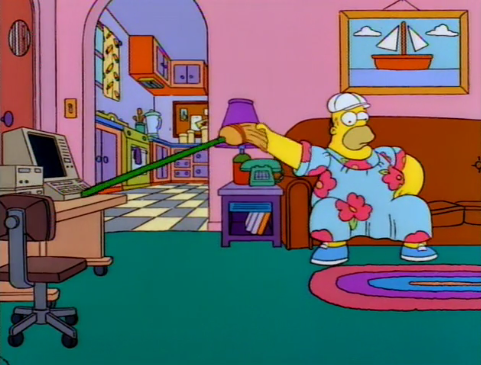
Amidst the goofiness of the concept of the story is an actual dose of reality. Lisa is rightfully concerned for her father’s health, where Marge turns mostly a blind eye, asserting most of her husband’s hair-brained schemes deflate once he finds something good on TV (“But this season…”) I really like how we see both Simpson women’s viewpoints, where Lisa, as a peppy youngster, is very outspoken, while Marge is a bit more reserved, not wanting to be a bother, and has to be pushed to say what’s really on her mind. She eventually confronts her husband about her worries, but it’s to little avail. Meanwhile, it turns out Homer is equally as incompetent at home as he is at the plant, watching TV on the couch whilst batting at his keyboard with a broom, then later going out to the movies, leaving his drinking bird to tap away at the keys. This of course bites him in the ass when he returns to find that he accidentally caused an impending catastrophe at the plant, and must find a way to get there to save the day.

While I appreciate the attempts made to create a realistic layer to this story about rampant obesity, this episode is pretty much fueled on jokes. You’d think a whole episode filled with fat jokes would grow a bit tired, but that’s not the case here. Plus, there’s other avenues of humor, from Homer’s ignorance of computers (“‘To start, press any key.’ Where’s the ‘Any’ key? I see ‘Esc,’ ‘Ctrl,’ and ‘PgUp’…”) and his general workplace ineptitude carrying over to the home as he inadvertently gases an entire field of crops (“Oh, no! The corn. Paul Newman’s gonna have my legs broke.”) The only thing in the show that mildly bothered me was Burns leading the exercise program. He’s got his fair share of great lines (“I want to see more Teddy Roosevelts and less Franklin Roosevelts!”) but his generally cordial attitude to his workers felt a bit alien for him. But it does lead to the great finale where he attempts to coach Homer to get thin, but gives up and decides he’ll just pay for his liposuction. Which begs the question, why didn’t they suck out more fat and make Homer thin? Maybe Burns only wanted to spend the money to get Homer down to his normal weight. Or maybe we just love Homer just the way he is, 239 and feelin’ fine.

Tidbits and Quotes
– A truly pathetic, but hilarious shot of Homer reduced to his underwear and sweating up a storm after doing a few jumping jacks.
– Homer attempts to get himself injured to get on disability: he stands under a hard hat area at a construction site, but thinks better of it when he witnesses a man get crushed by a wheelbarrow full of cinder blocks. Then we get a wonderfully staged sequence when Homer spills oil on the floor at work and attempts to slip and fall, but just ends up sliding through many different rooms of the plant until he ends up in Burns’s office. After an awkward back-and-forth, Homer asks Burns to give him a push the other way, which he does.
– I love Homer reading off the list of qualifying disorders (lumber lung, juggler’s despair, achy breaky pelvis) and his ultimate grief over having none of them (“I’m never going to be disabled! I’m sick of being so healthy!”)
– Dr. Nick coaching Homer on gaining weight may be his best scene in the entire series, starting with revealing the four neglecting food groups: the whipped, congealed, empty calories, and the choco-tastic. In a serious manner, Homer asks what he can do to speed up the process. Dr. Nick tells him to be creative (“Instead of making sandwiches with bread, use poptarts. Instead of chewing gum, chew bacon!”) Bart throws out his own suggestion (“You can brush your teeth with milkshakes!”) which Dr. Nick is impressed by (“Did you go to Hollywood Upstairs Medical College too?”) As a farewell reminder, Dr. Nick gives this tip: whatever food you intend to eat, rub on a piece of paper (“If the paper turns clear, it’s your window to weight-gain!”) This comes back later in a great scene where Homer is concerned how fatty a fish sandwich is, until Bart rubs it on the wall until it turns clear.
– I love Homer’s insane dream of what working at home will be like, with his power station set up in the backyard with a snack machine and Marge doting on her go-getter husband. Meanwhile, Ned returns from work looking a wreck (“A crazy guy shot a bunch of people and the subway ran over my hat.“)
– There’s some great animation of Homer’s new chubbier self, first when he gets in bed, lowering the mattress and causing Marge to tumble on top of him, then later when he gets up for work, and the entire bed shifts as he whips his massive frame to the edge of the bed. Just fabulous.
– Homer’s one pound away from salvation, but Bart informs him they’re out of food (“We’re even out of the basic elements of food. You ate all the tarragon and you drank all the soy sauce.”) Maggie comes to the rescue with a Play-Doh donut. Bart informs his father it’s non-toxic, but Homer has eaten it anyway. He just makes the 300-mark… then notices that his gut is stuck on the towel rack, and jostling it loose, he sees he’s actually 315 pounds.
– Burns still doesn’t know Homer’s name, even after the dramatic events of “Who Shot Mr. Burns?” I love how Smithers refers to him as a “chair moistener.” Homer working at home also makes the paper… sort of (“Burns Survives Brush with Shut-In.”)
Amazing dream sequence of Bart wanting to be like his dad, morbidly obese and bed-ridden. The reading of “Ah wash mah-self with a rag on a stick” is so disturbing, but hysterical, one of the best lines of the series.
– I love the throw-away line when Marge talks about how sensitive Homer is (“Remember when I giggled at his Sherlock Holmes hat? He sulked for a week and then closed his detective agency.”) I’d love to see the story behind that.
– The confrontation between Homer and Marge is an incredibly honest scene, with Marge concerned for her husband’s health, but also their marriage, clearly not so physically attracted to Homer’s new lifestyle. This leads to a great moment later when Homer discovers he only has to type ‘Y’ instead of ‘Yes,’ so he thoughtlessly takes the opportunity to gloat to his wife (“Hey, Miss Doesn’t-find-me-attractive-sexually-anymore: I just tripled my productivity!”) Marge could care less, of course. Another great moment is when Homer is briefly distracted by the dog, but when Marge comes to the room, he rushes back to his desk and taps the keyboard, like a kid caught doing something he shouldn’t of by his mother. As Marge leaves the home to do errands, Homer asks for a lemonade and a beer, referring back to his dream in the first act.
– There’s two jokes in this episode where Lisa attempts to defend her father, then her assertions are dashed. Neighborhood kids stare at Homer on the couch through the window, and Lisa attests he’s a good-hearted person, then Homer yells and berates the kids (“Don’t make me close that shade!”) Later on the bus, Lisa tries to claim her father isn’t a food-crazed maniac, then Homer drives by in an ice cream truck stuffing his face.
– Homer attempts to call the plant to warn them, but is unable to dial properly, getting a voice message (“The fingers you have used to dial are too fat. To obtain a special dialing wand, please mash the keypad with your palm now.”) Even better is the message is done by Joan Kenley, who was the voice of many answer machine and voicemail systems.
– Similar to the crazed derelict in “Bart Sells His Soul,” Homer acts like a raving crazy man attempting to hitch a ride with anyone foolish enough to pull over and engage with him. When he rants at an unsuspecting ice cream truck driver, he runs off terrified, like this is his worst nightmare that a big fat guy would take over his truck.
– Lisa and Bart have their own unique takes on Homer saving the day (“I think it’s ironic that Dad saved the day while a slimmer man would have fallen to his death.” “And I think it’s ironic that for once Dad’s butt prevented the release of toxic gas.”)