
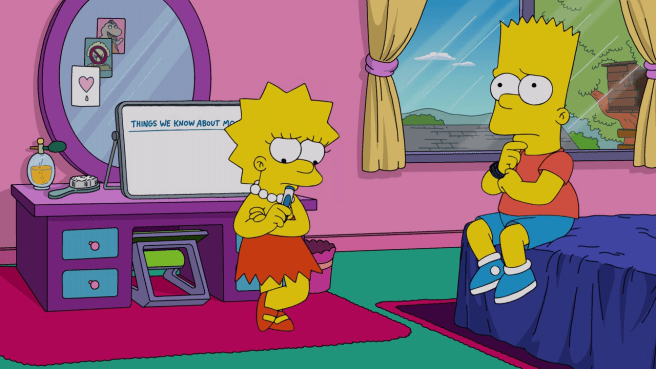
 Original airdate: November 12, 2023
The premise: Bart and Lisa half-ass Marge’s birthday present, and after seeing how devastated she is by it, they vow to make things right by finding the perfect thoughtful gift. Meanwhile, Homer goes on a watchdog crusade on a Citizen-type app, with his sole motivation being to jump up on the leadership boards.
The reaction: The ending of season 10’s “Make Room for Lisa” features Lisa briefly seeing the world through her father’s eyes, and ultimately feels bad she gave him a hard time, and that she should be grateful for all the things he’s done for her. That episode was written by Brian Scully, during his brother’s period running the show, and now over twenty years later, Mike Scully returns with what feels like a revived version of that concept, stretched to an entire episode. Here, the emotion at least feels more understandable, as we swap parents with the saintly Marge, who seems to have been worn down by years of underwhelming birthdays. Despite clearing wanting a fancy new robe to gloat to the judgy neighborhood hens, Bart and Lisa instead use the money they raised to buy themselves a cool spy kit, and give Marge two ironing board covers they got from the store for free. But when they overhear Marge break down to Ned, they realize they fucked up. Now not only do they need to get a make-up gift, they also realize they barely know anything about their mother. I kind of like the idea behind this episode, it’s about the moment where children realize their parents are actually human beings, with lives and interests before they were born. One of my favorite lines from Back to the Future is when Doc asks Marty what his parents like to do together, Marty thinks for a beat and replies, “…nothing.” I feel like that’s a sentiment I understood as a teenager, not really thinking too much about the inner lives of my parents in favor of my own. Where I feel like it falls down a bit is that Bart and Lisa are so young, that the level of burden on them by this seems too great. Kids their age with no money are giving their parents homemade gifts, and that should really be enough for any parent. The onus is really on Homer to help them plan a great birthday for their mother, but he’s off on his own little B-story this week, so he shows up to give Marge his own shitty gift and leaves the story completely. Then, instead of just getting Marge the robe she clearly always wanted, Bart and Lisa pay for bus fare to go several towns over to find her old childhood parrot that they just learned about. It’s a very uninteresting adventure, and even the twist reveal that the parrot was actually an absolute menace who Marge hated doesn’t really do much for me. And then we get the sickeningly sweet ending (“We see you as a person.” “We really do! Our favorite person!”) It’s just so much treacle. So, so much treacle. I get there’s some fans that like this stuff, but it’s so aggressively sappy to me. I’m such an easy mark for this shit, but it needs to come at the end of a story I give a shit about. This feels like a story any generic 90s sitcom would do, the kids wanting to make their mom feel better by getting her the perfect present. No amount of “snarky” jokes on top of that are going to make this feel any more substantive to me.
Three items of note:
– This episode kind of reminded me of a wonderful Bob’s Burgers Valentine’s Day episode with a similar premise. Bob, feeling he needs to step up his boring V-Day routine, decides to go out and find a unique meaningful gift from he and Linda’s past, a love tester machine they used on their first date. Also the kids con him out of taking them to school so they can go with him. He finally tracks down the love tester, ends up having to pay out the nose for it, only to realize his memory betrayed him, as he remembers that the date he thought he was on with Linda was actually with an ex. He’s mortified, but upon telling the entire story to Linda, she is over-the-moon about how above-and-beyond Bob went for her. It feels more realistic that this is a story for a spouse versus a young child, and the story is more specific with Bob’s character, a simplistic, no-frills man who is a slave to routine, actually feeling he has to put in a little more effort to make his wife happy, versus this episode where Bart and Lisa are more-or-less generic kid characters for most of it.
– Bart and Lisa shop at Bullseye, another in a long line of really, really great store names the crack team of writers spend literal minutes coming up with. These sort of “joke” names based off of real stores are pretty common, but what boggled my mind was the giant slogan written under the name, “Our Logo Looks Like a Target!” So, what’s the meaning of this? Are they commenting on their on-the-nose writing? Or is this an intentional swipe at the Target logo, a very timely jab in the year 2023? Either way, it’s incredibly groan worthy.
– There’s really nothing I have to say about the B-plot. Homer ends up going toe-to-toe with Agnes to be the top dog on the “Alarmist” app, only to both end up in a sink hole together with no hope of rescue. They even try to wring an emotional moral out of this story too, giving the epiphany to Agnes, of all characters, after she is saved from choking by Homer (“Simpson, instead of mongering fear, you mongered…” “Life itself.”)
 Me Blog Write Good
I think it speaks to how much the show has changed over the years because Mike Scully always had a distinctive style, whether he was a writer or the showrunner. You always knew when he had his hands in an episode. Nowadays, most episodes end up the same way no matter who’s involved in it, but the co-runner system seems to be fixing that problem somewhat.
Was there anything in this episode that let you know that Scully wrote it?
To me, not really besides there maybe being a few more jokes (or rather, attempts at them) than you’d normally get from a Selman episode.
Otherwise, it’s another episode where I would’ve quit after zoning out of the main plot halfway in if it wasn’t for the subplot.
That’s how I felt when watching the episode. Even his own Fox animated sitcom had more of his tells in it than this episode did. It just goes to show how watered down everything’s gotten since the late-20s/Early 30s run of the show started.
There’s someone on Nohomers named Ryan (I don’t know if it’s the same one on here) who summed up this episode (and quite honestly most of not all episodes that Omine has co-run) perfectly:
“Is this show full house now
Cuz it feels like full house”
Which when combined with your comment about the ending feeling like it’s from some sappy 90s sitcom makes it both funny and telling that she actually was a writer on Full House. So that combined with how showrunners tend to have more influence on an episode than one would think, that definitely would explain how it’s impossible to know that this was written by Mike Scully other than a few more joke attempts than you’d normally get from a Selman/Omine episode.
Otherwise, it’s about as exciting as most of her other episodes as co-showrunner are where by the halfway point you’ve completely checked out of the main plot and only the subplot is keeping you from quitting the episode completely despite how it abruptly stops (Agnes leaving Homer in the sinkhole the way she did wasn’t really an ending).
Thats not me, I was a friend of Phil Reed/noiselesschatter, i think he told me about or linked to this blog once. I dont actually watch the episodes unless it got a good review here.
Disney’s The Simpsons, folks.
What? This episode was written by the man that singlehandedly RUINED The Simpsons?
Now that’s a great sign right there!
Don’t worry, you can hardly tell that it was written by him.
That said, if you’re not big on any of the other Selman/Omine run episodes (some of which are Pixelated and Afraid, My Octopus and a Teacher and A Mid-Childhood Night’s Dream), then you’re probably not gonna like this one much either.
“Don’t worry, you can hardly tell that it was written by him.”
On the contrary, you can.
@vyrnnus Only in that there are a few more joke attempts than in other Selman/Omine episodes. That’s literally the only thing setting this apart from them (and I’m counting the reveal with the parrot as a joke attempt).
Here’s the thing; I know that everyone online, even to this day, likes to act as if Mike Scully destroyed the Simpsons in one fell swoop, but it wasn’t like he did it alone. Hell, I’d argue Al Jean has done far more damage to the show by looking at what Scully did and saying “yeah, this is good”. For example, Scully brought in writers like Tim Long and John Frink in Season 12… and kept them around for over a decade.
And in the same vein many like to say that the show actually improved once Selman began running episodes when actually not really as many of the problems Jean’s episodes have you can say the same about Selman’s episodes.
And that’s not mentioning the flaws that are unique to his way of showrunning like the much more forced sentimentalness that feels like it’s from a lame sitcom.
By the way, I was simply pointing out how despite Mike Scully writing this episode, it hardly feels that way and not feeding into the stereotype of him ruining the show. If anything, I’d honestly take the entire Scully era warts and all (even Season 11) over the point when Selman began showrunning (2011 onwards).
This blog can be a bit miserable sometimes. I thought this was a great episode, striking more of a balance between comedy and emotion than usual for co-runner Carolyn Omine. It’s a successful return for Scully, and I genuinely laughed out loud at moments that quite clearly came from him. I mean, seriously, this is light years from the garbage we were getting just a few short years ago. Some of you are so completely entrenched in your anti-Simpsons viewpoint you don’t even realise how it colours your perception. Your loss, I guess.
Fuck this episode up its fucking ass.
That genuinely is my view. Feel perfectly free to disagree with it, but do please respect it just as we respect yours.
Now I’m off to re-watch “Lisa on Ice” and “Marge Be Not Proud”.
Hi Des,
I certainly disagree with your opinion and vocalised that, but I don’t think I disrespected any of you in doing so.
Thanks!
This blog is miserable ALL the time. A bunch of pasty malcontents whining about a TV show to the nth degree and thinking they’re hot shit. And ‘witty’ rejoinders from sanctimonious dilrods like Des Elmes:
– “This blog can be a bit miserable…”
– “Fuck this episode up it’s fucking ass! Now don’t be disrespectful!”
…Huh?
Some commenters might be more vitriolic than I care for, but as long as they keep it directed at the show and not at each other, I’m okay with it. You, on the other hand, have chosen to be directly insulting to people who have done nothing to you. Take that shit elsewhere.
Aww I really liked this one. Honestly maybe it’s just me but I didn’t even think the plot was getting extremely “sappy” at the end because 1, I thought it was a good contrast to the Homer subplot which also seems to go down the same path when Agnes comes out of the hole (only to rewind at the end). And 2, because I thought that cheesiness felt earned when you still have things like the twist that Marge hated Petey. Idk, I honestly thought it was the kind of subversion and emotionality that the classic era handled (and honestly it’s not even far from Scully’s scripts tbh).
“I honestly thought it was the kind of subversion and emotionality that the classic era handled (and honestly it’s not even far from Scully’s scripts tbh).”
It absolutely was. The way this twist subverts the sentiment without undercutting it is signature classic Simpsons.
yeah, I honestly give credit to Omine for her attention to the details that manage to build the craftsmanship of the moment. It’s the kind of execution that the classic era had in how it is built in such a way that you think you know what it will be in the end (inspired by the sitcoms of the time) only to turn back and give it its “Simpson touch”. Plus either way, I genuinely think this one works the same way Scully’s other scripts worked (we even have the Homer subplot, for that matter).
This blog can be an interesting read but sometimes I think there is some genuine bias or “whitewashing” for things the modern era does that aren’t too far off from some classical era performances. The magic of opinions, I guess.
Credit where it’s due, I definitely wasn’t expecting the reveal with the bird, I just assumed the emotional resolution would be played completely straight. There’s definitely a great compare & contrast that could be made with this and “Marge Be Not Proud” overall, and the distance between the two of them really isn’t that far. Of course, so much of it is subject to what pushes your emotional buttons, but how the Omine-led episodes handle these moments feel so much more heavy-handed to me. And yes, you can make a similar argument with “Marge Be Not Proud” to be sure, but I guess it’s just a matter of personal degrees. The third act with Marge “giving up” on Bart and it emotionally devastating him is both funny and very affecting, and really drives Bart to want to make things right with the photograph. The set-up of “Iron Marge” is very similar and relatable, disappointing your parent as a child and wanting to make things right, but it just doesn’t hit me the same way. Maybe because Marge is so removed from the story, it’s just all Bart and Lisa bouncing off each other and repeating the same things to each other. I feel like the on-the-nose dialogue is a big thing too, like the two exchanges from the A and B story quoted above, it just feels a bit artificial. An ending like “Lisa on Ice” may be just as sappy, but Bart and Lisa’s recollections of their past are all played non-verbally, carried only by beautiful music and sweet animation.
“I honestly thought it was the kind of subversion and emotionality that the classic era handled (and honestly it’s not even far from Scully’s scripts tbh).”
It absolutely was. The way this twist subverts the sentiment without undercutting it is signature classic Simpsons.
The key problem with “Make Room for Lisa” was that it was one of the first instances of Jerkass Homer in full effect, where Homer spends much of the first and all of the second act just being completely oblivious to Lisa’s problems (he flat out states that he hates everything she likes and even blames Bart for trading a fun day for dessert, acts like a total moron at the Smithsonian exhibit, sells her room for a cell phone tower without consulting her, puts her with Bart who deliberately is going to harass her, thinks she’ll like Weekly Fox Reality TV Special instead of homework, and believes she’ll prefer the harsh antacids over a holistic approach). Yet, the episode ends with Lisa believing she’s in the wrong, while Homer goes on a wacky misadventure in the third act. There is that moment where Lisa has a vision of being Homer and accidentally interrupting the ballet by snoring despite bringing a sandwich with three kinds of bacon and a veal chop, but that felt too weak compared to the things Homer did to her in the rest of the episode to make up.
To answer Nobody’s point, Scully episodes as showrunner often had characters louder and angrier (but no access to a time machine, though if they could, they would), as if the general idea was that the only emotion a character could process was the raw kind. Except now that every character in the Sellman era has been diluted to being milquetoast in order for them to arranged as chess pieces for scenarios, they can’t be loud and dumb anymore.
As for this episode… I get why they didn’t want to do the materialistic option, given that we can’t let characters have nice things, but it also highlighted the fact that, in over 30 years, the staff just doesn’t really have a lot for Marge because they never bothered to flesh her out at any point in the show’s history. Bart got super popular at the beginning of the show before they phased him down with Homer soon being established as the true main character, Lisa became the focus of authority and morality, and Maggie was effectively used as setting up shorts starting in the 2010s, but what of Marg Himson? It’s easy to create an avatar of sorts with a child, but you can’t do it with an adult woman, particularly in a sausage factory that was the writers room of The Simpsons for decades, and as the show’s writing philosophy became “make the jokes more obvious for the stupider viewers, lest they complain, furrowing the brows in a vain attempt to understand the situation”, writing Marge episodes became harder and harder to do, so they largely stopped and now she’s just a plot device.
“and now she’s just a plot device.”
I disagree. A THOH segment like ‘The Pookadook’ and this episode succeed in large part because they tap into what I believe to be the fundamental tension at the heart of Marge as a character since the series began – a woman who is routinely relegated the background where she is overlooked, underappreciated, and taken for granted. It’s patently false to say that she’s a ‘plot device’ in these stories when they’re *about* her anxieties, frustrations, resentments and dissatisfactions as a person.
“Fear of Flying” and “Scenes from the Class Struggle in Springfield” are still better episodes than this one, though.
And I’m happy to be called a “sanctimonious dilrod”. 🙂
‘Scenes from a Class Struggle’ is definitely a better episode. I wouldn’t ever suggest otherwise.
I don’t normally like Flanders, but he was his classic self here: kind almost to a fault and genuinely being nice to the Simpsons family. It is a little sad he’s the only friend Marge has at her birthday party. Patty and Selma don’t come although that’s probably for the best as they would have just made cutting remarks, I think.
Homer’s present was cute in that it’s normally what a kid would buy for his mom, small jewelry like earrings or in this case a bracelet charm. And Marge appreciates because small and silly it may be, he really did think about it and wanted her to like it. The kids present in contrast was just something they got for free with their true purchase: the spy gear. I do love that in the end they let Marge use the spy gear too.
Honestly I really liked this. It was mainly sweet with good use of Agnes being her unrepentant jerkass self to counterbalance all the nice feels. Homer had his little mini adventure but it didn’t eat away too much time from the main plot which I felt was very cute and reminded me of Marge Be Not Proud for it’s similar themes of disappointing Marge, the ultimate patient and forgiving mother.
I had a good time watching it and even laughed at Petey the obnoxious parrot. A good episode of Modern Simpsons.
Everyone’s talking about the more obvious stuff like Mike Scully writing this episode after not writing one for at least 20 years, some comparing it to Marge Be Not Proud (Kind of a stretch), along with this being the last episode by Carolyn Omine as co-showrunner or something, but what I’m surprised about and also find odd, is why was TV Show host Megan Mullaly brought in for only like a single sentence of dialog, with I think Clancy’s wife in the beginning of the episode? I thought she was voiced by Pamela Hayden no? I recall her voice being much different.
Nonetheless, kind of weird to make up the effort to have her in for a single paragraph of dialog when a regular cast member can do it no problem. I hate the guest stars just for the sake of guest stars.
There was an episode two seasons ago that was all about Sarah Wiggum, with Megan Mullally taking over the role. Since then, she’s made brief appearances a few times.
Huh, I didn’t know until now, yeaaaah…. I didn’t like it after watching it. It’s the HouseWife of Clancy and Mother of Ralph, not some Sexualized spy or whatever shock twist they did. I forgot the plot so fast because of how boring it was, which that tells you something if its forgettable that quick. A bit odd to see a change really made for a single episode still somewhat stick around, as usually characters remain the same since debut, and most other stuff either wacky or nonsensical resets after the episode ends, and kind of jarring even for a brief line, Pamela Hayden can’t reprise the role?
It seems like they reverted her persona back to her original state, I think “SheWiggum” one of the producers called it? How she was prior to that episode you mentioned. Kind of rude and insulting towards Hayden doncha think? I’ve never heard of a Character in a TV show needing a voice change or even retcon before staring as the main character, and its not like the stupid reason with characters that aren’t white in the case with Carl, Lou, Dr. Hibbert, etc, being recasted with actors of color because it was deemed “inappropriate” like with the whole Apu thing. Hayden still has a major presence on the show, so its not like anything happened to her.
A bit odd and kind of unnecessarily jarring if you ask me.
Ehhhh … yeah, I’m sorry, I have to agree with Des Elmes here. Fuck this episode up its fucking ass, indeed.
It’s not that it’s particularly egregious in terms of plot or character or anything, but like so much of modern Simpsons, everything is so, so, soooooo belabored. This script talks down to the audience so much that it must have been written by the Very Tall Man from 22 Short Films About Springfield. Perhaps he and Scully teamed up. And that’s this entire series now. The most bare-bones expositional dialogue that takes twice as long to deliver as snappy multifaceted dialogue in shows that are actually well-written.
The Bob’s Burgers episode Mike mentioned is a perfect contrast to this. Both are animated sitcom episodes going through about the same character arc, but on a fundamental level, Bob’s Burgers respects the audience’s intelligence and taste. By contrast, this felt like a children’s picture book in Simpsons form.
I wanted to like it. I wanted to hop on board the Carolyn Omine showrunning train. I liked THOH 33. I liked Pixelated and Afraid. I liked My Life as a Vlog. But I do not like this episode. I don’t like a lot of her episodes, same as the rest of modern Simpsons. They retain too many of the series’ fatal flaws to rise above the condescending mediocrity it’s consistently put out over the last couple of decades. But maybe that’s a good thing. It means the scant but significant glimmers of hope we’ve been seeing over the past couple of seasons don’t rest entirely on Omine’s shoulders. Despite her departure from the show, there’s still hope we can keep getting a couple of great episodes each year.
I pretty much dislike most if not all of Omine’s episodes as co-showrunner as they just come off as more sappy with so much forced sentimentalness and the characters just act like blank slates as the plot demands to make the sappiness work (Bart & Lisa are just generic kids and nothing more), which I guess is bound to happen when you’re someone who used to be a writer on Full House.
So I don’t have the same sadness as most others to hear that she’s no longer co-showrunning as I viewed her as on-par as everyone else and not as the “One good co-showrunner” as others would say.
The heartfelt moments she would bring to the table are really something else though, like a level of really REALLY wholesome if that makes sense, like the level of sweetness of the classic era. I guess it makes sense since she is a Mother and a matured Woman, as in she really knows how to work with the Female characters on the show that feels natural to Woman in real life and knows how to write new angles and ideas that still fit the context of the Ladies.
There really needs to be more writers like her on the show if I’m being honest, especially when it comes to tackling stories centered on the Female characters as the male writers and the younger Female writers, (especially todays young Females) will write the Female characters in a way that more makes them like a stereotypical pole dancer prostitute or something along the lines of that persona and traits of that nature if that makes sense, or a lesbian. Just nothing that would be logical that fits the character.
“Despite her departure from the show”
She remains the co-runner of the episodes she wrote.
What you characterise as ‘talking down to’, I would suggest is didacticism. The show has increasingly become a series of parables. Its sprawling canvas is being used to relay instructive messages and morals, couched in allegories and metaphors that are telegraphed and unsubtle. There is absolutely nothing wrong with this approach, though your mileage will vary on how effectively it works for you.
It certainly works for me.
“By contrast, this felt like a children’s picture book in Simpsons form.”
There’s a reason Aesop’s Fables have endured for as long as they have.
I don’t think the problem is that the show’s stories are parables, though. The problem is how they deliver those parables as though the audience won’t pick up on basic cues unless the characters draw attention to the simplest story elements over and over.
You can have parables that convey a clear message and still respect the audience’s intelligence. Take something like “Lisa’s Rival”, for example, or “The Telltale Head”. (I know comparisons to the classic era are done to death, but I cite it because we’re definitely both familiar with it as Simpsons fans.) Those episodes didn’t put their jokes and story on pause every few seconds so the characters could give on-the-nose explanations of what was going on. Yet their messages about jealousy and peer pressure were very clear.
Parables don’t need to be this patronizing. In fact, being patronizing limits their effectiveness. Adults often forget that the lessons they’re taught as children take many different forms in the real world, because the stories that taught them those lessons back then were exclusively on-the-nose. Assume the audience understands those fundamentals already and you can build on that knowledge to teach advanced lessons, lessons that might be helpful for even grown adults. “Iron Marge” assumes the audience is clueless, and as a result, it only manages to be an introductory course.
Obviously, none of this invalidates your or anyone else’s enjoyment of the episode. But that’s why its tone doesn’t work for me. And I imagine that’s why it doesn’t work for so many others.
I respect your response and agree that stories shouldn’t be patronising even when attempting to teach or instruct, though I haven’t really felt that when watching Omine’s episodes. Honestly, I didn’t really pick up on the characters giving “on-the-nose explanations of what was going on” when I watched this episode. Could you provide some examples that I could refer to for closer inspection?
Regarding on-the-nose exposition, the B-plot is probably the clearest example of what I’m talking about. Like, here’s an unbroken stretch of dialogue from its climax:
HOMER: Are you choking? Hang on, I’ll save you. Wait, is this irony? *Agnes hits him* Ow. Ow! Okay, I’m doing it. *heimlichs Agnes*
AGNES: I can breathe! Simpson, instead of mongering fear, you mongered… life itself. Thank you.
HOMER: This is the feeling I was after. Not some stupid leaderboard. I’m gonna help you get out of here. Step in my hands, I’ll boost you up.
AGNES: *grabs him* Oh, there’s so much to grab onto. *escapes hole* I’ll tell everyone you’re down there … *snaps photo* … which will make me Alarmy number one. Suck it!
I think this sequence takes a solid minute, but I just looked up the transcript instead of watching the episode because I don’t want to sit through it again, so I’m not sure. But look at how boring this dialogue is. The only purpose most of it serves is exposition, but it’s almost all redundant. The audience sees Homer saving Agnes, the audience sees Agnes is now safe. And the audience can probably be trusted to understand Homer is satisfied with this just by his expressions.
A better show would recognize how redundant this is and either craft non-expository dialogue instead (like jokes or in-character reactions) or execute this sequence with minimal dialogue so it goes by quicker and there’s more room for the good stuff. It would still function as an effective parable and waste less of the audience’s time. But even if there has to be so much exposition here, is it too much to ask that it at least be delivered in an interesting way? This feels like an AI was trained on this scene and they asked it to provide a summary in the voice of Homer and Agnes.
Furthermore, the jokes they do make in this scene are extremely basic. That Homer sure is stupid! That Homer sure is fat! That Agnes sure is mean! Those character observations can be amusing, but you have to lure the audience into a false sense of security and deliver those moments as a surprise. Homer humming a song in his head? Charming, perhaps, but not inherently funny. Homer humming a song in his head at Troy McClure and Selma’s wedding when the show sets up that he’d want to speak now and reveal the wedding’s dark secret? Hilarious. You could definitely execute Agnes’ heel turn like that. But the closest thing this episode did there was assume the audience’s expectation of “characters in stories like this do the right thing” overrides their expectation of “Agnes Skinner will be a selfish person”, which only works if this is your first Simpsons episode with Agnes in it. Considering how much of this series’ appeal lies in its storied past, I doubt that holds true for many viewers.
Most scenes from this episode aren’t so egregious, but a lot of them get close. That’s just how modern Simpsons dialogue is written. There are other episodes where this is more of a problem, mostly the ones run by Al Jean, but it’s still too much of a problem here for me to call Iron Marge an exception to this tedious, agonizing rule.
So I checked and you’re close – about 50 seconds elapses from the moment Homer asks Agnes if she’s choking to when she walks away from the hole.
I’m not sure how your example qualifies as exposition though? There’s no background information being conveyed here. These are character reactions and, for the most part, they seem perfectly natural to me.
The only clunky line that pops out is “Simpson, instead of mongering fear, you mongered… life itself”, which I’m not sure anyone would say naturally.
I’ll grant you that the ‘jokes’ are basic, but they’re not really the point.
I think we’re using different definitions of exposition, then. If you’re thinking of exposition in terms of the formal first chunk of a story on a plot diagram, that’s not what I mean. When I say “expository dialogue” I mean dialogue whose purpose is to explain things to the audience. I guess just substitute “explanatory” where I say “expository” – I use them interchangeably because I’ve seen others do that, but technically, “explanatory” is the word.
Anyway, I think the overabundance of explanatory dialogue is a problem because that information is already being conveyed to the audience. The overexplaining is a waste of time and to me, it feels like the writers don’t trust the audience enough to tell a satisfying story.
Imagine if Simpsons episodes were only allowed to use words a student learning to speak English for the first time would understand in their first semester of instruction. Even though much of its audience is fluent in English and those who aren’t have other options (dubs or subs, take your pick). I think we can agree that would be an absurd creative limitation and it would make The Simpsons more tiresome to watch. To me, this insistence on dragging out explanatory dialogue is much the same thing. I want to appreciate and enjoy these episodes, but the writing grates on me too much.
How would you write the dialogue in this scene?
I’d probably keep the parts we see on screen (Agnes chokes, Homer saves her, Homer happy) to a minimum and try to think of more jokes to do with the saved time.
I know that’s a non-answer. But I actually tried to write a version of this in response to your comment and the #1 thing I kept bumping up against was the lack of substance in this scene and how it basically became me throwing in extra jokes unrelated to the original text, because what is there to even do with the “plot” of the original? It turns into creating something ex nihilo, and at that point it has nothing to do with the original scene at all. So we might as well speed through this plot resolution stuff to free up more time for jokes anywhere else in the episode.
If I could scrap the B-plot’s resolution outright I would. I’d let Homer be a cautionary tale, as he often has been, because I feel like the audience gets the point as soon as the two of them are stuck in the hole and have driven away anyone who could help. The B-plot could honestly end there, or if it must have a final scene, I’d make it less concerned with wrapping things up than emphasizing the absurdity of Homer and Agnes’ rivalry.
As for sticking to the actual scene and integrating jokes, that’s pretty hard to do without changing the scene itself, as I mentioned. It is by nature a plot development scene and my main gripe with it in particular is because it should have been gotten out of the way much faster than it did. But here’s the best line I could think of that can be organically integrated with it.
HOMER: (while Agnes is choking, getting progressively worse, and he’s looking in the other direction): I get it. I do. I had a pocket full of Sour Patch Kids when I got here. But I ate them all so I could report that hungry adults were eating this park’s delicious kids. Lousy honesty, I should’ve just lied. Stupid swe– (turns around) –et Jesus, you’re choking!
I don’t know why my previous comment didn’t show up. I didn’t swear or say anything mean, just that I liked the episode.
Your comment was marked as pending for some reason, sorry about that.
Thank you!
I use to love reading your critiques but over the years I think you’ve become too bitter, and looking back to be honest you seem pretty contradictorily in your analysis of episodes past the ‘Golden Years’.
Yeah, they ain’t like what they used to be!
But your latest commentary is so shallow, I went ahead and watched the past few seasons even though you said there was nothing of note, and I’m glad I ignored you.
Yes, it’s not the same. Yes, modern Simpsons has had a lot of duds. But you are so stuck in the past that you can’t recognise when something good happens. Sorry
I’ve talked about many times on this blog how I can appreciate the change in direction in episodes like these, but I don’t personally find them entertaining. I’m glad you “ignored” me and found a lot to enjoy with these latest seasons, lots of people have, and that’s just fine! The thoughts of this blog aren’t sacrosanct, I’m not warning anybody to not watch the show. I just give my knee-jerk, off the top of my head thoughts after watching each new episode. I’d certainly take an episode like this or “A Mid Childhood Night’s Dream” over the bulk of the episodes from the 2010s, but I’m just not connecting with them the way other people have been.
I re-read what I wrote and I must apologise I didn’t mean to come off sounding like a complete douche. I do love your commentary, otherwise I wouldn’t be here in the first place. You’re clearly passionate about the show
That’s okay, I appreciate you saying that. I just know the Internet is filled to the brim with people screaming, “THE SIMPSONS IS SHIT NOBODY CARES ABUT IT,” and even if I’m negative or apathetic about something, I never want to come across as one of those people. I also try not to get too stuck on what the show was in the past and not make so many direct comparisons; a good TV show SHOULD feel different from what it was 30 years ago. In fact, it’s inevitable that it will be, but how you feel about it now is subject to your own opinion.
I think it’s fair to say that Mike is simply exhausted from the show that most of the episodes have been mixed together for him. Idk, I think maybe he should just take a break. I don’t think continuing to watch a show that I clearly no longer like is healthy, especially how uninteresting (and superficial) the latest reviews of it have been.
I admit I’ve made something of a suicide pact with this show, feeling the need to cover it until one of us finally ends. But I wouldn’t still be writing this blog if I didn’t still enjoy doing it. The new directions this show has taken in the last few years has been interesting to see unfold, even if I don’t enjoy them as much as others have. And the show still has managed to surprise me, with two episodes last season I genuinely enjoyed, one of which being a Carolyn Omine joint. Yes, I can’t say I like the show overall, but I don’t consider this a torturous exercise, and I try to give every episode its due. But I’ll say as far as these kinds of emotional episodes go, I feel like there’s only so many ways I can say this kind of writing isn’t hitting the right buttons for me, especially with this one coming so hot off the heels of “A Mid-Childhood Night’s Dream.” These episodes are certainly more successful than the sloppy, tacked-on nature of a lot of the Al Jean-led heartstring tug moments in recent years, but your mileage may vary as to whether you’re genuinely affected by it. Like it’s fine if you don’t agree with me, or like reading this blog, but calling it “superficial” feels a bit harsh. But hey, my apologies, I guess, I’ll try to be a little more explanatory of myself in the future.
Mike, I think you’re doing fine. I certainly like some of these episodes a lot more than you do, but I still find your insights thought-provoking and I don’t think you *need* to do anything more than you are. Superficial is definitely a bit harsh from Agony.