
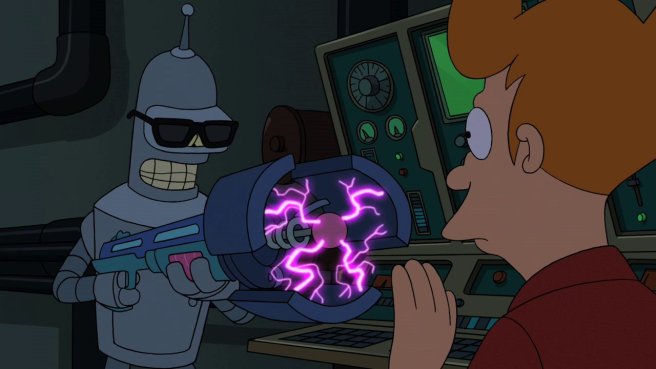
 Since it started running on the block in 2003, Futurama became a pivotal piece of Adult Swim’s programming for the next several years. To a diehard fan like myself, it was certainly bittersweet. Sure, it was nice to have the series still on the air, becoming a decent hit in syndication, but I never really watched it that much, since I already had the season DVD boxsets and had completely worn them out. I feel like the number of times I’ve watched the original four seasons of Futurama has to come close to my rewatches of classic-era Simpsons, if not even exceeding it. Between initially obtaining poor-quality TV rips of the show via file sharing sites as a wee pre-teen, ordering a mysterious “VCD” of the first season online as I waiting for the official DVDs to end up stateside, and poring through all 72 original episodes on DVD with and without commentary over and over again, I felt like I knew the series backward and forward. But we all had to just accept the series was over. Even when Family Guy got its 2005 revival, it just didn’t look like it was going to be in the cards for Futurama. But then, a miracle happened. In early 2007, we heard rumblings about a potential DVD movie, and then by Comic-Con, it was confirmed that four DVD movies were in the works. My mind was blown. Sure, it wasn’t a new season, but this was still incredible news. Some fans had hoped for a revival in the form of a Futurama movie, and now we were getting four of them? Incredible! In deciding which of the movies to cover, there’s really only one option. “Bender’s Big Score” came out of the gate swinging, giving the fans everything they missed about the series and then some, an epic time-bending adventure starring our favorite space pals.
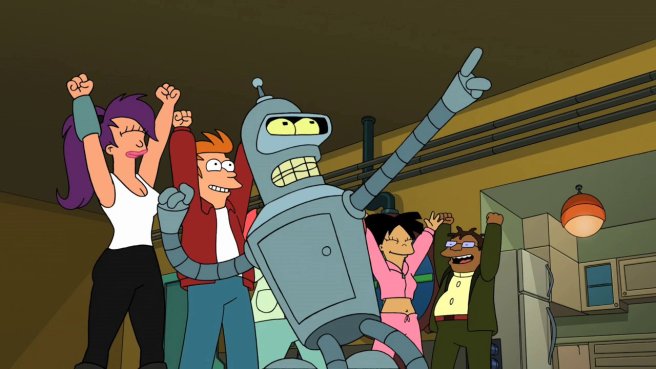 It’s hard to express just how wonderful it felt watching the first five minutes of this movie for the first time. The grandiose re-introduction to our main cast, the merciless bashing of the FOX executive stand-ins who “cancelled” Planet Express (“Good news, everyone! Those asinine morons who canceled us were themselves fired for incompetence!”), and going into the new HD version of the opening theme. It was like magic. The show was BACK. Right off the bat, the transition of the show from SD to HD is seamless. Considering Futurama was digitally assisted from the very beginning, it really feels like this is how the series was always meant to look. Unlike The Simpsons, where the shift to HD only intensified its sterile, over-simplified design and animation style (to be fair, they would improve over time on that front), it became a real strength to Futurama, the widescreen format lending itself beautifully to detailed alien worlds and space battles, giving the movies, and later the revived series, a crisp, clean look. I remember being somewhat concerned that since these were straight-to-DVD movies, they might have a somewhat reduced budget, but even if they did, you certainly can’t see it on screen. From a presentation-aspect, the show really was back and better than ever.
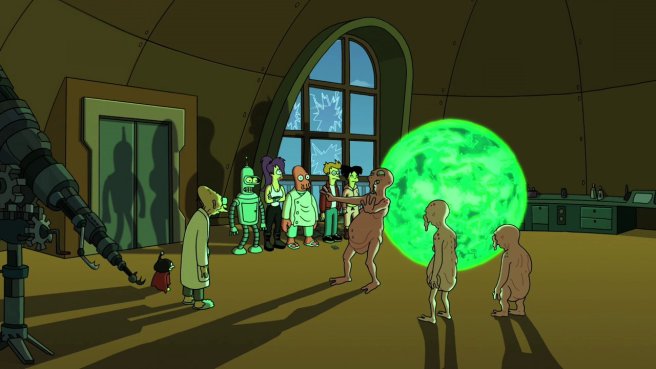
I previously talked at length about the difficulty in transitioning a TV show to feature-length, something that both The Simpsons and Bob’s Burgers struggled with. Even though these movies were created knowing they would be aired on TV in the future in four separate parts, they still face the same potential issues with taking a beloved series and ballooning it up to a larger format. The degree to which the four films succeed as satisfying, complete “movie” stories varies, but “Big Score” is easily the most cohesive, feeling the most like a complete story with very few digressions. The plot mainly centers around the schemes of three nudist scammer aliens, who early in the film take control of Planet Express, and eventually acquire New New York, followed by the entire Earth. It all starts innocently enough with the crew naively giving them their email addresses, resulting in massive spam in their inboxes, and worse yet, the Professor ignorantly signing away his entire company. The aliens, spearheaded by their leader, Nudar, are merciless opportunists, willing to do anything to get themselves as much money and power as they can. The spam email aspect of the story feels a little dated now, but in our current social and political landscape filled with grifters trying to squeeze as much money as they can out of a flimsy business venture before getting out before it all collapses, the scammer aliens feel more relevant than ever. As the movie progresses and we focus more on the time traveling shenanigans of our cast, the scammers are still in the background, impoverishing the denizens of New New York more and more until eventually swindling President Nixon himself, resulting in the eviction of all Earthicans. The scammers are selfish, incredibly gross, and very funny in their shamelessness, particularly through Nudar’s petulant needling of the suckers he swindles. They’re really fun villains overall.
 The other main catalyst involves Fry’s ass, specifically a mysterious tattoo of Bender on his left butt cheek. Upon closer inspection by the scammers, the tattoo contains a secret binary code, which, when read, creates a “time bubble,” a one-way gateway to any point in the past. The scammers utilize Bender, who has been glitched into (mostly) unquestioning servitude by a computer virus, to repeatedly travel back in time to steal all of history’s most valuable treasures, stowing away for thousands of years until exhuming himself in the “present” to do it all over again. Bender has always been a very malleable character, capable of great cruelty and great humility, sometimes within the same scene, so he works really great here. He’s no stranger to screwing over his friends for his own selfish means, so it’s not much of a stretch to see him offer not a ton of resistance to being manipulated (“Don’t you realize you’re completely under their control?” “Of course I realize it! Doesn’t mean I can’t enjoy it!”) Bender’s continuous time traveling also gives us some great fan service, where we see that his escapades in the 2300s, trying to run from the authorities in flying saucers, were the cause of the decimation of old New York that we see outside the cryogenics lab window in the pilot as time progresses while Fry is frozen. Once the scammers have exhausted their thieving options, they erase Bender’s memory and attempt to kill Fry to wipe the time code from existence, but Fry uses it himself to escape through time too, with Bender hot on his tail.
I’m a sucker for a good time travel story, so that’s probably a big reason why this one is my favorite of the four movies. Bender’s pursuit of Fry ends up getting more complicated when the two of them use the time bubble multiple times, generating time duplicates of themselves, another concept in the time travel genre that I love. The first Back to the Future is pretty objectively the best of the three, but Part II will always hold a special place in my heart for its third act where Marty and Doc have to deal with tiptoeing around their past selves, it’s just an inherently fun concept. Although in this case, the fabric of space and time is in no danger of being torn apart (at least not yet), as we get a bunch of snippy conversations between doubles of Fry and Bender; it’s always fun when a character thinks their own self is kind of a jerk. The time bubble guarantees “paradox-free” time travel, meaning the timeline naturally rights itself out by killing any time duplicate, leaving only one left per timeline. This idea is introduced right away, as Nudar uses the time bubble first as a test, and his double is crushed to death in a freak accident. This fact becomes incredibly pivotal through multiple parts of the rest of the film, thankfully reiterated a few times by an irate Professor, just to keep it in the back of your mind, as well as signal the final big twist of the film.
 Fry escapes to the past by going, where else, back to December 31, 1999 (lamp-shaded in a great line from Bender, after the scammers are surprised he knew where he went, “That’s where he always goes!”) I realize this is now my third highlighted episode that involves Fry’s past, but the idea of Fry as a man out of time is such an intriguing element of the world of the series, one that naturally fell out of focus relatively quickly into the show’s run. As I think I said before, at some point, Fry needs to become acclimated to his new present, so the future shock largely died down by even mid-season 2. But Fry getting frozen is such a pivotal moment of the series (hell, the pivotal moment), that it makes sense that in this first revival movie, we’d go back there one more time, giving Fry the option to live out his own life back in the newly dawned 21st century. This is another part of time duplicate stories that I like, where alternate versions of the same person can live out entirely different lives based upon a few changes or different decisions. As such, we see Fry living a fairly happy life in the early 2000s, reunited with Seymour and the rest of his family, still working for Mr. Panucci… but he still yearns for his lost love Leela, his dreams of finally getting together with her dashed by a new mysterious paramour, Lars Fillmore. But we’ll come back to him…
We initially see Bender blow up Fry’s upstairs apartment in 2012, but then discover that was merely a time duplicate, with the “real” Fry having gone back in time, then accidentally frozen himself in his own cryogenic tube (I love the multiple characters hiding out in tubes, tucking themselves away in the back somehow, before they re-emerge sometime later when necessary.) Over the course of the movie, we see Fry’s 21st century life, going to work at the aquarium and forming a bond with their newest acquisition: a lonely narwhal named Leelu (get it?!) When the sea creature is forced to go back to the ocean, Fry leads a fishing expedition to find it, but upon seeing that Leelu yearns to be free to frolic with her own kind, particularly another narwhal in a healthy shade of orange (get it?!?!), he lets her go, concluding that “it’s enough just to know you’re happy.” It’s all rather simplistic, but it still really works. There’s a powerful earnestness with Fry at his most focused, and seeing him try to work through his feelings for Leela, ultimately realizing he can’t control everything that happens, and he just needs to let her go, is incredibly sweet. So yeah, Leela is with Lars in the future, and the Fry of the past has made peace with that, and those two statements are in no way intrinsically connected. …or are they?
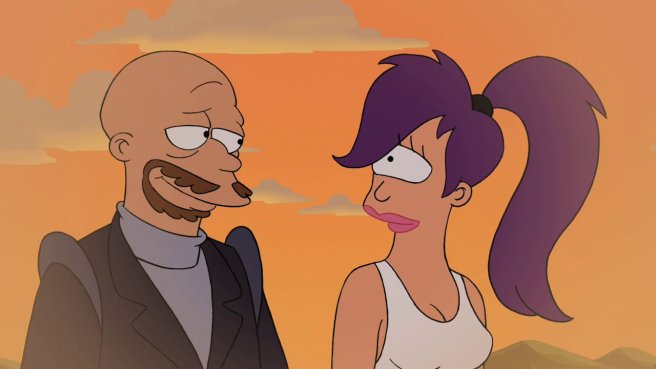
Fry’s breaking point with abandoning the future is the arrival of Lars, attendant at the Head Museum, who sparks up a relationship with Leela. He’s cool, he’s collected, and he seems to really connect with Leela in a really short amount of time. He also seems strangely familiar, but your mileage may vary on how quickly you were able to figure out his secret. Upon first seeing Lars, I remember thinking his design was kind of Fry-esque, and I knew that it was Billy West doing his voice, but he’s voiced so many incidental characters on the series, I didn’t think much of it. But it turns out that Lars is a time duplicate of Fry, in what feels incredibly obvious upon every revisit. But I think the fact that you see Bender blow up duplicate Fry’s residence above Panucci’s in the past, completely decimating the building, it feels so definitive, so I wasn’t thinking there was any dangling thread there with another Fry running around somewhere. But the final flashback showing that Bender’s fiery ambush incinerated Fry’s hair and damaged his larynx, “turning” him into Lars, is absolutely brilliant. It’s such a deceptively simple change that I fell for it. The hints about Lars’ identity are all relatively subtle (saying he’s been waiting for Leela his whole life), with the biggest being his reasoning for calling off his wedding with Leela, when he finally hears the Professor talk about how time duplicates are always doomed. His very quieted “What?” in the background of that scene is very effective once you know what’s going on, the whole thing was just handed so, so well.
I can’t remember exactly, but I feel like I didn’t figure it out until the final money shot, and upon first watching, that shot of the smoke clearing as you finally see the Bender tattoo on Lars’ ass was really incredible, as your brain starts working backwards and everything starts to fall into place. There’s no way to recreate the mystery of watching for the first time, but I still find myself impressed by the ultimate reveal. It’s one of those perfect time loop situations, where 2012 Fry recognizes himself as “Lars” with glee, but he escaped to the past in the first place to get away from Lars. This also feels like the absolute breaking point of the endlessly waffling will they/won’t they of Fry and Leela. We’ve had Fry sacrifice his life for Leela on multiple occasions, but I certainly wouldn’t say that alone has “earned” him the right to finally be with her. But post “The Why of Fry,” we have Fry as a strong romantic figure in Leela’s coma fantasy, we see that Fry and Leela are happily married in an alternate reality almost entirely identical to the one Fry and Leela Prime are from, and now we have Leela falling madly in love and almost marrying a time duplicate of Fry, someone who she herself admits she can’t imagine loving anyone more. It just feels like the absolute limit that they’re teasing this relationship. In the first episode of the revival season, they concocted a reason for Leela to once again not want to give her and Fry a shot, which felt like such pointless kicking the can further down the road, that I was thankful that by the following season, they finally cut the bullshit and had them be a couple at last.
 Oh yeah, there’s other stuff going on in this movie, right? Hermes is decapitated near the beginning, leaving him a despondent head in a jar for most of the runtime while his mangled body is being repaired. A very strange running joke involves his wife LaBarbara, who has taken this opportunity to become “reacquainted” with her ex Barbados Slim, with the gag being that their son Dwight “needs a daddy.” Hermes pleads with Bender to bring him back a time-duplicate body from the past, which wins him his wife back temporarily, at least until time catches up with him and his new body is destroyed, resulting in LaBarbara going back to Slim once again. LaBarbara isn’t a very prominent character in the series, but she just felt unnecessarily cruel, and not in a particularly fun way. The movie is also stuffed with returning characters, but not in a way that feels like overkill. The Harlem Globetrotters assist the Professor with figuring out the ramifications of the time bubble. President Nixon and Zapp Brannigan show up in the back half as Earth’s forces must mobilize to finally put a stop to the scammers. The whole planet is exiled to Neptune, putting them in the clutches of Robot Santa, but he’s too depressed to kill them, as the scammers stole his naughty list to use for telemarketing (“Do you know the harm they could do with that information? I was going to do that harm!!”) Sure, I guess you could call some of this stuff fanservice-y (we also get cameos by Hedonismbot the Hypnotoad, Leela’s parents, and others), but all these characters all felt like they still worked within the confines of the story and contributed their bit.
Towards the end, we get our big action climax as the people of Earth must fight for their planet, with the greatest of their space forces waging battle on the scammers’ fleet of solid gold Death Stars (remote-controlled, of course, the weaselly little scrubs they are.) It’s a very exciting sequence, filled with even more fun cameos by the robot mafia, the Nibblonians, and even Al Gore contributes to the attack (“Finally, I get to save the Earth with deadly lasers instead of deadly slideshows!”) It’s also incredibly gorgeous, another shining example of how the show’s visual quality hadn’t been compromised at all in its return. Many fans, myself included, engaged in incredibly wishful thinking that Futurama might get a theatrically-released movie (I never believed it, but I wanted to believe), but if this was the closest we were gonna get, I was happy with it. “Bender’s Big Score” just seemed to nail everything that made the show so engaging, but expand it over four times its normal length. It was a hopeful sign of things to come, even if, in my opinion, the future movies all never reached this high benchmark.
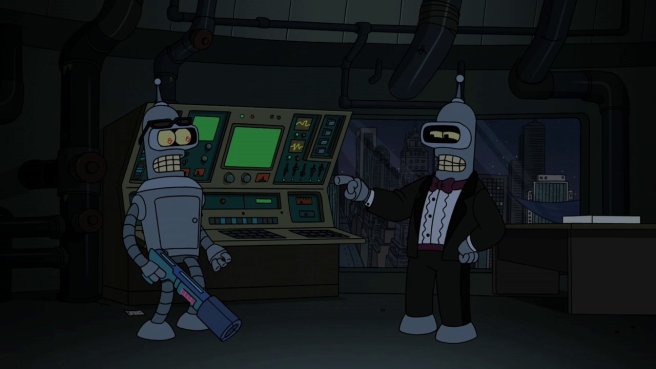 The next three movies came out within the next year and a half, so Futurama fans were eating damn good for a while. “The Beast with a Billion Backs” is my pick for second best; with a less complicated plot, it’s filled with great goofy gags and overall feels more humor-focused than “Big Score.” It mostly works as a movie-length story as well, the tale of a mysterious alien from another world seeking the universe’s largest polyamorous relationship. I’m also a sucker for any time Bender exhibits actual emotion towards Fry, and the subplot of him forming an entire army, and later laying siege across the vastness of space, all so he can get his best buddy home, is incredibly adorable to me. The third movie, “Bender’s Game,” is my least favorite, in that it feels the most disjointed (which makes sense, as it’s the only one to have separate writing credits for each of the four acts), and the fantasy, Dungeons & Dragons-inspired setting of the second half doesn’t really interest me, nor did it seem very cleverly written. A series of jokes about White Castle making you have to shit yourself? A hoard of Robin Williams orcs called Morks? Come on. The completely disconnected first half involving MomCorp is okay, but nothing that great, but once we enter dreamworld, it becomes a real slog for me. The fourth and final movie, “Into the Wild Green Yonder,” is just alright. It definitely has its moments, but it’s kind of weak overall. It’s trying very hard to be a show-stopping final movie, with Fry wrapped up in a conspiracy plot about a dark force that might cause a mass extinction of all life in the universe, but a lot of the movie feels kind of aimless and casual that it never really hits properly. For me, it was a bit of a bummer that the movies only got “worse” after the first one, but even by the final one, I was still just so over-the-moon we were getting new Futurama that I couldn’t grumble too much over it.
Adult Swim would lose syndication rights of the show in 2008 as the series moved over to Comedy Central, with the four-part episodic versions of each movie premiering a few months after their release on DVD. I think there were discussions between Fox and Comedy Central regarding funding new episodes pretty early during this period, but it was unbeknownst to any of us fans if the show would ever extend past these four DVD movies. All we could do was buy them, continue showing our support, and maybe the show would be jolted back to life with actual brand-new episodes…
 Me Blog Write Good
It’s funny that out of the three series-to-film adaptations covered on this blog, it’s the smallest scale direct-to-video one that succeeds the most in its transition. But hey, that makes sense. There was less that needed to be changed or introduced to a larger general audience.
Personally, I’m always a fan of when good episodic TV shows do multi-part storylines and the best Futurama movies feel like 4-part episodes of the original show. A character-driven time travel plot, with all the plot intricacy and emotional reflection that implies, is a really good fit for an extended episode like this one. Later Futurama movies start feeling like disparate episodes stitched together, but Bender’s Big Score stays cohesive through-and-through.
I may be being hypercritical but I feel the quality of the series starting from these straight-to-DVD movies (and then even more so starting from season 6) is greatly diminished. It’s never been as bad as zombie simpsons, but it shares many qualities with it: Flanderized characters, repeated ideas, and jokes that simply don’t land or feel like they’re from Family Guy.
I might be in the minority but I never understood the clamor to bring the show back in the first place when we all knew from The Simpsons (and many other shows) that it’s very easy for TV series to outstay their welcome. “The Devil’s Hands Are Idle Playthings” is such a beautiful and perfect series finale and I really wish it was the last ever episode. I’d rather a show end at a good four seasons of gold than limp on for the sake of it. Disenchantment is not perfect by any means, but I appreciate that it’s a new idea with a lot going for it. I’m just so sick of the tendency to draw out and revive these intellectual properties forever.
Alright, rant over – just sharing my two cents. I’d just like to thank you for keeping this blog up for so long, I’ve read it for about 11 years and it’s always been my favourite blog ever.
I’m in total agreement of being sick of the seemingly endless zombie IPs spilling out of Hollywood. I’d rather this latest Futurama reboot not happen, but I feel that it might be worthwhile. I’ve actually been really impressed how good the latest new seasons of Beavis and Butt-Head have been, so I hope the same for Futurama. As for Disenchantment, I was unmoved by its first season and never had any desire to revisit it or watch the other seasons, but I absolutely respect it for being something new and trying something different.
And thank you for your kind words!