
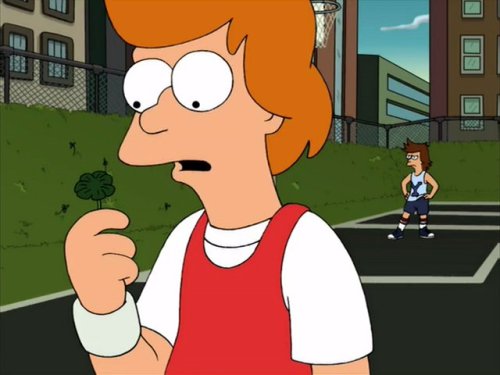
 Look up any list of the best Futurama episodes ever, and amongst the top rankings are probably the really emotional ones. The series had heart from the very beginning, but it really started to plumb the depths of feelings as it went along, as the characters became greater established. Leela’s loneliness thinking she’s the last of her species, Bender’s snarky facade briefly dropping to display actual emotion, these moments only work because we’ve grown to love these guys. Season 3 contains a fair share of powerful episodes that are incredibly memorable and feel emotionally resonant: Fry’s love note in space that won Leela’s heart being destroyed before anyone gets a chance to see it, Bender meeting “God” the space entity, even moments stuffed within crazier episodes like Bender’s yearning to be remembered or Fry’s realization that fear has brought his found family together during Xmas time. But to me, the granddaddy of them all in the original FOX run of the series is “Luck of the Fryrish,” the tale of two brothers who never saw eye to eye before it was too late. Yes, “Jurassic Bark” is the more famous example, but I think “Fryrish” is more successful at really getting to me. As much as I love dogs, and the ending to “Bark” is an absolute gut punch, it really is pretty depressing, and a dour note to end an episode on, versus the final reveal in “Fryrish” coming off as more uplifting and sweet.
The episode opens back in the 20th century with Fry’s birth, being placed in a crib with a colorful mobile of a spaceship cruising around a bunch of planets, which of course is very prescient (and very adorable.) We also meet his older brother Yancy, who is shown to be very jealous of his little brother. As we keep cutting back to past events as the Fry boys get older, Yancy has made a habit out of copying his brother to one up him, whether it be shooting hoops or street dancing. We can see how this is incredibly annoying from Fry’s perspective, but also see that these are two young brothers who are just naturally prone to getting into squabbles. On top of that, you can picture Yancy harboring a sizable chip on his shoulder for not being the only child anymore, and taking it out on his little brother. Interspersed with this new relationship, we also get a more developed look at Fry’s past: we meet his parents, an ex-military father obsessed with doomsday prepping (“Better keep your hands off these bananas. Gonna need them when the radiation turns us all into monkeys,”) and a mother who is so apathetic towards her children she barely even notices her own son’s birth. Between meeting Fry’s immediate family and the absolute dump of a house he lived in, it just further emphasizes how lucky it is that Fry got his second chance at life in the future.
 One of Fry’s only saving graces in the past was his discovery of a seven-leaf clover, which seemed to give him incredible luck whenever called upon. Meanwhile, we see modern day Fry in the future plagued with incredibly bad luck, leading him to yearn for his old good luck charm. He, Leela and Bender travel to the underground New York ruins to his old home to open the safe Fry kept the clover safe in, only to discover it’s missing. They then stumble upon the statue of “Philip J. Fry,” first man to walk on Mars, with a seven-leaf clover in his lapel. Fry is enraged, believing that Yancy changed his name and stole his beloved clover after he went missing in the past. Just as Fry felt his brother was always trying to one-up him, now it seems like he’s stolen his entire life from under him. Learning about all of other Fry’s fabulous exploits, from his lavish fortune (made after striking oil in the bathroom of the mansion he had won in a lottery) to leading up the hit rock band Leaf Seven (a joke I feel stupid for never getting up until now), all our Fry can see is all of the stolen opportunities his brother took from him. Learning where his brother is buried, Fry vows to take back what’s his by digging up his body and recovering his rightful clover. Before our final scene, we flash back to Yancy on the eve of his wedding, the absence of his brother still looming over the family. He opens Fry’s record vault in the basement, and is absolutely astonished to find the clover hiding inside, dropping into his hand like a ghost from the past. It’s at this point I start to get a little emotional, even though I’ve seen this shit dozens of times, just off of Yancy’s shocked gasp at this ultimate reminder of his little brother’s past. Tom Kenny does such a great job in this role; despite being best known for incredibly over-the-top characters, he also nails it when it comes to playing regular schmoes like this.
Fry, Leela and Bender arrive at the orbiting cemetery, finding out that the other Fry is buried in the World Heroes section (“I should be the one in that grave!”) But uncovering the monumental gravestone reveals the truth, as we see in flashback: Yancy bestowed Fry’s clover to his firstborn son, as well as Philip’s name, in honor of his much loved and even more missed little brother. Philip J. Fry is actually Fry’s nephew, “named for his uncle to carry on his spirit,” as his epitaph reads, the living embodiment of Yancy’s love for him. It’s such a wonderful twist ending that feels rightly earned, and serves as a great reevaluation moment for Fry. As terrible as his life in the 20th century may have seemed, there were also bright spots too, ones that he may not have ever really thought about before. But in a way, none of that really matters anymore, since everyone he ever knew back then is long dead, so there’s no making amends, no mending fences, all he’s left with is his own feelings, with no one to share them with who would truly understand. All Fry can do is lovingly place the clover back on his nephew and reflect on how much his brother really cared about him. Similar to Fry’s naivety about the future, there’s only so many years they could play out Fry’s homesickness about the past before he would naturally need to be well acclimated in his new present, but it’s really harrowing to think about the trauma Fry has gone through in being frozen. It doesn’t make for a lot of knee-slapping comedy though, but they certainly do try (and largely succeed) at making you laugh and tear up at the same time, just like this show’s own big brother was so masterful at.
 The writers would use this flashback formula again next season in “Jurassic Bark,” aka “the dead dog episode,” which I also love, to be clear, but I appreciate the twist ending of “Fryrish” more than getting my heart ripped out knowing Fry’s dog waited a decade in hopeless misery for him to return. It’s so devastating that they sort of retconned it with “Bender’s Big Score,” as we see that a time duplicate of Fry stayed in the 21st century and cared for Seymour into his old age. The revival seasons would take two more cracks at digging into Fry’s past, with somewhat mixed results. Season 6’s “Cold Warriors” looks back at Fry’s relationship with his militant father, with him attempting to win big at the science fair, despite lack of encouragement from his old man. Meanwhile in our future, Fry comes down with the common cold, all but unheard of in the 31st century, causing a biohazard panic. It doesn’t hold the same impact as “Fryrish” or “Bark,” but it’s a pretty solid episode, with the final scene of Fry’s father relating to him that he’s only tough on him because he wants him to grow up resilient is ultimately pretty sweet. Season 7’s “Game of Tones” proves less successful, trying to do a similar sympathetic reframing to Fry’s mother, whose only joke up until this point has been she is a terrible mother who barely even acknowledges her children. It is interesting in that it’s the only one of these four episodes to not feature flashbacks, rather we see past events directly through Fry’s memory, with him experiencing gaps of information based on what he was or wasn’t around to witness. But the ending where Fry and his mother have a tearful reconciliation, while viscerally affecting in concept, doesn’t completely work given what we know about Fry’s mother. Deep down, I’m sure she loved her son, but there was no believable turn or explanation from her previous characterization like there was with her husband’s episode. It’s not a bad episode, but definitely the weakest of the four.
Production season 3’s twenty-two episodes would end up airing over the course of two years on FOX, with the 2001-2002 “season 4” only cranking out twelve new episodes. Constant pre-emption thanks to the World Series kept the premiere episode, the Emmy-winning “Roswell That Ends Well,” from airing until December, until the season limped along until April of the following year. FOX had clearly stopped caring about the show, but still wouldn’t officially pull the plug on it, even after the fourth production season was completed and the producers were met with radio silence as to whether they were getting a fifth season pick-up. In this brief period, the show was floating around in this weird stasis, where it seemed all but assured that it was done for, but nothing was confirmed as of yet. All us fans could do was hold on to the falsest of false hopes that maybe, just maybe, a miracle could occur.

 Me Blog Write Good
It’s a measure of how great I find this episode that whenever I hear “(Don’t You) Forget About Me” I think of “Luck Of The Fryrish” first, and then The Breakfast Club.
“All Fry can do is lovingly place the clover back on his great-great-etc.-nephew and reflect on how much his brother really cared about him. Similar”
I think you got Philip II and Farnsworth mixed up. His brother’s son would just be his regular nephew.
Great review as always!
Shit, yeah, thanks for pointing that out. Always remember to proofread your work!
I’ll be honest, I never clicked with this episode the way so many other people did. I felt like I was being told to care about Yancy instead of being shown compelling reasons to care.
I think this is because Yancy is an invention of this episode, not part of the greater Futurama series I’d already been watching. Looking back at the Simpsons episodes I find emotionally compelling, like Lisa’s Substitute or And Maggie Makes Three, they work for me because their emotion is derived from existing constants of the series. Homer and Lisa’s relationship. Homer’s job and forgotten third child. These episodes draw on the entire series thus far in order to punch me in the heart. Luck of the Fryish only draws on its own 22 minutes and while I respect the effort, I’d be lying if I said it felt as earnest.
(I think this is why I’m not nearly as in love with Mother Simpson as most people. Mona is only really relevant in that one episode, not the entire series. As Fry and Homer’s family members, Yancy and Mona inform who the lead characters of their series are, but only because their episodes in question say so.)
I get what you’re saying. Both examples are examining characters we know through brand-new close relations to them, but I feel like they’re effective as they’re based off of information we already know about them (Homer’s never-spoken-of mother, the family Fry left behind.) Them being emotionally based in a universal understanding of family is almost like a cheat code, since we can all relate to fraught relations with family members and those we’ve lost. It’s a different kind of potency than a Fry/Leela or a Fry/Bender episode, so I can see how it won’t work with everyone.
I actually rewatched this episode to re-evaluate my thoughts on it after my last comment and I think I misdiagnosed my issue with it. I think it’s not so much that the concept of Yancy feels artificial, it’s that Futurama’s dialogue feels artificial. That might actually be a more heretical opinion, I’m not sure, but what I mean by it is that it doesn’t feel like the characters are real people who would have the human emotions I’m meant to infer from the situation.
Yes, Fry’s family would grieve for their lost son and vice versa, but the characters never feel like they care about that. If that was intentional for Fry’s parents, that they didn’t care enough because of their own preoccupations, then it falls flat for me because no one else does care enough in order to contrast with that. Futurama only conveys character traits in two ways: straight exposition and jokes, very clever jokes usually, but jokes nonetheless. And I mean, yeah, it’s a comedy, but other comedies like Community or, of course, classic Simpsons took their characters and situations more earnestly throughout the comedy’s runtime, so less explicitly “punchline-y” moments felt natural.
I want to be moved by Yancy’s gasp at the clover, but it’s not like we saw anything from Yancy before that to indicate his world is shaken by Fry’s disappearance … except for the characters explicitly mentioning said disappearance. That’s why I felt like I was being told to care and not shown that I should: the episode’s writers just explicitly told me to. They didn’t let me come to that conclusion myself. Which I guess something like Lisa’s Substitute also did, but since The Simpsons treats its characters more like real people, my natural empathy with other people was already showing me that I should care.
I guess the takeaway is that I have a greater appreciation for the shows that nail these emotional beats. For me, they have to either take its characters earnestly as a default state or the beat must be paying off aspects of the entire series up until that point. Probably because I’m overly analytical, but I can’t be the only person like that in the world.
TLDR: Pulling off dramatic moments in sitcoms is clearly really hard. It takes a seven-leaf clover and a millennium’s worth of effort to do that.
“I want to be moved by Yancy’s gasp at the clover, but it’s not like we saw anything from Yancy before that to indicate his world is shaken by Fry’s disappearance … except for the characters explicitly mentioning said disappearance. ”
To be fair, at that point in the episode there is meant to ambiguity as to Yancy’s intentions – is he shocked at finding the clover because it’s a tangible remnant of the brother he lost, or because the object of all that childhood envy has unexpectedly fallen into his hands? It’s only in the final flashback that we get confirmation of how much Yancy truly cared about Fry, and anything too explicit beforehand would have risked telegraphing the twist too early. By this stage, the episode is clearly already thawing on Yancy, but through more subtle means that I personally think are very masterfully done – the initial flashbacks reflect Fry’s distinctly negative assumptions about his brother, whereas the two later ones give us insight into the more nuanced world that existed beyond his perspective, and which had to carry on without him. Even with there being some lingering ambiguity around Yancy in the penultimate flashback, you get to see him in a whole different context to simply being a bully to Fry, and there’s a sense of him as a much more rounded person. Like Fry we still don’t know the full story, but I think we’re already a step ahead of Fry in suspecting that there has to be another answer.
Anyway, I’m happy to see this episode covered as part of this retrospective, since it was my favourite back in the day. Personally I would rate it as being on the same level as “Lisa’s Substitute”, in that both episodes marked the first time that their respective series hit me on a deep emotional level I was totally unprepared for.
I’m glad this moment landed well for you!
I think a lot of this difference in opinion comes down to it being a twist. That puts all the emphasis on the reveal being a gut punch – it’s an all-or-nothing gambit. You have no other moments to buttress your main one if it falls flat, and audience members’ reaction to a single moment will vary more than their reaction to an overall episode.
I agree with your assessment about the dialogue in Futurama, there’s definitely lots of lines I could point to that feel too overly written, or unnatural-sounding “joke” lines (“It’s like a movie with this happening in it!” has always stuck out to me as a particularly bad one.) Community, which you cited, also had a similar issue at times, but that show had a more distinct comedic rhythm with its dialogue that it seemed to get away with it more on average. I don’t think there’s anything that egregious in “Fryrish,” but in terms of selling the emotion, I think there’s just enough there to show the Fry family feeling Philip’s absence, even if it’s just Yancy Sr.’s heavy sigh before wishing his son were here to watch his brother get married. And like Scampyspiro pointed out, they don’t spell it out completely to serve the twist at the end, which definitely puts a lot of risk on the ending to either really work or fall flat.
I think Bender’s Big Score retconning the end of Jurassic Bark was the first time I felt something “off” about the writing on Futurama. I was one of the few people who didn’t find Jurassic Bark sad (not because I’m a monster, I just felt it was a bit cliche), but I appreciated how loved the episode was for its downer ending. Then to just undo it? What were the writers thinking? It’s like they didn’t want the viewers to be sad anymore… but them being sad is why they loved the episode, lol.
“Leaf Seven (a joke I feel stupid for never getting up until now)”
Wh-wh-what am I missing?!
\_O_/
I think it’s that a pot leaf is seven-pointed
My favorite part is Yancy’s line about clearing out the wedding reception with the Breakfast Club LP.