
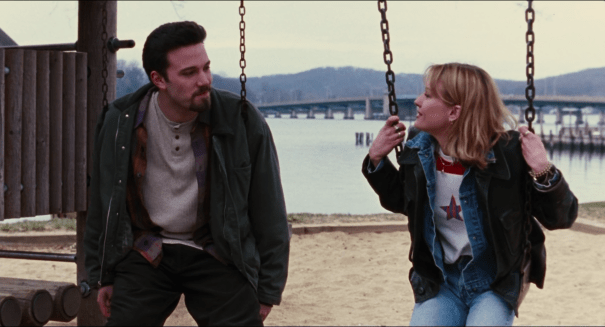
 Things weren’t going so hot for Kevin Smith after Mallrats, considering it made no money and everyone hated it. But there was one silver lining for Smith on his sophomore film: Joey Lauren Adams. The two met on the Mallrats set, and ended up dating for a while. It was only a few years before they split on amicable terms, but their romantic tryst ended up being the direct inspiration for Smith’s next film, a more dramatic turn taking a naked and honest look at relationships, specifically on how one’s insecurities can cloud and warp them. Made on an incredibly small budget, Chasing Amy turned out to be Smith’s second wind, with many critics being pleasantly surprised by his headier, more serious film. It showed that there was a little more that Smith had to offer than his usual crude fare, and although that’s pretty much the pond he continued to wade in for most of his ensuing career, Chasing Amy definitely displayed a new side of him.
As I mentioned before, Mallrats and Chasing Amy are the only two Kevin Smith movies in this series I haven’t watched since high school. And while I felt reasonably confident my thoughts on Mallrats wouldn’t change much from my memories of it (and they didn’t), I was curious to how I’d react to Chasing Amy. I could certainly see why a slow-moving romantic drama wouldn’t be that appealing to my teenage self, but I’m definitely more susceptible to this sort of film as an adult. I was also curious how much of a potentially cringe-worthy time capsule this would be in regards to its gay subject matter; the premise alone of a lesbian falling for a man seemed like it might not hold up super well. So after finally seeing it again, I’m definitely a little conflicted. I wouldn’t consider it a good movie, but there’s definitely quite a bit here that I think works well. It certainly feels like Smith’s voice is back in it after Mallrats, undoubtedly because of how personal the subject matter is to him, but the execution of the film is a bit of a mixed bag.
 Ben Affleck and Jason Lee jump from being Mallrats adversaries to long-time friends Holden and Banky, indie comic artists who have found decent success with “Bluntman and Chronic,” a crude superhero series partially inspired by Jay and Silent Bob. At a local convention, Holden is introduced to Alyssa (Joey Lauren Adams), and the two quickly hit it off. Clearly enamored, Holden is quick to accept an invitation to a night out at a club, only to be shocked to find Alyssa making out with an old (female) flame. After a brief period of disillusionment, Holden continues to hang out with Alyssa, until he finally breaks and confesses his love to her, and funnily enough, she reciprocates. Their relationship proceeds to be tested by Banky’s quiet animosity toward Alyssa in an over-protectiveness of his best friend, and Holden’s creeping insecurities of not being as exciting or experienced as his new partner.
Chasing Amy feels like an unusual hybrid, in that at its core it’s a interpersonal drama focused on a love triangle, but it also has Kevin Smith’s signature dialogue and all of his other familiar trappings. Having the film take place in the world of comic books is a clear Smith touch, carrying over from Mallrats, as the film opens at the rinky-dink looking Manhattan Comic-Con (New York Comic-Con wouldn’t start until nine years later). There’s another big Star Wars discussion within the first ten minutes of the movie, in case you forgot whose movie you’re watching. Over the opening credits, in a montage of comic book pages and panels, as well as newspapers clippings introducing us to the characters, we see Holden and Banky had initial success with their indie comic “37,” an obvious Clerks reference. Freeze-framing to one of the articles, the comic was based on the duo’s unsatisfactory experience working at a supermarket, again, mirroring Smith and Clerks. It’s almost like Smith purposefully opened the film with all these hallmarks before getting into the meat of the story he really wanted to tell. Also early on, the interconnected Smith universe gets even tighter, as Holden finds out that Alyssa used to date Caitlin Bree and attended Julie Dwyer’s funeral, and we get other references to the Quick Stop and the Eden Prairie mall. Even though the interweaving nature of these movies mostly boiled down to just passing references, I still like the idea of multiple stories featuring characters related to other characters sharing a universe. It’d be like if someone made a movie about your neighbor you barely knew anything about, and you were shocked to find out what their story was.
 So the elephant in the room for me in revisiting this movie was the handling of the gay subject matter, and as a straight man, I feel extremely confident talking about this issue. The verdict? Not as bad as I’d thought. Putting aside Banky’s raging homophobia (and possible closetedness) for now, the Holden/Alyssa relationship, on paper, is handled pretty well. After Holden learns of her sexuality, we get a scene of him questioning the mechanics and impulses behind lesbian sex, which is wildly ignorant, borderline offensive at times, but there’s a certain degree of naivety to Holden that it doesn’t feel like an attack on Alyssa. Later on, Alyssa understandably harshly rebuffs Holden’s declaration of love (“I am fucking gay!! That’s who I am! And you assume I can just turn all that around because you’ve got a fucking crush?!”), only to jump into his arms by the end of the scene. Cliche? Yeah, a bit. Unrealistic? Not entirely. I’m enough of a romantic to believe that one specific person can change how you see yourself, even down to your very core being. There’s a whole spectrum of sexuality that’s opened up in the relative mainstream since this movie’s release, predicated on all variety of different personal feelings and beliefs, so a self-professed lesbian realizing she has feelings for a man doesn’t seem all that strange. Alyssa talks about how she’s not really had the best experiences with men over the course of her life, but also how foolish it seems to close yourself off to half of the people in the world who might be your sole mate just by the basis of their sex or gender. She never found herself attracted to a man, but now, with this particular man, she does. This is basically her story of realizing she’s actually bisexual, which the movie basically all but says directly.
The ingredients are all here for a pretty solid story. I’ll easily admit, I am a sucker for a schmaltzy romance as long as I can get invested in the performances and the characters. I’m a big softie, so I can definitely get into a movie like this. But the biggest problem is that for a film that’s ostensibly about this incredibly intimate and emotional relationship between Holden and Alyssa, we really don’t see a whole lot of it. They meet, they have a couple scenes together that consist more of pithy banter than anything personally connecting, we have the scene where Holden interrogates Alyssa on her sexuality, and then a weirdly sparse montage of them hanging out, where Holden reads Time Out magazine on the steps of Washington Park with a bored Alyssa, as well as Holden presenting Alyssa with a hideous cake shaped like a topless blonde (BECAUSE SHE LIKES GIRLS, GET IT). So after that when Holden screams at Banky that he loves her, it’s hard for me to go along with it, since they read more like burgeoning friends to me. There’s only ten minutes difference between the scene where Holden confesses his deep, powerful love to Alyssa (“There isn’t another soul on this fucking planet who has ever made me half the person I am when I’m with you,”) and the scene where he debates her whether lesbian sex counts as real sex if there’s no penetration. There just isn’t enough runway here for this insanely deep romance-for-the-ages to have room to properly take off.
 That confession scene, earned or not, is a pretty solid, impassioned performance by Ben Affleck, I gotta give it to him. And Joey Lauren Adams too, with her rejoinder as well; the two of them are very, very good in this movie, digging deep to give emotional performances. The bare basics of the relationship that we do see are only made potent in part thanks to the fierce commitment of the two actors. It’s what’s written on the page that isn’t keeping up. Holden at one point muses about how he feels he hasn’t lived a particularly notable life, feeling he doesn’t have anything particular unique to say or express in his comic book (more speaking on Kevin Smith’s behalf, again), but it would have been nice to actually delve into those feelings more. There had to be some critical memories or introspective thoughts he could confess to Alyssa that makes us understand him more, and make us realize why he’s connecting with her so deeply. We don’t get that much more out of Alyssa; we learn about some of her past partners and their exciting sexual escapades, and we can go along with her wanting to move forward with her love life with a partner she exclusively loves in a more “normal” relationship. She feels Holden could be that person… but why? I’m not expecting them to explicitly say out loud why they love each other, but throughout the entire movie, I just felt this big disconnect between the great amount of unrivaled love they felt for one another, and what I was actually seeing on-screen.
It was hard for me to get much investment in the romance, but the turmoil surrounding it was more interesting. Holden gets distraught when Banky uncovers Alyssa’s high school nickname “Finger Cuffs,” which she “earned” while having sex with two guys at once. Having up to this point believed that he was the first man she was ever with, Holden isn’t too pleased with this discovery. While on a date at a hockey game and clearly stewing, he tries to casually bring up the topic of high school colleagues of the past to Alyssa, with her giving short answers in response. Eventually, enough is enough, and she loudly admits to what happened. It’s clear she knew all along what he was getting at, she just wasn’t going to play his game, and it’s a pretty great moment. Outside the arena, the two get into a screaming match, with Alyssa (rightfully) refusing to make excuses for the person she was (“Good or bad, they are my choices, and I am not making apologies for them now!”). The sexual experimentation of her past, the choices she made, what she did or did not end up enjoying, all of that made Alyssa into the person she is, the person that’s choosing Holden now, but Holden just can’t see past that, no matter how loudly she screams it. The more we hear from Alyssa, the more I wish the movie were about her, as her, her past, and her current dilemma certainly feel more interesting than Holden’s. Of course, it’d be a completely different movie, but it’s kind of a more interesting story. We only get one glimpse at life from Alyssa’s perspective, packaging comics with her lesbian friends, as she omits using pronouns in discussing her new relationship until she’s called out on it, finally admitting she’s seeing a man. The mood quickly sours after that. The idea of sexual identity as a social circle, and changing that leading to being ostracized is pretty fascinating, but we don’t see anything beyond this scene. Although the one bit that feels weird to me is where one of the woman salutes to their fallen comrade, one more in a line of gay women who’s been stolen away by a dude (“Another one bites the dust.”) In a movie whose content had mostly avoided it, that’s the one line I can point to that makes it feel like this is a “lesbian finds the right man” story. I thought it was pretty unnecessary.
 The third wheel hobbling along during all this is Banky Edwards (Jason Lee), Holden’s long time friend and collaborator, a hotheaded malcontent who is bothered by Holden and Alyssa’s relationship at the jump, even before it turns romantic. He’s also incredibly liberal with his homophobia, shouting about “fucking faggots” and rug-munching dykes at any given opportunity. It doesn’t go beyond anything other than cheap shots, or at best semi-good-natured ball breaking with he and Holden’s mutual gay friend Hooper X, but it’s definitely the most cringeworthy element of the movie looking back on it. Despite Jason Lee going as hard as Affleck and Adams in his heated scenes, it makes it really hard to sympathize with Banky when he’s pretty awful to virtually every character in the movie. However, one of the best scenes in the movie involves the only time Banky actually gets along with Alyssa. After he and Holden both first discover Alyssa’s sexuality, the latter being completely stunned, Banky is so tickled by his friend’s massive blunder, he puts his hate spewing aside to actually converse with Alyssa. The two end up swapping stories back and forth about injuries they suffered in past sexual encounters, with each tale getting more and more intense as they attempt to one-up the other until they both devolve into fits of tearful laughter. Lee and Adams are just wonderful in this scene, with their excited energy feeling truly authentic, and of course perfectly contrasted by a mopey Holden, who’s so in his own head he can’t even be bothered to react to them at all.
Banky’s sexuality is never made clear in the movie; he’s obviously extremely protective of Holden, but whether that’s a result of strong platonic love or an unrequited romantic one is up to the viewer’s interpretation. All Holden has to go off of is Hooper X’s gay-dar, and that seems to be enough to convince him that his best friend has been secretly pining for him for years. Just like with Holden and Alyssa, I wanted a little more back story, some meat to build onto Banky’s character to make me understand him better. He’s incredibly skeptical when Holden and Alyssa finally get together, affirming that “everybody has an agenda,” but we don’t really know why he’s so paranoid and untrusting. Instead, Banky basically feels like a slightly more accelerated version of Mallrats’ Brodie for the most part, cracking wise and pushing people’s buttons for kicks. There are a few points where Lee gets to slow down and get a little serious, and he’s pretty good with those scenes, like in his heart-to-heart (sort of) with Holden, which is the strongest hint at his deeper feelings for his friend (“She’s not going to ruin the comic.” “I wasn’t talking about the comic.”) But I still felt I wanted more out of their friendship. Comparing any Kevin Smith best friend duo to Dante and Randal seems like an inevitability, but it’s incredible how clearly their relationship is presented with hints of their past and personal interactions beyond the movie in the dialogue, and that feels more real and developed than either Holden & Alyssa or Holden & Banky in this movie that’s entirely about those relationships.
 After he and Alyssa’s big fight at the hockey match, when Holden is at his absolute lowest, he’s got to meet up with Jay and Silent Bob, seeking their regular cut of the likeness rights for “Bluntman and Chronic.” It’s pretty jarring when they show up, but they’re definitely more like their Clerks incarnations here than Mallrats, decently adapting to the tone of this film. Holden ends up relaying his romantic troubles to them, which Jay is less than sympathetic to (“There ain’t no such thing [as love]. You gotta boil it down to the essentials. It’s like Cube says: life ain’t nothin’ but bitches and money.”) Surprisingly, it’s Silent Bob who chimes up, telling his own related story about a woman named Amy that he used to date. In discussing their sexual past, Bob was aghast when she mentioned that she had had group sex with her last serious boyfriend, causing him to angrily drive her away out of his own insecure hang-ups, and how he now regrets it, feeling he’s spent every moment since then “chasing Amy,” giving us the film’s namesake.
This whole scene is basically Kevin Smith reiterating the point of the movie, as well as literally giving voice to his own feelings (“I am not used to this sort of thing. I mean, I was raised Catholic, for God’s sake.”) But I don’t really know how well this moment works considering what Bob tells Holden is more or less what Alyssa told him in the scene just before. I feel like you do need this kind of breathing moment for Holden to have a chance to experience clarity in his situation, but watching it play out with Bob unfolding the story still felt a little derivative to me. I do kind of like how despite being told point blank what he should do with his problem by multiple people, Holden still thinks he has a better solution. Even someone as thick as Jay has it figured out better than he does (“Bitch tasted life, yo. Now she’s settling for your boring funny-book-making ass.”) Also, as an added note, Jason Mewes feels a little more muted and one-note than the last two films, which doesn’t hurt the scene, but definitely feels like a result of his increased drug use around this time. Kevin Smith’s relationship with Mewes and his demons could basically fill an entire book (or at least a lengthly series of blog posts he wrote about it after the fact). Getting him clean for the next two films as to not be a liability to the studio would prove to be their own unique challenges, but those are stories for another time.
 So we’re finally at our big climax. Holden gathers Alyssa and Banky to the apartment to finally hash things out, because, after much deliberation of all possible options, he thinks he’s found the foolproof solution to mend both of his relationships. How could he possibly hope to overcome his own feelings of sexual inexperience, prove his true unconditional love to Alyssa, and satisfy the seemingly unspoken sexual tension between him and Banky? Simple: a threesome. To Holden, this would fix everything: he’d have a little taste of Alyssa’s past “deviant” world, experiencing it together with her, and he and Banky’s will-they-won’t-they would finally be resolved, and they could go back to the way things were. To him, this is a perfect plan. But of course, he’s a fucking idiot, and Banky, and especially Alyssa, knows it. Adams is just brilliant during this scene, knowing what’s coming from a mile away, sitting there with a cigarette, meekly telling Holden, “Don’t…” She doesn’t want him to say it, she would love to be wrong, but she knows he’s going to. Holden is dumbfounded by Alyssa’s “no,” telling her he thought she would be receptive to his plan, given her sexual history. Alyssa, silently seething, replies, “You did. What does that say about me?”
This resolution is pretty excellent, with the movie culminating in Holden coming to the absolute worst conclusion. It’s the logical vs. the emotional, with him desperately trying to come up with resolutions to his own feelings, and those of the two people that mean the most to him, thinking this one act will address and solve every problem. But real life is never that simple. Alyssa tearfully explains to Holden that this proposed threesome would only complicate things further, that he would find some small moment or detail of their sexual congress to obsess over, or if not that, it would be something else. And it’s true. If Holden’s not getting it now, he’s just never gonna get it. He says aloud that he doesn’t understand how this idea is any different than any of the stuff Alyssa used to do, but that’s just it, she “used” to do those things. Alyssa tells him that’s not who she is anymore, but if these are things he wants to do, she doesn’t want any part of it, because what she found down that road brought her no happiness. After a parting hug and slap across the face, Alyssa leaves, as does Banky, with Holden all on his own, his whole life pretty much crumbled before him by his own doing. This ending really makes me wish I cared more about the characters, it seems like it would be so much more devastating if that were the case. Instead, like a lot of this movie, it’s emotional in generality, not in anything specific to the movie itself.
 In a short epilogue taking place a year later, we see Holden and Banky have parted way, with the former signing over full “Bluntman and Chronic” rights over to the latter. Banky and Alyssa are at different corners of an Artist Alley at a con, both of whom get an unexpected appearance by Holden. For Banky, the reunion is only from afar, with the two exchanging affirming smiles as Holden holds up a copy of Banky’s newest original comic. With Alyssa, Holden appears to drop off an issue of his newest work, “Chasing Amy,” featuring cover art with a woman remarkably similar to her. Their interaction is very sweet and muted, with Holden wanting to share this accomplishment, finally having something personal to write about, and casually asking to contact him later once she’s read it, just keeping the door open a tiny crack that they might rekindle any kind of relationship in the future. It’s a nice ending, giving you just enough closure with the three that you need to see they’ve all grown and moved on from the events of the movie.
Chasing Amy was definitely a successful experiment for Kevin Smith in terms of jump-starting his career back up again, but I’m not sure how successful it stands as a movie. Like I said, its biggest strike for me is the romance at the center of it being rushed and undeveloped, which is kind of weird because the movie also feels too long, with some of Smith’s dialogue coming off overbearing and repetitive that some scenes felt like they could have been easily trimmed without losing much meaning. I actually was kind of bored through a decent amount of it. But then there’d be those moments that would actually work, mostly thanks to the dedicated performance work of Affleck, Adams and Lee, and the beating heart of the movie would shine through. I’m glad I got to see it again with fresh eyes, and I can appreciate it for the real life story and feelings that inspired it, but I’ll probably never watch it again.
 Me Blog Write Good
Very nice overview.
I haven’t seen ‘Chasing Amy’ in more than twenty years and I remember liking it but not quite getting it as a teen, though I did like Joey Lauren Adams. I’m surprised she didn’t become a bigger star but I guess Rene Zellweger (who she uncannily resembles in looks and style) hit it big in the late 90s and there was only room for one.
I do think I’d like to give it another go. It sounds a more difficult but potentially more rewarding film than ‘Mallrats’ and I think I might be able to appreciate it more even if it didn’t quite click for you.
You probably already know this Mike but Alyssa interacts with Dante and Randal in ‘Clerks: The Missing Scene’ where she is a mourner at Julie Dwyer’s wake. It was written up as a comic and included in the ‘Clerks’ comic trade paperback.