586. Much Apu About Something

Original airdate: January 17, 2016

The premise:
Sanjay hands down his share of the Kwik-E-Mart to his now college graduate son Jamshed, who proceeds to reinvent the convenience store as a trendy health food market.

The reaction: For a show to run for almost three decades now, and make absolutely zero effort to introduce any change, you end up with running jokes, show elements, and even whole characters who start to feel out of date. Apu is one such example. Born from a simple stereotype of an Indian convenience store clerk, he has since grown into a more nuanced character, but seeing him after all these years, as television has grown more and more diverse, a hilarious Indian caricature voiced by a white guy seems a little bit off (the show has also done some offensive, borderline racist jokes with Apu over the past decade as well.) I only bring this up because the show calls this out directly, as Jamshed butts heads with Apu, calling him out on his exaggerated stereotyped persona. It felt like another example of the show pointing out the laziness of their writing and feeling like that excuses it, but to me, it just makes things worse. Not-so-little Jamshed makes his return, as does Sanjay, having both been absent for over fifteen years. “Jay,” as he likes to be called now, is a recent Wharton graduate, and seeks to completely overhaul the Kwik-E-Mart into a healthy “Quick-N-Fresh” store. So what’s the point of all this? With Jay, I was vaguely reminded of Aziz Ansari’s Master of None, which features his complicated relationship with his traditional immigrant parents. It’s a rich topic, and that show is consistently hilarious in dealing with it (helped in no small part with Ansari’s father playing himself, who is just the best.) But we don’t get anything like this. Jay is just a venue for them to make first draft hipster/millennial jokes (“Swipe left on that accusation, bro!”) Didn’t this show have its fill already after that Portlandia episode? We’re at the point where these episodes feel so empty, they’re about nothing and they’re saying nothing. We get nothing new from the Jay character, his store is filled with limp health food jokes we’ve seen several times before, and we learn nothing about Apu except he had a stupid addiction to scratcher tickets. Meanwhile, a subplot involves Bart promising Homer he’ll give up pranking, he does, and then in the end, he starts pranking again. This show is like an empty void.

Three items of note:
– This episode features Tress MacNeille doing a few lines as Manjula, her first speaking role since the death of Jan Hooks. I guess that puts her in the same category of Lunchlady Doris… sorry, Lunchlady Dora as replaceable guest stars. Why not write her out like they did with Mrs. Krabappel? Again, I really don’t understand what the line is. What separates performers like Phil Hartman and Marcia Wallace from the likes of Hooks or Doris Grau?
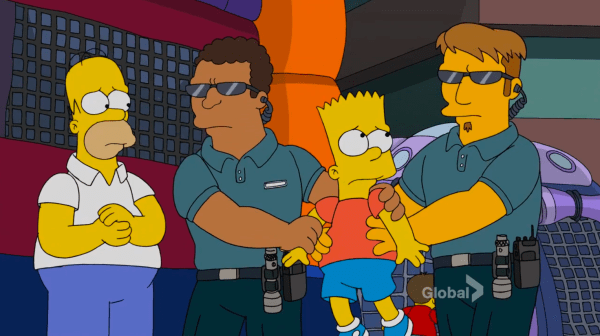
– Because I guess the show didn’t get its fill from an entire Treehouse of Horror segment out of it, we get a stupid Clockwork Orange moment when Bart is convinced to prank once more. He stares at camera as music from the film plays, which is all you need. We get what this is referencing. It’s halfway decent in context. But as always, we need to both push it too far, and acknowledge what we’re referencing. So Bart puts fake lashes on his eye like the protagonist of the film, and Homer comments, “I never should have bought that Clockwork Orange video for his fifth birthday! I thought it would help him tell time!” Also, what a belabored set-up for such a weak joke. But I expect nothing less from this show.
– Apu getting called out for being a stereotype is nothing new. Remember “Team Homer” with the bowling team The Stereotypes? (“They begged me to join their team! Begged me!”) Luigi was on said team, who shows up as a capper to the scene where Apu and Jay square off, where the joke is he says he doesn’t like stereotypes, but he totally is one! That’s what I mean when I say all this feels wrong. All of this material the show has already pushed to the nth degree. By season 7 and 8, the show was already ripping itself inside out, making fun of its running gags and being very meta and self-conscious about show hallmarks. That’s why a character like Apu feels almost like a relic to me, but he’s untouchable not only because the series is such a hallmark, but the show doesn’t change anything regardless unless a cast member dies, and sometimes not even then (see: above). I’m interested in seeing the documentary The Trouble With Apu by comedian Hari Hondabolu to see a different perspective on the character. I guess the larger point for me is that I mostly feel about Apu like I do with everything else about the show: it’s all played out, it’ll never change, and it should have died years ago.

One good line/moment: Bart and Lisa teasing Grampa, making him think his hearing aid was busted was pretty cute. It’s always nice seeing them getting along. The context is that Bart is actually getting good grades now that he isn’t pranking, but is ignored by his parents, which Lisa fully relates to. But isn’t messing with Grampa sort of like pranking? Or is that just child-like fun? Oh, whatever.
585. Teenage Mutant Milk-Caused Hurdles

Original airdate: January 10, 2016

The premise:
Bart falls for his new military vet teacher, but must combat with Skinner for her affections. Meanwhile, he and Lisa deal with accelerated puberty thanks to hormone-blasted “Buzz Milk.”

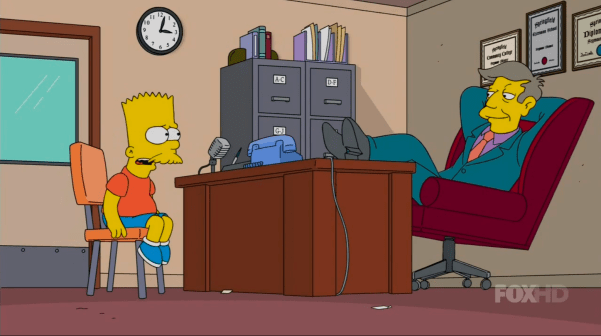
The reaction: “Tell, not show” is not just commonplace in episodes these days, it’s the fundamental piece of bedrock the show sits on. It’s to the point where I’ve tried to stop complaining about it so much, but it seems like it just keeps getting more and more egregious. This episode is a pretty awful example, featuring piles of exposition performed as characters inner monologues. Bart’s new teacher is a beautiful badass war vet who quickly wins over the room by how cool she seems to be. In case you can’t figure out why Bart would be smitten by this by, you know, his behavior on screen, his mind tells you for us, like we’re listening to descriptive captions (“What am I doing? I’m sitting up straight, my hands are folded like a nerd! Now one’s up in the air!”) The next morning, Bart is well groomed to impress Sofia Vergara (who voices the new teacher, whose name I won’t bother to look up), and Marge exposits some more (“Hair combed? Face washed?”) There’s not even a funny third observation, it’s literally just saying aloud what’s on screen. It’s all over this episode, moreso than usual. So what happens is that by way of hormone-tainted milk, Lisa gets a bunch of zits and Bart starts growing a mustache (which looks incredibly disturbing, as seen above). To disguise her facial blemishes, Lisa takes to wearing make-up, which makes her a hit on the playground. The progression of her “plot” is 90% internal monologue (“Oh my God, I’m popular! Hope this doesn’t go to my head. …it went right to my head!”) Later on, she’s all tarted up at a cool kids party, then notices it’s about to rain, and we get twenty seconds of her thinking what’s going to happen when she’s exposed, and decides to just come clean. When she gives her rambling, nothing speech to the other guests, someone off-screen yells, “Is there a point to this?” Is that the audience surrogate? The main story involves Bart and Skinner fighting for Vergara’s affections. It reminded me slightly of that episode a few seasons back of the Kristen Wiig art teacher inexplicably being interested in Skinner. There’s one brief scene of Skinner and Vergara bonding over having both served in the military, so at least there’s somewhat of a connection there, but it doesn’t really matter. But this plot of a boy and his principal fighting over a woman, their jabs and one-ups at each other… it felt like such a sitcomy premise, the kind this show used to make fun of. Among many of this show’s sins, one of its biggest is embracing the old TV tropes and conventions it used to gleefully satirize. Rather than feel above such common television trappings, the show is now content to wallow in the conventional, non-challenging ooze.

Three items of note:
– This episode I guess is the first to really address what has become of Bart’s class now that Mrs. Krabappel is gone. We start with Willie as an ineffective substitute, then they bring in Vergara. By the end of the episode, she breaks up with Skinner after taking one look at his mother, and our final tag features a throwaway line about her re-enlisting to Afghanistan to get away from them all. You figure at some point the writers are gonna have to bite the bullet and come up with some solution to this vacancy in the cast. A new character, maybe? But that would be too hard, considering this show has just been recycling the same jokes from the same batch of characters from the first ten seasons for about fifteen years now. I don’t know for sure, but I’m almost positive that over the next few seasons, there will still be no new fourth grade teacher. Again, writing new things is very hard, so why bother?
– As mentioned, the constant exposition is absolutely rampant here. Homer drives along singing what his BAC level is, passes by Wiggum, and he comments on what Homer just said. Then Marge appears in a thought bubble and tells him to pick up milk (“And not just any milk. Healthy milk, without any hormones!”) She holds up the carton and there’s a brief pause, so I guess you can laugh or something. Then as we get another close-up of the same carton as Homer walks it to the counter, we get an ADR line (“Woo-hoo! I’m running a basic errand!”) The amount of time that passes between reiterating what’s happening in the story is getting shorter and shorter.
– Homer teaches Bart to shave, which inevitably reminded me of the same sequence from “One Fish, Two Fish, Blowfish, Blue Fish.” Great relatable bits like Homer tending to his many bleeding areas and freaking out after applying aftershave are replaced with him wanting to eat shaving cream because that darn Homer sure loves food! He’s also a big dummy because he shaves with the razor strip still on, so then he actually shaves his beard and reveals a creepy-looking chin. He runs to show it off to Marge, but his beard reappears off-screen during a cutaway. Wasn’t it funnier, and visually more interesting, seeing Homer’s beard reappear mere seconds after shaving it with an audible ‘pop’ noise in “Some Enchanted Evening”? Honestly, I really try to avoid doing direct comparisons, especially with similar jokes, but when the parallels are this close, I can’t help but think back to how much sharper and smarter the humor was back then.

One good line/moment: Another outsourced couch gag, this time done by British animator Steve Cutts. “La-Z Rider” is a pastiche of 1980s pop culture, mostly Miami Vice, featuring tough cop Homer and his partner, his cybernetic couch, kicking ass and taking names set to “Push It To The Limit.” It’s a truly bizarre, but wonderfully executed sequence, really fun and imaginative. The level of creativity in guest pieces like this or the pixel opening is just so stunning, that you can just see the clear artistic divide between these and the episodes themselves. Even the couch gags over the last few years have been really dull and lazy, sometimes they ending before there’s even a clear punchline. It’s even more apparent in this instance. For whatever reason, they decided, seemingly last minute, they needed an in-universe “joke” to end the piece on, so we get the family on the couch, having just watched this fake opening title. A hastily animated Homer jots his arm forward to turn the TV off (“Damn reruns!”) Then Maggie rolls by in a little couch with a trail of flames, the other family members remaining static save for their pupils keyframing from right to left. Just lazy, lazy shit to immediately follow a beautifully animated sequence.

584. The Girl Code

Original airdate: January 3, 2016

The premise:
Lisa and her new radical coding teacher team up to create an app that will predict the real-world repercussions of impulsive social media posts. Case in point, a tongue-in-cheek Facebook post from Marge at the power plant gets Homer fired, and he ends up working as a dishwasher at a Greek diner.

The reaction: There’s certainly been an abundance of Lisa episodes lately. What fun. And this one kicks off like “Paths of Glory,” with Martin, Database and the other nerds scoffing at the idea of girls doing STEM stuff, which makes no sense for them to do. They’re taking a coding class (why the fuck a regressive dump like Springfield Elementary would be teaching this is beyond me), taught by a punk, no-nonsense instructor voiced by Kaitlin Olsen (another great talent wasted), who immediately takes to Lisa, and they end up working together to develop a new app with a team of female coders. With the instructor’s dismissal of “trouser browsers” and “dongle donkeys,” the episode is trying to be pro-feminist, but really has nothing to say other than “women can do this too.” Midway through the episode, they recreate the Silicon Valley opening titles as tribute to another show the writers love (once again, this is a reference, not a parody), but it only served to remind me how that show directly dealt with the issue of women in tech and actually said more than one thing about it. All we get here is that feminist coders dress alternative, have piercings, and perpetuate the stupid “offended by everything” stereotype. The app they create has a non-threatening British face to it, voiced by Stephen Merchant (another great talent wasted), but Lisa is shocked to find “Conrad” is actually sentient, and doesn’t want to live a life of servitude fixing stupid people’s mistakes before they make them. At first it’s unclear whether this is just a hallucination of Lisa’s sleep deprived brain, but turns out it’s actually real. Now Lisa must decide whether or not to set Conrad free. So now we’ve piled on the topic of artificial intelligence rights on top of our women in STEM episode? What is this? In the end, Lisa abides Conrad’s wish and faces her fellow coders (“We have a chance to show all the dongle donkeys that women coders can do something extraordinary! But you have to be tough!” “I am a strong female. But deep down, I’m more like Conrad: a fragile soul.”) I have no idea what I’m supposed to take away from this ending. I can’t even hazard a guess, if anyone wants to pull meaning from this, be my fucking guest. Lisa has become a retroactively hated character because of episodes like this, her acting as a smug and hollow liberal/feminist stereotype. The thing is, even though I agree with a lot of Lisa’s causes, these episodes are flaming hot garbage because they ultimately are saying nothing, and in some cases, actually end up sort of undermining what they’re claiming to glorify.

Three items of note:
– This has been a slow process over the years, but near the beginning of the episode, when Marge and Smithers have a conversation, you can really tell how off their voices are. Our actors are getting older, of course, but it seems Julie Kavner and Harry Shearer’s characters specifically seem to be getting hit the hardest. Kavner’s Marge just sounds weaker in general, while a lot of Shearer’s voices have gotten more low register.
– Homer is fired after Marge posts a picture of him holding a dripping ice cream cone in front of the cooling towers with the captain, ‘Meltdown at the Nuclear Plant!’ which raises Burns’s ire. Turned off by all the tech nonsense going on under his roof, Homer vows to return to the most low-tech job he ever had: dishwasher at a Greek diner. He gets buddy-buddy with the owner, and then embraces the Greek lifestyle or something. It’s basically multiple scenes polluted with Greek stereotypes. I guess he’s no less of a one-dimensional stereotypical restaurant owner than Luigi, but notice that Luigi hasn’t been given his own plot (at least not yet. Stay tuned for season 30, folks!)
– Displaying the various social media photos and their predicted consequences, Lisa displays a photo of Bob Belcher behind the counter, with the displayed consequence “Restaurant Boycotted by Short People.” I couldn’t understand what the gag was at first, then noticed the Burger of the Day chalkboard reading, “Short People Got No Braisin’ To Rib Burger.” I didn’t even think to read it. On Bob’s Burgers, the chalkboard is just a one-off gag that changes every week as a background joke. It’s not really a visual focal point. If Bob were gleefully holding up his burger in front of the sign center-frame, I could actually figure out what’s going on. And what’s the pun there? “Short People Got No Reason To Live”? I just looked it up and saw that it’s an old Randy Newman song, so alright, fair enough. The cameo just seems so random and pointless. Shots fired?

One good line/moment: I like how confused and incensed Burns gets when Smithers feebly attempts to explain Marge’s play on words in using the word ‘meltdown’ (“Wordplay is for crosswords and Kazurinskys! We produce atomic energy! We can’t joke about the m-word! How many people have seen this hate speech?”)

583. Barthood

Original airdate: December 13, 2015

The premise:
Bart’s life is chronicled from boy to man, exploring his strained relationship with Homer and his attempts to get out of Lisa’s more accomplished shadow.

The reaction: This is like if a flashback show and a future show had a baby, and it was a well-intentioned, but bland and meaningless mess. Bart’s upbringing is marked by the influences of two people: Homer not giving a shit about him, and everything he does being eclipsed by Lisa’s great successes. We start with the former, seeing li’l Bart continually ignored and cast aside by his father. We also see he has a much greater relationship with Abe, which is kind of sweet when we see it carry on into his adolescence. There’s even a somewhat illuminating moment between teenage Bart and Homer (who is smoking a bong with Wiggum for some reason.) Homer opens up about how he had Bart at such a young age and he always felt unprepared for the responsibility, as we have seen in the past. It’s a sweet, honest moment, but it’s basically just him saying this outright (tell, not show strikes again), and ultimately ends just repeating the same refrain of him undermining Bart. Meanwhile, from kid to adult, Bart always finds himself unfavorably compared to Lisa, who even ends up eclipsing him at his own high school graduation. Lisa blows up at him, sick of being blamed for his misery for their whole lives. She tells him he’s a great artist, though the only hint we saw of that is briefly seeing him do simplistic boardwalk caricatures, so we end with seeing Bart having his own bike repair shop, and he’s also a mural artist. There are scenes and moments here that might have actually felt somewhat impacting (if they were better written), but it would have helped if the episode had actually felt like it went through a progression. We see Bart grow up over twenty years, but each time jump he’s still dealing with the same problems, and explaining how he’s feeling exactly the same over and over and over again. It’s like watching an episode trapped in a time loop.

Three items of note:
– Like I said, Bart’s relationship with Abe was pretty sweet, especially him hiding out from the cops as a preteen after a night of shenanigans. It would have helped if Abe had actually imparted some wisdom that would have pushed the plot further, but instead that happens in a thought bubble after he’s dead, just flat out telling Bart what he should do. Finding out that Abe is dead also could have actually been a sweet, affecting moment given how much he meant to Bart, but instead, it’s treated as a “joke.” More like a fake out, as we see teen Bart bike past the retirement home to the neighboring cemetery, then he does a trick off another headstone and lands in front of Abe’s grave.
– If I can give this episode a little credit, this is the first time we’ve seen Bart, Lisa and the other kids in town as teenagers and it actually feels like they’re older. I remember in “Future-Drama” where you see a crowd shot of all the high school kids and it just looks like they pasted the kids heads onto teenage bodies. Milhouse’s maturing over the years was neat to see, Martin actually had a deeper voice, unlike previous appearances, and we get a disturbing line from Sherri after Bart thought he was making out with her twin (“The further we go, the more you’ll know the difference.”)
– Obviously the episode is based upon Boyhood, and it’s filled with small references to the film. The most prominent is during the party, some kids are tossing saw blades at the piano and a photo of Homer, a reference to the film where a bunch of kids are tossing blades into a piece of drywall. I remember watching the movie thinking something terrible was going to happen, like a kid was going to get seriously hurt or something, but it didn’t. Later in the film, he’s texting and driving after having told his mom he wouldn’t, and nothing happened there either. Boyhood was fascinating as an experiment, seeing these actors grow up as you watch, but ultimately it kind of felt like not much really happened to justify watching it. I guess it’s more similar to this episode than I thought. Plus, I couldn’t think of another thing to bring up, so there you go, my mini review of Boyhood.

One good line/moment: There were actually a few small moments here that I liked. Of all the future characters, I really enjoyed the brief appearance of a sad Disco Stu sitting alone at the boardwalk (“I used to think disco was coming back. Now I’m just Stu. Nothing Stu.”)

582. Paths of Glory

Original airdate: December 6, 2015

The premise:
Lisa seeks to clear the name of a disgraced female scientist from Springfield’s past. Meanwhile, Homer and Marge worry that Bart might be a sociopath because they’re stupid.

The reaction: Boy, this episode turned from dull to asinine real fast. We start out with what seems like a boring Lisa story: all the other boys become inexplicable sexists to chastise her for being a girl interested in science, then she learns about supposed crackpot lady scientist Amelia Vanderbuckle (or, rather, she reads her Wikipedia page for a minute of screen time), and then goes off to find her long lost great invention. Exciting stuff, huh? Bart tags along with her to an old insane asylum, where he discovers a diary of an old patient, filled with some pretty grim stories. He shares it with his classmates, Chief Wiggum finds Ralph reading them, then he gives the pages to Marge, believing that these are from Bart’s diary. Forget how he jumped to this conclusion, and how they’re not even in Bart’s handwriting, and sound nothing like him, but these pages are from a diary over a century old. They’re clearly very, very, very aged, but who gives a flying fuck about these stories making sense, eh? Marge, and then Homer, automatically assume Bart is a sociopath, but rather than actually do anything about it, they just let Bart get away with whatever he wants out of fear. Then later, they have Bart committed to an institution, which turns out to be a recruitment facility for the military wanting empathy-free kids to man their combat drones. Yeah. Homer and Marge are fucking awful people in this episode, not even attempting to do anything to help their child (“We’ve tried nothing and we’re all out of ideas!” comes to mind). When they appear sad and frazzled after locking Bart away, are we supposed to feel bad for them? Is this the show’s version of a farce? Lisa intersects with this premise briefly, asking her devastated parents where Bart is, feeling worried about their noncommittal answer, but then goes off to unveil Vanderbuckle’s invention. Who can worry about her incarcerated brother when she can bolster her self image? Bart is released when he expresses remorse after finding the simulated drones were actually real (or were they?), and everything is wrapped up as sloppily and half heartedly as the rest of the episode. More junk to throw on the pile.

Three items of note:
– I didn’t recognize the credited writer’s name and decided to look him up. This is the first and only episode written by Michael Ferris, whose previous credits include the third and fourth Terminator movies, and Catwoman, of which he won a Razzie for. He’s a Harvard Lampoon alumni like a lot of other classic Simpsons writers, but besides that, I’m not quite sure how he came about writing this. Not that it matters, of course, it doesn’t matter whose name is on the script, since eery episode ends up the same colorless slop by the time it airs.
– Fearing for her son’s sanity, Marge, instead of taking Bart to a psychiatrist, or an actual medical professional, opts to have him take an online test to see if he exhibits sociopathic tendencies. Conveniently labeled ‘SOCIOPATH TEST,’ Homer comments that they should give it a different name. Marge agrees. As usual, all of this is laboriously explained by our characters, in case we are watching after having undergone serious head trauma. Rather than print out a new page, they use a label maker to print a false title on the front page. Of course, this easily peels off and Bart discovers the truth. Now Bart gets to exposit too! (“Fine, I’ll pretend to be the biggest sociopath in the world!”) It’s scenes like this that really just boggle my mind. The writing on this show is just so, so fucking bad. How do they watch shit like this and think that it’s just fine?
– The sociopath kids in the army twist is so bizarre. It feels like something out of South Park, they pull the secret government program card quite often. But what are we supposed to take from all this? Bart took advantage of Homer and Marge’s frightened state in a hilarious montage where he drives Homer’s car, chucks baseballs at his face, and kicks him out of bed to sleep next to Marge (???), and they just openly let him. And again, they’re terrible parents for not trying to get Bart actual help. Instead, they send him away to an asylum they got from a 1-800 number at the bottom of the online test. What the fuck is this test and where did it come from? Bart is visibly scared when he’s sent away, and finally returns home almost in tears, and it’s basically his parents fault. This is two in a row for Marge being kind of a shitty parent, and it’s not a good look for her.

One good line/moment: Vanderbuckle’s invention turns out to be a sophisticated loom that is actually a calculator, accepting punch cards and generating a mathematical response. This as a concept is a clever idea, a traditionally feminine tool as disguise for a STEM invention. Too bad everything about the unveiling scene itself is awful, with the device having to be elaborately explained and the crowd going nuts about it for some reason. Lisa’s story ends with her desperately seeking validation for her ego, hunting down museum guests to look at the loom, and more specifically, her name on the plaque. Then we get our final tag of Homer using the loom to print Internet porn on. Those writers sure know how to ruin just about everything, don’t they?