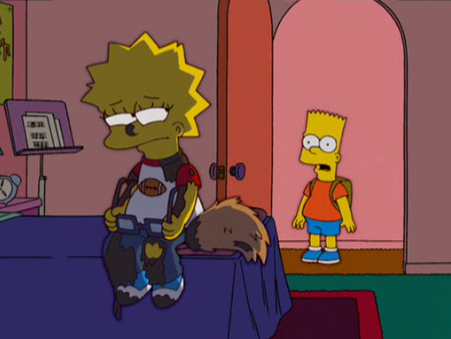
375. Girls Just Want To Have Sums

(originally aired April 30, 2006)
Ho-hum, another boring episode. It’s sad the series has gotten to this level of unremarkable where entire episodes (whole seasons, even) feel like they can be completely written off. The Simpsons see the Itchy & Scratchy musical, which is a big Lion King rip-off, and though a bit too on-the-nose, it’s probably the only interesting bit in the whole episode. After the show, Skinner has a bizarre conversation on stage with the director Juliane Krellner (or Julie Taymor, continuing the show’s tradition of taking a name, tweak it slightly, and there! Instant joke!) Here’s what’s said (“It’s no surprise you became such a success. You always got straight A’s in school!” “Well, I remember getting a B or two in math.” “Well, of course you did. You are a girl!”) I honestly can’t figure out why he would say that. The road to our main plot hinges on this, and it feels so flimsy, and eventually becomes nonsensical in multiple ways. People are outraged by Skinner’s accidental sexism and he’s replaced by a new principal (voiced by Frances MacDormand, another fine talent wasted), who jumps to the conclusion gender integration is to blame for the grading disparities between the sexes, and demands the school be split in two: a boy’s school and a girl’s school.

Lisa is excited for a challenge in girl’s math, but is shocked to find the class is focused on getting in touch with feelings and instilling confidence boosting (“What does a plus sign smell like? Is the number seven odd, or just different?”) On the surface, this is mildly clever, but I don’t get how we got to this point. If the offense was taken by statements that girls weren’t as smart as boys, what’s the deal with this class? I guess the response to the criticism was that women need to be split from the aggressive, rowdy men, except that doesn’t tie into wishy washy Skinner. Anyway, in order to get intellectual stimulation, Lisa masquerades as a boy, where the show reaches She’s the Man levels of comedy. I guess that’s not fair, She’s the Man is actually kind of charming and funny. By the end, Lisa receives an award for her outstanding mathematics and reveals her true identity. Bart stands up and declares he deserves the credit for teaching his sister to act like a boy, then Lisa throws the award at him, then she quickly realizes what she’s done and what she’s become. Except we never see any of that. Her truly blending in with the boys is told over a montage toward the end. Maybe if more time had been spent on that, showing her going native and being terrified of it, it could have been interesting. Instead it’s just a dry, dull affair.

Tidbits and Quotes
– The musical at the beginning has some good stuff in it, like the giant puppet knives and the guys in organ suits doing curtain calls at the end. I also like them alternating between using Itchy & Scratchy’s real voices, and their actually musically inclined equivalents.
– Exactly why Skinner so uniquely shot himself in the foot is strange to me, but I like his fumbling to cover up his missteps to a bunch of angry feminists (“It’s the differences, of which there are none, that make the sameness exceptional! Just tell me what to say!!”)
– I guess the school had the money to reconstruct the building, creating two separate entrances, two separate cafeterias, amongst other things.
– There’s a small running bit of Marge’s annoyance with Homer, thinking he believes women are mentally inferior. It’s silly and goes nowhere. We also get a flashback lifted from “Mr. Plow,” where we see young Marge studying for calculus before she’s whisked away by Homer, leaving her undereducated forever. It feels a bit more devastating than funny here, but the line following it is pretty good (“Since then, I haven’t been able to do any of the calculus I’ve encountered in my daily life!”)
– The boy’s school is a feral, violent, animalistic society, which I guess is the gag, but it wears thin pretty quickly. I like Nelson’s obsessive gun drawings, but that’s about it.
– Bart instructs Lisa how to be a boy in the third act. First he teaches her about eating dirty disgusting food off the floor. Then we get a Homer-Marge scene. Then we get Lisa’s final test: pick a fight with a boy. We hear her thoughts (“A fight! That would mean rejecting the last part of me that’s still a girl!”) That sure explains it. Also, what? We’ve seen none of that whatsoever in this episode. Maybe if we had, it would have been interesting seeing her transformation, but like modern Simpsons always says: tell, don’t show. Lisa gives a big speech at the end that’s supposed to be our message, about how she compromised everything she believed in, even though we didn’t see any of it, then they cut her off anyway, so if the show could care less, than I care even less than that. Whatever.

374. The Wettest Stories Ever Told

(originally aired April 23, 2006)
I really don’t like these anthology episodes, they’re just absolutely not interesting to me. They were mildly amusing and novel at first, going over Bible stories and tall tales, but now it’s just like random stories that the Simpsons happen to be in. This time it’s three stories that all involve boats. First is the Mayflower’s voyage to America, second the infamous mutiny on the Bounty, third is The Poseidon Adventure. It seemed like the idea with these episodes was putting our beloved characters in the roles of famous fictional or historical figures, like Milhouse as Moses or Homer as Odysseus. It doesn’t really apply in this case, it’s just going through the motions of these stories you sort of know, with Simpsons characters in it as they crack insufferable joke after joke. The first segment is about how Puritans talk funny and are crazy religious types, the second is Skinner vs. the kids a la “Skinner’s Sense of Snow,” and the third, I don’t even know what to make of it. The characters take the time to introduce the story and their roles within the story itself, so it couldn’t be more lazy. I can’t even pad this more than a paragraph, I feel nothing for these episodes. Just twenty minutes of white noise.

Tidbits and Quotes
– The wrap-around story involves the family waiting for their meal at the Frying Dutchman, and with Captain McAllister’s lack of knowledge of sea stories, the family takes their crack at telling some. Makes sense. The trilogy format also has started becoming self-referential, which for most running gags means it’s probably about time to stop doing it (“Homer, you can tell the third story. Bart will tell the second, which is usually the weakest.”) But why do that when you can run the same shit into the ground for years to come?
– Flanders is at the helm of the Mayflower, and with the joke being that the crew are religious fanatics, it’s quite the feat that they made Ned even more psychotically devout, whipping himself merely for acknowledging Marge is a woman, pouring salt into the wound as he does.
– I’ve been noticing over the past few seasons, but especially in this one, there’s an abundant use of “gay,” mostly by Homer, to be used as an insult. Bart and the bullies use it too, but at least it makes more sense with them since they’re kids, but even then, that alone doesn’t work as a joke. Think back to “Lisa’s Date with Density,” where the bullies taunt Nelson (“You kissed a girl? That is so gay!”) That’s using the slang term and making it ironic. But now, calling someone gay and homosexuality in general is kind of treated as a big goof. There’s three gay “jokes” here: Homer calling the ship the “Gayflower,” one of the kid’s drawing of Skinner making out with a merman, and at the ending with Bart saying Dolph is gay for Kearney. None of these are funny whatsoever. I’d hesitate calling it homophobic, but it just feels unnecessary and misguided.
– There’s one joke I chuckled at. Flanders goes down to the brig to find the crew drunk and gallivanting about (“Horseplay! Rough-housing! Horse-housing?!”) We see a drunken horse with a little house over him. A dumb visual gag, but it worked for what it was.
– As these are three stories that we’re generally familiar with, we get a lot of “hilarious-in-hindight” jokes: Homer mentioning how fundamentalists will rule America by the twenty-first century, Skinner’s incredulous nature about a possible mutiny (“On the Bounty?!”), and the entire first half of the third segment is literally all jokes about the ship will soon be tossed upside down.
– Similar to the last episode, there’s also many jokes involving Homer’s blind ignorance toward the misfortune of others. He celebrates the new year surrounded by dozens of dead shipmates, then he kicks Comic Book Guy into the water and ignores his dying plea after he had just saved his ass. What a guy!

373. Kiss Kiss, Bang Bangalore

(originally aired April 9, 2006)
With some of these episodes, I feel it’s enough of a review to just post the synopsis, as the stupidity and silliness as presented usually can speak for itself. There’s glimmers of interesting ideas in this episode, but they’re completed buried under nonsensical plot turns. We open with Burns announcing he’s outsourcing the plant to India, but he’ll need to hold on to one American employee. Who do you think that will be? I feel like “Homer gets picked for something he’s grossly unqualified for” is almost like a running gag, but like almost all the running gags in this series, it has run out of gas and just descended into goofiness. “Homer the Smithers” in season 7 was poking fun at this, now ten years later, Burns tosses a bouquet into the crowd to see who gets the position. He’s a smart businessman, why wouldn’t he just pick the most senior man? Doesn’t matter though, since this is a strange new kind of Burns. Not cartoon supervillain, not frail old man, but an unusually affable self-identified showman: making a big entrance in India, chumming it up with Homer… what happened to the joyless old miser? He’s long dead at this point.

So Homer is off to India, and despite knowing nothing about management or how to run a plant, he ends up doing fine at his job. Some of the gags are effective, like how the Indians seem to just be humoring Homer so they can get to work, or the many outsourced jobs Apu’s cousin has picked up, but the plot making no sense blares over any bright spots. Then we have our ending, where Homer believes he’s a god and the employees seemingly worship him. The entire third act is one great big “WHY.” Why does he think he’s a god? Because someone mentioned power corrupts and he says he’s a god. Why does he not think he’s a god anymore? Because he says so at the end. The end with the plant being “ruined” by the Indians finding out about American work benefits is kind of clever, but again, it makes no sense through the plot. How did they find out? They claim it was through a binding contract Homer gave out. How could he put together such a message? I feel the core idea of this episode is pretty strong and could have worked, but it’s in completely incapable hands.

Tidbits and Quotes
– The pro-outsourcing video is pretty good, with the American workers whining that their jobs are too hard (“Hey, America! Why not let some of the other countries carry their share of the load!”)
– It’s a small moment, but it bugs me when Lisa, or Bart, can identify things that no kid would be able to know about. How does Lisa know about Mac Tonight? Those commercials ran in the late 80s.
– The B-story involves Patty and Selma meeting the man of their dreams, Richard Dean Anderson, MacGyver himself. When he rejects their fanatical advances, they resort to kidnapping. Anderson is able to escape his confines just like his character, and finds it so thrilling that he has the sisters restrain him again and again, until even they get sick of him and come up with a plan to get rid of him. I like the idea of a revered celebrity getting on a fan’s nerves, like Stan Lee in “I Am Furious (Yellow),” and as a B-story, I’m willing to forgive the silliness a bit more. There’s a fair amount of mention of his other show Stargate, almost to the point that it feels like promotion. Anderson is a good sport, and he gives a pretty great performance. I certainly liked it more than the main story, but under it all, it almost feels too-little-too-late. When was the last time Patty and Selma even mentioned MacGyver? We barely see them anymore as it is.
– The best joke in the episode is when Homer must find Apu’s cousin: medium height, dark complexion, brown eyes, black hair. Shouldn’t be too hard to spot out in the middle of India.
– Patty and Selma return to their apartment to find Anderson is gone. Selma panics, claiming she can’t face jail. Patty shrewdly responds, “I can.” Because she’s a lesbian and she would love women’s prison! So her being gay is now her default character trait, I guess.
– There’s more weird jokes in this episode that we’ve seen in the past, of horrible things happening or being mentioned to Homer and him just shrugging them off or ignoring it. Bart calls his father in fear of a bully who breaks into the house, Marge mentions Chief Wiggum was mortally wounded, is any of this supposed to be funny?
– None of the ending makes any sense whatsoever. Why did they paint the tower like Homer’s face and dress like him? It’s just building to the big cop-out at the end, and then everything can go back to normal. And also the obligatory Bollywood ending, which doesn’t feel earned at all.

372. Million Dollar Abie

(originally aired April 2, 2006)
Another episode with no idea what it’s doing or what it’s supposed to be about. Some of these shows I find difficult to surmise. Is it about Grampa getting a new lease on life and living it to the fullest? Well the second half is, but it barely even feels like it. It’s just a bunch of ideas thrown together into something that vaguely resembles a coherent story. It starts with Homer succeeding at getting a football franchise in Springfield, which I guess is something that not only are we supposed to just accept, but it only serves as part of our first act. Abe roughs up the NFL commissioner thinking he’s a burglar, costing the town the game and making him a town pariah. He then resolves there’s nothing left for him but to kill himself. So the show’s tackling euthanasia now; there’s nothing grossly offensive about it, except that it gives no real commentary on the serious issue, and feels completely inconsequential. This episode’s like a pinball game, just batting around from one idea to the next.

Once Grampa decides to keep on living, the episode shifts gears once more: something needs to be done about the football stadium the town built, and it’s randomly suggested that it become a bull fighting ring, with Grampa volunteering to be a matador. All of this totally makes sense. Everything is so slapdash, each act feels like a completely different episode. So now the conflict is between Abe and Lisa, who is disappointed at her grandfather’s gross animal cruelty. Thankfully it feels more innocent than preachy, but the treacle is still pretty thick. Grampa says for the first time in his life people are cheering him, to which Lisa responds, “I was always cheering for you, Grampa. Until now.” Is that so? I wish the episode had led to this point even the slightest bit. In the end, Grampa frees the bulls, and they proceed to terrorize and gore the entire town. There’s a shit ton of filler here too: the Hollywood video, two music montages… the story is just so damn thin. But it doesn’t even have to be. Grampa having a near-death experience and wanting to live it up is a premise that’s rife with potential. Instead we get this, whatever it is.

Tidbits and Quotes
– The only specific thing I remember about this episode is that when it aired, they premiered the first teaser for The Simpsons Movie. It was a pretty simple teaser: panning across a giant ‘S’ so you thought it was for Superman Returns, but then pulling out to show Homer on the couch with a Superman shirt and undies on. Even back then, I was kinda disappointed considering how much they were hyping it.
– The Los Angeles pitch video is a full two minutes of complete time killing. All you need is the board to express disgust over Hollywood’s phoniness, which you could communicate with a flyer or a brief conversation or something. The joke in the pitch video is that LA is awesome and Springfield sucks, which grows tired instantly, and I’m just praying for it to end when we get to the “Springfield Blows” song. Everything just draaaaaaaaaggss.
– If anything, the town fucked themselves over by renaming all their street names, which is why the commissioner gets lost in the first place.
– I don’t know what to make of the euthanasia bit. I’ll say something like the diePod crosses over into “so-dumb-it’s-funny” for me, and I like the callback that the man the doctor had just killed was Wiggum’s brother-in-law, but all of it felt very uncomfortable, seeing one of our beloved characters about to die willfully. Then it’s swept under the rug rather quickly. Grampa inadvertently admits it to the family, who are shocked, then he assures them he’s fine, because he’s learned a lesson. Cut to him staring hopefully at the stars as saccharine music starts playing. It’s like someone spliced two different episodes together, the tone shifts so quickly it’s like whiplash.
– Everyone is so completely on board with the bull fighting idea, they cheer immediately for it. Why are they so psyched? Why is everyone so blood-thirsty in the third act?
– The tension builds as Grampa debates killing his first bull, then he finally does, with no sound effect. Were they trying to be dramatic and artsy, or did they just puss out? Meanwhile later there’s sounds of clothing ripping and flesh piercing as Luigi is gored by a group of bulls.
– The show ends with Grampa and Lisa floating on lawn chairs with balloons. Why? I dunno. Then we see some bulls have tied balloons to themselves and floated up too. What the ever loving fuck is happening?

371. Homer Simpson, This Is Your Wife

(originally aired March 26, 2006)
If there’s any series more in desperate need of some fresh creative blood, it’s this one. Writers come and go, but with Al Jean entering his twelfth year at the helm, the series seems to be in an endless stagnation. This couldn’t be more evident in this episode, “written” by Ricky Gervais. I use quotes because thanks to massive rewrites, the show to his name feels as homogenous as any other episode. The only evidence of his involvement comes from the character he voices, which is more or less another version of his normal role, a dogged, flustered man who attempts to make people laugh, but fails to recognize his audience. His humor style of awkward pauses and long silences doesn’t exactly gel well with modern Simpsons‘ joke-every-twenty-seconds mentality. This couldn’t be clearer in one scene where Gervais’s character Charles tells Marge a slightly offensive joke. In one of his own shows, it would be told uninterrupted, and the comedy would come from the recipient’s offense and Gervais’s endless backpedaling to cover himself. Here, Charles is interrupted many times by Marge’s inane commentary (“That’s just the set-up!” “Well, you’ve set me up for laughs down the road!”) Any attempts at alternate rhythms of humor are completely trampled upon.

This also is another episode with basically no story: to get the money for a flat screen TV, the Simpsons go on a reality show where two families swap wives, in this case with a British couple with a frosty marriage. Homer is stuck with a cold English harpy, while Marge lives with Charles, who becomes instantly smitten with her kindness. There’s barely any reality TV commentary here (wasn’t “Helter Shelter” enough?), so most of the episode is just seeing the families new lives. English prude Verity makes the Simpsons write reports and do chores, which is boring, and Charles attempts to woo Marge, having seemingly fallen in love with her based upon… she’s nice? That and Marge is apparently a total dummy (“I wrote this song for a woman: you.” “What an odd thing for a man who’s not interested in me to do!”) She’s always been naive to certain things, but I think she’d be able to pick up on this guy’s intentions. There’s a handful of other things to whine about, but largely this show is shockingly empty. I’d love to see whatever Gervais’s first draft was and see just how much they tore it down to size to fit in with the rest of the slop this season.

Tidbits and Quotes
– Lenny holds a party at his apartment. The guest list? Skinner, Krabappel, Sideshow Mel, Ned Flanders, Dr. Nick, the Van Houtens, the Hibberts, Professor Frink… basically all of your Springfield regulars. How do they all know Lenny? It’s more of that “everybody-knows-everybody” thing of later seasons that I hate so much.
– Why the fuck would Lenny allow Homer to live for days on his couch? I get that maybe he doesn’t want to be mean, but I can’t imagine this would go on more than a day before he would kick him the fuck out.
– In an irrelevant, out-of-nowhere joke, Homer completes collecting fifty years of The Family Circus, then throws the scrapbook in the fireplace. I’m confused, mostly at the fact that he’s gluing a comic into the book, then we see in the next shot that it’s taped in. Is anyone watching this shit?
– Gervais has already tackled exploitative reality shows on the Extras finale, which was a bit bloated at ninty minutes, but is still well done, and has an alternatively scathing and heartbreaking finale. It won’t be quite as powerful if you don’t know the context, but here it is. He’s hit or miss at times, but Gervais is a very strong writer, but in this episode, none of it is allowed to come through.
– I’m not big on Homer and Bart openly mooning the camera crew and this family they’ve just met, but it’s partially saved by this exchange (“Ugh! We better pixellate those.” “There aren’t enough pixels in the world!”) The cameraman’s panicked read is great. But in the spirit of ruining good jokes, they add on one too many (“Yeah, just cover it with Ryan Seacrest’s head.”) Oh snap!
– The only clever moment in the show is Homer’s summation of Charlie: “You take forever to say nothing.” It’s a great read of how one might see his kind of rambling humor.
– This show is just filled with awful, awful Marge lines. Again, it appears that no one knows how to write her as a normal human being anymore (“I don’t choose the committee as such, but I choose where they meet. This year, I’m thinking of Conference Room C.” “Oooh! That leaves A and B available for overflow!”)
– My only other laugh came from the quick bit of Itchy & Scratchy. They’re in old English garb, Scratchy is thrown into a guillotine… then Itchy shoots away at him with a Tommy gun.
– I’m sure Gervais’s song went untouched, but I’ve never been a fan of any of the comic songs he’s done. Except of course when he’s serenading Elmo. The sequence goes on foreeeeeeever, and it couldn’t be less funny. And then they extend it over the credits!
– On top of it all, the show gets a Homer-Marge relationship moment at the end. Marge says she misses Homer, and Charlie randomly says he does too, despite the fact that they met once. Marge explains why she loves him: “He’s loved me ever since the first moment he saw me, and he’s never stopped, and whatever it takes to make me happy, he’ll do it, even if it kills him.” Cut to when she returns home to find Homer with slices of pizza strapped to his bare legs. In the best moment of the show, she comes in with such joy, then sees the state her husband is in, and completely deflates (“…put your pants back on.”) It’s so unbelievably sad. Her delusions of her husband are completely swept away as she instantly realizes she’s once again stuck to this disgusting ape-like man who whines about having to spend time with their children. The end of the episode features Homer finally having got his stupid TV and singing about it, while Marge is clasping her pillow on her head trying to get some sleep. In the past you’d understand why these two are together. But now, I just don’t get it. I feel so bad for Marge in some of these shows.
– And on top of that we have our great finale: Varity has hooked up with Patty, joined by their mutual hatred of Homer! And Patty’s in a plaid shirt and jeans, dressed like a man! Because she’s a lesbian!