212. Mayored to the Mob

(originally aired December 20, 1998)
Well look at that, another job for Homer! I don’t know how these ideas came to be, but I’m guessing that someone in the writer’s room said, “Hey, wouldn’t it be funny if Homer was a bodyguard?” And before someone answered “no,” another writer had written an outline already. This is certainly not a terrible episode, but it has the same kind of ridiculous plot turns and circumstances that most Homer-gets-a-job shows have, the biggest of which being who in their right mind would entrust Homer Simpson with their lives and why so many people would just go along with it like it’s normal. The guy can’t even run down a city block without becoming exhausted, he’s going to be muscle to the mayor? The impetus for this premise begins at the Springfield comic convention, which has a few good gags, but it only reminds me of the infinitely better “Three Men and a Comic Book.” There, it was a small town rinky dink operation, here it’s this massive event with big time guest star Mark Hamill and characters like Willie and Lenny and Carl are inexplicably there. When a riot breaks out, Homer, with no real provocation at all, screams and bursts through the crowd to save a trapped Mayor Quimby and Hamill. Quimby proceeds to fire his two loafing bodyguards and hire Homer in their place.

I’m of the belief that you can make any kind of story work, and as improbable as it sounds, Homer the bodyguard could have worked. He could have some kind of specific drive toward wanting the job, train a little bit, do his fair share of expected bumbling, confront some believable conflict and eventually end up back at square one as status quo dictates. So why does Homer want to be a bodyguard? Because Mayor Quimby pointed at him. Does he have go through any hardships for the position? He does go through training, but that’s like a minute and a half of screen time and we don’t really see Homer in action, or caring about it at all. Before long, he’s donned in full black and exacting the sleeper hold on his wife and children. Never mind the cruelty, or the fact they reuse the joke over and over, but really? He learned that? At this point, Homer is not so much a character anymore as he is a vehicle for whatever joke the writers need.

The main conflict arises at the midway point with Fat Tony. When Homer finds Quimby is allowing him to supply the local school with rat’s milk, he demands the operation be shut down. Fat Tony is  not pleased and makes a very obvious death threat towards him, over public air waves, no less. To take his mind of violence and gangsters, Homer takes Quimby out to a dinner theatre performing Guys and Dolls (with leading man Mark Hamill), where of course Fat Tony is there. The stage is set for some kind of suspense, but instead they squander it by having henchman Louie do a ridiculous dance routine on stage before accosting Homer, and have the pay-off be that during the fight, Fat Tony was pummeling Quimby with a baseball bat. Out in the open. Come on. When you play your entire episode silly and over-the-top, you run the risk of falling hard when the jokes don’t work, and boy do a lot of them not work. There are a few shining moments here and there, particularly with Hamill, but a lot of this is just too big a mess to salvage.

Tidbits and Quotes
– Again, I’ll say the treatment of the comic convention in “Three Men” was a lot better. Springfield’s a small time nothing burg, the biggest star they could get was the guy who played Fallout Boy, who is currently doing community theater. Here, not only did they get Mark Hamill, but also Neil Armstrong, Dr. Smith, and ALF! ALF! Armstrong’s agent is appalled that his client’s booth is getting no play against the likes of Doctor Who and Godzilla, crying that he’s an actual sci-fi hero. Armstrong himself isn’t thrilled either (“This is one small step towards firing your ass!”)
– Comic Book Guy gets a shining moment, griping that some uninformed fool has mixed up two separate series of Spider-Man comics. He then comes across a nerdy girl and a potential love connection (“Tell me, how do you feel about forty-five year-old virgins who still live with their parents?” “Comb the Sweet-Tarts out of your beard and you’re on.” “Don’t try to change me, baby.”)
– Lenny desperately wants to act out Star Wars with Mark Hamill? Why? Willie critiques Frink’s lightsaber sounds. Why? Again, it’s just whatever characters we can cram into a scene, regardless if they would believably be there or not.
– Here’s a distasteful Homer line (“Oh my God! Someone has to go back in for Maggie!” “Forget Maggie! She’s gone!”) Now compare this to “City of New York vs. Homer Simpson” where Homer drives alongside the carriage telling Marge, “Throw the kids! No time for the baby!” Same kind of line, but different context. Homer’s paranoia about the city has turned him into a crazy madman, so the line there makes sense and is actually funny. What’s going on in this episode? Nothing. Homer’s just an inconsiderate asshole for some reason.
– Nothing at the bodyguard school is funny. Homer screaming because he has to do push-ups? Meh. And I guess they thought the instructor singing the theme from The Bodyguard was hysterical.
– The best bit of the show is Homer learning the ropes his first day on the job: whilst driving, be sure to slow down when you see a hot babe on the sidewalk so Quimby can do cat call them (“Good work, Simpson! I couldn’t be happier with the way that went.”)
– There are a few good Quimby lines here, like asking Fat Tony for a nondescript briefcase instead of a sack with a dollar sign, and his outrage at finding out about the rats (“You promised me dog or higher!”)
– There’s o much dumb suspense in this episode. Homer bursts into the school and we get like a dozen shots of everyone drinking milk and him looking disgusted. I do like how he spots Bart who is about to use the craziest crazy straw I’ve ever seen, and Homer has a few seconds before the liquid reaches his precious son’s mouth.
– Stupid, stupid, second act break where Quimby gets flung out the window, because it makes perfect sense for someone to set up their treadmill right in front of their open window, so the fresh air hits their back while they’re exercising.
– I cringed when Homer informed Quimby not to fear, as he’s the best bodyguard in the business. When did his self-confidence sky rocket so much? Remember in “Homer Defined” the absolute shame he felt at being acknowledged as a hero for saving the town accidentally? If that were a season 10 episode, he would lap up the praise and demand all the town’s riches.
– We get the first appearance of the Frank Nelson “Yesss!” guy. Somehow he sort of became a regular character, but I kind of like him. I just love that voice.
– We get the great joke at the entrance of the theater (Mark Hamill is Nathan Detroit, Peppered Steak is the Entree), which is made funnier when Hamill is confronting a showboating Louie (“Hey, pal. That’s my head shot up there next to the pepper steak, and don’t you forget it.”)
– I like Hamill’s despair of being pigeonholed as Luke Skywalker regardless of context, and he does give it his all with the songs. I still love “Luke, Be a Jedi Tonight.” In high school, I was doing stage crew for Guys and Dolls, and no matter how many times I heard “Luck, Be a Lady Tonight,” I’d still think about Hamill yammering on about Chewy and the Ewoks.
211. Homer Simpson in “Kidney Trouble”

(originally aired December 6, 1998)
It’s usually a good idea to make sure your protagonist is likable. You don’t want to keep him a saint, and there’s something to be said about the benefit of having an antihero lead, but in the case of a series like this, it helps if you’re on your main character’s side as he struggles with life’s many foibles. For almost the entirety of this episode, Homer is an awful, awful, awful human being. It’s this black cloud that hovers over the whole show. With all of the bizarre plot twists and poor attempts at humor through the tense situation, all I could focus on what a colossal ass Homer was. Going back to the antihero thing, one of my favorite episodes of South Park involves Kyle needing a kidney, and Cartman, being his only blood type match in town, says he’ll only give it up for ten million dollars. Cartman is a selfish, immature dickhead, but we still love him for it. He’s one of the greatest antiheroes in TV history. But seeing Homer act like this? Granted, Cartman is an extreme, but Homer is absolutely the most despicable we’ve ever seen him here, and that’s not a trait you really want associated with your hero.

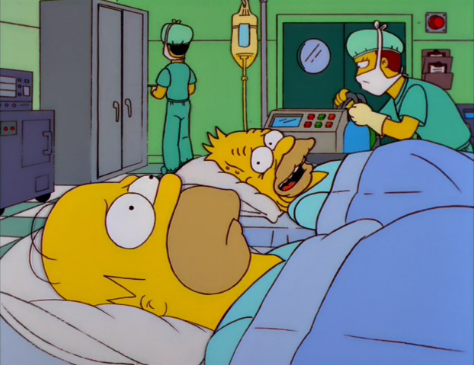
The only part of the show I like is the beginning at the ghost town, but even there, the jokes are hit and miss: for every great line from the tour guide and the ridiculous gun fight, there’s all the dumb robot jokes and Homer acting like an asshole. Grampa ends up tagging along when the Simpson car stalls in front of the retirement castle, a bit that could have been funny on its own, but it only serves to remind me how much worse Homer’s treatment of his father will get. On the way home, Homer ignores his father’s begging and pleading to stop to use the restroom, ultimately causing both his kidneys to burst. This early on, I felt like checking out. Seriously? I don’t expect realism from this show, but come on. So Homer is already pretty deplorable at this point, and giving up a kidney for his father is pretty much the only way he can get redemption. At least he promptly agrees to it when Hibbert brings it up to him. A talk about the danger associated with the operation at the bar gets Homer worried, and on the operating table, right after his father tearfully says he loves him, Homer leaps out the window and runs off in cowardice.

I don’t even know what to make of the third act. Ashamed to go back, Homer becomes a sailor for two minutes aboard the ship of lost souls, who each have their own tale of debauchery, but Homer’s story outrages them all and they cast him out. I’m just as disgusted with Homer as they are, so I’m in no mood for this wildly out-of-left-field shit to even know what to think of it. Homer eventually goes back to the hospital, gets back on the operating table… and then runs off again. When that car fell on him at the end, I was so happy. At that point, it would have been a more satisfying ending if he had died and Abe had taken both kidneys. And in the end, Homer is furious at his newly recovered father, a saint till the end. After watching this episode, I had to listen to the commentary to hear the defense. Of course being a Mike Scully-era commentary, there wasn’t much information to be had, but boy did they laugh loud and hard: after every dumb Homer line, at the ship of lost souls, each time Homer runs off… During the driving home sequence, Ron Hauge comments Homer’s behavior is “awfully cruel, it borders on making Homer unlikable.” Borders? And in response, Mike Scully just laughs. It’s pretty incredible to hear the people responsible for the show whooping it up over scenes you’ve just watched mouth agape. Bar none the worst episode so far, and probably one of the worst in the entire series.

Tidbits and Quotes
– I really do think the bit with Abe walking to the car like a zombie and Homer desperately trying to start the car could have been funny, but in any other episode that didn’t involve Homer willfully leaving his father to die.
– Bloodbath Gulch is rich in its history (“Founded by prostitutes in 1849, and serviced by prostitute express riders who could bring in a fresh prostitute from Saint Joe in three days, Bloodbath Gulch quickly became known as a place where a trail hand could spend a month’s pay in three minutes.”) Marge isn’t thrilled (“I never realized history was so filthy!” “First on our tour is the whore house, then we’ll visit the cathouse, the brothel, the bordello, and finally the old mission.” “Oh, thank heaven!” “Lots of prostitutes in there!”)
– The robot jokes here are nothing we haven’t seen before done better like in “Radio Bart” and “Selma’s Choice.” Also it doesn’t seem to make much sense that they have the robots just sitting out in the open for visitors to go up and mess with. And the saloon dancers have flesh colored robot asses? I guess maybe it makes sense given the seedy history of the town, but I dunno. This opening bit is the only thing this episode has going for it, and there’s still lots of stuff about it that seems wrong to me.
– The number of horrible Homer lines in the show is staggering: assuring Hibbert he knows more about medicine than him, telling Marge to blow up the hospital, and Homer moaning, “This is everyone’s fault but mine,” when it’s nobody’s fault but his. Really, did no one notice just how much of this episode comes off sour?
– I like the flashback of how “great” a father Abe was, using NyQuill to knock out little Homer.
– Homer washes ashore to conveniently witness a father and son building a sand castle. He vows he’ll go back to the hospital and go through with the operation. And just if you thought he wasn’t enough of an asshole, he walks right through the sand castle, destroying it.
– That car lands right on top of Homer. He didn’t even have time to duck, it crushed him. It seems if it was not fatal, he should be way more banged up than he was. And really, he’s got a kidney shaped scar on his side? I know some of these are smaller jokes I’m picking at, but this episode doesn’t even come close to earning laughs from absurdity. Never watch this episode, ever.

210. Lisa Gets An “A”

(originally aired November 23, 1998)
Similar to “Lard of the Dance,” this is a smaller Lisa story. These kinds of shows feel so alien amongst the bombastic and wacky hijinks that seem to be running rampant lately. And while I have less problems with this one than I did with “Lard,” there’s still something about it that keeps me from full emotional investment, as the episode seems to go too far with its quieter premise with an over-dramatic conclusion. The first half of the story seems to work, starting with Lisa being forced to stay home sick by her mother. With nothing to do, she ends up getting addicted to playing video games, leading her to purposely extending her leave of absence and ignoring her take-home assignment of reading The Wind and the Willows. It’s another great instance of showing how Lisa is still just a kid, and how even the most brainy, level-headed kids can get sucked into the tantalizing allure of platforming games. Though I’ll say it’s a tad unrelatable, because when I was in school, I never blew off schoolwork in exchange for playing Paper Mario for weekends on end. Nope. Never.

Lisa returns to school to face a test for the book she didn’t read, and she’s in deep, deep trouble. Her calling for a miracle leads her to Nelson, who holds hundreds of answer keys in his possession. It’s an interesting moral dilemma for her; upon receiving continuous accolades for her ill-gotten A+++, she goes from embarrassed modesty to a more seething displeasure. It isn’t long before Lisa has to confess, which she eventually does when Skinner informs her that her high mark raised the school’s GPA to the state’s minimum standard, making them eligible for a basic assistance grant. Now, here’s where the episode starts to lose it for me. Aside from it being absolutely ridiculous that one student’s grade on an inconsequential test was enough to boost the school average, Lisa’s reveal at the end of act two changes the emotional dynamic. It’s not really Lisa vs. herself, it’s Lisa vs. Skinner and Chalmers, who want to keep her hush hush for the good of the school. They present a bleeding heart case to her about improving school conditions, but I’m sure Lisa’s fully aware of their intentions to squander it, especially considering the exorbitant electronic scoreboard taking up all the space in Skinner’s office.

Lisa coming clean feels less of a personal vindication, but would it have been better to keep her secret to the very ending? Then we would have two whole acts of stuff building up to make her feel worse and worse, it’d be “Miracle on Evergreen Terrace” all over again. But I think there could have been a direction to go with this that could have added a new element to the plot and had Lisa’s remorse run in the background. While its title is riffing on “Bart Gets An ‘F,'” the plot holds more resemblance to “Bart the Genius,” with a Simpson kid cheating on a test and having to admit it at episode’s end. Maybe Lisa could have been moved up a grade, appreciated the new challenge and her new surroundings, but deep down know she was there under fraudulent circumstances. But the meat of the story is still pretty solid, albeit a little low impact. There’s also the B-story of Homer’s beloved pet lobster Pinchy, which is pretty aimless and stupid, but that’s exactly what you’d expect and want from that kind of premise. And who doesn’t love Pinchy? He blows Spider-Pig out of the water for title of Best One-Off Simpson Pet.

Tidbits and Quotes
– The free-sample supermarket set piece at the beginning is pretty empty. I smiled at some of the Ben & Jerry-esque ice cream flavor names though (“Candy Warhol? Xavier Nugat?” “Nah, nothing made of dead guys.”)
– They’re both stupid gags, but I like Homer evening out the levels of salt in the fish tank to accommodate Pinchy and the fish, and the callback to the supermarket in revealing he has a packet of cold tablets on a toothpick.
– I love the scene where Lisa first plays “Dash Dingo” and her complete derision and lack of interest in the whole affair. Cut to not long afterward and she’s a girl obsessed. That’s how it works…
– Great nightmare illustrating Lisa’s paranoia that her one bad test score would deny her admission to Harvard (“Nasty business, that zero. Naturally, Harvard’s doors are now closed to you, but I’ll pass your file along to… Brown.”) What a silly dream. Almost as silly as one high test score affording a school a grant. …oh wait.
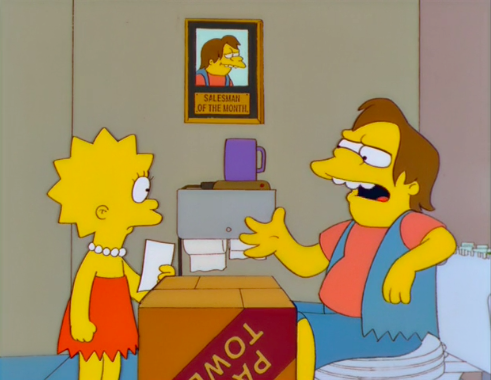
– My favorite part of the episode is Nelson’s makeshift bathroom office: his employee-of-the-month frame, keeping his files in the empty toilet tank, and insisting the purity of his business (“These are study aids. They’re for novelty purposes only. If a few bad apples use them for cheating, I can’t be held responsible.”) Also great is when he comes back in act two to further remind Lisa of her misdeeds (“Tomorrow’s fractions quiz. I’ll give you the numerators free, but the denominators are gonna cost ya’.”)
– Great bit on the bus illustrating the two mindsets of the Simpson children (“Cheer up, Lis. You got a good grade without even reading the book. That’s win-win!” “Can’t you see the difference between earning something honestly and getting it by fraud?” “Hmm, I suppose, maybe if… no. No, sorry, I thought I had it there for a second.”)
– As dumb as the entire third act dilemma is, I do love that all the ruckus is about a basic assistance grant. Fighting for the right to be proclaimed merely average.
– Great stuff showing the poor condition of the school, from the Oscar Meyer periodic table (“Who can tell me the atomic weight of bolognium?” “Delicious?” “Correct. I would also accept snacktacular.”) and the school’s only computer, a rusty old Coleco. And of course, we have the classic moment of Ralph saying “Super Nintendo Chalmers,” and “I’m learn-ding!”
– Part of me feels I shouldn’t like the Pinchy plot for the very reason I do like it, because it really is so dumb. But I really like Homer’s unusual affection toward the crustacean. The best scene is him dragging him along the beach and Pinchy getting schooled by a tiny hermit crab. Homer is incensed (“You don’t have to take that from no punk-ass crab!”) Then of course is the big finale when the lobster is accidentally boiled alive, and Homer must eat him in absolute misery (“Pinchy would have wanted it that way!”)
– The very end with the reveal of the phony ceremony before the real one is pretty stupid. The fake Comptroller is voiced by Harry Shearer, who also plays Otto, but am I supposed to believe Otto is a talented mimic? Plus such a realistic mask must have cost the poor, poor school a pretty penny, shouldn’t it have? But their ruse is pulled off and the real Comptroller hands Skinner his giant check (“I know a liquor store where we can cash this right now!”)

209. D’oh-in’ in the Wind

(originally aired November 15, 1998)
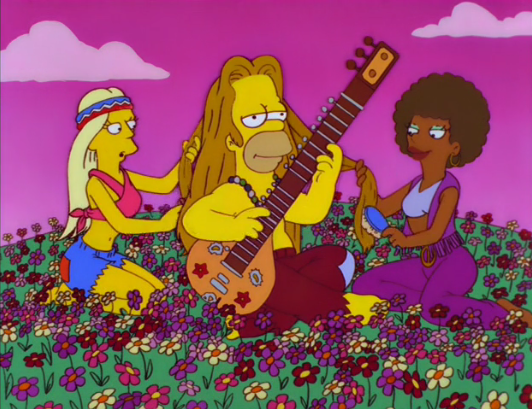
At this point, it seems I’m going to have to settle in with this new personality of Homer’s if I’m going to even remotely enjoy any of these episodes. Brash, misguided and strangely self-righteous, this new Homer has a more get-up-and-go attitude, diving head first into crazy new adventures. Not to say that he didn’t have his fair share of wild endeavors in the past, but the way it’s handled has changed. That being said, if the context is right, alternative characterization can actually make sense, and this episode is almost proof of that. It starts with Homer realizing he doesn’t know his own middle name, sparking a trip with his father to the old hippie commune his mother ran off to to dig up some answers. Inspired by this connection to his past and the laid back lifestyle of his mother’s old friends Seth and Munchie, Homer decides to become a hippie himself. Upon discovering his fellow hippies have “sold out” and run an organic juice plant, he encourages them to rekindle their golden years and let their freak flags fly.

Turning to a life of lazing about, not worrying about bathing or wearing proper attire? That lifestyle fits Homer to a T, and in that respect, I can totally buy this plot. But there’s other aspects to his hippiedom that don’t exactly add up or go anywhere. Trying to live up to his mother’s past is kind of a sweet premise that could have had some emotional weight, but it’s pretty much dropped after the first act. But that’s okay, I don’t expect a story like this to be very deep. But Homer seems way too energetic over his new outlook on life, parroting empty statements about peace, love and understanding. It’s like when someone tries to fit in with a certain group and everyone can tell he’s just trying to look cool even though he doesn’t have a clue what he’s saying. Then there’s his relationship with Seth and Munchie, who seem to like and put up with him at the start, but quickly become exasperated by him. They agree to go out with him to relive their pasts and “freak out squares,” but then they return home to find their latest juice shipment destroyed. Is this a comment on how you can’t go back to your past and must focus on your present? No, it was Homer’s stupid frisbee jammed in one of the machines. What a wacky character.

Homer tries to make things right by reproducing the spoiled juice and shipping it out all over town. But unfortunately, he used crops from Seth and Munchie’s “personal supply,” causing the people of Springfield to start tripping balls. Police arrive at the commune, and Homer ends up shot in the face with a flower. So yeah, this episode’s got its fair share of dumb elements, like Homer’s ramped up enthusiasm, but it’s definitely the best I’ve seen so far from season 10. It had a bunch of laughs from beginning to end, and I can see Homer indulging in the hippie lifestyle far more than I can see him in some of the many absurd jobs we’ll see him hold down the road. Also props to Martin Mull and the great George Carlin who do great work here. Oh, and cool psychedelic ending theme done by Yo La Tengo. A flawed, but still mostly enjoyable episode.

Tidbits and Quotes
– The power plant recruitment commercial is pretty much a big dead zone, although I do like this exchange (“There were script problems from day one.” “Didn’t seem like anybody even read the script.” “That was the problem.”) At least it goes by pretty quick and it’s an adequate stepping stone to our main plot.
– Great reveal of Grampa stuck in the foyer having fallen over Bart’s skateboard. Homer just calls for him casually and no one bothers to help him out.
– In this episode, we learn what the “J” in Homer J. Simpson stands for. Pretty clever that it’s just “Jay,” a tribute to Rocky and Bullwinkle‘s Jay Ward, and his similarly named creations Bullwinkle J. Moose and Rocky J. Squirrel.
– It’s a dumb joke, but I love the reading of Homer’s slow, contented “Ouuuuuuucccchhh” when he nonchalantly stick his hand in a bee hive.
– Wonderful flashback to Woodstock with a wonderful portrayal of a younger Abe Simpson, the stuffiest of stuffed shirts played against his much more liberal wife and naked son playing in the mud. Abe is not pleased (“Put some damn pants on, and then pull ’em down! ‘Cause it’s time for a spanking!”) Dan Castellaneta does a great job as always playing his characters younger.
– I don’t know if I care for the implications about Homer’s mother being promiscuous. I mean, I’m sure it happened, but given the sweet matronly image in our minds from “Mother Simpson,” it’s something I’d rather not think about.
– I’ve always loved Munchie’s line about selling their old hippie bus (“In a way, the sixties ended the day we sold it: December 31st, 1969.”)
– Homer, Seth and Munchie show up at school to decree the “conformity factory” closed. The kids all run out cheering. Cut to a displeased Skinner (“Fifteen years of loyal service and this is how they tell me? A jester with an invisible proclamation?”)
– Great bit of news from Kent Brockman (“Stunned league officials say point-shaving may have occurred in as many as three Harlem Globetrotters games.”)
– Highlights of the town-wide freakout consist of Grampa and Jasper reverted to acting like Beavis and Butt-head and Lou spinning around in his chair at the station (“The electric yellow has got me by the brain banana!”)
– Fantastic deadpan reading from George Carlin to the police responding to Homer’s insanity (“You can smash this drug barn all you want, but first you’ll have to smash our heads open like ripe melons!” “This man does not represent us.”)
– The ending is pretty darn silly, but it’s still kind of funny (“He was lucky. If that had been a gladiola, he’d be dead right now.” “Why don’t you just pull it out?” “I’m a doctor, not a gardener!” “Can’t you just prune some of the leaves so I can watch TV?” “What did I just say?”)

208. When You Dish Upon A Star

(originally aired November 8, 1998)
Let’s talk about the role celebrities play on this show. This is a series that skewers all elements of American society, and the media elite is a humungous prime target. Along with the dozens of pop culture digs they make in every show, whenever a celebrity does a guest voice as themselves, they’re always subject to some level of mockery or derision. James Taylor is surprisingly disgruntled, Dick Cavett is a fame whore leech, Ernest Bourgnine ends up lost in the woods and presumably killed. Sure, the writers respected anyone who would be nice enough to do the show, but the humor was always sharp that even with mocking them, it still felt sincere and appreciative. They felt like they could have it both ways. Now we have this episode, where the celebrities are the stars: Alec Baldwin and Kim Basinger are presented in the highest, most holiest of lights, more so than any other guest star. There’s lots of problems with this trash heap, but the first being that the gentlest of kid gloves are used here in handling these two. Be it characters saying it, or the rarefied air throughout the episode, they’re presented as such great people. Bleeeccch.

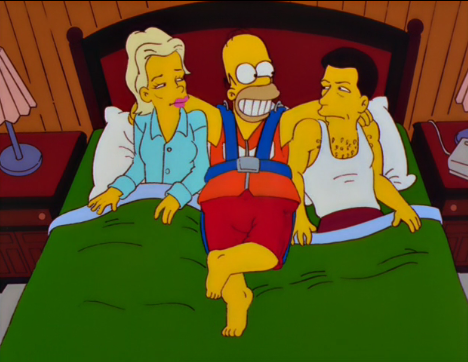
So through a bonehead mishap, Homer winds smackdab in the bedroom of Baldwin and Basinger’s secluded Springfield estate, where they’re residing to get away from the hustle and bustle of Hollywood. Then somehow Homer winds up their servant/friend/something. He doesn’t appear to be starstruck at all upon meeting them, and becomes incredibly annoying and options to work for them apropos of nothing. He really becomes this big suck-up that they can’t get rid of, which actually could have been a little interesting, except here Baldwin and Basinger really like him for some reason. Aside from Jerkass Homer present through the whole show, this is a fatal flaw here. Homer is most lovable when he’s a down-on-his-luck schlub. Like the common man, it seems the whole world is against him, and we cheer on when he manages to achieve something despite himself. Here, he’s playing badminton with celebrities and having a grand old time. It’s like polar opposite interpretations. Later when the celebrities “fire” him, he’s gotten used to the high life and believes he’s better than his commoner family. He even turns down Marge’s bargain basement sloppy Joes. Homer turning down food of any kind? Ridiculous.

There’s not much I can praise this episode for. I guess the only bright spot is Ron Howard and his inexplicable alcoholism, and how he shamelessly steals Homer’s movie pitch at the very end. Unlike the other two celebs, I guess the writers felt he wasn’t high profile enough so they could rip on him a bit, even enough to have him back next season for no apparent reason. There’s some mocking of society’s obsession with celebrity culture in the mob of Springfieldians flocking to the celebrity home, and later indulging in Homer’s perverted museum of oddities, but it all feels either really obvious or real softball stuff that could have been crammed into any episode. A lot of terrible changes occurred during the Mike Scully years, and it’s not clear who to blame, but one big thing was not only the sharp increase in amount of random celebrity guests, but in having them on and treating them with the utmost reverence. So you’re gonna have Britney Spears, Richard Gere and the Rolling Stones on just so you can kiss their asses and say how cool they are? That’s not The Simpsons. That’s Entertainment fucking Tonight. Fuck this episode.

Tidbits and Quotes
– I feel I should like Homer’s Yogi Bear dream at the beginning, but for some reason, I don’t. I do like his recollection of it when he wakes up (“I was having the most wonderful dream. I had a hat and a tie with no pants on.”)
– Nice moment in cartoon timing when Homer’s parachute gets ripped off in the trees, he floats in the air long enough to moan about it, then he plummets to the ground.
– Why the fuck didn’t Baldwin and Basinger have an assistant before? Or some means to get things if they’re running out of toilet paper and toothpaste? They could have all that shit mailed to them, they obviously have the funds and connections to do so.
– So… the Homer-can’t-read bit. What’s spectacular about this is a minute after that joke, we see Homer drive to the Kwik-E-Mart (in a Humvee for some reason. Presumably Baldwin and Basinger’s) and proceeds to read off a list to Apu. So since he clearly can read, the joke can be two things: either Homer felt he needed to make up a secret on the spot to impress the two celebrities, or Homer is so unbelievably stupid that he forgot he could read. I don’t like playing guessing games when it comes to a simple joke like this. Also the joke wasn’t funny, so fuck it.
– The bit with the Oscar polish and Baldwin whining that too much of it will take the finish off really reminds me of the bit where Krusty tries to come up with everyday problems for the average man (“You mean like when your lazy butler washes your sock garters and they’re still covered with schmutz?”)
– At some point, Homer morphed into this bizarre clingy guy who believes he’s super awesome and everybody’s best friend. He’s so annoying and bizarre in this episode, and many after it. Who thought this was a good character turn?
– Moe tricking Kirk Van Houten to climb the electric fence and get shocked right in front of his son is pretty cruel. I mean, even by Moe’s standards.
– I like during his incensed rant about celebrities, Homer name-drops Ray Bolger (“And when it’s time to do the dishes, where’s Ray Bolger? I’ll tell ya! Ray Bolger is looking out for Ray Bolger!”) Research reveals he was the Scarecrow in The Wizard of Oz. Also he’s been dead for twenty-five years.
– Why are Krusty and Sideshow Mel stooped outside the celebrity house? And when the celebrities leave and chase after Homer’s van, the crowd just stands there and watches. Wouldn’t they immediately flock the vehicle? And the car chase is so unbelievably dumb, the Humvee continues moving even when no one’s at the wheel, powered by magic, I guess.
– Homer’s final statements in court about the nature of celebrity is a pretty alright wrap-up to such a shit show (“If celebrities didn’t want people pawing through their garbage and saying they’re gay, they shouldn’t have tried to express themselves creatively. In closing, you people must realize that the public owns you for life! And when you’re dead, you’ll all be in commercials, dancing with vacuum cleaners.”) Also the restraining order keeping him five hundred feet from any celebrity sure worked out, didn’t it? How long before that got broken? About four more episodes before he’s bodyguard to Mark Hamill. Mmn.