217. I’m With Cupid

(originally aired February 14, 1999)
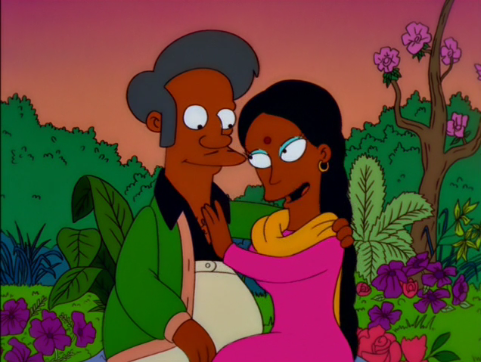
I feel this episode is kind of similar to “Homer to the Max” in that it also has a plot that does feel like it could work, but somehow it doesn’t. I’ll say it’s more on point story-wise, but said story proves to be not entirely that funny, and soon devolves into a ridiculous stupid ending and making our characters unlikeable. But I’d be hesitant to say either episode is terrible, but I also couldn’t choose which I thought was best: they’re both kinda… okay. We get our first look at Apu and Manjula’s marriage since their wedding last season, and find there’s trouble in paradise when Manjula finds out that eighteen-hour work days are not an American standard. The beginning certainly works with the couple inviting Homer and Marge to dinner, with some nice character stuff and things quickly becoming awkward when the marital spat ensues, with Marge thinking they should leave and Homer attempting to eavesdrop. This starts as a smaller, more intimate episode, and when it stays grounded, it works.

To make it up to his wife, Apu puts together a week’s worth of romantic surprises all leading up to the main event on Valentine’s Day. Training a bird to sing, tickets to the opera, encasing himself in chocolate, he spares no expense for his beloved, and inadvertently ends up making the other husbands of Springfield look bad. This results in a collective of them, spearheaded by Homer, spending their Valentine’s stalking Apu to try to sabotage his last big romantic gesture. They’re misguided and stupid, I get it, but it really does make you sort of root against Homer when he’s trying to thwart the earnest actions of one of his good friends. Also we have more roping in characters into scenarios for no real logical reason. Wiggum and Hibbert I can buy, but Flanders? The man who sung a beautiful Rod Stewart song in a heart costume to his wife? Even with his constant insistence against their mission, he should not be in that car. Also Moe is there, just ’cause. This is when characters stop feeling like characters and more like utilities for whatever jokes or flimsy premise needs to be held up.

The climax ensues when the husbands find out Apu’s plan: a love note in the sky done up by a skywriter. To thwart the mission, Homer hops aboard the skywriter’s plane and engages in an all-out fist fight with him. It’s already stupid enough before the skywriter flies the plane upside down, smashing Homer’s head into lampposts, bridges and other blunt object to try and kill him. Seeing a scene like this makes me think of instances of Homer getting hurt in the past, which seemed like a rarer occurrence than nowadays. The humor always seemed to come from something more than just the act of violence: Homer becomes too cocky while jumping over the Gorge so fate makes him fall down it twice, he tries to maintain a sense of bravery to his son whilst being pummeled by reindeer, Bart’s attempts to pin his father up against Milhouse’s mom’s new boyfriend by randomly smashing a chair on him in the tub. What’s happening at the end of this episode? Homer is a raving lunatic who purposely engages in a fight with this man and get brutally injured. And yet he still succeeds in the end when he does a perfect landing from the sky with roses for his wife. Homer famously succeeds despite himself, but it only really works if he tried at all to begin with. He spent all of Valentine’s Day trying to betray his friend and beat the crap out of an old man, but still wins. Anyway, the first two acts work well enough, and there’s some jokes to be had, but I’m still ambivalent about this one. Like I said, it’s alright, I guess. Just alright.

Tidbits and Quotes
– Apu is surprised when Marge mentions that all the other stores in town close so early (“At 11:30? But this is the peak hour for stoned teenagers buying shiny things!”) Cut to Jimbo marveling at a sheet of tin foil (“It’s like a living mirror!”)
– I love all the stuff at Apu’s: calling Manjula a “Ma-hot-mama,” the two wives compromising that they both feel ashamed of their respective houses, the seemingly stereotypical Indian music being the result of the record player being on the wrong speed, the succulent meal of chickpeas, lentils and rice, and Homer attempting to translate Apu and Manjula arguing in Hindi (“I’m picking it up… ‘Sala’ seems to mean ‘jerk,’ and I think ‘Manjula’ means some kind of spaceship.”) Also, great act break with Homer reading the Kama Sutra, complaining that they apparently stole one of he and Marge’s trademark sex positions.
– Marge and Manjula discuss Apu’s new romantic ways over badminton (“I can’t believe it; he covered your whole bed in wild flowers!” “Oh, I’m sure Homer has done that for you.” “Sometimes I find pickle slices in the sheets.”) I also love later when she’s discussing the bird incident to Homer in bed, who is immersed reading the back of a box of Krusty O’s for some reason (“Then the bird sang ‘I Love the Night Life’ with clever new lyrics.” “Yeah, I hate that song.” “I do too, but it was sweet.”)
– The best joke in the whole show is the Wiggums in bed: Clancy is confused as to why reading from his dirty joke book isn’t turning his wife on like it normally does, and Sarah comments how Manjula got opera tickets and shuts off the light. Clancy pleads with his despondent wife, then quietly comments, “Sarah, it’s ten dollars a pill.”
– Another example of just throwing characters anywhere: Captain McAllister is amongst the bitter men at Moe’s griping about Apu, then the next day we see him happily accept the porn magazines from him aboard his ship.
– Elton John makes a pretty good appearance, and at least he ties the plot up. I like his surprised joy at Wiggum’s bullshit claims about “teaching us to love again” (“Really? I did that?”) and his displeasure at Apu’s self-satisfied laughs at quoting titles of his songs.
– The resolve of the story with “I LOVE YOU [BLOB]” kind of works, I guess, as every wife in Springfield sees what they want to see in it. I do like Edna’s extrapolation (“‘I Love you, Edna K.!’ It’s a little run together, but that’s what it says!”)

216. Homer to the Max

(originally aired February 7, 1999)
Even at this point in the run, there’s still a dwindling sense of vitality in the Mike Scully run, with episodes that have elements and ideas within them that could actually work and be entertaining. Homer changing his name and getting wrapped up in the cultural elite? Farfetched, yes, but it’s possible. The problem here is that this episode is so lopsided that we spend two-thirds of the episode dwelling on the set-up, which is a lot less funny than the writers seem to think. The story begins with the family watching the new mid-season show “Police Cops” and being surprised to find the suave hotshot detective lead is named Homer Simpson. The entirety of act one is focused on Homer becoming a hometown celebrity, which he absolutely laps up, asserting that the fictional character was wholly based on himself. But watching the next episode of “Police Cops,” he’s shocked to find the character has been altered to be a bumbling idiot, leaving him to subject of constant mockery by the whole town. Unable to get the TV executives to change their show, Homer is left with one option: change his name to Max Power.

That short plot write-up is basically the entirety of the first two acts, and it plays as thinly as it sounds. Not even in the town of Springfield do I buy that not only would people care so much about Homer sharing the name of a TV character that it would make the paper, but Moe and the barflies seem to believe Homer’s bullshit about the producers of the show using him as inspiration. The same basically applies in the second act except in reverse, where the townspeople are making Homer’s life a living hell, mocking him and trying to goad him into saying his TV catchphrase. So Homer changes his name to Max Power, a moniker that grabs the attention of the fellow awesomely named Trent Steele, who invites him and Marge to an elegant garden party. Homer’s new name seems to have been enough to grant him access to Springfield’s cultural elite, something he takes full advantage of, until he gets himself stuck at their ecological rally to save the town’s redwoods from loggers.

The ending set piece with affluent people being activists for self-obsessed reasons is really a rich topic for comedy, but it’s localized to the last three minutes. Meanwhile we spend half the episode with the stupid “Police Cops” shit. Why didn’t they just have the Homer Simpson character be a doofus to begin with? They could’ve gotten their jokes, like Homer commenting how the dumb idiot character is nothing like him, gotten his name changed by act two, and developed his relationship and feelings toward his new social group better. There really isn’t any need for any of the material in the first act, it’s inconsequential to what the main story is. This is an episode that I think really could have worked if there hadn’t been so much time wasted getting to Max Power. Homer developing this other self in distancing himself from his TV persona, then desperately having to back out when he gets in too deep, it could have been kind of interesting. But instead he screams and yells and causes every tree in Springfield to collapse like dominoes. Much better.

Tidbits and Quotes
– I would like to see a bit of “All in the Family 1999” (“Aw, jeez, they got me livin’ with an African-American, a Semite-American, and a woman American there, and I’m glad! I loves youse all! I love everybody! I wish I’d saved my money from the first show…”)
– I like Homer’s enthusiasm for midseason TV, having written up a scorecard of two categories: Excellent Shows and Very Good Shows. But upon watching the first program “Admiral Baby,” Homer is struck with a bizarre feeling (“I never thought I’d say this about a TV show, but this is kind of stupid.”)
– Great ending of “Police Cops,” with Homer saying, “Arrest that guy!” after having just flung a bullet through the crook’s heart, and the credits card revealing the blood used in the show is real, donated by the Red Cross.
– A trend in the Scully years is Homer consistently being happy and sure of himself, which there’s a lot of in the first act, with his cocky attitude towards his peon friends, and saying he’s available when his high school prom queen calls him. I do like the callback to her later on (“This is our chance to rub elbows with Springfield’s young, hip power couples, like me and Debbie Pinson!”)
– All the scorn and mockery turns Homer into a crazy attic-dwelling hermit, for all of one scene. Again, not a lot of material here.
– At first I thought “Police Cops” was shot in Springfield, like Krusty’s show and other local productions are, but that wouldn’t make sense given that the producers probably wouldn’t have named the character after Homer if he was a local, semi-well known resident. So yeah, it seems Homer flew out to Hollywood somehow for a single scene. Whatever. At least it’s a funny scene, with the producers explaining how they came up with the idea of the show (“The thirteen of us began with a singular vision: Titanic meets Frasier.” “But then we found out that ABC had a similar project in development.”) Also the original name: “Badge Patrol.” (“But the network idiots didn’t want a show about high- tech badges that shoot laser beams!” “So we asked ourselves, ‘Who’s behind the badge?'” “Police…” “Cops…” “‘Police Cops.'”) Brilliant minds at work.
– Homer’s alternate names for himself are pretty amazing (Hercules Rockefeller, Rembrandt Q. Einstein, Handsome B. Wonderful), as is Judge Snyder’s decree to give Homer the only name he actually spelled correctly.
– There’s a few good bits with the family finding out about Homer’s name change: Homer callously commenting there are acids to burn off Marge’s tattoo of his name on her nether regions, learning about the right way, the wrong way, and the Max Power way (also the wrong way, but faster), and this raw but still hilarious line (“Nobody snuggles with Max Power. You strap yourself in and feel the G’s!”)
– I like Homer’s innocent revelation that he got Max Power off a hair dryer. It totally makes sense that that’s where he got it from.
– More celebrity name dropping, but it makes sense coming from a starstruck Marge to point out Woody Harrleson and Ed Begley, Jr. by name. Begley isn’t given much, though I do like his personal go-kart powered by his sense of self-satisfaction.
– Great moments with President Clinton, mentioning he’s done it with pigs (“Really, no foolin’, pigs!”) and telling Marge if she’s near the White House, she can find him in his tool shed out back.
– Trent Steele addresses his guests about taking up their cause, while an obnoxious and irritating Homer makes loud comments after each sentence. And no one says a word about it for some reason.
– The ending is so fucking stupid and makes no sense. Homer running in circles with the chain around him for what couldn’t have been more than a few minutes cutting through an entire redwood? Which then of course causes a chain reaction and knocks over every tree. Uggghh…

215. Sunday, Cruddy Sunday

(originally aired January 21, 1999)
With a title that’s very much an omen, this episode is pretty bad. But I’ll be honest with you, I was expecting a lot worse. This is one of those episodes that stuck out to me as being absolutely atrocious, but it didn’t feel that level of terrible upon re-watch. Where shows like “Kidney Trouble” and “Viva Ned Flanders” were particularly offensive, this one was just kinda… whatever. Its lack of story and absolute squandering of its cast was disappointing, sure, but never to the point that I became upset. For its bombastic setting and cavalcade of guest stars, it was just very banal. The “fun” begins when Homer crosses paths with some schmuck named Wally Kogan, a travel agent with no discernible personality who invites him and his buddies to Miami for the Super Bowl. Before long, a collection of notable secondary characters are on their way to the game. We see a lot of familiar faces who make sense as football fans, but also many who don’t. Sideshow Mel? Comic Book Guy? Reverend Lovejoy? Burns’s lawyer? Something’s not quite right with the whole line-up.

But really, none of that matters since every single character exhibits no real personality throughout the episode, they’re just mindless sheep in Homer’s insane Super Bowl mob. While I suppose the point is that they’re like revved up football fans psyched for the game, it still feels like such wasted potential. You have a show filled with so many great side characters and not give any one of them their time to shine? Instead they’re identity-less, with each one saying a token line of expository dialogue here and there (“I can’t believe it! We’re actually in the winning locker room!” Thanks a lot, Ned, I didn’t notice.) It’s kind of amazing how much is in this episode, and yet how empty it feels. The whole second half of the show is Homer and company running from set piece to set piece, with isolated guest appearances from the likes of Dolly Parton and Rupert Murdoch. Nothing that happens is particularly funny, or in the least bit interesting. It’s just like a bunch of random crap that happens. Like I said earlier, nothing I can get too angry about, it’s just a bunch of dead air.

There’s something about this episode that feels very ominous, a show filled to the brim with useless guest star appearances with the hopes that they’ll be funny and eat up enough screen time that they don’t have to write as much story. But in the end, it all feels sort of empty. And the plot line doesn’t kill enough time, so the writers have to cram in a sub”plot” involving Marge and Lisa coloring eggs. I barely have much to comment on the main story, so I got nothing for this one. It’s just inoffensive and dry, with only the ridiculousness of Dan Castallaneta’s Vincent Price impersonation to help it along. By the end, the writers (all four of them!) try to cover their asses by having Pat Summerall and John Madden comment on the absurd and nonsensical nature of the episode, but that only serves to make the show out to be even worse in retrospect. “What a way to treat the loyal fans who put up with so much nonsense from this franchise!” Madden complains. No kidding. It’s a pretty damn awful episode, but some sporadically placed laughs help it slightly. Very slightly.

Tidbits and Quotes
– The post office opening is pretty much laugh-free. There’s a pretty crass line where the postman assures the kids that the days of disgruntled mailman shooting up the place are in the past, and Skinner comments, “Well, I’m just glad I work in an elementary school.” This episode aired a few months before the Colombine massacre, and what seemed to be a growing number of school shootings (at least from a media coverage standpoint anyway). I guess I can’t blame the writers for this being questionable in hindsight, but it’s a pretty distasteful joke nonetheless.
– I laughed at Homer mistaking ‘colonic’ with ‘colada,’ and singing “Escape” to that effect.
– Wally Kogan is named after the classic era writing team Jay Kogan and Wally Waladorsky. I’m sure they must be honored to have one of the dullest characters in the history of the series named after him. And poor Fred Willard with absolutely nothing to work with.
– I get the bit with Homer, Wally and Moe holding the mugs up to their mouths while mentioning the team names, a meta joke about how the show can just dub in whatever year’s teams with no concern about lip sync, like how they would update reruns of “Lisa the Greek” to include new dialogue with whatever two teams were at the Super Bowl that year. But it kind of felt too inside baseball.
– I love Harry Shearer’s nondescript Lenny noises when Homer pleads with him to go to the Super Bowl (“Naaaaaaah…”)
– The bit with Marge saying how glad she is Homer’s going to the Super Bowl feels off, kind of like a sign of things to come where she’d become more and more enabling of her husband’s insane hijinks.
– I like how Jerry “Lightfoot” McGee seems to be Dan Castellaneta doing his Grampa voice from Hey Arnold, a show created by Matt Groening’s brother-in-law.
– The only guest appearance I like is Troy Aikman as a caricaturist. I love his bizarre insistence of drawing everyone on dune buggies because it’s so stupid and random (“Everyone likes dune buggies!”)
– The absurd Super Bowl ad for the Catholic Church got the show in a lot of trouble back then. The joke is so obvious though, but you know how uptight fundamentalist groups are about things like humor and fun. It’s a pretty good gag, especially Lisa’s confused, slightly disgusted reaction.
– Dolly Parton’s explosive make-up, the gang running out of Murdoch’s skybox Looney Tunes style, them winding up in the locker room… the third act is absolute shit. The only bit I like is after they get out of jail, we get a montage of them running around like maniacs to “Song 2” by Blur, which is cut short by Moe stopping and saying, “We’ve been running around cheering for an hour! Where the hell’s the game?” It’s just really well timed and delivered.

214. Wild Barts Can’t Be Broken

(originally aired January 17, 1999)
Pretty much all the episodes in this season I either don’t remember that well, or just remember that they’re horrible. This fell into the former, and I was quite surprised at how much I really enjoyed it. It had a fairly solid premise and theme that played throughout, characterization was strong, lots of laughs throughout, satisfying conclusion… a pretty damn good episode, helped even more coming after the last couple of clunkers. We start on the baseball field where Homer mocks and berates the perennially losing hometown team the Isotopes, but is quick to jump on the bandwagon many months later when he finds out they made it to the championship game (Moe casually comments, “That sniper at the all-star game was a blessing in disguise.”) Following the ‘Topes win, Homer and his pals have an inebriated celebration, driving his car through the school and wrecking up the place. What I love most about this opening is that everything Homer does works: his petulant and childish demeanor regarding the game (“I’m gonna warm up the car.” “But there’s only been one pitch! “And it sucked”), his quick turn-around to supporting the team when everyone else does, and of course his drunk driving, and the spectacular sequence of his faulty memory regarding the drunken night prior (SCENE MISSING).

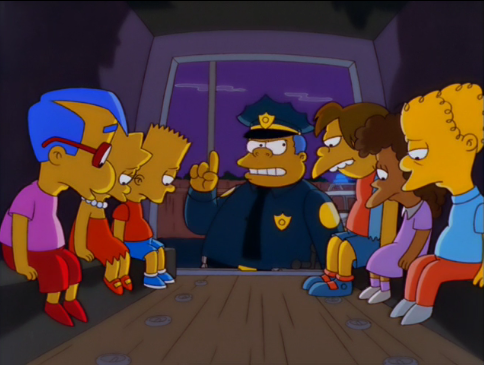
Chief Wiggum jumps to the conclusion that the damage at the school was caused by punk kids, thereby issuing a curfew for all minors to be indoors by sunset. The dynamic and building animosity between the children and adults sets in at the start of act two with Bart and Lisa adamantly against this unfair punishment, with Homer and Marge being less than supportive. This turmoil brings the kids of Springfield together as a collective in a way that makes sense. Together they agree to sneak out after dark to catch a drive-in screening of the new horror film “The Bloodening,” which is an amalgamation of classic scary movie tropes: a black-and-white picture allegedly unreleased to the public due to its content, and now showing with a registered nurse on staff (“trained in the treatment of terror.”) It features disturbingly soft-spoken little English kids using psychic powers to read the thoughts of the villagers, then brutally kill them. When the Springfield kids are caught by the police, they use the movie as their inspiration to enact revenge on the adults.

Through jury rigging the transmitter on the newly installed police billboard, the kids hijack the radio airwaves to put on a program revealing the dirty untold secrets of the people of Springfield. Even with Lisa in the group, this seems a little out there that they’d be able to do this, but it works so well within the story that I really don’t mind the improbability of it. The kids are caught, and it’s time for a big generational stand-off. By what means? Through song, of course. I’m not totally on board with this idea. The song isn’t terrible, but I feel like there could’ve been a better means of resolving the plot. But it does get us to the very ending that I love, where the seniors get everybody under curfew and “take back the streets.” So hey, while I can’t say this episode is perfect, it was really enjoyable, certainly at the top of the season 10 pile, though that’s not saying a whole lot. It at least proves that the writers still have some sense in them, but how much of it they can enact over a whole season seems to be questionable.

Tidbits and Quotes
– Pretty useless cameo at the beginning by Cyndi Lauper. I guess the joke is that she sings the national anthem to the tune of her hit song. I guess? But I like the announcer’s comment after she leaves the field and most of the people in the mostly empty stands take her lead (“Thank you, Cyndi Lauper! Just to remind you, folks, we do have a baseball game today.”)
– The baseball game was a great early sign for me as each scene had a joke that worked: the two players urine testing positive and them clinking their glasses, Marge’s mother’s advice to stick with your loser choices ’till the bitter end, the pitcher’s arm snapping (“That’s a rotator cuff, his career’s over!”), Babe Ruth the Fourth bunting, then getting tackled immediately, and Homer sitting outside in the car singing the childish edit of “Whistle While You Work.”
– I like this exchange on the car ride home (“With a little middle relief, they might even make the playoffs!” “You’ll be in your cold, cold grave before that ever happens.” “Homer, would you please stop talking about the childrens’ graves?”)
– Not only does he immediately change into a ‘Topes fan at the drop of a hat, Homer becomes one of those boorish obnoxious super fans for Kent Brockman’s news cast. I love Dan Castellaneta’s read for that bit (“It’s a great team, Kent! We never gave up hope! I wanna thank Jesus, and say hi to my special lady Marge. We did it, baby! Woo!”)
– Homer’s memory of what happened the night prior is fantastic, told in silent movie slides and everyone in old timey garb. He goes to Moe’s for a drink, SCENE MISSING, Homer dancing with some faeries around the maypole, SCENE MISSING, THE END. I love how the nice piano music comes to a loud end too.
– Homer has some great logic regarding blaming kids for everything (“If kids are so innocent, why is everything bad named after them? Acting childish, kidnapping, child abuse…” “What about adultery?” “Not until you’re older, son.”)
– There’s a really sweet scene in the middle of the show with Bart and Lisa bored in the house keeping a kite afloat with a fan. They let go and it wafts into the kitchen and gets caught in Marge’s hair. Without looking up from his paper, Homer comments, “Marge, kite.” It’s such a charming, funny bit that feels so alien in this bombastic, over-the-top season, I love this stuff.
– Wiggum forces the kids to clean off the new police billboard and leaves them with some great final words (“Let this be a lesson to you! Kids never learn!”)
– Lisa tunes the old radio past FDR’s war declaration speech after Pearl Harbor, and after a few seconds into the secret broadcast, Homer comments, “Boring! Go back to that infamy guy.”
– Amazing bit where the kids reveal Luann Van Houten has been cheating on Pyro with his brother Gyro. The two muscled men duke it out with giant cushioned sticks like true American Gladiators.
– Nice bit with another scandalous secret. “And guess who’s been practicing medicine without a license?” Hibbert looks worried. “That’s right: Homer Simpson!” A faint “D’oh!” is heard in the distance.
– I like the Crazy Old Man’s rantings running into the credits (“You wanna stop with the kicking? My pills are in that can! Good gravy, I don’t kick your things!”) All the way into the Gracie Films shush (“Don’t tell me to shush! You stupid lady!”)

213. Viva Ned Flanders

(originally aired January 10, 1999)
One of the biggest crimes of the Mike Scully years is making me hate Homer. Or rather, the exaggerated cartoon version of himself he had become. But another aspect that made it even worse is that no one seemed to comment that his behavior was anything unusual. As obnoxious, inconsiderate and downright brain dead as the things he said and did were, no one around him would call him out on what really is clinically insane behavior. There’s so much wrong with this episode, rotten almost to its core, but what baffled me the most is that it seemed to center around canonizing this new crazy-go-nuts Homer, almost like a spiritual sequel to “Lost Our Lisa,” but instead of just the last three minutes, it’s the entire episode. But before all of that, our episode begins where Ned Flanders is goaded into a confession at church, revealing that he’s sixty years old, and has kept his youth by living a tame, risk-free life. This whole idea feels so silly, considering it steps on the idea he was raised by beatniks, but honestly, the episode gets so much worse from this point, it’s the least of my worries.

Ned feels he’s squandered his life by playing it safe, so who does he turn to? Captain Wacky, of course, who all of a sudden has in place a program for living on the edge, and decides to take Ned to Las Vegas. Much of the back half of the episode consists of Homer doing something incredibly stupid and irresponsible, and Flanders either not reacting to it at all, or asking how he could be so stupid and irresponsible not out of anger, but of reverent amazement. I was just plain stunned more than anything watching Homer not even bat an eye as he makes reckless turns while driving, gambles away all of Ned’s cash and credit cards, and inadvertently cause the death of Captain Lance Murdoch. He’s really beyond a cartoon character, because at least in a cartoon, there are usually some clear motives for what someone is doing. Here, I really don’t understand what Homer is doing through parts of this episode, he doesn’t act like anything closely resembling a human being. And again, no one seems to comment on this. Ned has become Homer’s sidekick, which is something that makes absolutely no sense whatsoever.

So our big third act climax is that during their wild Vegas night, Homer and Ned get married to two cocktail waitresses. Okay. Well considering they’re already married, then this new one is presumably not legally binding, so that’s it. They straighten it out and leave town. End of episode. Or we can have a big dumb chase sequence that makes absolutely no sense that ends with the two of them having to walk home through the desert. Yeah, that’ll work. I’m hard pressed to really add on or elaborate on anything. Most of the entire episode as I’ve said is Homer doing some absolutely moronic and Ned acting as his fawning lackey. From this, I assume that the writers think that Homer’s behavior in this episode was so hilarious that it could act as the crutch for the entire show. If that’s the case, then we are in big, big trouble from this point on. The throne for worst episode has a new owner and “Kidney Trouble” was only two episode ago. Oh dear.

Tidbits and Quotes
– I hate the beginning with blowing up Burns’s casino. The writers tried to cover their asses about how it makes no sense for it to be there after they moved the town, but it just serves to remind how much it wouldn’t make sense for them to move it, and also how the ending of that episode made no fucking sense. It’s just like they were saying, remember how that made no sense, and neither does this? Well let’s remind you. And then for some reason Don Rickles was still in the building when they blew it up. Okay.
– Perhaps the only good line from the episode comes from Reverend Lovejoy (“And, once again, tithing is ten percent off the top. That’s gross income, not net, please people, don’t force us to audit.”)
– The craziness starts when Homer stands up in church to put Ned on trial about apparently lying about his age, making an overly dramatic speech which everyone in church just sits quietly for and listens to. And all gasp in unison when appropriate. Why is this happening?
– An episode about Ned wanting to live life more dangerously is feasible, but it just doesn’t work here. I don’t buy his wanting to be more risky, and I certainly don’t like how he words it that he feels he’s wasted his life. That’s not the Ned I know and love.
– I guess Homer barbecuing a chicken over the chimney is something we expect is normal for him to do now. I don’t get it, when did he become Homer the Daredevil? When did this become normal behavior for him? If Homer wants a chicken, he whines for Marge to cook one for dinner. I don’t think he’d even have the energy to climb the ladder to the roof on his own volition.
– Homer talking to Ned in the car about living life impulsively pretty much mirrors the scene with him and Lisa in “Lost Our Lisa,” except it’s even more terrifying here since it’s happening with more than half of the episode left to go.
– Lance Murdoch’s lovely assistant appears to be the replacement Lisa from “Spin-Off Showcase.” Just interesting to note.
– During Murdoch’s stunt, Homer hilariously sits up from the ‘X’ to make sure Ned doesn’t spill his beer. Murdoch is startled and reacts, and ends up crashing his bike. His head is still encased with a safe, which I assume is a lightweight one to hold on his shoulders, but he flies off the bike and hits that wall so hard. Just from seeing it, and maybe it’s just me, but I think he’s dead. That impact felt so final to me, there’s no way he survived. And Homer walks away not giving a shit. At that point, my hatred towards him was seething.
– Alright, what’s left… Ned attempting suicide, wacky chase scene atop slot machines… oh, one last thing that was pointless was the Moody Blues cameo. Homer addresses them by name, and each band member gets one line each. In the coming seasons, we’ll be seeing that over and over and over again. Ugh…