130. Radioactive Man

(originally aired September 24, 1995)
Bloated big budget Hollywood pictures are prime targets for sharp satire, but this episode isn’t so much interested in that as much as just doing a bunch of silly gags, but since said gags are really funny, who am I to complain? Hollywood executives are producing a film version of Radioactive Man (starring McBain’s Rainier Wolfcastle) to be filmed in Springfield, much to the pleasure of Mayor Quimby, who levies as many taxes on them as he can get away with. Auditions are held for the superhero’s ward, Fallout Boy. Bart is eager to get cast, but it ends up going to a greatly reluctant Milhouse. Production halts when Milhouse, sick and tired of the life of an actor, runs off, and when a last minute swap for Mickey Rooney doesn’t work, the film is hastily cancelled.

I really like the concept of someone getting fame thrust upon them against their will, and it certainly makes sense with Milhouse. He’s the eternal second banana, and has no real urge to change that. I like his melancholy attitude through the whole production, which later turns to a weird seething anger regarding the repetitive nature of the business (“We already did it. It took seven hours, but we did it. It’s done.“) Things get a bit weirder in the third act when Bart finds Milhouse in hiding, who expresses his displeasure about Hollywood and how he could be curing diseases or stopping famine. It leads into a jokey monologue by Bart, but it would have fit more if he’d just expressed his lack of interest of being in the spotlight. But the story has a competent balance between Milhouse, and Bart, who has to fight between being jealous and being supportive of his best friend.

While not as much as I’d hoped, there’s plenty of great pokes at Hollywood, mostly from the fast-talking director, building people up with great enthusiasm before cutting them down, and not being bothered to check whether his actors are actually at risk. It’s all worth it for his artistic vision. Wolfcastle works perfectly as the title role, our pseudo Schwarzeneggar, who gets a number of great scenes (“Up and atom!” “Up and at them!”), culminating with one of the most quoted lines of the entire series, “My eyes! The goggles do nothing!” Mickey Rooney proved to be a great guest, giving Milhouse a pep talk, and then later scolding the town of Springfield for driving those good-hearted Hollywood folks out of town (“They weren’t thinking about the money. They just wanted to tell a story, a story about a radioactive man, and you slick small-towners took ’em for all they were worth.”) Which leads to the hilarious end which seems to take place in a very normal and believable version of Hollywood, where the failed production crew are met with open arms and open hearts. It’s truly a forgiving, accepting place, ending on “Lean On Me.” Wonderful.

Tidbits and Quotes
– Noticeable right off the bat is the change in animation this episode. This was the show’s first test at using digital color rather than painting on cels. Some years later, they would try this again (“Tennis the Menace,”) then the show would go all digital starting in season 14.
– We’ve seen Comic Book Guy a select few times in the past, but rather infrequently. I think it’s not until the increasing advent of social networking on computers that he took off, adapting the anal-retentive Internet geek persona, almost mocking the die hard Simpsons fans. Bart and Milhouse pride themselves on collectively owning every Radioactive Man (including the special limited-edition issue where he and Fallout Boy get killed on every page), and wish to know who’s playing the lead in the Radioactive Man picture. So it’s off to the Internet! The animation of CBG waddling to his computer in the back room is hilarious, where he consults alt.nerd.obsessive, most likely referencing the old alt.tv.simpsons newsgroup.
– Amazing parody of the old Batman TV series with Radioactive Man, with guest star Paul Lynde as the Scoutmaster (“Don’t be afraid to use your nails, boys!”), which of course ends with beach party music and dancing girls.
– The producers flip through Variety, and one of them singles out the very small “FLIM SPRINGFIELD” ad (“All right, this place must be hot. They don’t need a big ad, or even correct spelling!”) Another producer responds, “I agree with that logic.” It’s like the writers knew how stupid this plot turn was to get them in Springfield, so they point it out with a good joke.
– I always laugh at the “We ‘HEART’ Phonies” banner up in downtown Springfield.
– It’s pretty much unrelated to the story, but I love the traumatic flashback to Moe’s Little Rascals days, where he killed the original Alfalfa after he stole his “eye in the exhaust pipe” bit. It’s great that a stagehand refers to the poor boy as “the original Alfalfa” in the flashback, and Moe’s afterward to his story (“Luckily, Alfalfa was an orphan owned by the studio.”)
– The director at the auditions has a lot of great bits, from not going with the perfect choice (Martin) because he didn’t sign in (“Oh, forget him, then. It wouldn’t be fair to the other children who filled out their application forms in full,”) and then building Bart’s hopes up twice before rejecting him.
– I love how after Milhouse gets the part, he’s immediately swarmed by fans and runs home, only to find his parents have already bought a living room full of stuff, like somehow they knew already. And great, great elaborate prop of the scuba suit.
– Good timing on the first Milhouse exploding in front of Bart, and then the second, which ends up being the little person actor who we’ve seen in “Burns’ Heir” and “Homie the Clown.” That poor guy can’t catch a break.
– Great sequence where Homer and the teamsters fight over who’s the laziest, culminating in them all writhing on the floor stretching and making loud relaxed noises.
– The whole conceit of the power plant scene is so ridiculous. Why would they use real acid? It’s like the ultimate form of method acting. I like how worried Rainier is after the director announces it, seemingly hearing of it for the first time (“Real acid?”) And how exactly was Milhouse supposed to bring him to safety that he couldn’t do himself? And why was there no safety mechanism to bring him up? And why didn’t Wolfcastle suffer extreme acid burns or die after getting swept up in a gigantic tidal wave? None of this matter of course, since we have “My eyes! The goggles do nothing!”
– Great joke regarding the spinning newspapers, a gag we’ve seen many times in this show and other shows. We get two ones about Milhouse being missing, then a third one reading “Spinning Newspaper Injures Printer.”
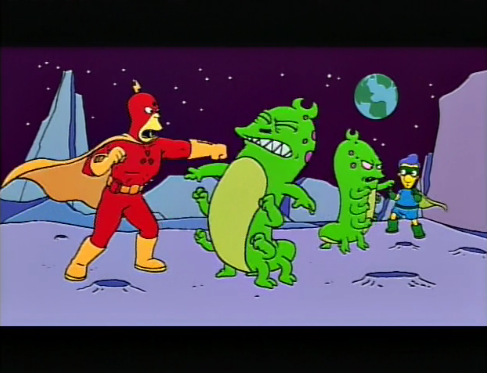
– The best scene of the episode is the shifty editor claiming they can finish the movie by splicing together shots of Milhouse with new footage. So Wolfcastle and Milhouse are surrounded by some thugs underground. Cut to Wolfcastle whispering to his sidekick off screen. Cut to the two of them in a bright open field so Milhouse can say his line. Cut to Wolfcastle again whispering, “Are you ready?” Cut to Milhouse on a green room couch, with a flat, “Yes.” Cut to the two of them punching aliens on the moon. Absolutely stellar work (“Seamless, huh?” “You’re fired.” “And with good cause!”)
– Great bits as Bart searches for Milhouse: he’s not at Slot Car Haven where Comic Book Guy and Otto are racing, not at the Spirograph Factory, where the owner has gone mad, but he is at the treehouse, with a great joke featuring a repeat pan to the apparently six corners of the treehouse before we finally land on Milhouse.
– I love how dramatically Mickey Rooney shows up in the helicopter. It’s ridiculous, but then they have a joke explaining how he found them, by tapping their tin can and string phone. If they did this now, there’d be no explanation; celebrities just show up randomly and it’s all good. But here, the Mickster’s so funny, and a real good sport to say “Jiminy Jillickers!” and comment how he could easily sub in for a little girl in a JELL-O pudding commercial.
129. Who Shot Mr. Burns? (Part Two)

(originally aired September 17, 1995)
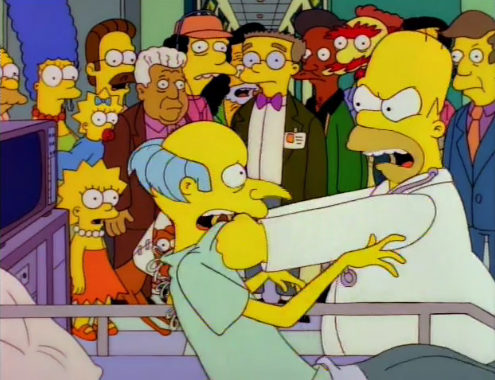
And now, the spine-tingling conclusion! If anyone reading this watched these episodes firsthand, I’d like to hear what you thought the ending was going to be, because I can’t see how anyone saw it coming. The 1-800-COLLECT contest to name the shooter, with the prize of getting yourself animated into an episode, was a bust (although according to the commentary, someone actually did guess correctly online, but they weren’t eligible to win) and I’m sure the big reveal infuriated a lot of people. But I’ll get to that in a bit. This second part focuses on Wiggum’s manhunt for Burns’s shooter, with most of the key suspects getting crossed off quickly. We open to find Smithers as a drunken wreck, who realizes he actually did shoot someone that night, but it ends up not being Burns. That leaves Homer, who, after finding Simpson DNA on Burns’s suit and the old man waking from his coma shouting his name, is promptly arrested. But in the end, Burns reveals the shooter is none other than… Maggie Simpson. Attempting to relinquish the baby’s lollipop in the town hall parking lot, Burns’s revolver fell into her hands and unloaded.

Considering the build-up and all the promotion, I guess there’s no way part two could not be a let-down in some regard. Part one was just so strong, with the drama just building and building until the very end. It was sort of exciting to see our beloved characters appear bloodthirsty, that any one of them could have been fired up enough to be attempted murderers. On top of that, Burns’s condition was in question during the summer between seasons. The old man could very well have been dead, which would made a huge, lasting impact on the series. Part two starts out affirming that Burns is alive, which pops that bubble right away. Act one is about Smithers believing he had done it, but that leads us to believe that of course he didn’t, and act two quickly absolves all of the other characters. Then we get to Homer, who we know couldn’t have done it, which leaves us with… Maggie. While there were a few clues within these two episodes that might have pointed you to her, it’s such an out-of-nowhere choice that one would make that the mystery of it all becomes a red herring in itself. While this is a little unsatisfying, I absolutely love it at the same time; it was all a big unsolvable goof. There were some tricks pulled, but it all makes sense within the story. There weren’t any purposely misguiding clues or incorrect information. It all pointed to Maggie, you just didn’t know it.

With the plot pretty thin, we end up with a lot of great free-standing scenes, and also a lot of cultural references. We ingeniously start off with Smithers finding Burns in his shower, referencing the episode’s precursor Dallas, when they wrote over an entire season claiming it was all a dream. There’s also a great send-up of Twin Peaks where Lisa appears in Wiggum’s dreams to give him a subconscious clue, which is incredibly eerie, as they had Yeardley Smith speak her lines backwards then play it back, just like they did on that series. There’s plenty of funny jokes here, many coming from Wiggum’s incredible incompetence in his investigation, and other suspects like Moe, Skinner and Willie proving their innocences (the latter in a hilarious Basic Instinct parody). While it may not be as perfect as part one, it’s definitely what one could have hoped for in a satisfying conclusion to this two-part epic. “Who Shot Mr. Burns?” is one of the cornerstones of the Simpsons library, and for damn good reason too.

Tidbits and Quotes
– I love the beginning, focusing on an empty bottle of Vagrant’s Choice Fortified Scotch (“may cause ejection of stomach contents”), then turning about to reveal Smithers’s completely trashed apartment. He awakens, coughing up cigarette butts. He then finds Burns in the shower, which we know is ridiculous, but then they just push it even further with Speedway Squad! In Color! (“The year is 1965, and you and I are undercover detectives on the hot rod circuit. Now, let’s burn rubber, baby!”) Of course it was all a dream, but to Smithers’s chagrin, his apartment being an absolute wreck was not. And he still coughs up cigarettes.
– Great reporting from Kent Brockman (“Burns was rushed to a nearby hospital where he was pronounced dead. He was then transferred to a better hospital where doctors upgraded his condition to ‘alive.'”)
– Grampa gets up to use the outhouse, which causes Homer to leap up (“My tool shed!”) Kinda lowbrow humor, but the callback of Homer hosing out the tool shed is damned funny.
– The flashbacks to “Part One” I suppose are necessary to highlight on important incidents, particularly, “It’ll be like taking candy from a baby,” but are a tad less effective when watching each one back to back.
– Following his dynamite one-scene-wonder in “Part One,” Sideshow Mel comes back with a vengeance here. I absolutely love Mel. Like Sideshow Bob, he’s a culturally high-minded thespian stuck playing second banana to a buffoonish clown, but he takes it with a more quiet dignity. Here, he unravels the mystery that Smithers couldn’t have shot Burns, as he left the town hall meeting early to catch the show “Pardon My Zinger.” I love how dramatic he takes it, and how Krusty ends up becoming his tag-along. The best is when Mel bursts into the police station, introducing himself, and Krusty as his associate. Krusty, bewildered by what he’s got wrapped into, musters a confused, “Hey hey.”
– Turns out the man Smithers shot was Jasper, who was none too pleased at Smithers’s drunken staggering (“Sidewalk’s for regular walkin’, not for fancy walkin’.”) But, he was just shot in his wooden leg, so it’s fine. Also he’s senile (“Who shot who in the what now?”)
– Great quick line from Grampa (“You never know what you’re capable of. I never thought I could shoot down a German plane, but last year I proved myself wrong.”)
– Of course the police immediately start with the most high-profile suspect Tito Puente, who has chosen to enact his vengeance toward Burns through song. “Senor Burns” may feel a bit like a time killer, but it’s such a great song that who cares. Also interesting is that it’s sung by the lounge singer from all the way back in “Homer’s Night Out.” By the end of the performance, Wiggum is won over (“Okay, I believe you’re innocent. Gee, I hope all our suspects are this much fun.”) That leads us right to Skinner, who boringly spends a long period of silence attempting to recall his whereabouts that night. Finally he remembers he was going to ambush Burns, going to the bathroom to apply his camo makeup, but ended up taking his mother’s. Chalmers walks in on him, and things immediately become awkward. Skinner attests Chalmers can confirm this story (“But anything else he tells you is a filthy lie.”)
– Willie proves his innocence thanks to his arthritis he got from playing Space Invaders, which prevents him from firing a pistol (“That was a pretty addictive video game.” “Video game?”) The best suspect is Moe, who’s hooked up to a lie detector, and ends up ultimately confessing his evening plans (“I’m gonna sit home and ogle the ladies in the Victoria’s Secret catalog!” BUZZ. “…Sear’s catalog.” DING. “Will you unhook this thing already please? I don’t deserve this kind of shabby treatment!” BUZZ.)
– Great act break joke by Wiggum after arresting Homer (“Yeah, that’s what they all say. They all say ‘D’oh.'”)
– Wonderful parody of The Fugitive when Wiggum’s paddywagon tips over as he attempts to reach out the window at the Krusty Burger drive-through. Jasper make a return appearance (“Dang fools. Drive-through’s not for a-parkin’!”) ramming his oldsmobile into Wiggum’s, as Homer in chains hobbles to safety, just like the train derailed in the film. The pimply faced teen has seen enough (“Diane! I’m going to take my break now!”)
– Lisa isn’t convinced by the evidence; that could be any Simpson DNA, except Marge’s, but she insists it could be (“When I took your father’s name, I took everything that came with it, including DNA.”) She also figures Homer’s fingerprints could have gotten on the gun any other way, which we see in a flashback where Homer feels around under the car seat to relinquish a fallen ice cream, only to find a sticky lollipop (which will come into play later, of course).
– First mention of Marvin Monroe Memorial Hospital, meaning the good doctor is dead now for no explainable reason, other than Harry Shearer hated doing his voice. He comes back in a much later episode for no apparent reason other than to annoy the fans.
– The resolution really fits if you think about it. I love Burns’s recollection of the story (“Smithers had thwarted my earlier attempt to take candy from a baby, but with him out of the picture, I was free to wallow in my own crapulence.”) I also like how he immediately deflates the significance of collapsing while pointing to “W” and “S,” which was considered a big clue, but really, would a dying man really think to do that? Burns explains what he really did with his last ounce of strength (“I sucked out my gold fillings and swallowed them. Those paramedics have sticky fingers.”) He insists that the police arrest Maggie, but Wiggum explains no court system would ever convict a baby… maybe Texas. Then we go out with some sinister Maggie sucking. Fantastic.

128. Who Shot Mr. Burns? (Part One)

(originally aired May 21, 1995)
Man, I wish I hadn’t been a young’n when the “Who Shot Mr. Burns?” saga was underway. From what I read of it, it was quite the event, with widespread debate and discussion amongst fans regarding the mystery. The only two-part episode in the show’s history, it rides the line of being a gimmick episode, and being a parody of one. There was a lot of real promotional tie-in stuff around this “event,” but the episodes themselves were filled with enough winking nods that they didn’t feel disingenuous (the conceit itself is a parody of the “Who Shot J.R.?” mystery from Dallas). But audience reaction to this event episode only came from how solid and well crafted it was. Such great care was put into setting up clues, giving every character a motive, and ending on a note where there’s no real definite suspect. Yet even with all the information to be fed and groundwork to be set, it all feels cohesive, and more importantly, it still feels like The Simpsons, with plenty of funny bits that work in tandem with the dramatic parts. These are undeniably landmark episodes of the series, put together with great attention to detail, and absolute treats to watch unfold.

Oil is struck at Springfield Elementary, much to the thrill of Principal Skinner, and to much chagrin of Mr. Burns and his energy monopoly within the town. Through slanted drilling, he manages to tap the oil before the school does, resulting in many catastrophic events that cripple the denizens of Springfield. Saddled with the cost of drilling, Skinner has to lay off Willie and new music instructor Tito Puente. A jettison of oil from Burns’s drill destroys Bart’s treehouse, injuring him and his dog. Fumes from the rig end up condemning Moe’s, leaving Moe out of work and Barney out of booze. Underground drilling creates a fault line under the retirement home, bringing half the building into the ground. Not even the tireless sycophant Smithers can stand for this level of dastardly deeds, resulting in his termination. Burns completes his comprehensive takeover of the town’s resources by blocking out the sun, keeping its citizens totally reliant on his power supply. It’s soon after that the most hated man in Springfield is shot by an unidentified assailant, leaving him to collapse on the town square.

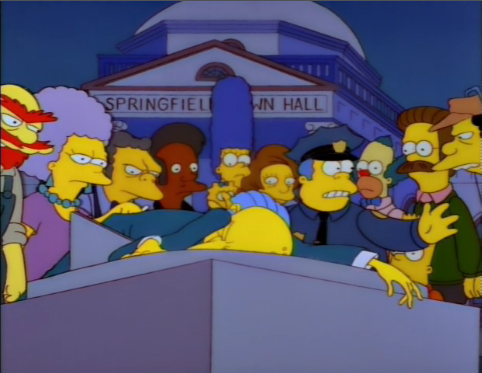
Most of the town’s hatred of Burns comes through chain reactions of his rampant greed, self-serving nature and desire for unchecked power. And while his plan and execution of blocking out the sun might be a little silly (or as Smithers puts it, a cross over into cartoonish supervillainy), it works perfectly as the proverbial last straw; with no natural light, the entire town is completely at Burns’s mercy. The two seeming front runners for the gunman are the two with personal grudges toward Burns. First is Smithers, whose conscious is racked through the entire episode until he is quickly fired after daring to finally say no regarding the sun scheme. Second is Homer, who falls into a manic state because Burns continuously doesn’t remember his name. It’s sort of the last hurrah for this long running joke, being pushed way over the top until Homer just loses it. The climax at the town hall meeting is one of the greatest scenes in the entire series, where the town is so impassioned in their unified hatred, while Burns just eats it up, loving every minute of it (as he wonderfully puts it, foreshadowing the ending, “You all talk big, but who here has the guts to stop me?”) I knew the conclusion before I watched the first part, but I really wish I didn’t. There’s so many hints and clues to extrapolate from, the most damning being Burns’s missing revolver, that it would have been neat to be a part of unraveling this mystery. Of course the big reveal is something no one ever suspected, but more on that later.

Tidbits and Quotes
– Wonderful sequence of Burns’s important piece of postage exchanging hands, with great music and dizzying use of alliteration (“Profoundly pressing package of power plant profit projections for Pete Porter in Pasadena.” “Priority?” “Precisely.”) This also effectively starts Homer’s growing antagonism for Burns when the letter ends up with him, who rushes it to his boss’s office, only having read the return address. Burns is not pleased.
– There’s some great Skinner-Chalmers stuff in here (“Why is it when I heard the word ‘school’ and the word ‘exploded,’ I immediately thought of the word ‘Skinner!‘”) The two laugh uproariously at the suggestion they use the oil money to give the students college scholarships, and there’s a hilarious back and forth when Skinner blocks out the first word of a newspaper headline “Awful School Is Awful Rich.” (“An unrelated article. Within the banner headline.”) It’s very similar rhythm-wise to the later “steamed hams” discussion in “22 Short Films About Springfield.”
– Great montage of requests from the students and faculty: Lunchlady Doris is a highlight (“The cafeteria staff is complaining about the mice in the kitchen. I wanna hire a new staff.”) Requests from Otto (“You know those guitars that are like… double guitars?”) Ralph (“Chocolate microscopes?”), and Skinner (“More rubber stamps,”) are also granted.
– I love Burns’s truly pitiful disguise to trick Skinner, and the principal’s deadpan affirmative stance against him (“I’ve got a monopoly to maintain! I own the electric company, and the water works, plus the hotel on Baltic Avenue!” “That hotel’s a dump and your monopoly’s pathetic.”) Burns’s pathetic attempts to attack Skinner, and Smithers coming at him with the stapler is just icing on the cake (“Please don’t waste those.”)
– Smithers’s turn against Burns is gradual through the show, and believable in his character: he’s fine with Burns’s ruthless practices in the workplace, since that’s all business, but his attempts at robbing a local school of funds it desperately needs is going too far.
– Great sequence of Burns and Smithers eating chocolates, with Burns identifying each Simspon on the photo inside, except Homer, of course, whose face remained obscured by, of all things, a sour quince log. I don’t even know what quince is, but it sounds disgusting. The payoff is phenomenal when Homer gets a thank you note, but realizes his name isn’t included. He holds the paper up to his face and reads, then lowers it and his pupils get smaller. Sending the kids out of the room, he takes a deep breath, then… “Ffff-” Church bells chime and the entire neighborhood is stunned, including Ned Flanders (“Dear lord, that’s the loudest profanity I’ve ever heard!”)
– Great “Aye carumba!” from Tito Puente when they announce someone’s tapped the school’s oil.
Classic Burns line preparing for his oil rig to burst (“Ah, soon that mighty apparatus will burst forth with its precious fluid. Almost sexual, isn’t it, Smithers?”) A still dissatisfied Smithers can only muster a murmur at his beloved’s blatant entendre.
Classic Willie line upon his termination (“I’ll kill that Mr. Burns! And, er, wound that Mr. Smithers!”)
– Moe’s becomes certifiably toxic from Burns’s oil rig. Barney comments, “These fumes aren’t as fun as beer. Sure, I’m all dizzy and nauseous, but where’s the inflated sense of self-esteem?”  Scientists in hazmat suits then enter (“Man alive! There are… men alive in here!”) and shut down the bar, prompting Moe and Barney to wield their own guns (“Ahhh, now there’s the inflated sense of self-esteem!”)
– I love how everything is set up fluidly, even the mention of the sundial as Smithers protests Burns’s master plan (“Every plant and tree will die, owls will deafen us with incessant hooting, the town’s sundial will be useless!”)
– Homer’s descent into madness is fantastic, picturing multiple Burnses popping up in his car running through the thesaurus of insulting names to call him. He arrives at the plant and in large letters in Burns’s office spray paints “I AM HOMER SIMPSON.” Burns arrives, and of course, as flat as possible, asks, “Who the devil are you?” Homer snaps, and runs across the office (accompanied with a great camera move) and accosts Burns, only to be led out by security. It’s a bit outlandish, but I still believe Homer’s reached his breaking point.
– Stuck at the Simpson home, Grampa gets a great scene where Bart finds his old Smith & Wesson (“If you’re gonna play with it, be careful, ’cause its loaded.”) Marge finds it, and is understandably shocked. Abe retorts, “How can you have a house without a gun? What if a bear came through that door?”
– The town hall meeting starts out strong (“We’re all upset about Mr. Burns’s plan to, uh, block out our sun. It is time for decisive action. I have here a polite but firm letter to Mr. Burns’s underlings, who with some cajoling, will pass it along to him or at least give him the gist of it.”) During Quimby’s speech, we cut to shots of a bunch of hands brandishing guns, which the mayor’s aide quickly informs him of (“Also it has been brought to my attention that a number of you are stroking guns. Therefore I will step aside and open up the floor.”)
– After Burns arrives, and then flashes his weapon at a small child, the tension just builds and builds as the townspeople threaten the old man, and I love love love that in all of it, Flanders steps up and asks, “I’d like to hear from Sideshow Mel!” You know what? I would too, because I love that voice. Mel doesn’t disappoint, wielding a switchblade (“I’ll see to it that Mr. Burns suffers the infernal machinations of hell’s grim tyrant!”)
– Great subtle clue that Burns’s jacket swishes open as he swirls around the lamp post, reminding you the gun is still there, then later when he collapses, it’s not.
– We end on a great call to arms from the fans to get involved in solving this mystery, as Hibbert seemingly asks the audience if they can solve the mystery. Actually he’s just pointing at Wiggum (“Yeah, I’ll give it a shot, I mean, you know, it’s my job, right?”)

Season 6 Final Thoughts
After a relatively insane season 5, I feel like things sort of leveled out and got a bit more grounded here in season 6. There were some wild bits, sure, but we got a fair share of episodes that were very down-to-earth stories (“Bart’s Girlfriend,” “Lisa’s Rival,” “Lisa on Ice,” etc.) Even episodes that were pretty out there like “Homie the Clown” still focused on the characters and felt very genuine. I guess largely this was a very character driven season: Homer’s relationship with his father, we delve in Marge’s troubled past, Bart and Lisa go mad in their own ways without school, and a look into the future at Lisa’s first love. Even without the change of show runners yet, it feels like one season segues into the next; Bill Oakley and Josh Weinstein’s seasons are noted as being more emotional, and this feels like a balance between David Mirkin’s insanity and the more level-headed stuff of season 7. Still, great, great, great, great stuff. Great.

The Best
“Treehouse of Horror V,” “Homer Bad Man,” “Homie the Clown,” “Bart vs. Austrailia,” “Lisa’s Wedding”

The Worst
“Another Simpsons Clip Show” by default, but as a clip show, I barely count it.

127. Lemon of Troy

(originally aired May 14, 1995)
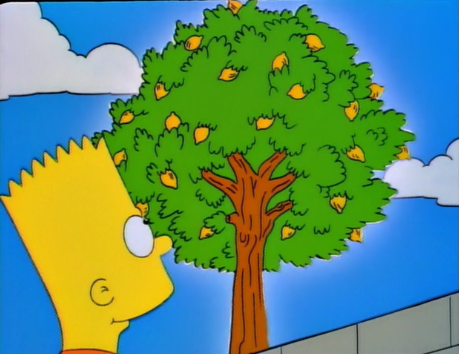
Shelbyville is probably one of my favorite overall elements of the series, this neighboring town that the people of Springfield needlessly vilify to assert themselves to a higher plane. In this episode, we find out the origins of the towns (with the reasoning of their divide being just as stupid), and, more enlightening, that the Shelbyvillians are just as spiteful and vindictive as their neighbors. It’s just one never-ending feud over inconsequential matters, with each party too pig-headed to realize how stupid it all is. This is the quintessential Springfield-Shelbyville episode, that does a great job examining the dynamics between the two towns and how each side is equally as foolish.

Through his mother’s repetitious urgings, Bart is instilled with a renewed sense of town pride, just in time to find punk kids from Shelbyville have taken off with their beloved lemon tree. In response, he forms a ragtag group of kids to venture into uncharted territory to get back what’s theirs. Before this, we have the scene where the two groups of kids meet at the city line, and it sets the stage perfectly: their childish back-and-forths and swipes at each other fit, but it’s also just interesting that they’re fighting over something they have no real consciousness about. Hatred of their neighbors is something just instilled to them by their parents, they’re unknowing pawns in this ongoing stupidness. To push this artificial rivalry further, Shelbyville appears to be full of “evil” parallels, with the main kid Shelby being like a bastardized Bart (and his father as well, adapting Homer’s original Walter Mattheu-like voice). The petty rivalry between Springfield and Shelbyville is one I felt could have been explored a lot further in future episodes, but in a way, I think this one kind of ruined it by making it so ridiculously over-the-top. Would you want to see an episode featuring the goings-ons of Joe’s Tavern and a gender-swapped Willie? No, but it works spectacularly for that one stupid joke.

Soon enough the Springfield parents get involved in tracking down their kids, and then they quickly learn of the abducted lemon tree. Homer’s mindset is brilliantly encapsulated in the few scenes where they find the kids: he’s initially angry and lecturing to his son, then upon hearing Shelbyville stole the lemon tree, immediately switches gears and channels his anger toward that. I’m sure Homer didn’t even know there was a lemon tree in Springfield; all he knows is Shelbyville took it and it’s theirs, goddammit. Shelbyville may seem more antagonistic than Springfield, but the latter did burn down the former’s city hall, so both cities are pretty reprehensible. The plot basically would have been the same if the cities were reversed, but not quite as satisfying for us. Throughout all the silly assholery in this universe, we’re still pleased as punch as the Flanders RV drives the lemon tree back through the city line… and laugh when they inadvertently damage a large portion of their sacred icon.

Tidbits and Quotes
– Nice ridiculous fantasy of Bart imagining being labeled a future God by writing his name in wet cement (“He must have been much smarter than his sister Lisa, about whom we know nothing.”) They’re an advanced civilization who can bring a person back to life with what must only be a speck of DNA, but are absolutely amazed by a simple yo-yo trick.
– I like the quick montage of Bart and Milhouse running to the lemon tree, with Milhouse repeatedly stumbling and injuring himself over nice, light music. It’s not really emphasized as a joke, it’s just kind of there, just a quick illustration over the disparity between hero and sidekick. This ain’t Milhouse’s show.
– Because the kids know nothing about the ongoing feud, they must invent stuff to be angry about on their level. Milhouse accuses the Shelbyville kids of copying their own habit of wearing their backpacks over one shoulder. He’s rather incensed about it (“Step over this line and say that! I’ll kick your butt! …at Nintendo.”)
– Grampa regales the kids with the story of the origin of the two towns (“Hey everybody! An old man’s talking!”) If the name Jebediah Springfield wasn’t silly enough, his partner was Shelbyville Manhattan, who believed the whole reason for their journey was to form a town where one could marry one’s cousin. Jebediah asks why on earth one would want to do that; Shelbyville responds, “Because they’re so attractive.” That tears it, and the two split up their parties (“The town of Springfield was born on that day, and to mark that sweet moment, our people planted this lemon tree, lemons being the sweetest fruit available at the time.”)
– Great bit where Nelson calls the kids out of class, it’s an emergency and no time to explain. This works when you have an immediate cut to them arriving at their destination, but we see them running downtown and Nelson stopping at a drinking fountain (“I said there’s no time to explain and I stick by that!”)
– The lemon tree is gone, and Bart vows to get it back (“That lemon tree’s a part of our town, and as kids, the backbone of our economy. We’ll get it back, or choke their rivers with our dead!”) At home, Bart tells his mother her speech about town pride really stuck and he’s going to go teach some Shelbyville kids a lesson. Marge is none the wiser (“I choose to take that literally!”) Outside, Bart yells, “Death to Shelbyville!” Homer goes along with his wife’s interpretation (“Tute on, son! Tute on!”)
– I love the quick fantasy Milhouse has, that his camo outfit will give him Cheshire Cat-like abilities (“Over here, my friends! Or is it over here?”)
– Milhouse seems to be the most irritated of all of the kids, but I feel he’s putting some of it on just to seem ramped up about the mission (“The kid with the backpack said ‘radical.’ I say ‘radical.’ That’s my thing that I say! I feel like I’m going to explode here!”) Of course I don’t remember him ever saying that. His complaints are usually targeted toward that one similarly blue-haired kid, which has a beautiful payoff when he learns he’s also named Milhouse, and a great microcosm that the two towns could really have a fine bond if they drop their stupid feud (“So this is what it feels like when doves cry!”)
– I love how dense Marge is regarding Bart’s actual border-crossing activities. Lisa eventually has to flat-out tell her mother that Bart’s waging war on Shelbyville, and Marge is horrified (“Homer! Come quick! Bart’s quit his tutoring job and joined a violence gang!”)
– The scene with Martin and Nelson shaking down Shelbyville kids in wonderful: Martin acting assertive is fantastic, under the consistent assertion that his best buddy and protector Nelson will save him. Nelson sheepishly appears and reasserts his cred (“I never hang out with him, normally.”) before knocking out Martin’s would-be attacker. Martin is most pleased, singing a song of triumph while dancing around Nelson, who has such little care or energy to deal with this he just half-heartedly swipes at him.
– I like how Bart’s big reveal of himself to the Shelbyville kids lands so flat, like the name Bart Simpson is not as immortal as he’d hope. They even saw him the other day and don’t recognize he’s a Springfieldian until he says so.
– The scene where Bart has to escape the tiger feeding area by deciphering Roman numerals is kind of dumb, but I still like it for calling back earlier when Bart didn’t pay attention in class, and his solution in recalling the titles of Rocky movies (“Rocky V plus Rocky II equals… Rocky VII: Adrian’s Revenge!”)
– I’ll reiterate how much I love that Shelby’s father has the Walter Mattheu voice. It’s almost like these are the un-evolved versions of Bart and Homer. He’s also got some of the best lines (“Get out here, son! There’s a doin’s a-transpirin’!” “Shake harder, boy!”)
– It’s such a stupid, stupid, stupid, dumb joke, but I still love the bit where Ned can’t start the engine because Homer has chosen this highly dramatic and tense get-away moment to cook and baste four turkeys in the oven.
– Homer and Bart taunt Shelbyville from the window (“Eat my shorts!”) Ned attempts to join in (“Yes, eat all of our shirts!”)
– Each town gets their moment of triumph: Bart and Milhouse celebrate with some lemonade (just a few drops with an entire glass full of sugar), and Shelbyville’s resident old man assures that their town valiantly evicted the lemon tree because it was haunted, and now they could enjoy some nice turnip juice.