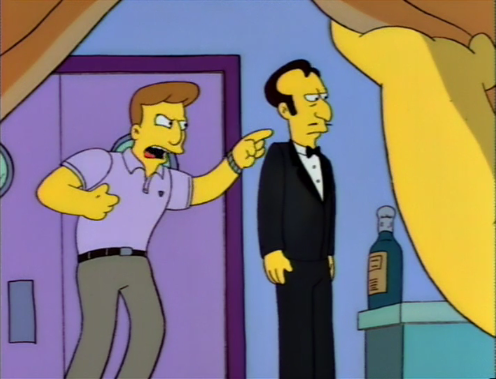
103. Secrets of a Successful Marriage

(originally aired May 19, 1994)
We haven’t seen a true-blue marriage crisis episode since season 2’s “War of the Simpsons,” which I’m fine with, since I always find them pretty hard to get invested in. As we would see in the many, many future episodes like this to come, most of them involve Homer being stupid and thoughtless to betray Marge and him having to make it up to her in the end. Homer is just barely in his wife’s good graces as it is, and when he screws it up further, he really needs to up the ante in his efforts to make Marge, and us watching, truly believe that he deserves to be taken back. “Homer’s Night Out” in season 1 is a perfect example, though that’s kind of a horse of a different color as Homer’s escapades were rather tame in that outing. Here, Homer’s dumbassery is truly ramped up, acting like a real “Jerkass” if you will. His actions really do go too far, and the payoff of his redemption isn’t nearly as satisfying as the writers may have hoped. In the end, I just don’t buy the two getting back together so quickly, and that’s kind of a fatal flaw.

The episode starts with Homer being hurt at the shocking revelation that he’s a bit slow, so he takes a trip to the adult learning annex. From there, he stumbles into the position as teacher of a class about marriage, which goes nowhere until he inadvertently brings up personal information about Marge. His gossipy class is riveted at these juicy tidbits, and Homer feels proud of himself for being able to captivate an audience. Now, we’ve seen Homer’s personality bounce around a bit this season, but his behavior always seems to make sense for the story. Episodes featuring a more obnoxious Homer like “Homer Goes to College” and “Boy Scoutz N The Hood” at least featured situations that made the way Homer acted make sense. Homer’s initial concern is that he’s none too bright, which then turns into a desire to be looked up to, so he breaks his promise to his wife and continues to reveal intimate details about her, then turns a family dinner into a humiliating class session. As an audience, we should never feel that negatively toward Homer, as his actions should always be innocently misguided, but when act two ends with him being thrown out of the house, he absolutely deserved it.

Act three involves Homer’s descent into madness, living in Bart’s treehouse a filth-ridden mess, pining for Marge to take him back. It’s a truly pathetic sight that seeks to set the groundwork for his great revelation at the finale. Lisa gives her father some advice, to remind Marge of the one thing he can give her that no other man can. In the end, Homer finally figures it out: he can give Marge complete and utter dependence. He needs her to put up with him because he loves her, and has learned that since he can’t even begin to survive on his own, he’ll never betray her again. I get it’s supposed to be half jokey, but something really rubs me the wrong way about this ending. Marge’s marriage/servitude to Homer is already an unspoken sad story throughout the series, but bringing it to the forefront like this, as a joke, doesn’t seem right. Outright saying Marge will put up with all of Homer’s shit because he loves her. I get the message here, and there could have been a way the scene could have really worked, but instead… it doesn’t. There’s some select scenes and jokes that work, but in the end, it’s a flat trouble-in-paradise episode with Homer being way too much of an ass. And this was almost a flawless season, too.

Tidbits and Quotes
– The opening with the card game is a pretty great set-up, perfectly illustrating how slow Homer really is. His dragging contemplation keeps him at Lenny’s well into the night, and when Lenny finds him, he starts his thinking all over again, and Lenny kicks him out. This episode looked pretty strong up until Homer got the teaching job… which really makes no sense. There could’ve been other ways this could have went, like Homer acquiring a new skill or taking an interest in education in a bizarre way. I dunno.
– The other classes at the annex are great: Moe’s gangsta rap self-defense class, which is so well-animated, Lenny’s class on tobacco spitting, who stare at him with such revery, and Hans Moleman’s class on eating an orange (“Just eat the damn orange!”)
– The best scene of the show is seeing Smithers’s past marriage, which starts as Cat on a Hot Tin Roof (with a great performance by Harry Shearer screaming “You leave Mr. Burns out of this!!”), then turns to A Streetcar Named Desire with Burns calling for Smithers. It’s a visually gorgeous black-and-white fantasy.
– I do like how petty and ravenous the class gets about Homer’s gossip. Homer bemoans the failure of his class (“I told Marge this wouldn’t work the other night in bed!”), a comment which Moe quickly twists (“So something wasn’t working in bed, huh?”)
– The scene where Marge first asks Homer to stop gossiping to his class is an example why this episode doesn’t work, where Homer randomly quotes a bunch of famous movie lines in a row. It’s a great performance, but has no business in this scene. You need to maintain that Homer is some kind of a human being reacting to the needs of his wife, but here he’s just completely out of his mind.
– Great line at the start of Homer’s first gossip-less class (“What is a wedding? Well, Webster’s Dictionary describes a wedding as, ‘The process of removing weeds from one’s garden.'”) The class immediately starts to leave. Another great line from Otto (“I can’t believe I paid $10,000 for this course! What the heck was that lab fee for?”)
– Speaking of “War of the Simpsons,” we get a similar bit from there of the Lovejoys convincing Marge should get a divorce. When asked if that’s a sin, Lovejoy sighs while holding a Bible (“Marge, everything is a sin. You ever sat down and read this thing? Technically, we’re not allowed to go to the bathroom.”)
Another scene I don’t care for is when Marge is driving and seems to be thinking of Homer’s voice saying he loves her, but it turns out to be Homer in the back seat. The joke completely back fires, and just reads as manipulative and creepy. I’d be even more pissed at him if I were Marge. But the episode’s only get three minutes left so we got to patch them up quick.
– Homer pep-talks his brain to think of something quick or they’ll lose Marge forever. Homer’s brain is on other matters (“Eat the pudding eat the pudding eat the pudding eat the pudding eat the pudding eat the pudding eat the pudding eat the pudding.”) Exactly eight times, mind you. A good friend of mine counted.
– I’m not positive, but this may be the first time Moe’s been shown to have a real shining toward Marge. I love the truly sleazy and manipulative way he tries to get himself into the house and openly admits to horning in on his best friend’s territory. Now, seedy behavior like this makes sense for Moe, but not Homer. I love the tension and dramatic angles when Homer walks in, wondering what’s going on, which sends Moe into panic mode, who smashes through a window and runs away.

Season 5 Final Thoughts
What a season. This show really has changed from its humble beginnings. With David Mirkin in the show runner seat, we’ve seen The Simpsons become a little more wacky. Did I say little? I meant a lot. The series has drifted from its grounded emotional state as was in season 3 and 4, and become more focused on over-the-top jokes and ridiculous bits. This would be catastrophic if not for two things: the stories and characters are continuously engaging, and the jokes are fucking funny. Season 5 is the funniest season by far so far, with more laugh out loud moments than I can even remember, and I just watched the damn episodes. In that season 3 was perfect in that it was full of heartfelt episodes that got you invested in the characters and their plights, season 5 is perfect in that it was consistently hilarious each and every episode. I greatly await this streak to continue in Mirkin’s second run in season 6.

The Best
This is the hardest list I’ve had to choose so far. I got my top five, but I have two amended runner-ups. It’s the best I can do.
“Homer Goes to College,” “Rosebud,” “Treehouse of Horror IV,” “The Last Temptation of Homer,” “Deep Space Homer” (Runner-ups: “Homer and Apu,” “Homer Loves Flanders”)

The Worst
“Secrets of a Successful Marriage.” And they were so close to a golden run.

102. Lady Bouvier’s Lover

(originally aired May 12, 1994)
Marge’s mother was first seen in “Bart vs. Thanksgiving,” a great joke on its own that she’s basically just an older version of Marge with gray hair and a voice so raspy it hurt to talk. Then she was briefly in “Selma’s Choice.” Now she’s the focus of this episode. After this, I can’t remember if we ever saw her again. Maybe in the background at a wedding or church function or something, but she was pretty much abandoned as a character. Why is that? Maybe for the same reason we see Grampa a whole lot more than Patty & Selma, your crazier, more joke-driven characters are easier to get mileage out of than ones who exhibit deeper emotion. Those characters also seem to always be women. But that’s a whole other can of worms; instead of bitch, I will choose to appreciate this episode for what it is: an interesting look at new relationships of those who have one foot in the grave already, seeking companionship for their final days. It’s got a sweet center to it, peppered with jokes, of course.

Jacqueline Bouvier and Abe Simpson kindle an interest in each other at Maggie’s first birthday party, swapping home remedies and waxing nostalgic about the old days. Abe is instantly smitten, Jackie a bit more reserved. I like the multiple dynamics here with their feelings on the relationship, along with Marge’s, who is happy for them but doesn’t want Abe to come on too strong, and Homer’s, who is a bit weirded out at the concept of his father and his mother-in-law dating. At a night out on the dance floor, Abe is cockblocked by Mr. Burns, who is equally smitten by the matron Bouvier, and hastily proposes to her. Jackie surmises that Burns can care for her financially, while Marge is incensed by her mother’s decision due to Burns’s monster-like qualities. Abe makes a dramatic scene at the wedding, and Jackie concludes that she doesn’t want to be with either of them. To Abe, that’s good enough.

There’s really a lot of neat things going on with this story, with Abe’s impulsive nature, the love giving him a bit more vigor and purpose in his old age, and Jackie’s seemingly old-timey passiveness about marrying whoever, or not marrying whoever. I feel like a lot more could have been made of this story, but there seemed to be a need to give it padding with a mini B-story, where Bart gets conned into buying a crappy animation cel (which at least comes to a sort of conclusion thanks to the main story). The main ideas and emotions come through pretty clearly, I was just hoping for a little bit more time with them. There’s also bits of humorous satire, such as Lisa commenting about how their family’s rituals have all come from commercial jingles, like how media has kind of homogenized our individual culture. I found this episode really interesting, with a lot of heart and its share of good jokes.

Tidbits and Quotes
– Classic joke where Homer asks Maggie to point out the monkey, and she points at him. Homer dismisses this until that baby properly points to a credenza when asked.
– We get the second appearance of Gerald, the one eyebrowed baby. I tell yah, that baby is up to no good.
– I love Dan Castellaneta’s incensed read as Abe responding to Jackie’s medical suggestion (“Balsam specific?! While we’re burning money, why don’t we give her a curative galvanic belt too!”) I like the follow-up of Bart mimicking their outdated banter, to which Abe and Jackie retort in unison, “Don’t make fun!”
– The whole first act feels very genuine, with the family sitting around talking about past memories after putting Maggie to bed. Then we get into the great Armor Hot Dogs song, which is half joke, half commercial, complete with Homer walking by at the end holding a “BUY ARMOR HOT DOGS” sign.
– Great quick line from the Crazy Old Man on the senior bus (“Hurry up, hurry! Each Matlock could be our last!”)
– Marge first suggests the idea to Homer of their parents getting together. Homer responds, “Old people don’t need companionship. They need to be isolated and studied so it can be determined what nutrients they have that might be extracted for our personal use.” Marge tells him to stop reading those Ross Perot pamphlets.
– Great bit with Abe getting the wrong woman out of the retirement home, and the perfect timing with Homer rolling up the window, and the woman’s disappointed moan.
The B-story with Bart buying the animation cel is good in its own right. It starts with a great home shopping parody, with Troy hosting a segment on the Impulse Buying Network with Roger Meyers, Jr., who’s touts his wares (“I’m proud to offer your viewers these hand-drawn Itchy and Scratchy animation cels. Each one is absolutely, positively, 100% guaranteed to increase in value.”) Then a quick announcer disclaims, “Not a guarantee.” We also get the return of Comic Book Guy when Bart tries to sell it, who is starting to slowly develop into the sarcastic grump we know and love (“No groaning in my store.”) I also love Homer’s impulsive reactions to Bart’s confession: blind anger when he hears Bart used his credit card, then excitement over getting the money (“Three hundred and fifty bucks! Now I can buy seventy transcripts of Nightline!”)
– Wonderful sequence of Homer expressing his fear over he and his wife’s parents getting together (“We’ll be brother and sister! And our kids… they’ll be horrible freaks with pink skin, no overbites, and five fingers on each hand!”) The depiction of Bart, Lisa and Maggie as blonde, blue-eyed Caucasians is intriguing and frightening. I’d love to see a segment of a show, or maybe a fan-animation of an existing sequence, with the characters in that style. It would be mighty freaky.
– Great scene of Homer teaching his father how to play it cool, with smooth jazz music and a color palette change to shades of blue. It’s a neat sequence, coming from nowhere, but still greatly appreciated.
– I like how Smithers is Marge’s parallel as the confidant upset about Burns and Jackie’s relationship; their simultaneous murmurs walking side by side at the wedding is great. Also great is Smithers’s seemingly off-the-cuff love note for Burns to write his new lady (“Darling one, read my words and hear my heart speak of a love soft and undying: a love that will be with you always.”) Burns asks how he came up with that, and a devastated Smithers revealed he wrote it in a card for Burns’s birthday. Also great is his attempt to make Burns look foolish in telling them that Homer and Marge are Fred and Wilma Flintstone.
– We get our second appearance from Luigi, doing basically the same bit as his first appearance (“Hey, Salvatore! Break out the cheap hooch for Mr. No-Tip and the dried-up-ah zombie he’s-ah captured!”)
– Great line from a despondent Abe (“Who needs her? Now I’ll have more time to read things I find on the ground. ‘La… tex… con… do’ …boy, I’d like to live in one of those!”)
– I love at the wedding, only one man is on the groom’s side, an old man with a German WWI helmet on. I want to know more about that guy’s relationship with Burns, his only friend in the world, apparently.
– Of course the ending song is amazing, a great parody of The Sound of Silence. Also great is how Abe sheepishly quiets his ranting after the Gracie Films lady shushes him.

101. The Boy Who Knew Too Much

(originally aired May 5, 1994)
What a fine episode. At its core, it felt like one of the great morality tales we’d seen in seasons 2 and 3, but with all of the wacky and offbeat jokes we’ve come to know, love and laugh at from this season. Bart remains at the show’s center, starting with his truant escapades leading to the main event, then his guilty conscious starts eating away at him. The emotional through-line is never forgotten, even amongst the Quimby/Kennedy jokes, Skinner’s relentless quest against Bart, and a mini-plot line of Homer living it up at a fancy hotel as part of a sequestered jury. This is another one of those episodes where I didn’t remember too much about (except for the most famous bit), and it really surprised me of how great it was.

On a particularly lovely day, Bart decides to skip school, but when Skinner catches wind of it, he goes into hot pursuit. It becomes this great cross between Ferris Bueller’s Day Off and a gritty crime drama, turning Skinner into this seemingly impossible force that Bart cannot escape from. He finally actually does, in the back of Mayor Quimby’s nephew Freddy’s convertible, whose destination is the Quimby compound for his lavish birthday party. Freddy is just as you’d expect from a young Quimby: loud, arrogant, and extremely entitled, all of which he can get away with, ’cause he’s a Kennedy… er, Quimby. A disagreement over the pronunciation of the word “chowder” (the best scene in the episode, of course), Freddy and the waiter have an altercation in the kitchen, which only Bart is witness to, which leaves the waiter brutally beaten.

As Freddy Quimby stands trial, Bart is in crisis: he knows the truth, but admitting it will be exposing his own guilt for skipping school. I like the various turns of the court case that give Bart more or less wiggle room: at first it seems like the case is in the bag, as Mayor Quimby is basically buying his nephew’s freedom, until Freddy makes another violent outburst over the “chowder” incident, which immediately turns off the jury. But dumb luck goes in Bart’s favor as his father prolongs the judging, if only so he can live in luxury at an all-expenses paid hotel. The scenes where Bart talks about his situation with Lisa, then his mother, are very genuine, and all reach an increasing level of urgency, until Bart finally takes the stand and reveals what happened: the waiter did himself in due to his incredible clumsiness, in one of the most ridiculous, and ridiculously well animated, scenes of the series. Skinner applauds Bart for his honesty, but in a great bait-and-switch, gives him detention anyway. All’s well that ends well, I guess.

Tidbits and Quotes
– It’s almost as if Bart is forced to play hooky by the impossibly wonderful day outside, and coming to school on a prison bus. The kicker is when he looks out the window and see Freddy Quimby in his cool car and hot girlfriend (“And to think I got all this after dropping out of the fourth grade!”) This is also a really tight show, where the Freddy story is set up this early, and is the catalyst of Bart leaving in the first place.
– The almost destitute Springfield Elementary apparently has an extensive crime lab, which Skinner uses to examine Bart’s bogus note (“Please excuse my handwriting, I busted whichever hand it is I write with. Signed, Mrs. Simpson.”) Skinner takes action, as he and Willie grill Lisa as of Bart’s whereabouts, in a cute scene where Lisa giggles about the two switching good cop/bad cop roles.
– I like the grim reality of Bart’s Huckleberry Finn fantasy coming true… in the form of two creepy hobos on a raft (“Hey kid, wanna see a dead body?”)
– Skinner’s search for Bart is a great character piece, with no sign of him at the natural history museum or the youth center (“Am I so out of touch? …no, it’s the children who are wrong.”)
– The Westworld bit of Skinner walking through the stream is fantastic, especially when the music stops and then starts up when he submerges and resurfaces. Another movie I watched after seeing a Simpsons reference, then loved all the more.
– As if Rainier Wolfcastle wasn’t enough of a Schwarzenegger parody, we see him with his wife Maria and that he owns a Humvee. Talk about on the nose.
– The “chowder” scene is hysterical, with Dan Castellaneta being so loud and annoying as Freddy, and Hank Azaria as the waiter being as deadpan as possible (“Come back here! I’m not through demeaning you.”)
– Another great Wiggum line (“Oh my God… someone’s taken a bite out of the Rice Krispies square! …oh, and the waiter’s been brutally beaten.”)
– Great bit with Skinner glaring at Bart from the jury box (“I know you can read my thoughts, Bart. Just a little reminder: if I found out you cut class, your ass is mine. Yes, you head me. I think words I would never say”) and Homer’s thoughts, which consist of the Meow Mix jingle.
– It’s interesting here that in this case, we have our lawyers reversed. Quimby’s lawyer doesn’t look like him, but has the same voice of the Blue Haired Lawyer, who always defends the guilty, more affluent party, while Lionel Hutz is the cheap affordable schmuck the Simpsons can actually afford. It makes sense given the representatives, though.
– Odd that Hutz got Dr. Hibbert, normally a respectable doctor, to give testimony on something as dumb as the “evil gene” (“Hitler had it, Walt Disney had it, and Freddy Quimby has it.”) That’s enough for Hutz (“I rest my case. …what? Oh no, I thought that was just a figure of speech. Case closed.”)
– Bart’s fantasy of the future of being a grizzled school cafeteria worker is hilarious (“This creamed corn tastes like creamed crap!” “Watch the potty mouth, honey.”)
– Homer exhibits more thickness as he gets Skinner to describe exactly what happens when a jury is deadlocked, and gets increasingly excited about his potential accommodations (“We’ll get a free room, free food, free swimming pool, free HBO… ooh, Free Willy!”) Also, really fantastic minor bit from Skinner, offhandedly calling it a film about a disobedient whale.
– We get the amazing return from “McGonigle,” which does nothing to comfort Bart, involving the detective convincing a little boy to testify, only to have his throat slit. McGonigle is not so moved (“Hey, I’m trying to eat lunch here!”)
– The ending with Skinner is absolutely amazing. He commends Bart for his bravery, then Bart tries to give himself an out by having it excuse his previous transgression. Skinner admits, “I’m a small man in some ways, Bart. A small, petty man. Three months detention.” Bart begins to walk away, but Skinner stops him. Pause. “Make that…” Pause. “Four months detention.” Hilarious.

100. Sweet Seymour Skinner’s Baadasssss Song

(originally aired April 27, 1994)
Status quo is God for a reason. Just as in life, radical change can shake things up something fierce. Many characters in this show are defined by where they work and what they do, and are in deep trouble if they’re not. Mr. Burns needs the power plant. Apu needs the Kwik-E-Mart. And Principal Skinner needs to be Principal Skinner. Here we get a better examination of ol’ Spanky, the overbearing nature of his work, and his piddling attempts to live a life after he is let go. A lot of the middle of the episode of seeing Skinner’s day-to-day routine, living at his mother’s house, faux-conducting an orchestra in his bedroom, is extremely fascinating, and gives up real human insight into his character. As I mentioned last time about Burns, I’d love to see an entire episode just about Skinner and a regular week for him. These secondary characters are so rich, they’re just as engaging as the Simpson family.

The first time we see Skinner in the episode, he’s already a nervous wreck, struggling to defend himself on the phone with the superintendent. He’s a man who loves his job and the authority, but we can see he’s in hot water already. That leads us to further shenanigans when Santa’s Little Helper, who Bart brought in for show-and-tell, ends up roaming around the air ducts, and only a greased up Willie can apprehend him. When this turns into a disastrous fiasco, Superintendent Chalmers pays the school a visit (uttering the very first “SKINNER!!”) and promptly fires Skinner. Now Seymour is just any other civilian, shopping at the Kwik-E-Mart and paying a visit to the laundromat. The scene of Skinner running through all the detergent names and pondering which to use is spectacular. It’s so true to him that he would run through all his options and really consider his choice, even for something so trivial. Bart feels guilty for the situation he directly caused and decides to spend time with his ex-principal. At times it borders on out-of-character for him, but the fact that the friendship is slightly awkward on both of their ends feels very genuine.

Deciding it’s finally time to move on, Skinner re-enlists as a sergeant in the army, while the head of the PTA Ned Flanders is made the new principal. We get some nice moments displaying Ned’s namby-pamby disciplinary skills, and also a really telling look into his past, revealing his parents were a bunch of beatniks (I also want a young Ned Flanders spin-off too.) Eventually, Bart and Skinner hatch a plan to get him back, which comes up short, but Flanders ends up thwarting himself by daring to speak the name of the Almighty over the intercom (Chalmers delivers a classic line: “A prayer in a public school! God has no place within these walls, just like facts have no place within organized religion!”) As odd as it may have been at times, Bart and Skinner’s friendship was very sweet. It was interesting to see the two mortal enemies on a level playing field, actually enjoying each other’s company. They both acknowledge that once Skinner is back in power, their friendship must end, and they accept that (unless Bart becomes a good student, which he scoffs at the idea). It’s a real nice episode, lots of laughs, interesting character stuff. Jolly good show.

Tidbits and Quotes
– Nice home movies at the start, with Homer lighting his beard on fire, and the adorable baby Bart on the toilet. Marge makes a clever comment regarding Bart bringing the movies into class (“I’m not sure if I’m comfortable with the idea of your classmates laughing at our family’s private moments. How would you like it if, twenty years from now, people were laughing at things you did?”) Twenty years now, and I’m still laughin’.
– Nice quick moment with an ecstatic Willie, enamored by Santa’s Little Helper, pressing his face against the window of Mrs. K’s class.
– A nice brief appearance by Lunchlady Doris sifting through a barrel of assorted horse parts (“More testicles means more iron.”) Her deadpan reaction to Willie ripping off his shirt, revealing his muscular physique is fantastic (“Grease me up, woman!!” “…okey-dokey.”)
– The chase in the vents is wonderfully directed, and references not one, not two, but all three Alien movies. The first Alien with Skinner observing their locations on a computerized diagram of the vents (for a school with no budget, I’m surprised they have such sophisticated technology for such a useless purpose). Aliens when Skinner sticks his head in the vents and is licked by the dog. Then Alien 3 with the blurred shapes of the dog as he dashes through the vents. On catching the mutt, Willie delivers classic line (“There’s nary an animal alive that can outrun a greased Scotsman!”)
– Great timing as Skinner tells Chalmers everything’s under control, then a fireman falls off a ladder, knocks down the giant scoreboard machine and smashes the gymnasium window.
– First appearance of Leopold, who’s only been in two episodes, and serves one purpose: act like the angriest man who ever lived all for the purpose of a mislead when he drops the act. I love this character, and Dan Castelleneta does such a great job doing the grittiest, most enraged possible voice, all deflating for the final line of dialogue. I also love Chalmers’s anger toward the kids not responding to his jokes (“It’s just a damn popularity contest with you kids!”)
– Speaking of anger, Apu has a wonderful tirade toward Skinner’s obliviousness that he has ripped off Jurassic Park with his novel idea, with terrific time fades as Apu gets more and more irate (“…most popular movies of all time, sir! What were you thinking?! …I mean, thank you, come again.”)
– Great moment that makes Bart truly guilty about Skinner when the bullies steal his underwear at the laundromat (“I can buy a new pair! …no I can’t. I needed those, I really did.”)
– We also get the first appearance of Luigi, the greatest Italian stereotype, voiced by Hank Azaria. Not much to really say about him, other than he’s hilarious (“Hey Salvatore, give-ah the ugly kid a plate of the red-ah crap-ah!”)
– A nice sweet moment of a depressed Skinner mournfully gazing at the school after dark, remembering the good times, varying from serious (“I learned to read because of you, Principal Skinner!”) to the not so (“I got car sick in your office.”)
– More great true-to-Skinner moments when he reprimands his troops for their lewd army chants, who then switch over to a clean one about how old the Parthenon is.
Another first appearance, this time of Gerald, the one-eyebrowed baby, Maggie’s arch nemesis. The baby has got to be up to something.
– I always thought the kids wrecking total havoc throughout the school was a bit much, like that wouldn’t happen with the other teachers and faculty still there, no matter how much they didn’t give a shit. I guess it’s worth it for Chalmers’s blasé attitude (“The way America’s public schools are sliding, they’ll all be this way in a few months. I say, lay back and enjoy it! It’s a hell of a toboggan ride.”)
– An absolutely lovely ending with the “Kick Me” and “Teach Me” signs, and one final “Oh, mercy” from Skinner.

99. Burns’ Heir

(originally aired April 14, 1994)
Re-watching these old episodes has really ignited my love of Mr. Burns. He’s one of the show’s all-time greatest characters, so engaging and entertaining in pretty much every scene he’s in. I feel like I’m repeating myself, but regardless, some of the best Burns material comes from when we see a more human side to him, where the man with more money than God must face his own mortality. It was the subject of Marge’s famous painting, he sought happiness from his childhood with his bear Bobo, and now a near-death experience shocks Burns into pondering on his legacy when he’s gone. We see him as a withered old man who has ostracized nearly everybody, left to toil in his vast, empty mansion, but the question is, is he happy with this? Or does he long for something more? Both theories are tossed out in this very episode, and perhaps it’s a little of both. It’s nice that the show can allow you to theorize and not spoon-feed character emotions to you, or if they did, have the common decency to mock them.

The hefty weight of a sponge causes Burns to sink in the bathtub, causing his life to flash before his eyes, itself an incredible montage. I think the life of C. Montgomery Burns would make a fascinating mini-series, they should have done more stuff like this. Anyway, Burns sets up a casting call for the children of Springfield to try and find an heir, but no one wins him over, until a rejected Bart wreaks havoc upon his estate, exhibiting just the kind of feisty attitude Burns is looking for. The old man has the Simpson family sign the contracts, and then muses about spending his remaining years in solitude. This guilt trip leads Bart to make extended visits to Burns Manor, where he revels in the freedom to do as he pleases. We later find that Burns planned for the boy to live with him so he could mold him in his image to take his place after death. Despite this, I do like to think his cock-and-bull confession earlier had some nugget of truth in it. Burns seems to genuinely enjoy Bart’s company, basically admitting he’s the son he wishes he’d had. His motives are self-serving and his goal dastardly, but you still feel for the guy.

Bart’s role in the story is engaging too, as he finds he must choose between a life of no restrictions and anything his heart desires, and his loving, biological family. Burns pulls psychological tricks to make the boy stay, culminating in hiring stage actors to portray the family bad-mouthing him. Despite the comically poor performances, Bart is convinced, and his slow declaration of his allegiance to Burns is a little wrenching. The end, though, feels a little too much, with Bart being forced to fire Homer to curry Burns’s favor. I can’t pinpoint why exactly; perhaps it’s a bit too predictable way to get Bart back on his family’s side. But with all the great stuff leading up to it, and the hilarious denouement featuring Hans Moleman, it could have been the most contrived ending in the world and still the episode would be worth it.

Tidbits and Quotes
– Classic smash cut with Homer positing the rich must be suffering as much as he, then cut to Burns with top hat having a bath in his lush estate, and if that weren’t enough, eating a bad of “extra fancy” potato chips.
– Again, I’d love to see flashback episodes featuring Burns. I always thought that later day Simpsons could be made interesting again by focusing a fair amount of episodes on side characters, exploring more of their lives and own foibles. Instead, most of these characters became disposable, who’d show up for the sake of a joke and disappear. Ah well.
– Burns muses over never fathering an heir thanks to his hectic schedule and lethargic sperm. I like that even the complete Burns-sexual Smithers is disturbed at Burns’s plan that he will be buried alive with him.
– Wonderful THX movie parody, culminating in a man’s head exploding, and Grampa still not hearing it. The clip was later used by THX in theaters. Then comes Mr. Burns’s ad (“I’m looking for a suitable young male heir to leave my fortune to when I pass away. My vast, vast, vast fortune. Vast”) ending with him begrudgingly kicking off “Let’s All Go to the Lobby.”
– We get great moment with the kids of Springfield at the audition: Milhouse has nothing to offer Burns but his love (“I specifically said no geeks!”) Nelson threatens violence (which Burns likes), and later pummels a showtune-singing Martin (Burns also likes), and Lisa posits the idea Burns’s heir need not be a boy (“I don’t know what phallocentric means, but no girls!”)
– Great dream sequence by Marge of Bart graduating from Harvard (the most expensive, and therefore the best school.) Lee Majors randomly shows up to take Marge away, leaping into the air with bionic sound effects. Snapping back, Marge promises herself to stop dreaming about Lee Majors… after this next one. We hear the bionic sound again as she goes out of it.
– Astute fans will have noted that this blog’s title comes from this show, as Bart fumbles through the poorly written cue cards his father gave him (“Hello, Mr. Kurns. I bad want… money now. Me sick”), Homer comments, “Oooh, he card read good.” Also, great finale of Burns slowly activating the boot to kick Bart, his quiet satisfaction after doing it, and Homer’s uproarious response (“The boot kicked Bart! It kicked him right in the butt!”) And finally, some very important parental advice from Homer (“You tried your best, and you failed miserably. The lesson is: never try.”)
– Great bit from Krusty: being paid to deliver pizza to Bart, he admits he’s playing a rerun in place of a live show. Of course of all the years of tape, he picks the one where he abruptly stops the show after hearing the Falkland Islands have been invaded.
– I do enjoy Bart being a brat at the dinner table, and Homer’s ineffective means of stopping it (“Lisa, stop getting in the way of your wealthy brother’s peas.”) But he draws the line of feeding meatloaf to Santa’s Little Helper (“That was the end piece! That’s it, being abusive to your family is one thing, but I will not stand idly by and watch you feed a hungry dog!”)
– Homer drives to Burns Manor, running over Bart’s bike, to get back his son, and is incensed at Burns telling him to leave (“Or what? You’ll release the dogs, or the bees, or the dogs with bees in their mouths and when they bark they shoot bees at you? Well, go ahead, do your worst!”) At this point my brain automatically goes to the deleted scene from “The 138th Episode Spectacular” featuring the robotic Richard Simmons, but here, Burns just locks the door. Homer is dumbfounded.
– The animation of Bart’s wild joyride is fantastic; you can feel the motion and energy even from Bart’s POV of all the objects hitting his front windshield. Spectacular direction.
– Bart watches the phony Simpsons weakly reading their lines, but their cover is almost blown when fake Homer utters “B’oh!” I love the pacing that Burns slowly walks out of the room and into the covert set to yell at his actors. Also, it seems he’s hired Michael Caine to play Homer, who is very frustrating over the direction (“Sorry, M.B., but I’m having trouble with this character. Is he supposed to have some kind of neurological impairment, like Rain Man, or Awakenings? I mean, what the hell am I doing here?!”)
– I love Homer’s enthusiasm about kissing Moleman (“It’s like kissing a peanut!”) and the final line from Marge (“Homer, I want that thing out of my house.”)