44. Saturdays of Thunder

(originally aired November 14, 1991)
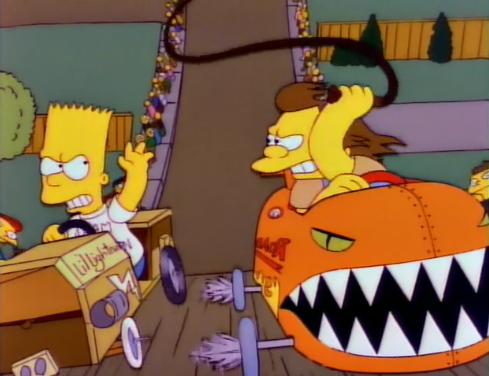
This episode features Homer realizing he’s been a poor father to one of his children and tries to set things straight. Sounds familiar, doesn’t it? This show is no stranger to retreading over covered ground, but the great thing about the classic seasons is their ability to take worn material and make it feel new again. I would have gone right through these two episodes without thinking twice about the similar elements if I hadn’t listened to the commentary. Anyway, while Homer is completely out of his element with handling Lisa, he’s got a better shot with bonding with Bart, who is at about the same maturity level as him (maybe a bit lower in some regards). Where last episode Homer failed a task for Lisa, here he barely even acknowledges his son’s existence until he fails a magazine quiz on fatherhood. At that point, he leaps into action, helping his son with his latest hobby: building a soapbox racer.

When Homer gives it his all, he gives it his all. The end result may be pretty shoddy, but he’s still all in. When Bart tells his father he’s going to ride Martin’s car in the final race, Homer is understandably hurt. Never mind a mere eight minutes ago, we saw him leaving his son alone to use a blowtorch (and chastise him for using such a low flame); we still feel for him all the same. When Lisa tries to present a distraction to him, all Homer can see is another chance for him to screw up as a father. Small-minded in his behavior, one bump in the road will leave Homer moping in a corner, or rather lounging on the couch the day of the big race, stewing in his own juices of failure. But in the end, he shows up to cheer his son on, of course, and Bart wins the big race. Father and son childishly taunt the loser Nelson, united in their infantile nature.

This episode also showcases a lot of TV and movie parodies, a real staple of the Al Jean/Mike Reiss years, who would later do as many parodies as they pleased in their series The Critic. We open with an installment of the infomercial series “I Can’t Believe They Invented That!” with Troy McClure and Dr. Nick. Phil Hartman and Hank Azaria play off each other so well, both selling their own unique brands of smarm and scammery. Everything about the segment is perfect, from the lame product name “Spiffy,” the inane banter, and the inexplicable fact that they seemingly ripped Edgar Allen Poe’s tombstone out of the ground and hauled it into a studio to film this stupid advertisement. Later at the video store, we get an equally fantastic McBain clip, in which our hero’s veteran partner is talking about how he’s finally leaving the force for a new cushy retirement, only to be killed mercilessly, shown from a number of gratuitous angles. The prelude to this is absolutely perfect, with every note hit to show this guy has a great life ahead of him, capped by a photo of his wife christening his boat, the “Live 4-Ever.” And of course, we get the immortal line, “MENDOZZZAAAAAAAAA!!!” ‘Nuff said.

Tidbits and Quotes
– Everything in the infomercial is quotable, but the last bit is especially great. Dr. Nick demonstrates the product (“With one application of Spiffy, you’ll think the body’s still warm!”) and McClure comments (“Quoth the Raven, what a shine!”) Also great is when the audience violently turns on Nick for his original, too steep offer, and Nick sweetening the deal with a Kansas Jell-O mold… which is just a rectangle.
– Homer fumbling through the fatherhood quiz is a great back-and-forth between him and Marge. I especially love his attempts to name Bart’s friends: the fat kid with the thing, and the little wiener who always has his hands in his pockets.
– Second of three (I think) instances of inappropriate hold music: “Cat’s in the Cradle” plays when Homer calls the Fatherhood Institute. Also, I love when the Institute heads haul Homer off, Bart, believing his father is being committed, quietly musing, “Maybe it’s for the best.” Like he’s been anticipating this day for a long time.
– The underwater fatherhood tank is so pointless and ridiculous to begin with, so I don’t know how much good wondering how the hell a shark could get in with the father and son will do. It’s funny, let’s leave it at that.
– Great overt references to Bill Cosby, the show’s rival at the time, but a relative high road is taken. His book “Fatherhood” is even cited, and helps Homer out (“Thank you, Bill Cosby, you saved the Simpsons!”) Also, we get the first time Homer is outwitted by his own brain, which seems not so much stupid as a sign of severe schizophrenia.
– This show is all about cramming as many jokes into a scene as possible. Martin smashes his soapbox racer into a wall, then the parachute deploys. Then the car sets on fire, and Martin as well, who runs out of the car screaming. That’s not funny enough though, as a fire engine arrives to put out the fire… of the car. Brilliant. Also I love Martin’s anger toward Dr. Hibbert (“Save your palliative clichés for the next poor sap, doc!”)
– Homer passionately calling Martin a homewrecker may be one of my favorite moments of the whole series.
– Homer getting increasingly excited for finishing the fatherhood quiz ends with a great moment of throwing a random question at Ned (needing to fulfill the “Name another Dad you talk to about parenting” question), then he immediately bolts before Ned can get two words out of his mouth.
– I love how the Fatherhood Institute is apparently filming the soapbox race. I guess they have cameras everywhere. They’re an insanely well-funded organization, doing incredibly dubious work: they fit right in with the Simpsons universe alright.
43. Lisa’s Pony

(originally aired November 7, 1991)
The relationship between Homer and Lisa is the most complex and emotional in the whole show. Lisa is an eight-year-old wise beyond her years, with the ability to feel great sorrow and melancholy amongst her mostly fluff-headed classmates (and teachers). She is openly loved and encouraged by her mother, though their relationship isn’t perfect (we’ll save that analysis for later). Her feelings towards Homer are a different story. At this point, Lisa holds no real resentment toward her father’s inattentiveness, just a level amount of expected disappointment. Homer, meanwhile, remains oblivious to Lisa’s deep emotions, but when they finally manage to cross his radar, he works into overdrive to try and make things right. In most cases, Homer is actually a pretty good father to Lisa, but he is plagued by his poor thinking and judgement. This is a perfect Homer/Lisa episode, and the favorite episode of my friends (Nick, who did commentary earlier), and may be one of my favorites too.

Before we can begin with all this, we get a great 2001: A Space Odyssey parody, where a Homer ape invents loafing on the job, mirroring present-day Homer. I only wish it were put in front of a more Homer-centric episode where it would make more sense as a lead-in. Anyway, Homer is awakened for an important task: to get Lisa a new reed for her saxophone for the school talent show. A lesser show (and maybe even later Simpsons) would make this first act have Homer forget the show completely and go to Moe’s, but that would be too easy and expected. Homer does go to Moe’s, conveniently located next door from King Toot’s Music Store, but only due to his Homer-logic that he can knock off a beer five minutes before the store closes. He gets the shop owner to reopen the store, and even remembers what instrument her daughter plays, which for Homer is a massive achievement. But despite his efforts, he still shows up too little, too late, adding one more paternal disappointment to the pile for Lisa.

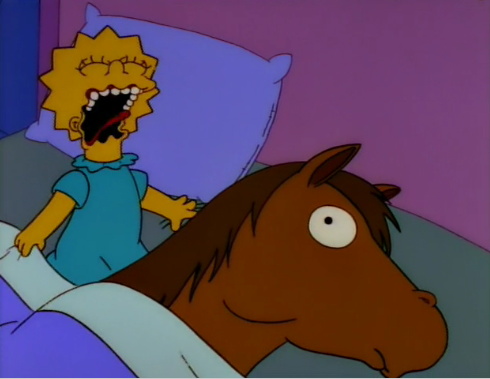
Homer attempts to slowly warm up to Lisa, but his growing impatience leaves him yearning for a quick fix, which leads to him buying Lisa her long-wished-for pony. It’s a large burden, financially and logistically, for the Simpsons to harbor a large animal in their suburban home, but it’s one that Homer plans to stick through, no matter what it takes. Eventually, he must take another job working the night shift at the Kwik-E-Mart, leaving him a sleep-deprived zombie toward the latter part of the episode. Due to his thick-headedness, Homer has foolishly put his eggs in the pony basket, believing the one way is the only way (“Lisa loves me, the pony stays,”) willing to sacrifice everything to keep his daughter happy. His methods are insane and his logic beyond faulty, but Homer is proven to be a great father. It isn’t long before Lisa takes note of her father’s struggle, and gives up the pony, acknowledging the lengths Homer went through for her. It’s a really sweet story, peppered with enough funny elements (the priggish riding instructor, Apu training Homer) to keep it consistently humorous throughout the emotional premise.

Tidbits and Quotes
– I love Bart’s talent show act, “The Boy of a Thousand Voices.” He turns his back to the audience for his Skinner impression to “prepare” himself, but then proceeds to talk in a stereotypical dumb voice, finger firmly planted in nose. Skinner is less than amusing (“That young man just became the boy of a thousand days detention.”)
– Much appreciation for the “My Ding-a-ling” kid. It’s such a little kid thing to do, but he’s really putting his heart into that song before Skinner yanks him off stage. I laugh every time.
– I like that Lisa’s poor performance is met with such strong boos and scorn from the crowd. The people of Springfield are easy to rile up, even at a children’s talent show. Although Sherri and Terri’s knife-throwing act and the one Asian kid’s chair balancing stunt were pretty impressive. I love Skinner’s incredibly pandering playing off of Lisa (“Let’s hear it for Lisa Simpson and her wacky sax!”)
– I want to go to Phineas Q. Butterfat’s ice cream parlor and get the Mount Bellyache. It’s the perfect way to start the second act, as Homer’s go-to would be to smooth things over the easiest way possible, and also involve food. The timing is great with Lisa barely eating a bite before flatly stating, “I’m done.” Homer is devastated (“That cost eighty-eight dollars!”)
– The home movies are cute, with the brief look at Homer watching Fantasy Island (“De plane! De plane!” “No, my freakish little friend. That’s a seagull.”)
– I love Homer’s dodging of Marge’s urges to not buy the pony with his signature non-committal noises (“Was that a yes or no?” “Buh.” “Those aren’t even words!” “Snuh.”)
– Homer at the pet shop is great, with the Charles Bronson-voiced owner trying to pass off a Scottish deer hound to Homer as a pony. Homer very slowly reads the breed name and realizes he’s been had. The owner responds incredulously (“Oh, my friend, you’re smarter than I gave you credit for!”)
– Burns approving Homer’s loan is a small great scene in itself, but I also love how it’s a bait-and-switch. Burns’s diabolical laughter on accepting the loan makes you think he’ll appear later on in a plot point, but it’s a ruse; it’s just Burns being Burns.
– Homer is full of insane plans this episode. When asked where the pony will live, he’s got it all planned out (“By day, it’ll roam free around the neighborhood, and at night, it’ll nestle snugly between the cars in our garage.”)
– Bart and Abe playing video games at the start of act three has nothing to do with the episode, but I love it all the same. “Where’s the hyperspace?!” is something my friends and I would randomly quote, usually when playing video games.
– There’s plenty of great Apu lines in here, from his elation that one of “them” (Homer) would be working for him to telling his new trainee to change the expiration dates on the dairy products. This is the first episode that expanded his character a bit more; we even see his swinging bachelordom, and hear the moans of his almost orgasm in an establishing shot of his apartment complex. My favorite line is probably his being frank with Homer on the dangers of the job (“I won’t lie to you. On this job, you will be shot at. Each of these bullet wounds is a badge of honor. Here’s a pointer. Try to take it in the shoulder.”)
– Even as Homer is fast deteriorating from exhaustion, he still insists he’s got everything going according to plan (“I’ll work from midnight to eight, come home, sleep for five minutes, eat breakfast, sleep six more minutes, shower, then I have ten minutes to bask in Lisa’s love, then I’m off to the power plant, fresh as a daisy.”) Mere seconds after speaking, the kids find Homer collapsed on the floor, passed out in front of Marge.
– Homer driving through Slumberland is perhaps the greatest dream sequence in the entire series. It’s so well-done, beautifully realized, within the context of the story, its nods to Little Nemo… it’s just all-and-all wonderful.
– I do like Lisa being a kid for once and not being openly aware how much keeping a pony costs and the toll it has caused her father. When told that the pony situation is up to her, she muses, “All the years I’ve lobbied to be treated like an adult have blown up in my face.”
– I lied, the final line of the episode is the best Apu line, and along with Homer giving Lisa a piggyback ride out of the store, perfectly encapsulates the snarky/sweet tone of the show (“He slept, he stole, he was rude to the customers. Still, there goes the best damned employee a convenience store ever had.”)

42. Treehouse of Horror II

(originally aired October 31, 1991)
This second installment of Treehouse of Horror confirmed these specials to be yearly, an outlet for the show to be as absurd, preposterous, and violent as they could not be in the series proper. But even when the segments would be wrapped in parody or a bunch of spooky stuff, it never lost sight of the characters. I feel later Halloween shows would do parodies just because they seemed relevant or could get some recognition laughs, like seeing a Transformer, Harry Potter or the Twilight vampires. But recognition of a pop culture item is not a joke (Family Guy fans might beg to differ). We get no better example than these early Halloween shows, which are filled with references and entire story lifts from old scary stories, Twlight Zone episodes and other sources, but feel entirely original and their own, taking their unique spins on these tales.

Our first segment is a classic example, based upon the age-old spooky story The Monkey’s Paw. Again, the joke isn’t that the Simpsons are in this story, it’s just the story. There’s even a psychic awareness of the story itself within the story, with the mysterious merchant stating right of the bat the paw could cause grave misfortune (upon experiencing it himself, Homer later muses, “I thought he was just trying to be colorful.”) Of course, the family’s wishes backfire in spectacular ways, perhaps the most ingenious being Bart’s wish for the Simpsons to be rich and famous. This leads to an amazing meta commentary where the family’s fame and fortune in-show mirror the real-life merchandising giant the show had become at that time. The citizens of Springfield go from amusement to boredom to just plain irritation. The products shown are also great send-ups, like the classic Bart Simpson T-shirts, and as strange as The Simpsons Sing Calypso seems, it’s every bit as bizarre as The Simpsons Sing the Blues. Lisa’s wish for world peace brings back Kang and Kodos, cementing them as Halloween regulars. We also get the first instance of their endless laugh, perhaps their greatest trait, confirming the comedy rule that extending something for just the right length makes it even funnier.

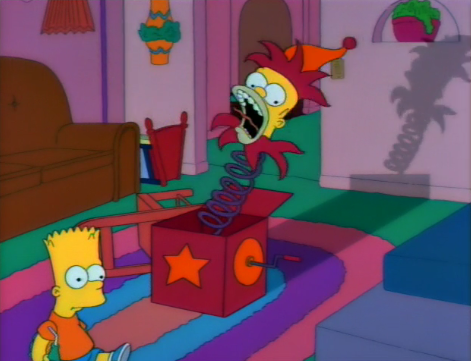
Segment two is an alteration of a Twilight Zone segment “It’s a Good Life,” where a child with psychic powers and the ability to read minds bends a town to his every whim. As Bart was larger than life at this point, it only made sense for him to fill the role. Childhood is painted as cruel and self-serving as Bart terrorizes his family, his school and just about everything else to tend to his desires, from changing national history in accordance to his test answers (making America now ‘Bonerland’) to morphing the family cat into a garish nightmare creature. There’s even a particularly grim sequence showing that Bart has forced his idol Krusty to stay on the air for days straight, pushing him to insane levels of exhaustion (hilarious for us, though, thanks to some great character animation and Dan Castellaneta’s crazed performance). As in the original Twilight Zone segment, Homer is turned into a jack-in-the-box by thinking negative thoughts toward the boy, but here, our wrap-up is more jovial, but still sarcastic as Bart’s hostility toward his father is defused by a super sappy father-son montage, made even more funny by Homer’s altered state. Bart waking up screaming after Homer kisses him goodnight is the icing on the cake, the exact moment his wonderful dream turned into a nightmare.

The third segment may be the weakest, a sort-of riff on Frankenstein where Burns believes he can create the ultimate worker by transferring the undying spirit of the working man into an impenetrable robot. All he needs is a brain, any will do, so of course, Homer is chosen. There’s some great bits of animation in Burns’s lab, with some portions mimicking closely to shots and visuals from the original film. There’s some great Burns-isms of course (though a pull from Wizard of Oz, calling the robot a “clinking, clattering cacophany of colligenous cog and camshifts” feels so very Burns), but I haven’t much to say on this one. I will say that this segment probably has the first genuinely disturbing moments in a Halloween segment, slicing Homer’s head open and Burns violently ripping the brain from his skull. I always felt these specials should be somewhat jarring and disturbing, but not in the way of senseless and gratuitous violence as some later specials (and even regular episodes) would be. Here, it fits the story and the tension of the scene, but of course, it’s played off immediately with Burns plopping the organ on his head, exclaiming, “Look at me! I’m Davy Crockett!” Brilliant example of the show having it both ways.

Tidbits and Quotes
– Marge returns at the opening for another warning about the special’s content, this time expressing exasperation over no one having listened last year, then conceding that no one will probably listen this time too. I wonder if people did complain about the content in the first special… Probably got some letters, I suppose.
– The wrap-around of the stories being bad dreams Lisa, Bart and Homer get after a suger-induced high is fair enough, which all builds to the final bit just fine.
– Brilliant bait and switch with Homer pointing the mysterious vendor out to Marge, only to find he has disappeared… We’ve seen this so many times that we accept that that might be the case, but then Homer points over to the left to show the vendor waving at him happily (“You’ll be sorry!”)
– On top of the, of all things, Midnight Express reference, it’s funny in hindsight to see an American being held up by airport security in the Middle East.
– I love Homer’s annoyance after Lisa wishes for world peace (“Lisa! That was very selfish of you!”) as well as the sequence of tranquility after it, and the human peace sign signaling the alien invasion.
– I guess here we introduced Kang and Kodos as an actual menace (sort of) as opposed to their generous nature in the first special. They’re great out of the box here (“Your superior intellect is no match for our puny weapons!”) Kang’s final monologue is so great and delivered with such seriousness, it’s been stuck in my head for years (“That board with a nail in it may have defeated us. But the humans won’t stop there. They’ll make bigger boards and bigger nails, and soon, they will make a board with a nail so big, it will destroy them all!”) Followed, of course, by extended laughter.
– I’m saddened I can’t come up with anything else for the second segment. I do like the very quick shot of the bus smashed up in front of the school, the bridge between Bart driving the bus and in the classroom. Classic example of telling a lot with a little, and keeping the story going.
– I love the design of the giant robot, which looks a lot like Homer, with wires extending on the sides of his head like Homer’s hair, and a muzzle-like metal mouth. Even without Homer’s brain, you expect him to laze about eating donuts upon activation.
– I’ve always love Burns’ pronunciation of “Bogeyman” as “Boogerman.” Also, a very disturbing moment of Burns viciously bashing a still-alive Homer in the sack with a shovel. Mollified in that he thinks Homer is dead, and the great delivery (“Bad corpse! [hit] Stop [hit] scaring [hit] Smithers!”)
– Upon finding Homer is still alive after reinstalling his brain, Burns tells Smithers he owes him a Coke. In a later installment, The Shining parody, Burns promises Smithers the same if they return to his vacation home to find Homer has massacred his family. Didn’t think that small thing would be a running gag, albeit a small one.
– I do love Burns’s inability to run out of the way of the slooooowwlly falling robot, and his dying breaths of describing his major aches and pains.

41. Like Father, Like Clown

(originally aired October 24, 1991)
Krusty represents the quintessential entertainer: a man who’s got the whole world in his hand in exchange for his morals, ethical qualms, and his humble roots. Behind his stage persona is an angry, bitter man, but going deeper than that, he is filled with guilt and remorse over his botched familial ties. With so much inner emotional turmoil based upon parental scorn, I guess it was only natural that Krusty would be revealed to be Jewish. We begin with the clown (yet again) cancelling a thank-you dinner to Bart for his actions in “Krusty Gets Busted” (I think our first big call-back of the series). When Bart is informed of this, he’s crushed. The boy’s faith in the lecherous clown is astonishing, considering Krusty can’t even remember his name, but there are limits to any rampant fandom, and this is Bart’s, who sends him a scathing letter (“I always suspected that nothing in life mattered. Now I know for sure. Get bent!”)

Krusty does eventually show up, and in an emotional state, regales the Simpson family with his sorted past, how his rabbi father (of course), played by Jackie Mason (of course), disowned him for his clownish ways. After finally getting all this off his chest, Krusty becomes an emotional basket case, thumbing through every photo album in the Simpson house, keeping them up to all hours. He yearns for what he felt he had to give up for his fame and fortune: domestic bliss, which he, of all people, admires the Simpsons for (Lisa puts it best, “A man who envies our family is a man who needs help.”) Beyond his grizzled off-stage presence is really the biggest softie: the man can’t even sit through a father-and-son themed “Itchy & Scratchy” without breaking down to tears on camera.

In a sort of reprisal of “Busted,” Bart and Lisa again set out to sort out Krusty’s personal affairs by tracking down the good rabbi. Rabbi Krustofski ultimately proves receptive not to childish pleas but to enlightened phrases and arguments from scripture. What finally breaks him is a quote about the treatment and perseverance of the Jews by Sammy Davis, Jr., an entertainer, creating the bridge for Krusty and his father, from secular to sacred. An on-air reconciliation seals the deal, and it’s a very sweet moment. Krusty’s Judaism is so ingrained in his character now, but I still laugh every time he makes the reveal that his real name isn’t Krusty, it’s Hersehl Krustofski. I can’t imagine him having any other name; it’s the perfect example of a performer re-adapting his name to distance himself from his humble roots. This is a great character-building show, very sweet and very funny.

Tidbits and Quotes
– Ms. Pennycandy, Krusty’s assistant, is a character we barely see anymore. I do like the idea that this woman would be alternately furious and admiring of the TV hero. Also, for some reason, I really like her performance; in the modern era of this series, it seems like every single woman character is voiced by Tress MacNeille, but Pennycandy is voiced by Pamela Hayden. I also love that Krusty passed over his dinner with Bart for the most insignificant of reasons: to scrub mildew off of his shower, a job he could easily hire someone to do for him.
– We are once again shown Krusty’s cripping illiteracy. I’m just waiting for the episode that they first said, “Fuck it,” and just made Krusty able to read. It worked for the story in “Busted,” but it’s kind of a hassle to keep going.
– I always laugh at the festive knock, horn honk, and Krusty’s laugh as he arrives at the Simpsons; Homer dumbly asks, “You think it’s him?” I also love his shock about Mel Brooks being Jewish. Unrelated, but there’s a similar runner in an Aqua Teen Hunger Force episode where Frylock lists Jewish entertainers for a Hitler balloon (don’t ask) and Shake reads, “Jackie Mason?! Come on!”
– Krusty’s father is introduced in the perfect way, as a wise rabbi full of answers. After answering two meaningful questions, someone asks him if he should by a Chrysler. The rabbi asks if he can ask him in the form of an ethical question, so he asks if it’s right to buy a Chrysler. The good rabbi responds jovially, “Yes! For great is the car with power steering and dyna-flow suspension!” Also great is his discouraging of his young son’s dreams (“Seltzer is for drinking, not for spraying! Pie is for noshing, not for throwing!”) And also great is later on in the flashback, his praising of his son being top in his class, being voted “Most Likely to Hear God.” When the rabbi he’s talking to says he’s exaggerating, he responds, “A rabbi would never exaggerate! A rabbi composes. He creates thoughts. He tells stories that may never have happened. But he does not exaggerate!”
– I guess I should just give straight praise for Jackie Mason’s performance. He’s the only guest star to win an Emmy for his work on the show. After that long string of great quotes, my favorite stuff here is his ramblings on the phone when a forlorn Krusty calls and can’t bring himself to say anything (“Anybody there? What’s this, I hear the phone ring, and suddenly there’s nothing. I’m listening and there’s no talking!”)
– Great stuff with Reverend Lovejoy, his recurring spot on the “Gabbin’ ‘Bout God” radio program, and finding the rabbi’s address in his “non-Christian rolodex.”
– I do love the running bit of Bart popping up into Rabbi Krustofski’s business, be it at a sauna, in the park, and even during a bris (“My friend, I’m still not convinced, and this is hardly the time or place to discuss it!”)
– I always love at the end that Krusty introduces the rabbi to his audience of children as his “estranged father,” followed by joyous cheering.

Also, note, I will be away until this coming Friday, so hang tight, more classic Simpsons goodness coming soon!

40. Homer Defined

(originally aired October 17, 1991)
As dysfunctional a group as they may be, the Simpson family are well aware of who they are and their station in life, and are just fine as is. A later episode would put it best (featuring Shary Bobbins) with the song “Happy Just the Way We Are.” Homer gleefully sings that he’d rather drink a beer than win father of the year because he knows who he is. He’s a lazy, selfish, thick-headed boob, but at least he’s comfortable with it. First season Homer would try to better himself, but the Homer we know and love is feelin’ fine. It’s when one is recognized as someone they’re not is when things turn sour. In this episode, Homer saves the plant from nuclear disaster by pure dumb luck and is acknowledged a hero by his employer and his family, much to his chagrin. I feel a modern-day Homer would soak up this misplaced fame with a pompous and arrogant air, but classic Homer knows he’s a fraud, and would love nothing more than to be exposed and go back to being his drunken slovenly self.

I feel I’ve just glossed over the entire first half of the episode, so let’s back up. We open with some wonderful stuff at the plant with Burns and Smithers small talk, discussing their weekend and Burns’s scathing critique over modern day raunchiness in film (“Just give the great unwashed a pair of oversized breasts and a happy ending, and they’ll oink for more every time!”) There’s a fair deal of quiet time of them talking, the calm before the atomic storm, and I really could have kept listening to Burns rattle on for even longer. The would-be armageddon is filled with great moments, from Burns’s phoned-in damage control to Kent Brockman, the flurry of rats fleeing the plant and Marge’s plea to God that in exchange for sparing the town, she’ll be sure to donate quality canned goods to food drives from now on. But Homer saves the day in spite of himself, and wins a bounty of riches, or more accurately, a plaque, a ham, Burns’s strained thumbs up and a congratulatory call from Magic Johnson. This initially feels like the kind of brief irrelevant cameo that we’d see in later years, but it’s not at all, because it’s funny, and works into the story, as he builds up Homer’s guilt. When Homer poses Johnson a hypothetical about people who succeed by accident, Magic replies, “Don’t worry. Sooner or later, people like that are exposed as the frauds they are.” And he makes a great reappearance at the end. Not a crucial role, but a substantial one nonetheless.

Apart from all this is a nice B-story, featuring Bart’s status quo being shattered as Milhouse informs him that his mom won’t let him play with him anymore, thinking that he’s a bad influence. Of course Mrs. Van Houten’s claims are completely justified, but you feel bad for them anyway. Bart has always been quite bossy and abusive to Milhouse, who takes any and all abuse without question, but all the two really have are each other, fantastically displayed by showing a pathetic, despondent Milhouse hopping up and down on one end of a see saw. He and Bart’s relationship seems one-sided, but they really do need each other. Marge acknowledges this and gets into Mrs. VanHouten’s good graces to dissolve the conflict. It’s a real true-to-life plot that gives us breaks from the averted nuclear holocaust A-story, and has a sweet ending with Bart thanking his mother for helping him. Which is then topped off with him unpacking a BB gun, cocking it ominously, and running off to reunite with his best chum.

Homer is exposed in the end, of course. He is invited to the power plant in Shelbyville by its owner Aristotle Amadopolis (another great Jon Lovitz voice) to give a motivational speech which is interrupted by a meltdown warning of its own, one that Homer averts once more with his tried-and-true eeney-meeney-miney-moe method. Throughout the show is a running gag depicting a search through the dictionary, finding pictures of Homer by certain words, such as “stupid” and “fraud.” We close with a new terminology being added to the English language, “pulling a Homer,” or to succeed despite idiocy. I’m surprised it’s not really used that often, it works perfectly. At least we got “D’oh” in the dictionary. Anyway, awesome show.

Tidbits and Quotes
– A few episodes back it was Reader’s Digest, this time, the show targets USA Today, another publication filled with easy-to-digest factoids and quips. Homer again defends his reading choices (“This is the only paper in America that’s not afraid to tell the truth, that everything is just fine!”)
– Bart’s birthday card is fantastic; it’s a Krusty product for children, but for no reason other than the clown’s rampant libido, it features a very well-endowed woman in a bikini.
– The build-up to Bart realizing that Milhouse had a birthday party he wasn’t invited to is so great, from Martin’s awed praise of the event (“Jelly bean basket, personalized noisemakers. But the little touches are what made it enduring!”) to Milhouse’s ingenius ability to change the subject to throw Bart off the scent (“Hey! Look at that dog! Isn’t that something!”) which surprisingly works (“Wow, brown!”)
– Great swipe at Gerald Ford with Smithers informing Burns that Homer was hired under “Project Bootstrap.”
– Burns on with Kent Brockman is wonderful right off the bat with the ridiculous file photo of him with a toupee, to his referral to the meltdown as an “unrequested fission surplus.” Also great is Kent’s apology when the crisis is averted (“This reporter promises to be more trusting and less vigilant in the future.”)
– I love the risqué bit after the crisis of the aftermath of an end-of-the-world hook-up (“Will I ever see you again?” “Sure, baby. Next meltdown.”)
– Bart, still depressed about Milhouse, can’t bring himself to laugh at Itchy & Scratchy. Lisa asks, “Too subtle?”
– I do love when Milhouse calls Bart to tell him he can come over, Bart immediately asks, “Did your mom die?” Milhouse answers, “I don’t think so.”