49. Lisa the Greek

(originally aired January 23, 1992)
As I mentioned with “Lisa’s Pony,” Homer/Lisa episodes are always emotional and entertaining, not in a laugh uncontrollably sort of way, but with subtler character behaviors and actions. Here we once again have Homer disregarding one of his child’s existences, but unlike Bart’s ambivalence in “Saturdays of Thunder,” Lisa is a girl who craves positive reinforcement. Marge recommends Lisa take an interest in something Homer likes, in an incredibly telling, somewhat sad but still funny line (“I pretend I’m interested in looking at power tools, going to those silly car-chase movies, and… some things I’ll tell you about when you’re older.”) So, Lisa decides to join her father in watching football. In episodes like these, you need to push the bonds between characters far at the start so their reconciliation later on can be that much more effective, but seeing Homer force her daughter to the other end of the couch is not so much thoughtless and selfish as much as it is cruel. Homer’s assholery is best when it’s accidental, not overt, especially toward his daughter.

Needless to say, Homer and Lisa form a bond while watching the game, especially when Homer realizes that his daughter has a knack for picking the winning team, resulting in numerous winning bar bets with Moe. The scenes of the two together have a real bittersweet feel to them: we love to see them getting along, and Lisa finding passion towards the sport and her logical analyses towards her bets, but Homer’s actions are still completely self-centered. Lisa has happened to enter her father’s field of vision and Homer has figured how to make her an asset for his own doings. Even lavish dinners and gifts for his family, sweet as those moments may be, are peppered with a self-congratulatory aurora thrown by Homer. These suspicions are validated when Homer confirms he’s planning on blowing off their “Daddy-Daughter Day” once football season ends, crushing Lisa, leaving him with a bottomless pit he must figure out how to scramble out of.

The third act sets up a very bizarre climax, with Lisa racked with guilt over her actions and seething with a quiet anger toward her father. She gives a very somber, yet serious proclamation to Homer: her love for him all hinges on who wins the Super Bowl. Homer remains desperate for a more concrete answer, leaving him a twisted emotional wreck through the game. It’s almost like a weird psychological mind game Lisa is playing on her father, like she’s the puppet master behind professional football and she can change the outcomes based on her whims. Whether she’s trying to teach Homer a lesson, or just being melancholy in her musings, Lisa makes Homer realize her value to him, and the two finally reunite in the end. This is a pretty solid episode, but I think it suffers having followed the much superior “Lisa’s Pony,” which put Homer in a bit more caring light.

Tidbits and Quotes
– There’s some absolutely fantastic bits of animation in the beginning: the opening to Inside Football Today does a great job mimicking early 90s-style computer animation, but with traditional means. And the sequence of Homer rapidly eating four different kinds of salty snack treats around him on the couch is spectacular.
– Smooth Jimmy Apollo may be my favorite one-off Phil Hartman character. Despite his indecisive nature (being right only 52% of the time will do that to a guy, I guess), he still exudes all the confidence and vigor you expect from Hartman. I love after his recommendation of Denver, and after Homer’s bet, thirteen seconds into the game, they’re down a touchdown.
– I always found it sweet that Marge is giving Maggie a bath in the sink, and very funny that Bart walks in and drops his dishes in it.
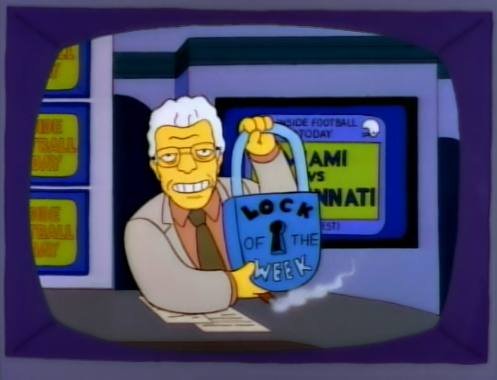
– The giant lock and giant shoe are great props for the sports forecasters. My favorite bit in the whole show though is the Coach’s hotline, a fast-talking man on the commercial, but sloooow to enunciation on the phone. A bone-headed Homer complains, “Come on, don’t you realize this is costing me money?”
– There’s a sweet minor plot in the first act with Marge taking Bart out to buy new clothes, from the discount rack. When Bart claims he’ll get beat up wearing outfits such as those, Marge responds, “Well, anyone who beats you up for wearing a shirt isn’t your friend.” Missing the point entirely, but a nice bit of motherly advice.
– I love the security guards catching a little girl wearing unpaid socks out of the store, rushing out of the control room with high-powered rifles.
– There’s some great bits in a montage of Sundays, with Lisa batting 100% (“I like the 49ers because they’re pure of heart, Seattle because they’ve got something to prove, and the Raiders because they always cheat.”) This is followed by an announcer calling another game (“And on an extreeeeeemely suspicious play, the Raiders win!”)
– The scene at the fancy restaurant is so sweet, where the family earnestly laugh at Homer and Bart’s hackneyed jokes.
– I love the talk box Homer gives Bart. I remember seeing commercials for those types of things, and it’s brought back excellently at the end of the second act, giving a minor break in the tension.
– Great dream sequence of an old drunken Lisa hawking jewelry for gambling chips. It’s horrifyingly wonderful.
– I thought we never saw Caesar and Uglion in any other episode, but here they are, passing over the big game for a Jerry Lewis comedy, of course.
– A brief appearance by Troy McClure plugging his new sitcom that will play after the game. When asked why he chose to do the project, he replies, “I fell in love with the script, Brent. And my recent trouble with the IRS sealed the deal!”
– Great bit with the “never tedious Super Bowl half-time show,” a bizarre display of men in giant alien heads dancing to “Rock Around the Clock.” Bart bemoans, “This sucks. Come on, snipers, where are you!” I also love the Duff Bowl. Upon hearing Duff Dry has won, Moe comments, “They wanted it more.”
48. Radio Bart

(originally aired January 9, 1992)
This is a show that’s never content with doing one type of story. Sometimes they’ll focus on one topic or relationship, like “Lisa’s Pony,” but other times it’s all over the map, covering a range of different subjects. “Radio Bart” is one of the latter, ranging from down-to-earth and sentimental to exaggerated ridiculousness, with a bunch of different elements peppered in along the way. We open on Bart’s birthday, where he will be turning 10 for the first of many, many times. At one point, he was younger, however, as indicated by his spiky hair chart. The first act is a great exploration about the excitement of birthdays as a kid, and how much it sucks to have them be let-downs.

Homer is suckered by a TV commercial into getting Bart a radio-style microphone, but of course has trouble realizing that what happens on TV doesn’t always reflect reality. Over time, Bart realizes the microphone does have good pranking potential, leading to a bunch of scenes of Bart wreaking havoc with his new instrument of mischief. His final prank creates a town-wide panic, fooling citizens into believing a young boy named Timmy O’Toole has fallen down a well. This creates a media frenzy, which ultimately leads to a bizarre carnival-type festival set up around the well, treating the scenario with more sensationalism than an actual desire to rescue. The episode also satirizes the sainthood of the victim, that the simple act of one befalling a tragedy, even by accident or on reckless purpose, they become a hero worthy of praise. This is best exemplified by Homer’s defense of calling Timmy a hero (“Well, he fell down a well and… he can’t get out.”) Even celebrities try to capitalize on the situation, with their “We Are the World” style relief song “We’re Sending Our Love Down the Well,” complete with Krusty hamming it up like Bruce Springsteen.

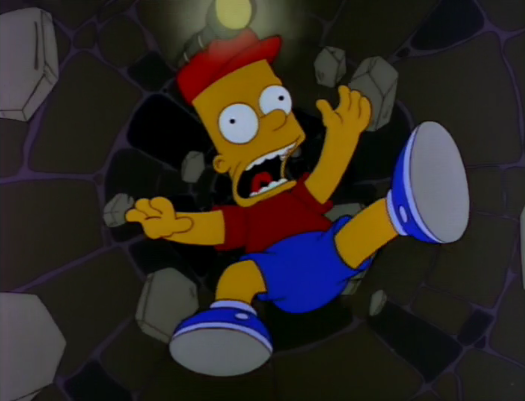
Realizing the possibility that he might be exposed due to all the attention, Bart attempts to cover his ass, but ends up victim of his own prank when he gets stuck down the well himself. The absurdity of the second act makes way for the real ironic punishment and pathos for Bart’s actions, as the town abandons their cause after realizing they’ve been had. A scene where Bart muses over the things he’ll never get to do in life is quite touching, even, of course, it involves getting a fake ID and shaving a swear word into his hair. Sting makes a guest appearance as a participant in the relief song, mocking the idea of a celebrity activist (“This isn’t about show business, this is about some kid down a hole… or something, and we’ve all got to do what we can,”) and getting kind of screwed in the end himself as he’s ungraciously pushed out of the way after digging his way to rescue Bart. This is an episode that covers a lot of ground, but has a seamless flow and nails every one of its targets completely.

Tidbits and Quotes
– The scene with the microphone commercial is perfect: it’s the ultimate shameless advertisement, and Homer gobbles up the whole thing.
– Wall-E-Weasel’s is a wonderful Chuck E. Cheese send-up, complete with the horrible animatronic singers. For some reason, Señor Beaverotti always gets me (“I’m-ah ready!”), and of course, his tail breaks off and bursts into flames after barely getting through the first verse of the birthday song.
– I really like Bart putting his label-maker name on everything in the house; it just feels like a real kid thing to do out of boredom. Homer bemoans that the lone Duff can in the fridge is branded (“Aww, there’s only one can of beer left, and it’s Bart’s.”)
– I love that Homer actually buys Bart’s prank that there’s an alien invasion, and runs through the house with a loaded gun. I also love Bart’s guttural “Uh-huh” when Homer realizes Bart actually liked his gift mid-choke.
– All of Bart’s early pranks are good, but my favorite is probably the first with making Maggie talk (I love Bart’s baby voice, “Sorry lady, show’s over!”) Runner-up, of course, is “God” speaking to Rod and Todd (“Walk through the wall. I will remove it for you… [thud] …later.”)
– This kind of feels like Groundskeeper Willie’s first “big” appearance, being first on the scene to get help for Timmy, taking a “nip of courage” from a flask and blocking traffic with his big tractor (“Look out, yah horse’s arse!”) I also love Bart trying to develop Timmy’s character by screwing other characters, claiming that Timmy wasn’t allowed into Springfield Elementary by Skinner because of his shabby clothes.
– The charity song is great of course, featuring all the celebrities, and quasi-celebrities, we’ve seen on the show. We also get the first speaking part of Sideshow Mel. I love Krusty’s explaining of where the proceeds of the song go (“We gotta pay for promotion, shipping, distribution… y’know, those limos out back, they aren’t free. Whatever’s left we throw down the well.”)
– I love the tastefully done Itchy & Scratchy tribute to Timmy O’Toole, and the “We’ll Be Right Back” title card with Scratchy with an axe in the back.
– Great sequence of Bart repelling himself down the well, great use of shadows and lighting, and Axel Foley music.
– Eddie and Lou are none too pleased to learn the truth that they’ve been punked. For some reason, “I’ve got an idea, let’s go home and go to sleep” has stuck with me, and was a big quotable line amongst my friends.
– The quick scenes depicting public reaction to Bart is great: Mayor Quimby openly admitting to flip-flopping, news of the Abraham Lincoln squirrel, and the hit single replacing the well song on the charts, “I Do Believe We’re Naked,” by Funky-See Funky-Do.
– The ending is perfect, of course, with the situation being resolved by a tiny sign, “Caution: Well.” Nothing has been learned, but Willie is satisfied (“That should dew it!”)

47. I Married Marge

(originally aired December 26, 1991)
Flashback episodes offer the series a valuable opportunity. Not only is it entertaining to see our characters in their younger days, but it gives us a look at what happened along the road of life that got them to where we know them now, not just in their jobs or their families, but how they grew and changed as people. “The Way We Was” ended with Homer and Marge finally getting together, but this episode focuses on how their love grew into a somewhat stable family. We see what sacrifices had to be made, monetarily and personally, in order to make the Simpson family what it is. And we see just why a smart, capable woman like Marge would love and stay with a big dumb oaf like Homer. It’s my favorite flashback show, and one of my favorite episodes, as it’s one of the best, if not the best, shows that perfectly balances its sweet moments with snarky humor.

The episode opens with Marge heading to Dr. Hibbert’s after failing a pregnancy test. Right off the bat, the show treads new ground: in other sitcoms, the notion of a character being pregnant is only met by euphoria by the husband and canned cheering and applause, but here, Homer and Marge seem very hesitant and tense about the prospect of having a fourth child. This all leads to Homer waxing nostalgic about the events that led up to Bart’s birth. At 24, Homer was still very much a man-child, working at the miniature golf course, taking Marge to see The Empire Strikes Back, and lounging about in his shitty apartment with Barney eating a tube of cookie dough. But when the news breaks that Marge is pregnant, everything changes. A man with no responsibilities is now responsible for a new life. This leads to my first of two examples of absolutely perfect scenes, where Homer proposes to Marge. He’s nervous about it, for sure (“Marge, there’s something I want to ask you. But I’m afraid, because if you say no, it’ll destroy me and make me a criminal.”) and he paws around the backseat looking for the card he wrote down what to say on. Marge ends up finding it and reads it aloud, a simple, but honestly written proposal, complete with a swell of music and Kavner’s slightly choked-up read. Homer flatly replies, “That’s the card, give it here,” while Marge basks in the moment, even though Homer’s asscrack is directly in her face. It’s unbelievable how the show manages to be so damn touching, but make me laugh at the same time. We love to hear Marge say yes, and we love even more Homer’s ecstatic reaction (“She’s gonna marry me! In your face, everybody!!”)

Getting married and preparing for a child ain’t easy on a shoe string budget. Homer’s attempts to provide for his future family go into a downward spiral, resulting in him leaving Marge. It takes a lot to still care about a guy who abandons his pregnant wife, but his goodbye note is written so sincerely, noting that he will send every cent he earns to her and their baby. The second perfect scene occurs when Marge finds Homer is working at a fast food joint and they have a heartfelt reunion. Homer laments that he couldn’t give Marge a decent wedding ring. Marge replies that any ring is special as long as it’s from him. So, Homer gives Marge an onion ring (repeating a line from “The Way We Was,” “Marge, pour vous.”) There’s a beat to appreciate the sweetness of it, for the characters and the audience, before Marge asks if she can take it off, as the oil is burning her finger. Homer does… and then eats it. Perfect.

This episode really illustrates why Homer is the man he is: with enormous responsibilities thrust upon him, he had no real time to grow and mature into a responsible adult. He went from man-child right to childish father. Impassioned by Marge’s visit, Homer takes charge and brute-forces his way into a position at the power plant, but hilariously, adamantly claiming he’ll be the most sycophantic kiss-ass Burns has ever seen. Going from a job he loved to one he’ll come to be miserable by, it’s all worth it for Marge and his future child. This episode presents such an honest, human depiction of two young fools in love and about to become parents; it has a minor tragic sting to it, but we have such faith and love for the characters that we know they’re going to turn out alright (relatively speaking). And it makes perfect sense that Marge’s announcement at the end that she’s actually not pregnant would trigger a great joy out of the two. Parenthood’s a bitch.

Tidbits and Quote
– How much do I love Barnacle Bill’s Home Pregnancy Test? The answer is a lot (“If the water turns blue, a baby for you. If purple ye see, no baby thar be. If ye test should fail, to a doctor set sail.”)
– I love Homer’s tenseness, in his animation and his voice, when Lisa asks if Marge is going to have another baby. It astounds me how much truly talented people can make mere drawings into believable human characters, even more so than flesh-and-blood actors.
– I do like young Homer’s attempts to sweet talk Marge (“You’re as beautiful as Princess Leia and as smart as Yoda.”)
– It’s odd that Marge calls “You Light Up My Life” as their song, not “Close To You.” I do like when Marge tells Homer she’s singing about God, and Homer replies, “Oh, well, He’s always happy. No, wait, He’s always mad.”
– Homer and Marge copulating inside the castle at the mini golf course seems so sweet apart from its seediness. I absolutely love Homer’s claim of the castle being “impregnable.” I doubt he’s ever used that word ever, ever again, but the one time he does, he’s dead wrong.
– I like the continuity that Dr. Hibbert’s dialogue telling Marge she’s pregnant is identical to the brief flashback we saw in “The Way We Was.”
– Shotgun Pete’s is great, from the raspy clerk (the great Doris Grau) laughing at Homer’s face for believing their marriage will last forever, to the “minister” not even bothering to remember people’s names. “Byoo-tee-ful.”
– Can you think of a more perfect name than Repo Depot? And the employee’s got a great line, sadly observing, “Repossessing stuff is the hardest part of my job.”
– I love the almost magical donut truck driver off to deliver happiness to the employees of the power plant (“All the colors of the rainbow!”)
– I like how Homer’s bravado nature continues through the day, from Burns’s office to the delivery room, as he stands up for himself in front of Patty and Selma, and the great bit where he fights with Hibbert over who will deliver the baby.

46. Burns Verkaufen der Kraftwerk

(originally aired December 5, 1991)
For almost all TV series, status quo is God. However outlandish and mixed up the universe may get over the course of twenty-odd minutes, things always end up right back where they started, or at least they will for sure in time for next week’s episode. But a show like this one uses its tried-and-true format to explore a deeper meaning behind these mechanics and how they’re not too far off from our own feelings, about being comfortable of where you’re at and how fragile one’s existence can be. Both Homer and Mr. Burns in their own different ways realize how valuable their roles are in this ballet of life and how much they both need their lives at the nuclear power plant.

We open with a melancholy Burns musing about the missed opportunities of his bygone years, ultimately deciding to sell the power plant to a group of efficient Germans. As he puts it, the world is his oyster, and he sets off into the world to conquer it. However, Burns quickly realizes that without a position of power, he’s nothing more than a withered old goat, puttering about without a purpose. Seeing him tend to beehives and attempt to box just seems wrong; Burns is a man who needs others to cower before him, but now, even a young whippersnapper like Bart can take full advantage of him. As he succinctly puts it himself, “What good is money if it can’t inspire terror in your fellow man?” Without the power plant, he has nothing.

Homer, meanwhile, is terrified about the regime change at work. He’s well aware of his limited intelligence regarding his job (he can barely even remember what position he holds to begin with) and knows those crafty Germans will be able to see right through him, kindly and welcoming as they may be. Every one of us gets that nagging feeling from time to time that we’re getting by a bit too easily, but Homer’s been living that for his whole life. Naturally, he is the plant’s only lay-off, and the Germans slowly learn that the plant is more unkempt and disastrous than they thought. A woefully unemployed Homer and a woefully purposeless Burns are simply no good, so the episode ends as it should: Burns takes the plant back and rehires Homer, under the adage of keeping one’s enemies close, biding his time before it’s time to strike, which as status quo dictates, will never, ever happen. Ever.

Tidbits and Quotes
– We’ve been seeing more developments in the Smithers-Burns relationship. Smithers is the ultimate sycophant: he loves his boss more than anything, because he’s the hyper-charged caricature of the spineless yesman. An affection exists between the two, but there’s nothing truly overt about Smithers’s sexuality. It’s secondary, if anything.
– A very brief, but wonderful appearance by Homer’s stock broker (voiced by Phil Hartman), a pale, broken husk of a man hunched over a desk in a dank office. Since he hasn’t called up his client in years, they have a brief catching up, and I really mean brief. Homer foolishly cashes in his stock too early, blowing twenty-five bucks on a fancy bottle of Duff, when he could have had a cool six thousand.
– Those Germans have some wonderful penmenship, writing “$100,000,000” in distinctly European font. Even a man as wealthy as Burns has his price, apparently. I also love how a German flag immediately ascends a flagpole upon the announcement, complete with a dramatic sting. This doesn’t bode well…
– Great reference to Alexander Graham Bell in Burns’s call to Smithers, as well as his very funny mocking Elvis impression.
– The running joke of one of the Germans repeatedly rephrasing asking Homer to have a meeting, thinking he’s not properly articulating himself in English, and Homer getting increasingly more freaked out is fantastic.
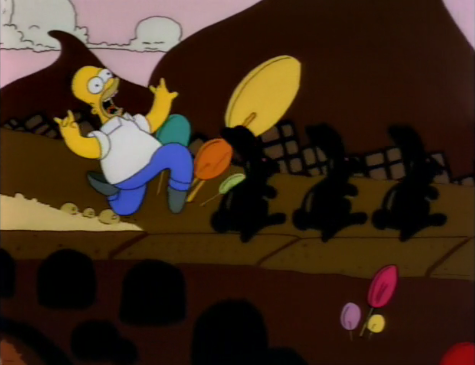
– The Land of Chocolate! One of the show’s most famous and beloved sequences. It feels out of place from the rest of the episode, something I’d normally call out, but for some reason it still works. It makes perfect sense to me that hearing “Land of Chocolate” would send Homer into a feverish daydream, delirious from excitement over the prospect. The giddy music, the glorious animation, and the great final joke that Homer’s most excited when he passes a chocolate shop with a half-price sign.
– The announcement of lay-offs is hilarious. I just love the brief pause before “that is all.” It reminds me of a similar joke later in “Cape Feare” when Bob lists off the people that he will not kill.
– I feel a later Simpsons episode would have loved to shock Homer repeatedly with the malfunctioning toaster, but here, the gag is left by itself, since Homer has enough problems on his plate without getting surges of electricity through him.
– Another spin on the crank calls is Bart having to set foot in Moe’s moments after he’s sent him into a rage over the phone. Moe, of course, is completely clueless, amused at Bart’s admission to harassing people with his shenanigans. It’s a great bit, which also leads into the final scene with Burns entering the bar and Homer confronting him. With Burns out of power, Homer has the ire to stand up for himself, and that’s a world that’s just no fun.
– What better way to end an episode than with Mr. Burns screaming at young children? (“This is a place of business, not a pee-wee flophouse!”)

45. Flaming Moe’s

(originally November 21, 1991)
A great Simpsons episode isn’t content with having just an A-story, or even a B-story, it’s also peppered with so many other elements, be them blink-and-miss-it signs or quick parodies or even lengthy sequences unrelated to the plot. The series would later notoriously have very disjointed first acts that have little to do with the main story, sometimes to a ridiculous level, but here we see that trend was being utilized here as well. The difference is the material: later “set-ups” would be so silly and over-the-top, but here we get a very funny opening scene featuring Lisa’s slumber party, which quickly turns into a nightmare for Bart. It’s filled with so many great small moments, like the age-old candle wax game and Bart’s attempts to un-jinx himself. And it naturally flows into our main story, with Homer getting fed up with the hijinks that he leaves six young children in the house alone to go to a seedy bar.

Homer and Moe’s relationship is wallowed in co-dependence: Homer needs Moe to get him drunk, and Moe is happy to accept his business. For this system to continue, Moe needs customers who are sullen, depressed losers, and he’s picked Homer as his favorite amongst them all. But even through all this, and his unwavering thievery of Homer’s alcoholic invention, we still feel sympathy for Moe; beneath his angry, bitter exterior is a man who craves acceptance, and will do just about anything for it, even sell out his best friend without even a second thought. Homer first reacts to this betrayal with simple anger, but it slowly puts him into a bizarre psychotic stupor, in a wonderful sequence where he hears and sees Moe wherever he goes. All he can think about is Moe’s success off of his back.

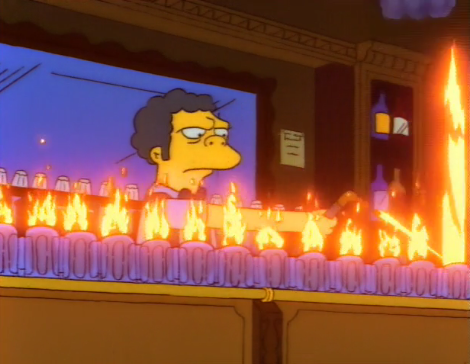
Meanwhile, Moe’s has turned into a happening joint, a regular Studio 54-type establishment, but also blended with a Cheers element where Moe falls into a love-hate relationship with a sassy waitress. Now, here’s what’s great about this parody. I didn’t grow up with Cheers, nor have I even seen an episode, but the parody still works as it is engrained in the story, and works as a stand-alone. The hooting and hollering of the crowd subbing in for a studio audience applause and she and Moe’s sitcom-esque banter in bed (eeesh…) still works even without knowing the reference. Also what works is Aerosmith, the show’s first musical guest stars, who work in the story, and are entertaining in their own right. This episode is also filled with some gorgeous animation, from the effects of the Flaming Moe drinks setting aflame to the enormous bevy of crowd shots to some of the individual character animation, particularly Steven Tyler’s “are you ready to rock?!” and of course Homer’s classic fairy dance. So many wonderful components in this show, it’s an absolute classic.

Tidbits and Quotes
– “Eye on Springfield” is a great segment, sending up those horrible fluff “news” shows. Particularly great is the brief preview clip of Drederick Tatum’s thoughts of growing up Springfield (“That town is a dump. If you ever see me back there, you’ll know I really [bleep]ed up bad.”) I’m surprised they could get away with using the bleep like that.
– I think we have our first “in-the-floorboards” joke where we see the middle layer between the two floors of the house, with a lead pipe and asbestos.
– Moe has a lot of great lines right out of the box (“Increased job satisfaction and family togetherness are poison for a purveyor of mind-numbing intoxicants like myself.”) I especially love his complete perplexed reaction to reading his dusty old cocktail chart (“Gin.. and tonic?”)
– The origin of the Flaming Homer is absolutely perfect, from the impetus of suffering through another of Patty and Selma’s slide shows (“As I stared up at that hairy yellow drumstick, Ia knew I needed a drink.”) to his intense analysis of the drink (“I don’t know the scientific explanation, but fire made it good.”)
– There’s lots of great bits in the second act: Homer’s initial obliviousness to Moe’s new-found success, Moe’s inability to understand that Tipsy McStagger is not actually a real person, Mrs. Krabappel demanding Bart bring the liquor he brought to class to the teacher’s lounge, and Lisa, of all people, asking for a Virgin Moe for dinner, which infuriates Homer. Oh, and Pimp Krusty. Again, what other children’s show host appears at local bars in lavish outfits with two girls in tow?
– The crank phone calls are getting a little bit tired at this point, so the show shakes things up by having Moe’s be so packed with people, there actually is a man present with Bart’s seemingly phony name “Hugh Jass.” Hugh turns out to be a good sport about it, and allows Bart to get off the hook.
– The second act break may be one of my favorites, it’s such a fantastic sequence, with Castellaneta and Azaria riffing off each other not being able to hear each other and the amazing animation and direction by Rich Moore.
– A great brief appearance by Lionel Hutz, who cites a case for Homer on how he can’t copyright a drink, and is very pleased by the fact that he actually did research for once (“How about that! I looked something up! These books behind me don’t just make the office look good, they’re filled with useful legal tidbits just like that!”)
– The depletion of Homer’s sanity ends with him taking on a half-assed Phantom of the Opera persona, appearing in the rafters of Moe’s to expose the secret ingredient. Castellaneta gives a great, maddening performance as Homer here, and again, it looks great, with dramatic shadows and the flaming drinks going off. And a great finale, and mild screw-you to their gracious guest stars by having him fall down and crush Aerosmith.
– I also like the very end too, with the secret out and imitation chains opening up all down the block, sort of like all the different Famous Original Ray’s Pizzas in New York.