28. Oh Brother, Where Art Thou?

(originally aired February 21, 1991)
NOTE: During the past week, I was visiting my hometown in New Jersey. However, that did not hinder my Simpsons obligations. I managed to burn through six episodes with two very good friends of mine, and together we recorded brief, five-minute commentaries for them. They’re quite rambling, misguided, and mostly disposable, but hey, they’re only five minutes, and if you’re reading this, chances are your time isn’t that valuable to begin with.

…well, here’s where the audio file would be, but Audacity crapped out and erased it after we recorded it. Which is too bad because it was actually the best one, very insightful. This write-up would only have paled in comparison.

Herbert Powell is a fascinating character. Firstly, I thought about how he’s never been reintroduced in newer shows. Desperate for ideas, recent episodes have drug up Lurleen Lumpkin and Santa’s Little Helper’s original owner, but Unky Herb has remained untouched. Then I moved onto thinking how rich of a character he is, a true testament to the show’s greatness that they can craft such a unique and staying personality in 22 minutes. He’s a very wealthy man, but unlike Mr. Burns, he worked hard for every cent he had, from working dead-end shit jobs to making his way through an Ivy league school to the successful vehicular mogul he is today. He’s a big-time tycoon, but he’s brash and impassioned, still feeling a connection to the average working man. That aspect would become his downfall when he invests too much trust in his newly discovered half-brother Homer Simpson.

We start our episode with Abe having suffered a minor heart attack upon seeing (and complaining about) the recent McBain film (which, of course, was amazing). He reveals to Homer an element of his sorted past involving a bastard child he had with a carnival floozy. How we still have any respect left for his character after this story astounds me, but dammit, the show manages to still elicit sympathy for this horny old man. Homer begins a frantic search for his lost kin, and eventually finds him in Detroit, Michigan in the form of Herb Powell, CEO of Powell Motors. Herb is a man with all the money in the world, but what he never had was a family, while Homer has a family, but no money whatsoever. The greatest exchange in the whole show, and one of the entire series, is after Herb holds Maggie for the first time, and tells his brother, “You’re the richest man I know.” Homer, still overwhelmed by Herb’s spacious estate, dumbly responds, “I feel the same about you.”

Becoming increasingly frustrated by his edgy competitors and his boardroom of numbskulls, Herb feels he needs the touch of the average Joe, enlisting Homer to design a car for him that will appeal to the masses. Blinded by his unusual sense of trust and elation of his new family, Herb leaves Homer to his own devices completely, opting to enjoy spending quality time with Marge and the kids. He effectively signs his own death warrant, and Herb has only himself to blame when ‘The Homer’ is revealed, an absolute assault on the eyes, an anachronism of every tacky car design and accessory you could possibly think of, for an absurd price of $82,000. There’s no safety net either; Herb’s company is bankrupt, and he leaves town gruffly asserting to Homer that he has no brother. We feel bad for Herb, but not as much as we do for Homer, who gets a minor lift at the end from Bart who compliments his car. It’s a wonderfully dark story of the rise and fall of a man’s empire, but also a funny and fascinating look at the boorish nature of the common consumer. We’d see Herb return for one more time next season to rebuild his fortune, but honestly, he’d be just as much of a memorable character if his story had ended right here.

Tidbits and Quotes
Again, I can’t praise the brilliance of McBain enough (“Right now I’m thinking about holding another meeting: in bed.”)
– More great Homer mood swings: Marge tells her husband he’s got a call from the hospital. “The hospital?!” he worriedly responds, until he gets to the phone and gives a very casual, “Yello?” Followed by “Oh my God!!”
– That flashback… is so disturbing. It fits with the lecherous vision of younger Abe we saw in “The Way We Was.” Not only do we have discussions of “dunking the clown,” which is a euphemism I want no business in deciphering, we get the great line following it (“She did things your mother would never do. Like have sex for money.”) Also, it’s delightfully stupid that baby Herb has a beard line.
Bart repeats more acceptable swears ad nausea like in “8th Commandment,” this time with “bastard.” I’m surprised they got away with it in 1991.
– The scene between Homer and the Orphanage director is so wonderful, as the director tries to allude as clearly as possible to his half-brother’s whereabouts, but Homer is so thick he can’t pick up on it (“Read between the lines, you fool!!”)
– Shame on me how I never mentioned Danny DeVito, who is absolutely perfect as Herb. The first scene in the boardroom is a tour de force; he gives Herb a sense of power, but also vulnerability in talking about how he has no roots. I also love the continued fake-out about how we never see his face to build up to the dramatic reveal to find… he looks exactly like Homer, but with hair and more brow lines.
– The scene where Herb gives Homer his assignment is filled with great lines, from chuckling about his cars having only fifty bucks worth of steel to his undermining of his employees, telling his brother to “tell the nice man what country you’re from.”
– Herb really has so many outs, so many ways he could have avoided the disastrous conclusion, but he turns a continual blind eye. Even more, he’s brazen about it, in the great scene where he gets a call from one of his higher-ups, and tells him to call back and say the opposite of what he just said. He then puts him on speaker to impress Bart and Lisa with falsified impressions of their father. The slow, calculated read of the employee is genius (“Homer Simpson is a… brilliant man with lots of… well thought-out, practical ideas. He is ensuring the financial security of this company for years to come. Oh yes, and his personal hygiene is above reproached.”)
I love any time Homer gets incredibly passionate about something, and after Herb’s pep talk, he becomes a maniac. Especially great is when he slowly, then quickly and angrily crosses out and rips down the prototype sketch of the car off the wall.
– To be honest… I would love to drive that Homer car around. They constructed an actual Simpson house in Las Vegas, but I really wish someone would make a full-size version of that car. Any insanely wealthy fans out there? Anyone?

27. Principal Charming

(originally aired February 14, 1991)
NOTE: During the past week, I was visiting my hometown in New Jersey. However, that did not hinder my Simpsons obligations. I managed to burn through six episodes with two very good friends of mine, and together we recorded brief, five-minute commentaries for them. They’re quite rambling, misguided, and mostly disposable, but hey, they’re only five minutes, and if you’re reading this, chances are your time isn’t that valuable to begin with.

These audio reviews will also be an excuse for me to write less. A bit of a cop out, but hey, I got four hundred episodes more, so cut me a break.

A great thing about the show for me was when the writers could take inherently jokey or stereotypical characters and make you see them as real people, but not betray their original natures. We saw it earlier, eliciting sympathy for the cunningly evil boss Mr. Burns in “Two Cars.” Here, we get a broader look at Marge’s sisters Patty and Selma. Up to this point, they existed to create grief for Homer, two one-note irritants permanently tied to his life to cause him misery. In that role, they’re fantastic characters, but here, we get to see them further fleshed out, seeing their hopes and aspirations, and their relationship with each other.

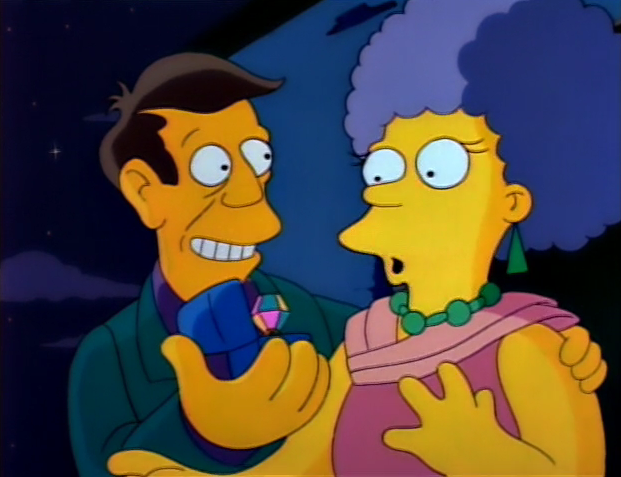
We first see that Selma is the softer of the two, who deep down wishes to settle down and start a family, while Patty is a bit more abrasive (Marge can put it better than me: “It’s Patty who chose a life of celibacy. Selma simply had celibacy thrust upon her.”) Saddened by her sister’s plight, Marge beckons Homer to find Selma a man. Side note, it’s a testament to Homer’s good nature that despite his seething hatred toward his wife’s sisters, he would do just about anything for Marge. His search ends with Principal Skinner, but due to Homer’s continued twin mix-up, he ends up hooking him up with Patty instead. The normally stuck-up stuffed shirt Skinner has now become as giddy as a schoolboy, head-over-heels in love with her. He’s really quite endearing, with a great performance by Harry Shearer; it takes a lot to take a line like, “Kiss me, Patty. I don’t have cooties” and make it work, but it totally does.

But the meat of this story lies with Patty and Selma, of how Skinner has become a wedge keeping them apart. Patty is apologetic over the situation, knowing the set-up was intended for her sister, but Selma remains adamant she not blow her chances at love like she had. Their scenes together throughout the show are the most interesting; we see these are two sisters who are primarily looking out for each other’s best interests, which leads to the inevitable conclusion that the only people they need are each other, in which Patty delicately dumps Skinner and saves Selma from a hell date with Barney. It’s one of the deeper early episodes, a real sweet episode, and given its subject matter and lack of focus on Bart or Homer, a forgotten gem.

Tidbits and Quotes
– The emotional trigger for the episode, Selma wanting a husband, couldn’t have been made more succinctly or fiercely. Attending the wedding of her co-workers, with the flashback of how they met; Selma could have been the lucky one, until Patty intervened. It even ties together with the ending. Absolutely perfect economy.
– Patty asleep on the couch… oh so disturbing…
– Here we get the first of many classic joke set-ups, where someone (usually Marge) alludes to a past event, which is then shown in photo or newspaper clipping form. Here, Marge refers to when Homer dragged the family to St. Louis to see the car shaped like a bowling pin. Homer fondly gazes at the photo at his bedside, a magnificent picture of Homer, in full tourist get-up with shades, posing with the car, with Marge off to the side, completely disinterested. All you need is the photo and you get the laugh. Another show starring a certain family guy would milk this situation for minutes in a lengthy flashback, but here we get the laugh quickly and perfectly and move on.
– Homer’s Terminator-esque search for a man was almost topical back then, but still remains funny. It’s one of the great Simpsons running gags that manages to keep being funny by escalating the ridiculousness. We get a great bit with Homer staring at a stranger (“Pro: Nice Stide, Con: Total Stranger), and then tops itself with the Laramie Billboard cowboy (“Pro: Smoker, Con: Just a Sign.”)
– We get first look at the Springfield Elementary Belltower, a structure that we’ve seen so many times since. At least we got a good Vertigo shot out of it.
– Homer Sexual may be one of my favorite Bart prank calls. And “Cons: Possible Homer Sexual” always kills me.
– First appearance of Groundskeeper Willie. Not much to say about it. …moving on.
– I love the Springfield Revolving Restaurant. It’s an early look at the overall stupidity of the whole town, like someone would invest money in this, which must cost a fortune, and the town would love it. It’s our first step toward the giant tower of Popsicle sticks and the escalator to nowhere.
– As sweet as he is in this show, Skinner hallucinating Patty’s head on Bart’s crude female stick figure body (with two giant circular breasts) and almost lusting over it is a tad disturbing.
– The show in its classic years has a lot more physical acting in it, which I love, but there’s also really small stuff that’s powerful. I can’t even place this one. Near her lowest point, Selma looks to the mouths of babes to cheer her up, asking Bart what he learned at school. Bart tells her that Skinner plans to propose to Patty. Selma sits stone-faced, and a single ash falls from her cigarette. I have no idea why this is effective, or what it means, but I absolutely love it. It may be my favorite part of the whole show.
– I love the disheveled Barney at Selma’s door (complete with his shirttail sticking out of his zipped fly), and his surprise upon looking at the label on the bottle he brought (“Schnapps?”)

26. Homer vs. Lisa and the 8th Commandment

(originally aired February 7, 1991)
NOTE: During the past week,  I was visiting my hometown in New Jersey. However, that did not hinder my Simpsons obligations. I managed to burn through six episodes with two very good friends of mine, and together we recorded brief, five-minute commentaries for them. They’re quite rambling, misguided, and mostly disposable, but hey, they’re only five minutes, and if you’re reading this, chances are your time isn’t that valuable to begin with.

These audio reviews will also be an excuse for me to write less. A bit of a cop out, but hey, I got four hundred episodes more, so cut me a break.

Homer/Lisa episodes have always been amongst my favorites, where the impulsive and hedonistic Homer must combat the moral compass that is his daughter. The plot-on-paper here is pretty cut-and-dry: Homer manages to get an illegal cable hook-up, and Lisa deals with the dilemma of scruples involved. From the opening at Mt. Sienna, we get right away this is a morality tale, with Moses laying down God’s commandments, with “Thou shalt not steal” befuddling the Homer expy of the time. In modern day, Homer is most ecstatic about his widened television options. The rest of the family is mixed: Bart is just as pleased as his father (especially upon discovering late-night nudie films), while Marge is mildly concerned about the legality, but is the quieter, less affirmative voice of reason. It’s up to Lisa to put her father back on the right path, but how?

First, a day at Sunday School strikes fear into Lisa over the possibility of her family being Hell-bound, which leads to a great sequence in which the living room morphs into the fiery pits below. Lisa then seeks help from Reverend Lovejoy, who suggests she perform a bit of a silent protest. The tension continues to build to the climax, a big house party Homer is throwing for an ultimate boxing match. Little items build up: concerns from his wife, a shifty return from the crooked cable guy, and catching Bart disobeying his orders not to watch X-rated TV (Bart bemoans, “I wish I was an adult so I could break the rules.”) Homer becomes even more frantic the night of the fight, hurriedly hiding other stolen items from guests and nearly breaking down before the police. His world is crumbling, but good wins out as he joins Lisa on the lawn during the fight, and cuts the cable.

It’s such a solid, sweet story, but this episode is also ripe with TV parodies given the subject matter. The first thing Homer sees on cable is a home shopping network pitch of a hideous clown figurine that no one has bought, and it brings a tear to his eye. Later, he watches a Seinfeld-esque comedian, who he’s much amused by (with the immortal line, and the most succinct summary of that type of comedy, “It’s funny because it’s true!”) There’s also the fight promotion and pre-show that’s great, with our first look at Drederick Tatum, the Simpsons universe’s Mike Tyson. We also see the introduction of Troy McClure, famous B-movie star who will do anything for a paycheck, including hawking a bogus teeth-whitening candy on a cheap infomercial. Phil Hartman is abound in this show, voicing McClure, the cable guy, and Moses in the opening. Like he was on SNL, he’s a valuable asset, and any character he voices is going to get a laugh. So yeah, this is a real good one.

Tidbits and Quotes
– Hartman scores immediately as Moses, who announces in a commanding, completely serious tone, “The Lord has handed down to us ten commandments by which to live! I will now read them in no particular order!” Then again, in the present, when Ned chews out the cable guy (“I should box your ears, you… you sneaky Pete!”), Hartman gives him a pandering, “Easy, tiger.”
– The “So You’ve Decided to Steal Cable” pamphlet is genius (“Myth: Cable piracy is wrong. Fact: Cable companies are big faceless corporations, which makes it okay.”) It’s also very fitting to Internet piracy today, which I of course never, ever, ever do. Ever. Maybe.
– I’d love to see entire versions of some of the stuff the family watches on TV: the Hear Me Roar network, for one. I want to see how to make your own band-aid with five yards of sterilized cotton.
– Odd that the Sunday School teacher claims that if anyone ever saw Hell, they would die, when Bart had been and left there a few episodes back.
– Bart in the car ride back endlessly repeating “Hell” is such a great kid moment, capped off by the great Marge line, “Bart, you’re no longer in Sunday School! Don’t swear!”
– I love the grocery clerk; he’s almost like the Charles Bronsan type, but even surlier. “I need a price check on two grapes!” kills me every time.
– Homer’s logic loophole for excusing his theft is bulletproof (“Look, Marge, I can’t afford it. when I can afford to pay for it, I will, but I can’t, so I’m not going to.”)
– They’ve played with Burns always forgetting who Homer is up to this point, but here’s where I first felt it to be extremely comical. His dinner at the Simpson house cost him the election, he was involved in a legal battle with them, but upon arriving for the fight, he mistakes Homer for Barney, not realizing a thing. Also, “Smithers, the Cheet-O’s” is such a great line, I always pronounce it like that, with both syllables emphasized.
– Homer’s moment of redemption is as begrudging as it gets, though we know he’s acknowledged what he’s doing is right… like it or not (“I hate to interrupt your judging me, but I wanted you to know that I’ve made a couple of really important decisions. Number 1: I’m cutting the cable as soon as the fight’s over, and Number 2: I’m not very fond of any of you.”)

25. The Way We Was

(originally aired January 31, 1991)
NOTE: During the past week, I was visiting my hometown in New Jersey. However, that did not hinder my Simpsons obligations. I managed to burn through six episodes with two very good friends of mine, and together we recorded brief, five-minute commentaries for them. They’re quite rambling, misguided, and mostly disposable, but hey, they’re only five minutes, and if you’re reading this, chances are your time isn’t that valuable to begin with.

These audio reviews will also be an excuse for me to write less. A bit of a cop out, but hey, I got four hundred episodes more, so cut me a break.

Here we have our first flashback episode, giving us a look at how our favorite couple met and fell in love, told in an absolutely perfect and heartwarming fashion. We open innocuously enough with the family watching TV, with not only a great Siskel & Ebert parody (Homer chuckles and comments, “I love watching the bald guy argue with the fat tub of lard!”) but the first look at McBain, the action-packed film series starring Schwarzenegger double Rainier Wolfcastle. As much as I know that the schtick would grow stale if extended, I would love to see a whole McBain film. We’ve seen enough snippets over the years that one could probably be cobbled together, but I think it would be fantastic. Anyway, the TV burns out, and the family are stuck having to talk amongst themselves, and topic eventually turns to how Homer and Marge first met.

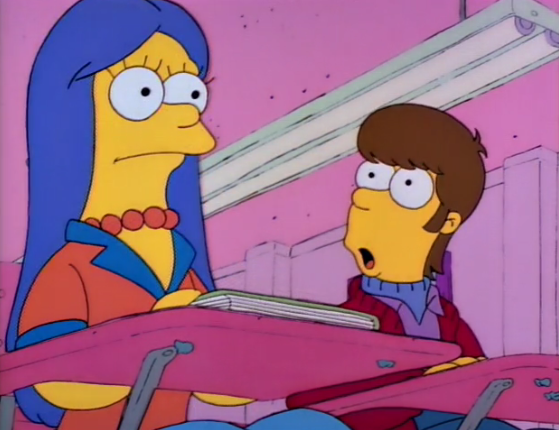
It’s now the bygone groovy time of 1974 where we meet our youthful heroes: Homer is a shaggy-haired slacker who skips class with fellow loafer Barney to smoke in the bathroom, and Marge is a headstrong go-getter with a knack for debate and foreign languages. These are two characters who would never have anything to do with each other if not for Marge being sent to detention for a radical bra-burning stunt on school grounds. Homer is immediately smitten, and seeks advice where he can: the guidance counselor suggests to find common interests and to “spend, spend spend!” while his father gives him a terribly reverse pep talk about aiming low (“Go for the dented car! The dead-end job! The less attractive girl!”) We get a real glimpse at how these characters matured and became who they are today, but in a very subtle way. We see Abe’s horribly dilapidated apartment and the rough way he treats his son and get a glimmer of where Homer got his questionable parenting from, and Marge’s discouraged political stunt dims the fire of her activism, sort of sadly paving the way for her future as a domesticated housewife. Both of these scenarios are kind of depressing now that I ponder them…

Homer fakes needing tutoring in French to get closer to Marge, which works, until she discovers it has all been a ruse. She instead goes with her pompous nerdlinger acquaintance Artie Ziff, voiced by the great Jon Lovitz. Lovitz is near the top of fantastic guest voices; his comic delivery and voice is almost tailor made for animation (which we would later get in spades on The Critic), and Ziff is a great character from Lovitz, a seemingly nice guy, but completely engulfed by his self-elevation from his peon classmates. He says it all in his acceptance speech as prom king (“Instead of voting for some athletic hero or a pretty boy, you have elected me, your intellectual superior, as your king. Good for you!”) True love wins out in the end as Artie gets grabby and Marge gives ol’ Homie one more shot, and the rest is history. It’s a really sweet episode, probably one of the series’s most so, full of lots of great character moments and sly nods to the future, the first at building the framework of the Simpsons past of how they became who the dysfunctional family we know and love today.

Tidbits and Quotes
– I always loved Homer imitating McBain’s cool quip, “That makes two of us”; he’s so like those dopes who do that, trying to sound cool. Also great is he and the kids desperation when the TV goes out, culminating with them staring intently at a single pixel. Marge shouts, “I think this is sick. You’re staring at a dot!!”
– We find out here that Bart was born out of wedlock, and that Marge’s pregnancy sparked Homer’s proposal. It was kind of ballsy for them to implicate this back in the early 90s, and I’m glad they did, as it inspired the wonderful followup flashback show “I Married Marge.”
– For some reason, I really like Marge’s activist friend. I think it’s because I wish a future episode would have further explored Marge’s high school days, showing more of the origins of her bottled-up indifference. Marge’s friend seems like the kind of person who pushes things onto people, thinking it’s of their best interest. Women should be given equal pay for equal work, but Marge contends, “Not if I have to do heavy lifting, or math.”
– Shakespeare’s Fried Chicken (a bucket of it sits in the Simpson apartment) is a chain I’d really like to see more of. Not related at all, I love Dan Castelleneta’s performance as middle-aged Abe, sounding younger and feistier. Actually related, his teenage Homer is wonderful too, having a higher, squeakier quality to it.
– Young Homer is brash, but oh-so-lovable. His query to his counselor (“I just met this girl Marge Bouvier and I want to force her to like me”) sounds so boorish on paper, but said and meant with such sincerity. Also great is his response when the counselor inquires about Homer’s post-graduate plans (“I’m gonna drink a lot of beer and stay out aaaaaaaaallll night!!”)
– Jon Lovitz also appears as the shop teacher, who has a more nasally tint to his voice. And one missing finger.
– The second act break is so golden, maybe one of my favorites ever. Homer may deal with rage and depression, but he’s the eternal optimist: even after Marge leaves in a devastated huff, he still knows it’s going to work out.
– I also wish we knew more of the Bouvier household. Marge’s mother appears briefly with some matronly advice (“If you pinch your cheeks, they’ll glow. Ladies pinch. Whores use rouge.”) We also see a rare glimpse at Marge’s father, long gone from this world (allegedly).
– We also see the first appearance of the “Wiseguy,” the sarcastic Charles Bronsan-sounding guy who fills a variety of jobs over the series. He’s Homer’s limo driver, and has some great lines, the best being his last as a dejected (and broke) Homer decides to walk home after the worst night of his life, to which Wiseguy responds, “Why spoil a perfect evening?”
– I’d talk about the perfect, sweet ending, but it’s hard to come up with stuff to say. It’s immortal, it’s classic, it couldn’t have been done any other way.

24. One Fish, Two Fish, Blowfish, Blue Fish

(originally aired January 24, 1991)
NOTE: During the past week, I was visiting my hometown in New Jersey. However, that did not hinder my Simpsons obligations. I managed to burn through six episodes with two very good friends of mine, and together we recorded brief, five-minute commentaries for them. They’re quite rambling, misguided, and mostly disposable, but hey, they’re only five minutes, and if you’re reading this, chances are your time isn’t that valuable to begin with.

These audio reviews will also be an excuse for me to write less. A bit of a cop out, but hey, I got four hundred episodes more, so cut me a break.

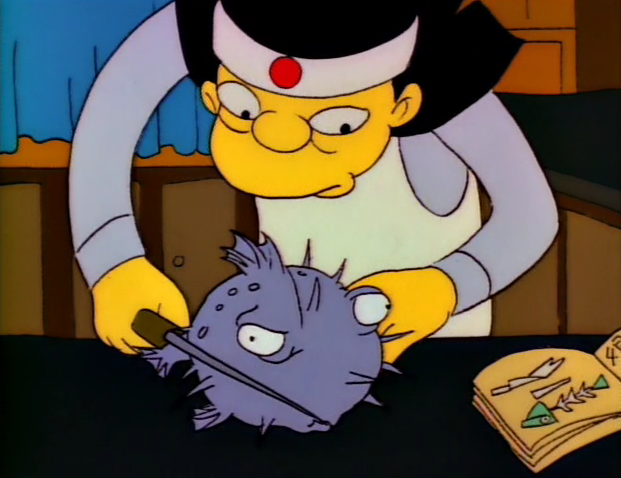
“Blowfish” is truly a tragic comedy, an episode that deals with the most serious of issues, a main character’s mortality, and not only does it never shy away from the premise, but still manages to get some laughs out of it. We begin with the Simpson family’s visit to a new sushi restaurant in a time when eating raw fish was a new and scary thing for the American populous. It is there that Homer ingests, amongst most everything else, fugu blowfish, which contains a poisonous toxin, giving him 24 hours to live. The show manages to keep tension not with foolishly messing with the audience about Homer’s imminent death, but in the worriment of Homer and Marge over the situation.

Comedy continues to shine through the dour plot, as Homer runs through his last wishes during his last day. He teaches Bart some valuable life lessons and phrases (“Cover for me,” “It was like that when I got here”), sits in on Lisa playing the sax, and records a postmortem video for little Maggie. With the latter, he borrows a camcorder from Ned, and devilishly agrees to attend his barbecue the following day; not even death will stop Homer from being an asshole to his neighbor-eeno. The show has its cake and eats it too best when Homer makes a tearful amends with his father, but grows weary of him taking up too much time during his final day. And of course, the best farewell words he can muster to his sleeping son is “I like your sheets.” As the episode ends, Homer, of course, is not dead, and continues to live exactly as he did before: eating salty snacks and watching mind-numbing bowling on TV. Homer is a simple man who appears to have learned nothing from his near-death experience, but we love him all the same for it.

Tidbits and Quotes
– I love Homer’s rampant stubbornness toward Lisa at the beginning; when she mentions how she’s always been told to be open-minded and try new things, Homer shoots back, “What are you talking about? Nobody’s trying to teach you that!”
– Great work by George Takei as the waiter Akira. Hank Azaria would later take over the role, doing a mighty fine Takei impression.
– First instance of depicting Mrs. Krabappel’s… sensual exploits. Ironic as I was talking with my friend Brad about the silly “Nedna” stunt from last season, and how it didn’t seem like those two were compatible.
– Despite Homer’s insistence against, he ends up loving sushi and eats everything. Then he’s going to die. The lesson here is never try new things. (“‘Try something new, Homer! What’ll it hurt you, Homer?’ I never heard of a poison pork chop!”)
– So many sweet bits in the show, but I love when Homer innocently asks Marge what she refers to their lovemaking as. That bedroom scene may be one of the most heartfelt moments in the entire series, but of course, it is immediately followed to Homer being shocked and furious that Marge let him sleep in (“You looked so peaceful lying there.” “There’ll be plenty of time for that!!”)
– Also first look at Burns’s antiquated form of ogling (“That’s it, baby. Work those ankles!”) I love Smithers’ follow-up “Ring-a-ding-ding, sir.”
– I like the inane chatter of the bowling announcers during the credits. It takes real skill to make something sound that boring, but still be funny.