
 (originally aired October 11, 1990)
If season 1 was a 13-episode experiment for this radical new series, it left season 2 in a tough bind. Everyone, the writers, the animators, the actors, needed to take what they’d gotten right and what they learned from the original run and build upon it for the next series of episodes, and after watching this premiere, that’s exactly what they did. The leap from “Evening” to this is absolutely staggering in every aspect of the show. The animation is richer, the world of the show feels more fleshed out and authentic, the characters feel more familiar (and on-model)… it’s a big improvement from a first season that was already pretty good to begin with.
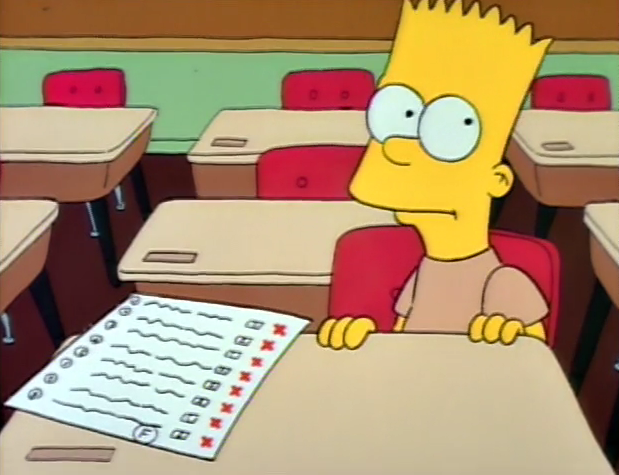
“Bart Gets An F” follows “Bart the Genius” in its illumination of Bart’s troubles in school. He’s a kid who exhibits creativity and ingenuity, but in none of the ways that involve standardized tests and book reports. As such, he is stuck with his weekly chalkboard punishment. This is a show that never creates clear heroes or villains; everyone is shown to be of blame of Bart’s situation. Bart is shown consistently procrastinating and could care less about colonial history, the school seems to give no mind to help Bart until it’s too late, and Homer and Marge seem mostly oblivious to Bart’s struggles, or gloss over it, like with Marge claiming her son is just a late bloomer. And where other shows would paint Bart as a bastard child who doesn’t give a fuck, here he truly is worried about his situation, vowing he will buckle down and pass the fourth grade (never mind he’s still there twenty years later.)
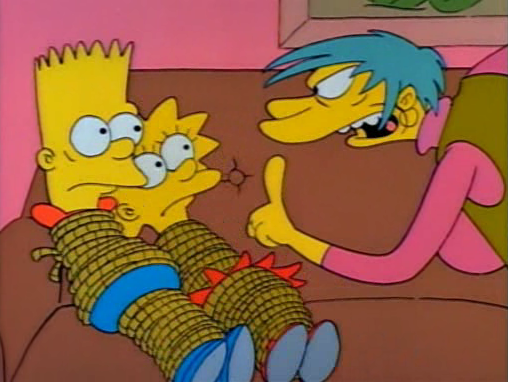
Desperate to do well on the final test, Bart enlists the help of fellow classmate Martin Prince. Martin may be a relatively minor character now, but like with Krusty in “Krusty Gets Busted,” we are starting to see secondary characters come out of the woodwork and being more fleshed-out. Also, this is a show that usually never sticks with typical archetypes. Martin could have easily just been a run-of-the-mill geek, but he’s not that cut-and-dry. As we will later see from Milhouse, Professor Frink, Comic Book Guy and others, the “geek” is merely an umbrella term for a whole variety of breeds of nerd. Martin is a real teacher’s pet, but he exhibits a weird brazen-ness to his geekiness and intelligence. He’s shocked to find that none of his academic achievements have gained him popularity, he just can’t comprehend that they don’t hold any clout. And so, he agrees to help Bart if he will help him become popular. This backfires when Martin gets a screw loose and becomes even more rambunctious than Bart, stealing his friends away in the process. Unhinged Martin is fantastic, just all that pent-up kid-like mischief finally allowed to release.
This is another episode by the great David Silverman, and as such, we see some more great animated sequences and direction. The night before the big test, Bart prays for a miracle and gets one in the form of a blizzard. Realizing he can’t squander the opportunity he’s gotten, he takes the day to study, where outside the funnest snow day of all time is happening. In one long panning shot, we see dozens and dozens of characters playing, sledding, throwing snowballs, skating, all sorts of stuff. It’s a breathtaking sequences; nowadays this would be no problem done digitally, but in 1990, having to composite so many characters on different cel layers must have been a huge pain in the ass. But it looks fantastic, a true animation highlight for the series. The scene where Homer and Marge are called into discuss Bart’s grades is also great, with Dr. Pryor and Ms. Krabappel talking back and forth in varying tones and concerns, as we cut to different angles of the three Simpsons reacting blankly as the pace increases. In many ways, this show feels like the spiritual successor to “Bart the Genius.” We even get another great limited-color-palette dream sequence as Bart imagines himself at the First Continental Congress, which is quickly interrupted by its own snow day (one delegate gleefully exclaims, “Look, everybody! John Hancock’s writing his name in the snow!”)
In true Simpsons fashion, we get a within-reason happy ending: Bart barely passes with a D-minus by way of parroting a historical fact he’s somehow memorized. In a triumphant ending, his paper is placed on the fridge and his parents compliment him on his “achievement.” This series is built upon the idea of backhanded accomplishment and accidental success, but there’s always a bit of earnest on the way there. As we see, Bart’s grade is well-earned, and we are filled with a weird sense of pride by it. We feel for Bart and his struggle. There’s so much stuff I’ve left out here, but I think with some of the best episodes, that’s going to happen. “Bart Gets An F” is a true signifier of the brilliance to come, and that’s saying a lot.
Tidibts and Quotes
– Starting the episode off with Martin’s book report, in Ernest Hemingway garb, which is brilliant and disturbing at the same time (“To catch a fish, to kill a bull, to make love to a woman! To live… I thank you.”)
– I’ve always loved when asked the name of the pirate in Treasure Island, one of the names swimming in Bart’s head IS Long John Silver, but he lands on the most preposterous option (“Bluebeard?”)
– This series is full of products I would love to have, one type of which being video games. “Escape From Grandma’s House” seems like a lot of fun to play (“Hide in the closet! Oh no, deadly mothballs!”) Also in the background of the arcade is “Robert Goulet Destroyer.” I can’t even imagine what that game is, but I want to know more about it.
– The scene at the dinner table showcases the family’s evolved personalities: I love Lisa’s sheepishness of talking about her latest in a long line of A’s, and Homer’s half-earnest, half-pandering over-the-top exuberance over the announcement. We also get our first real look at Homer’s other true love: television, especially when it involves movies with monkeys in them.
– Martin’s reintroduction into the story later in act one is fantastic, showing he can be a bit of a smart-ass himself (“As a natural enemy, I don’t know why I should care, but the information pertaining to America’s colonial period that you’ve just received is erroneous.” “So you’re saying…” “A blindfolded chimp with a pencil in his teeth has a better chance of passing this test than you do.”)
– Small details matter: when Bart enters the nurse’s office, she is picking up tongue depressors she’s spilled out of a jar. This simple action sets her up to be somewhat incompetent, or at least gullible enough to believe Bart’s act of being sick.
– The first act break of Bart passionately vowing to pass fourth grade is topped with a great Homer line (“And if you don’t, at least you’ll be bigger than the other kids.”)
– I forgot all about the other dream sequence of a middle-aged Bart still in fourth grade (“Look lady, I’ve got a peptic ulcer, a wife bugging me for a new car and a root canal. Will you quit bugging me about this damn pirate?!”)
– Again, I love crazy Martin (“Who would have ever thought that pushing a boy into the girl’s lavatory could be such a thrill! The screams! The humiliation! The fact that it wasn’t me! I’ve never felt so ALIVE!”)
– Bart’s prayer to God treads the line of sincere and self-serving, and is 100% funny and sweet (“Well, old timer, I guess this is the end of the road. I know I haven’t always been a good kid, but, if I have to go to school tomorrow, I’ll fail the test and be held back. I just need one more day to study, A teachers strike, a power failure, a blizzard… Anything that’ll cancel school tomorrow. I know it’s asking a lot, but if anyone can do it, You can! Thanking You in advance, Your pal, Bart Simpson.”)
– Lisa has a great assertion to who actually God is (“I’m no theologian; I don’t know who or what God is exactly, all I know is He’s a force more powerful than Mom and Dad put together, and you owe Him big.”)
– It’s never really bothered me before, but there’s a snow day before the last day of school… in June. I guess it truly was a miracle after all.
– And of course, the greatest final line of an episode: “Part of this D-minus belongs to God.”

 Me Blog Write Good